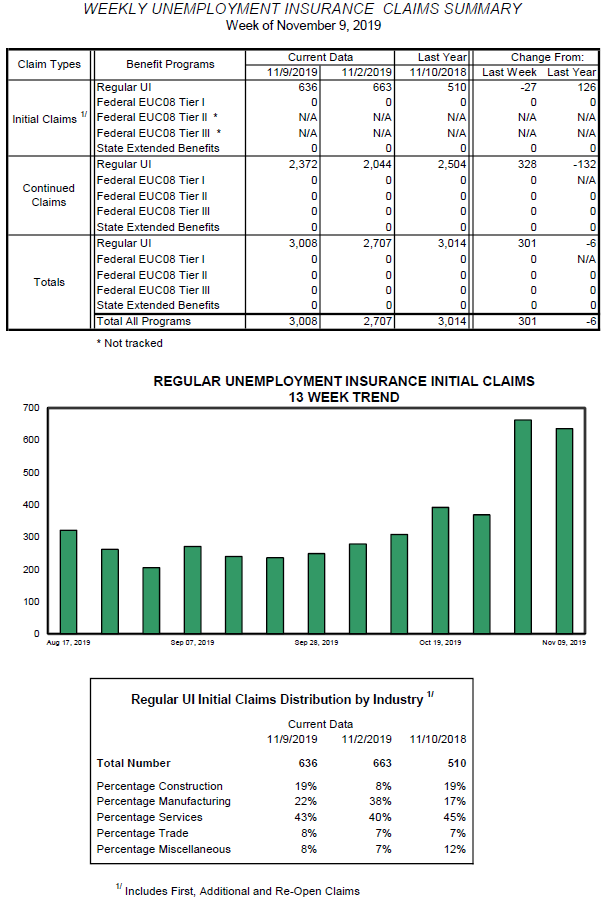
Vermont Business Magazine Weekly unemployment numbers fell last week but remained over 600 after a long period of very low numbers. They are also breaking a trend by being well above claims from the same time last year. Initial claims for the week of November 9, 2019, were 636, down 27 from last week but 126 more than they were at this time last year.
Altogether 3,008 new and continuing claims were filed, an increase of 301 from a week ago, and 6 fewer than a year ago.
Nationwide, according to the US Labor Department for the week ending November 9, initial claims for state unemployment benefits rose modestly 14,000 to 225,000. This is the most claims since June and 10,000 more than economists expected. The 4-week moving average rose 1,750 claims to 217,000. After a long decline from the Great Recession in 2009, claims have now generally leveled off over the past year.
For most weeks of 2017 and 2018 claims were lower than the year before, but have been up and down in 2019. This suggests the labor situation has settled after several years of a tighter and tighter labor market following the Great Recession of 10 years ago.
Vermont, like the nation as a whole, has been locked into a historically low period of unemployment and a tight labor market. If this is so, claims for the week and year should look similar to the prior year, as they have the last several months.
For UI claims last week by industry, Services, which typically accounts for most claims, represented 43 percent of all claims. Construction claims were 19 percent for the week. Manufacturing was at 22 percent, which is relatively high but down from 38 percent last week.
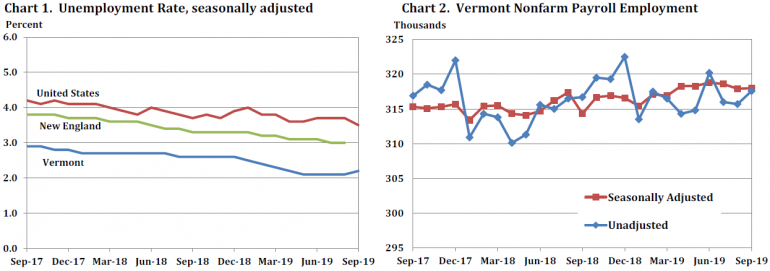
Vermont's unemployment rate for September increased one-tenth at 2.2 percent, the first increase in over 10 years. The rate had been at a historic low for several months. Vermont's rate is lowest in the nation. SEE STORY. The US rate was 3.5 percent, down two tenths from the previous month.
Stories:
Tax revenues rebound in September
Tax revenues finish year nearly $60 million above targets
E-Board hears cautionary tale with good economic news
UI tax rates for employers fell again on July 1, 2018, as claims continue to be lower than previous projections. Individual employers' reduced taxable wage rates will vary according to their experience rating; however, the rate reduction will lower the highest UI tax rate from 7.7 percent to 6.5 percent. The lowest UI tax rate will see a reduction from 1.1 percent to 0.8 percent.
Also effective July 1, 2018, the maximum weekly unemployment benefit will be indexed upwards to 57% of the average weekly wage. The current maximum weekly benefit amount is $466, which will increase to $498. Both changes are directly tied to the change in the Tax Rate Schedule.
Vermont's minimum wage rose to $10.78 on January 1, 2019.
The Unemployment Weekly Report can be found at: http://www.vtlmi.info/. Previously released Unemployment Weekly Reports and other UI reports can be found at: http://www.vtlmi.info/lmipub.htm#uc
NOTE: Employment (nonfarm payroll) - A count of all persons who worked full- or part-time or received pay from a nonagricultural employer for any part of the pay period which included the 12th of the month. Because this count comes from a survey of employers, persons who work for two different companies would be counted twice. Therefore, nonfarm payroll employment is really a count of the number of jobs, rather than the number of persons employed. Persons may receive pay from a job if they are temporarily absent due to illness, bad weather, vacation, or labor-management dispute. This count is based on where the jobs are located, regardless of where the workers reside, and is therefore sometimes referred to as employment "by place of work." Nonfarm payroll employment data are collected and compiled based on the Current Employment Statistics (CES) survey, conducted by the Vermont Department of Labor. This count was formerly referred to as nonagricultural wage and salary employment.