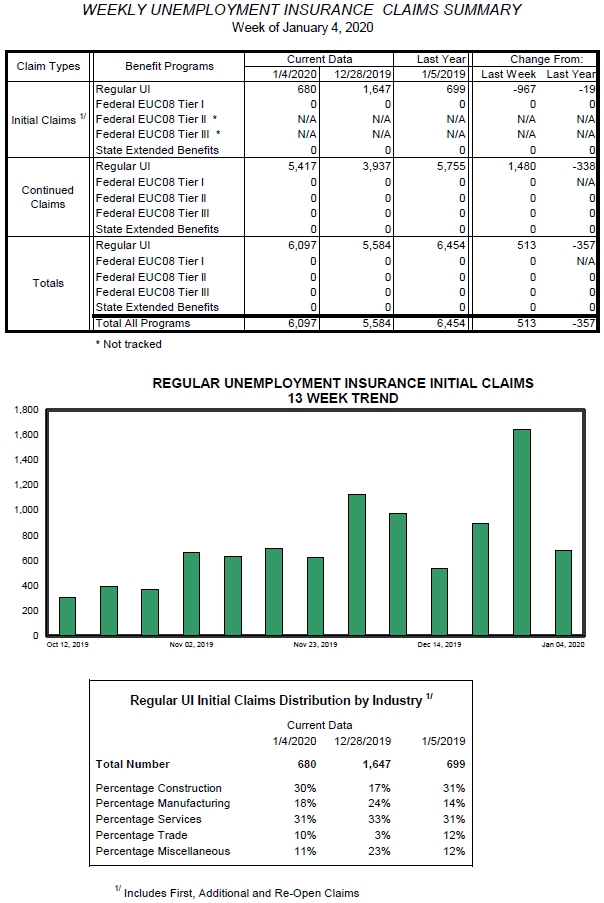
Vermont Business Magazine As expected, the manic nature of weekly unemployment claims continued last week. Claims fell by nearly a thousand last week. While this is typical for the post-holiday period, claims this year have been even more up-and-down than last year. After a long period during the summer and fall of very low numbers, claims have been generally higher over the last two months. Meanwhile the holiday period brings with it wild swings in claims, as retailers hire and then lay off seasonal workers.
Initial claims for the week of January 4, 2020, were 680, which is a more typical weekly number. They were down 967 from last week and 19 fewer than they were at this time last year. Thanksgiving was later this year, which could have altered the timing of the usual holiday hiring/firing.
Altogether 6,097 new and continuing claims were filed, an increase of 513 from a week ago, and 357 fewer than a year ago.
Nationwide, according to the US Labor Department for the week ending January 4, initial claims for state unemployment benefits were a little lower than expected at 214,000, a decrease of 9,000. Economists were anticipating about 220,000. Claims had been rising in recent months, but have fallen the last few weeks.
The 4-week moving average fell by 9,500 to 224,000 claims. After a long decline from the Great Recession in 2009, claims had generally leveled off over the past year, until the late 2019 increase pushed them to a two-year high.
However, reports suggest the national labor market is softening.
For most weeks of 2017 and 2018 claims were lower than the year before, but have been up and down in 2019.
Vermont, like the nation as a whole, has been locked into a historically low period of unemployment and a tight labor market. If this is so, claims for the week and year should look similar to the prior year, as they had been the last several months. The post-holiday period should bring better understanding of the labor market.
For UI claims last week by industry, Services, which typically accounts for most claims, represented 33 percent of all claims and about the same total as last week. Construction claims represented 17 percent for the week, but in actual claims held about even and similar to last year as the industry largely slows down for the season, though the weather has been relatively mild. Manufacturing spiked to 24 percent, with a large jump in actual claims to 395 from 53, which is also a jump from last year's high number of 285.
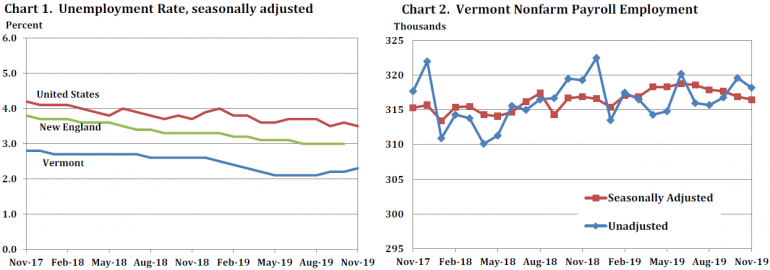
Vermont's unemployment rate for November increased to 2.3 percent. Vermont's rate is lowest in the nation. SEE STORY. The US rate was 3.5 percent, down one tenth from the previous month and the lowest it's been in 50 years.
Stories:
Weak personal income returns drag down General Fund
Tax revenues finish year nearly $60 million above targets
E-Board hears cautionary tale with good economic news
UI tax rates for employers fell again on July 1, 2018, as claims continue to be lower than previous projections. Individual employers' reduced taxable wage rates will vary according to their experience rating; however, the rate reduction will lower the highest UI tax rate from 7.7 percent to 6.5 percent. The lowest UI tax rate will see a reduction from 1.1 percent to 0.8 percent.
Also effective July 1, 2018, the maximum weekly unemployment benefit will be indexed upwards to 57% of the average weekly wage. The current maximum weekly benefit amount is $466, which will increase to $498. Both changes are directly tied to the change in the Tax Rate Schedule.
Vermont's minimum wage rose to $10.78 on January 1, 2019.
The Unemployment Weekly Report can be found at: http://www.vtlmi.info/. Previously released Unemployment Weekly Reports and other UI reports can be found at: http://www.vtlmi.info/lmipub.htm#uc
NOTE: Employment (nonfarm payroll) - A count of all persons who worked full- or part-time or received pay from a nonagricultural employer for any part of the pay period which included the 12th of the month. Because this count comes from a survey of employers, persons who work for two different companies would be counted twice. Therefore, nonfarm payroll employment is really a count of the number of jobs, rather than the number of persons employed. Persons may receive pay from a job if they are temporarily absent due to illness, bad weather, vacation, or labor-management dispute. This count is based on where the jobs are located, regardless of where the workers reside, and is therefore sometimes referred to as employment "by place of work." Nonfarm payroll employment data are collected and compiled based on the Current Employment Statistics (CES) survey, conducted by the Vermont Department of Labor. This count was formerly referred to as nonagricultural wage and salary employment.