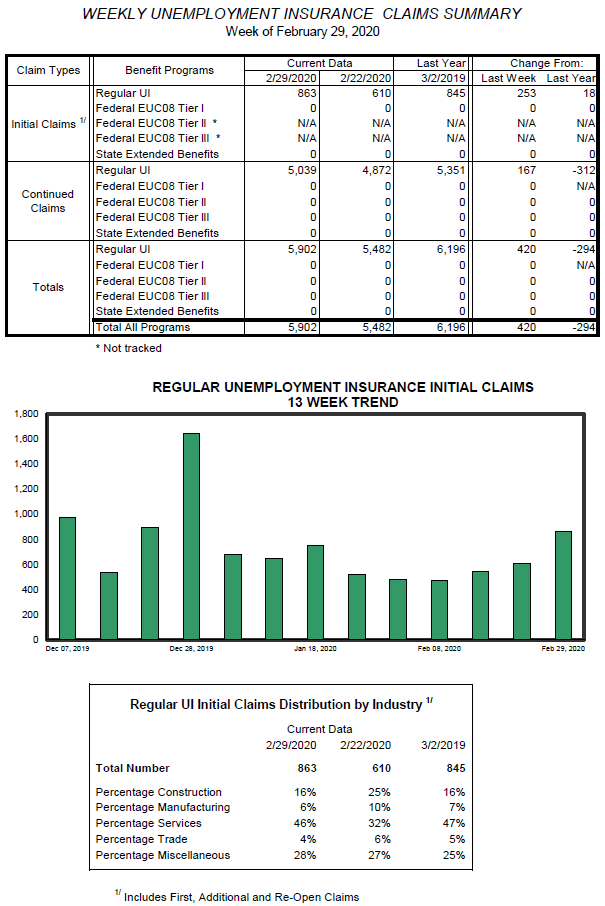
Vermont Business Magazine Weekly unemployment claims, which had shown a steady decline since the beginning of the year, moved up again for the third consecutive. Initial claims for the week of February 29, 2020, were 863, up 253, to the highest level this year. Claims were 18 more than they were at this time last year.
As of yet, there has not been a big impact on jobs from the coronavirus.
Altogether 5,902 new and continuing claims were filed, an increase of 420 from a week ago and 294 fewer than a year ago.
Nationwide, according to the US Labor Department for the week ending February 29, initial claims for state unemployment benefits were down 3,000 claims to 216,000. Economists were anticipating about 215,000.
The 4-week moving average rose 3,250 to 213,000 claims. After a long decline from the Great Recession in 2009, claims had generally leveled off over the past year.
For most weeks of 2017 and 2018 claims were lower than the year before, but have been up and down since mid-2019.
Vermont, like the nation as a whole, has been locked into a historically low period of unemployment and a tight labor market. If this is so, claims for the week and year should look similar to the prior year, as they had been the last several months.
For UI claims last week in Vermont by industry, Services, which typically accounts for most claims, represented 32 percent of all claims, which was a little higher than last week. Construction claims were at 25 percent for the week, which in total terms was about the same as last week. Manufacturing fell to 10 percent.
Vermont's unemployment rate for December held at 2.3 percent. Vermont's rate is tied for lowest in the nation. SEE STORY. The US rate in January rose one-tenth to 3.6 percent. Vermont will not release its January rate until March 16 to allow for year-end adjustments; the Unemployment and Jobs Report for February is scheduled to be released on March 27.
Stories:
January tax revenues ahead of targets to start year
Businesses to see double-digit rate decrease in workers’ comp insurance in 2020
Tax revenues finish year nearly $60 million above targets
UI tax rates for employers fell again on July 1, 2018, as claims continue to be lower than previous projections. Individual employers' reduced taxable wage rates will vary according to their experience rating; however, the rate reduction will lower the highest UI tax rate from 7.7 percent to 6.5 percent. The lowest UI tax rate will see a reduction from 1.1 percent to 0.8 percent.
Also effective July 1, 2018, the maximum weekly unemployment benefit will be indexed upwards to 57% of the average weekly wage. The current maximum weekly benefit amount is $466, which will increase to $498. Both changes are directly tied to the change in the Tax Rate Schedule.
Vermont's minimum wage rose to $10.78 on January 1, 2019.
The Unemployment Weekly Report can be found at: http://www.vtlmi.info/. Previously released Unemployment Weekly Reports and other UI reports can be found at: http://www.vtlmi.info/lmipub.htm#uc
NOTE: Employment (nonfarm payroll) - A count of all persons who worked full- or part-time or received pay from a nonagricultural employer for any part of the pay period which included the 12th of the month. Because this count comes from a survey of employers, persons who work for two different companies would be counted twice. Therefore, nonfarm payroll employment is really a count of the number of jobs, rather than the number of persons employed. Persons may receive pay from a job if they are temporarily absent due to illness, bad weather, vacation, or labor-management dispute. This count is based on where the jobs are located, regardless of where the workers reside, and is therefore sometimes referred to as employment "by place of work." Nonfarm payroll employment data are collected and compiled based on the Current Employment Statistics (CES) survey, conducted by the Vermont Department of Labor. This count was formerly referred to as nonagricultural wage and salary employment.