





Current News
by tim
Vermont Business Magazine The Senate Appropriations Committee has passed an amendment to the State Department and Foreign Operations Appropriations Bill that would fund the Green Climate Fund, an essential part of the international climate agreement reached in Paris last fall. The amendment was cosponsored by Senators Tom Udall (D-NM), Susan Collins (R-ME), Dick Durbin (D-IL), Patrick Leahy (D-VT) and Jeanne Shaheen (D-NH).
The Green Climate Fund is an international fund set up to help nations worldwide – particularly developing nations – adapt to climate change and transition to clean energy sources. This fund is an essential component of the framework that the international community developed in order to work together to take on climate change.
by tim
Vermont Business Magazine The Vermont Agency of Agriculture, Food, and Markets (VAAFM) has announced its adjusted fee schedule, from register and inspect lime products (up $10) to maple processor's fee (2,500 gallons or more for repackaging, up $50) to certification of seed potatoes (up $10 plus $1 per acre) to wild plants – ginseng licensing (up $15) to meat retail large vendor (up $40) to frozen dessert manufacturing (up $5) to many more. The Legislature approved the new fee schedule and it will go into effect Friday, July 1, 2016. VAAFM manages more than 50 fee-based programs. Most, but not all, fees increased. The Agency said in a statement that these services provide value to Vermonters, in accordance with the Agency’s mission: to support the growth and viability of agriculture in Vermont while protecting the working landscape, human health, animal health, plant health, consumers and the environment. The new fee schedule is available at the end of this article.
by tim
Vermont Business Magazine In May the Bennington Select Board adopted three new business and residential incentive programs that will directly impact the community’s downtown core. The three programs use funds already earmarked for economic and community development efforts, but put a fine point on a broad brush as to how a portion of these funds can be applied.
by tim
Vermont Business Magazine While gold prospecting is a fun summertime activity, the Agency of Natural Resources reminds the public that while anyone can pan for gold by hand, a state permit is required when using a sluice box. Recently, Environmental Enforcement Officers and Game Wardens made contact with several recreational mineral (gold) prospectors in and around streams in southeastern Vermont. Most prospectors were complying with Vermont law. However, three people were issued Environmental Citations for using sluice boxes in streams without a permit from the agency.
The waiver penalty for an unpermitted sluice for first time offenders is $150. Penalties for other or repeat offenses can be higher. Before heading out, prospectors must have permits for sluice boxes. Annual permits for Vermont residents are $25, non-residents $50. Landowner permission is also required, and suction dredging is prohibited.
by tim
Vermont Business Magazine The Vermont Fish & Wildlife Department has announced the syllabus of 2016-2017 migratory bird hunting seasons is now available. A printable copy of the regulations can be downloaded from the Vermont Fish & Wildlife Department website (www.vtfishandwildlife.com). A printed version also will be available from license agents and post offices by mid-July. A statewide Vermont open hunting season for Canada geese will occur September 1-25. The daily bag limit is five Canada geese in the Connecticut River Zone and eight in the rest of the state during this September season. The purpose of the September season is to help control Vermont’s resident Canada goose population prior to the arrival of Canada geese migrating south from Canada.
by tim
Vermont Business Magazine US Senator Patrick Leahy (D-VT) Wednesday announced that Vermont will receive more than $7 million in federal grants from the U.S. Department of Homeland Security (DHS) to help Vermont communities with prevention and preparedness. Leahy said: “Enhancing our security means supporting not only our border control and law enforcement, but also improving critical infrastructure. First responders in Vermont are on the front lines every day, protecting our communities, securing our borders and ports of entry, and keeping Vermonters safe. As our country’s infrastructure continues to feel the strain of budget constraints, these grants are an investment in Vermont’s safety and security. Prevention and preparedness are vital to this mission.”
by tim
Vermont Business Magazine The City of South Burlington received word this afternoon that Judge Crawford approved the motion for the City of South Burlington to participate as amicus curiae (friend of the court) in the F35 National Environmental Policy Act Litigation—Zbitnoff et al v. Deborah Lee James. Pursuant to a resolution passed by the South Burlington City Council at a special meeting held June 22, 2016, the MEMO below was filed in Federal Court Tuesday. The MEMO sought entrance to the Zbitnoff et al v. Deborah Lee James litigation to participate as amicus curiae.
by tim
Vermont Business Magazine RSG has been named (#79) one of FORTUNE Magazine’s “100 Best Workplaces for Millennials” – a list determined entirely upon employees’ own feedback and selected from a database of more than 600 Great Place to Work-Certified organizations. To create the list, Fortune asked Great Place to Work to survey more than 88,000 millennials (born 1981 or later), who rated their organizations on 58 workplace quality questions. Employees considered the sincerity of managers’ support for people’s personal and professional lives, how transparent communication is, people’s ability to be themselves at work and to invest in their lives outside work, and the meaning they get from their jobs, among many other factors.
by tim
Vermont Business Magazine At its June meeting, the Vermont Housing & Conservation Board awarded $4,597,550 to conserve nearly 3,260 acres of farmland, recreational land and town forests in 20 towns and to provide for home ownership and housing accessibility around the state. VHCB commitments of state funds will leverage an additional $7.8 million in town funds, local fundraising, bargain sales, donations, mortgage financing and federal dollars. Fourteen of the farm projects include special water quality protections and three projects use federal funding from the Regional Conservation Partnership Program, focused on protecting and improving water quality in the Lake Champlain Basin.
by tim
Vermont Business Magazine Senator Patrick Leahy (D-VT), Senator Bernie Sanders (I-VT), and Congressman Peter Welch (D-VT) today announced that Vermont has received $2.1 million in AmeriCorps funding. The grants are from the Corporation for National and Community Service (CNCS), the federal agency for volunteering and service programs. See recipient list below.
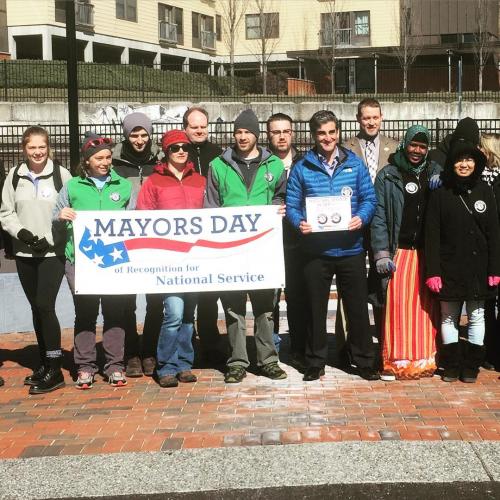 Burlington Mayor Miro Weinberger with AmeriCorps volunteers in April. Vermont mayors honored AmeriCorps, Senior Corps, and other service members. Weinberger joined volunteers at a Burlington waterfront clean-up service event. City of Burlington photo.
by tim
Vermont Business Magazine Martin Hahn, Executive Director of Community Capital of Vermont, announced in Community Capital's newsletter today that he is leaving the micro business lender and will become the Housing Director at the Vermont Housing & Conservation Board next month.
by tim
by Chris Pearson Voters have been clear they want property tax relief. Crystal clear. Voters also consistently support school budgets, which leads me to believe strong schools are a high priority. These two desires aren’t necessarily at odds and I’m pleased to tell you a solution is underway in Montpelier. The way we pay for schools today burdens low-income and middle-class families more than anybody. That’s because most of us, two-thirds of homeowners, pay under "income sensitivity" which brings our bill down to 3% of our income. This benefit is extended to everyone with a household income up to $135,000.
Further up the economic ladder families are paying just 1.5% or even 0.6% of their incomes to support schools. These are the families who've seen most of the growth in income since the 2008 recession. If most of us can afford to pay 3% of our income to support schools it seems fair to ask wealthy families to pay the same amount.