





Current News
by tim
by C.B. Hall Vermont Business Magazine In a US District Court decision handed down June 29, Vermont Railway has won the primary points in its litigation against the town of Shelburne, allowing the railroad to proceed with plans to build a transloading facility for handling road salt on a 32-acre site just north of Shelburne village. In the decision, Judge William Sessions addressed suits filed by both parties in the case. On January 25 the town sued for a preliminary injunction to stop the project, and Vermont Railway fired back with a request for a declaratory court judgment that would deny the town a role in permitting the construction.
by tim
Vermont Business Magazine Commissioner Susan L Donegan announced today that the Department of Financial Regulation (DFR) has reached a $5.95 million settlement with the securities broker-dealer firm Raymond James and Associates Inc. As the result of its investigation of securities concerns in connection with the sale of interests in Vermont limited partnerships tied to Jay Peak-related EB-5 projects, DFR found multiple instances of non-compliance with supervisory requirements and Vermont law. Vermont will get $1.45 million and the rest is earmarked for investors who might be reimbursed.
by tim
by Jon Reidel A new study analyzing traffic stops in Vermont shows that black and Hispanic drivers are pulled over, searched and arrested far more often than whites, yet white drivers are more likely to be carrying illegal contraband. The independent study of racial disparities in traffic stops and outcomes by Vermont State Police between July 1, 2010, and December 31, 2015, found that black drivers were pulled over most often, followed closely by Hispanics. When stopped, black drivers were searched 4.6 times more often than white drivers, while Hispanics were searched four times more often than whites. Despite having a significantly higher probability of being arrested and searched, black and Hispanic drivers had a lower probability of being found with contraband, also known as hit rate, than whites, according to the study.
by tim
Vermont Business Magazine Matt Dunne, Democratic candidate for governor, today unveiled a comprehensive plan for overhauling the state’s healthcare system. Dunne released his healthcare plan at an event at the State House, where he was joined by universal healthcare advocates, including Deb Richter, MD, and James Haslam, Executive Director of Rights & Democracy.
“Healthcare is a human right, but unfortunately our state policy has taken a wrong turn when it comes to ensuring every Vermonter has access to affordable, high quality care” Dunne said. “As Governor, I will begin on day one to put us back on track, starting by fixing the Vermont Health Connect website once and for all and laying the groundwork to move us to a model of funding public health.”
Dunne’s plan, issued by his campaign, to address the state’s healthcare system is built around three core strategies:
by tim
Vermont Busness Magazine Vermont business owners in Newport, Jay, and North Troy have reported receiving a call from a person claiming to be from the Vermont Electric Cooperative, the businesses’ electric utility, demanding immediate payment of an alleged delinquent bill. The caller threatens that electric power will be disconnected unless immediate payment is made. The caller had account numbers for some of the businesses. These calls are not from the electric utility – this is a scam call. Scammers have also used the names of other electric utilities when making these phony calls in past years.
If you receive a call from someone claiming your power is about to be disconnected, hang up. If you want to verify the claim, call the customer service number on your utility bill. Vermont Electric Cooperative customers may call 1-800-832-2667 or 1-802-635-2331 with any questions.
by tim
by Rob Roper In response to a lawsuit by sixteen Democratic and one Independent attorneys general (Vermont’s Bill Sorrell among them) claiming that Exxon Mobil committed “fraud” in regard to that company’s non-alarmist position on climate change, a group of thirteen Republican AGs made a salient counterpoint in an open letter to all Attorneys General: “If minimization is fraud, exaggeration is fraud.” What’s sauce for the goose could turn out to be sauce for the gander.
If Exxon and/or think tanks that question the alarmist talking points on climate change can be sued for making statements that minimize the burning of fossil fuel’s influence on global temperatures or extreme weather events, then organizations that have raised money, sold products and services, or applied for government grants with claims such as, “Act now, or the polar ice caps will be gone by 2014!” can also be investigated and prosecuted.
by tim
Vermont Business Magazine Governor Peter Shumlin today at Union Elementary School in Montpelier celebrated a law that guarantees access to pre-kindergarten for all three and four year olds in Vermont. The law, which the governor signed in 2014, goes into effect July 1 and will ensure all Vermont kids have access to Pre-K this coming school year. Vermont is the first state in America to guarantee access to Pre-K for all three and four year olds.
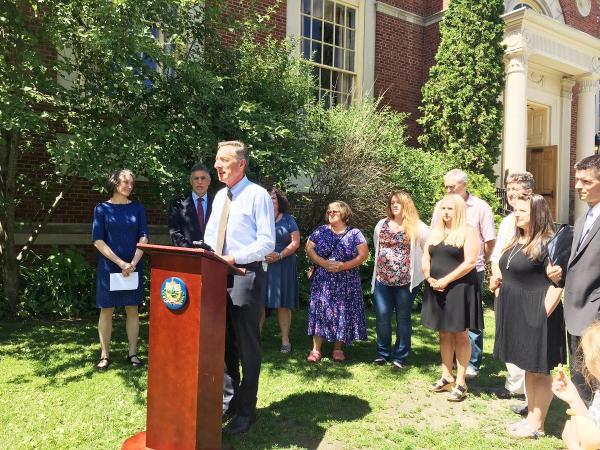 Governor Shumlin at Union Elementary School in Montpelier Thursday morning. Education Secretary Rebecca Holcomb is to the far left. Courtesy photo.
by tim
by Guy Page This spring advocates of divestment of fossil fuel stocks by public pensions, led by Governor Peter Shumlin, pushed the legislature to legally change the Vermont Pubic Investment Committee (VPIC) mandate from maximizing returns for beneficiaries to making toothless political statements with public assets. Thankfully the administrators of Vermont’s public pension, who have studied divestment thoroughly, determined that making politically reflexive decisions is not a responsible way to manage public workers’ retirement security.
In the course of this debate several pensioner groups, including the Vermont State Employees Association and the Vermont Troopers Association, expressed their opposition to divestment and passed resolutions indicating that investment decisions should remain with VPIC, and not with the legislature.
by tim
Vermont Business Magazine The following message was shared with the University of Vermont community at about 10:30 am Thursday morning. A construction worker died after an early morning fall at a new residence hall construction site. The worker's name has not yet been released.
by tim
Vermont Business Magazine The Senate Appropriations Committee has passed an amendment to the State Department and Foreign Operations Appropriations Bill that would fund the Green Climate Fund, an essential part of the international climate agreement reached in Paris last fall. The amendment was cosponsored by Senators Tom Udall (D-NM), Susan Collins (R-ME), Dick Durbin (D-IL), Patrick Leahy (D-VT) and Jeanne Shaheen (D-NH).
The Green Climate Fund is an international fund set up to help nations worldwide – particularly developing nations – adapt to climate change and transition to clean energy sources. This fund is an essential component of the framework that the international community developed in order to work together to take on climate change.
by tim
Vermont Business Magazine The Vermont Agency of Agriculture, Food, and Markets (VAAFM) has announced its adjusted fee schedule, from register and inspect lime products (up $10) to maple processor's fee (2,500 gallons or more for repackaging, up $50) to certification of seed potatoes (up $10 plus $1 per acre) to wild plants – ginseng licensing (up $15) to meat retail large vendor (up $40) to frozen dessert manufacturing (up $5) to many more. The Legislature approved the new fee schedule and it will go into effect Friday, July 1, 2016. VAAFM manages more than 50 fee-based programs. Most, but not all, fees increased. The Agency said in a statement that these services provide value to Vermonters, in accordance with the Agency’s mission: to support the growth and viability of agriculture in Vermont while protecting the working landscape, human health, animal health, plant health, consumers and the environment. The new fee schedule is available at the end of this article.
by tim
Vermont Business Magazine In May the Bennington Select Board adopted three new business and residential incentive programs that will directly impact the community’s downtown core. The three programs use funds already earmarked for economic and community development efforts, but put a fine point on a broad brush as to how a portion of these funds can be applied.