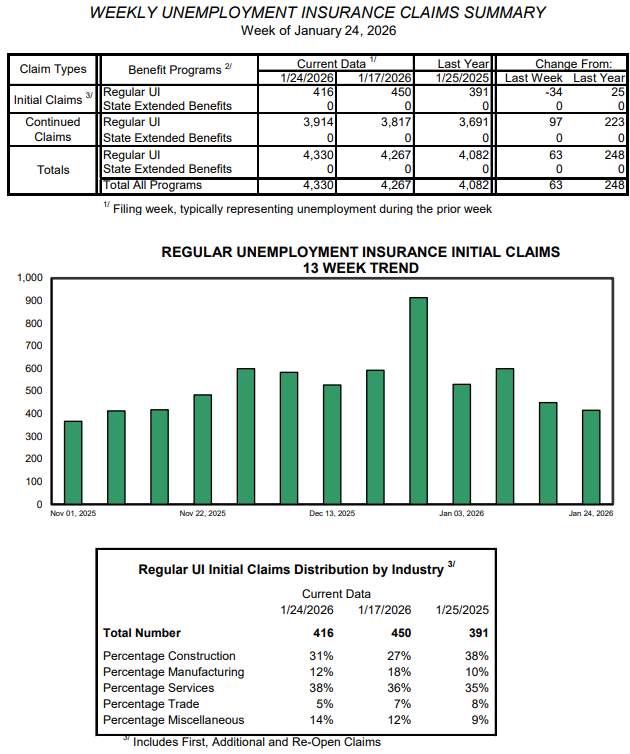
by Timothy McQuiston, Vermont Business Magazine Vermont initial weekly unemployment claims fell last week following as the usual volatile labor activity at the end of holiday season played out. For the week ending January 24, 2026, the Vermont Department of Labor reported that there were 416 new claims, down 34 from the previous week and up 25 from last year at this time. New claims are at typical seasonal levels, but ongoing claims remain high. Total claims were 4,330, up 63 from the week before and are up 248 from last year at this time. Claims, which tend to be lowest in the summer, were 181 at the end of September 2024 and 186 last September.
Claims tend to rise and fall around the holidays with temporary hires and layoffs.
The Montpelier-based Public Assets Institute released its analysis of the labor market this week, which found that the number of Vermonters working has fallen below pre-pandemic levels as of late 2025.
The Vermont DOL is reminding employers that beginning January 1, 2026, Vermont’s minimum wage will increase from $14.01 to $14.42 per hour - an increase of $0.41.
In Vermont for the weekly labor UI claims report, manufacturing accounted for 12% of the total, down 6 points from the previous week. Manufacturing overall has become a smaller part of the Vermont economy over the last 25 years and that trend appears to be continuing. The Service industry, which typically accounts for the most claims, last week reported 38% from the previous week, up 2 points. Construction was 31%, up 4 points.
Service hiring is strong during the holidays then slumps, while cold weather slows down construction.
The Fed kept its benchmark overnight interest rate in the 3.50%-3.75% range at its January 27-28 meeting. Reuters reported that a soft labor market appears to have stabilized while the trade deficit increased and GDP expectations are still positive but lowered by analysts.
In the week ending January 24, according to the US DOL, the advance figure for seasonally adjusted initial claims was 209,000, a decrease of 1,000 from the previous week's revised level. The previous week's level was revised up by 10,000 from 200,000 to 210,000. The 4-week moving average was 206,250, an increase of 2,250 from the previous week's revised average. The previous week's average was revised up by 2,500 from 201,500 to 204,000.
Wall Street had another chaotic week and will likely eke out a positive but disappointing month of January. Apple and Microsoft both had hard weeks. Wall Street was generally favorable of the nomination of Kevin Warsh as the new Fed chair.
However, a partial federal government shutdown appears imminent as of Friday afternoon (the deadline) after a stopgap plan came to a standstill. Initially brought on by Democrats opposed to ICE funding, other issues also have arisen at the last minute.
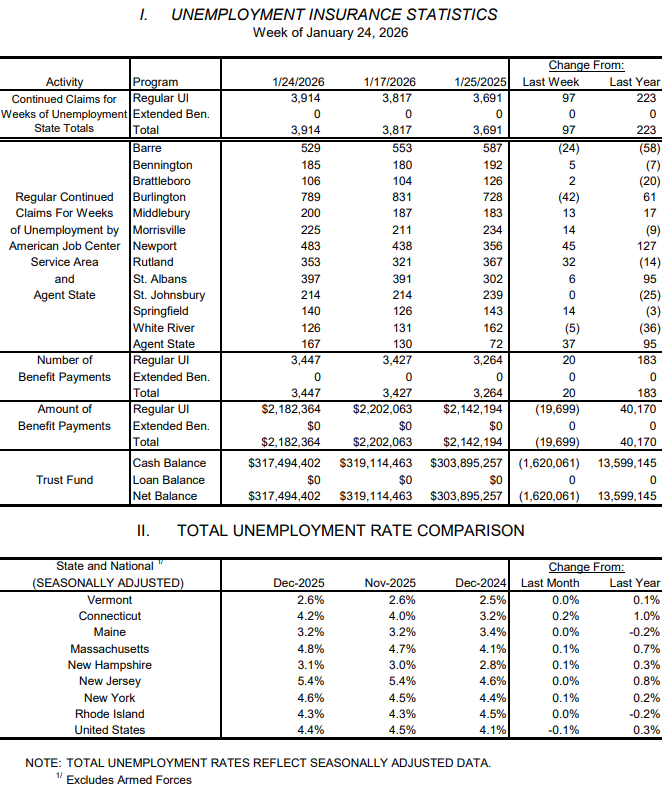
The Vermont Unemployment Trust Fund is well capitalized. As of the most recent data, there was $317.5 million in the Trust Fund, down about $1.4 million from the previous week (as claims are paid out on one side, employers are contributing to the fund on the other). The pre-pandemic Trust Fund balance on March 1, 2020, was $506.2 million.
Vermont’s unemployment rate holds at 2.6 percent in December
The Vermont Department of Labor has reported that the seasonally adjusted statewide unemployment rate for December was 2.6%. This reflects no change from the prior month’s revised estimate. Vermont has the third-lowest rate in the nation behind a tie behind Hawaii and South Dakota (2.2%). California has the highest rate at 5.5%.
The comparable United States rate in December was 4.4%, a decrease of one-tenth of one percentage point from the revised November estimate.
The civilian labor force participation rate was 64.0% in December, a decrease of two-tenths of one percentage point from the prior month’s revised estimate.
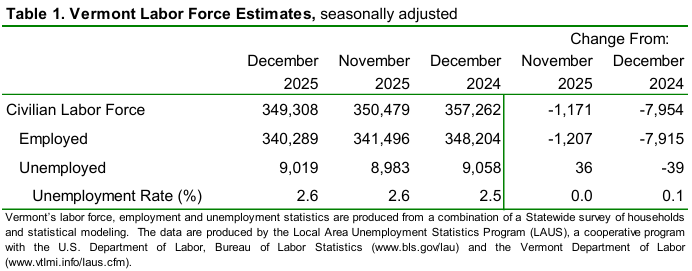
The data continues to show significant reductions in the Labor Force and Employed month-to-month and year-to-year. The Labor Force is the denominator in the equations, so when it goes down it minimizes the losses in the Employed category. The number of Unemployed is essentially unchanged.
See data tables below.
"The Vermont Department of Labor works directly with employers to help them hire, retain, and support the workers they need to succeed,” said Kendal Smith, Vermont Department of Labor Commissioner. “At the same time, we are helping Vermonters connect with available job opportunities as labor market conditions shift. Maximizing every working Vermonter’s potential helps workers build sustainable careers while strengthening and stabilizing Vermont businesses. Through partnerships with local Department of Labor offices (https://labor.vermont.gov/workforce-development/job-centers
), businesses can access customized services and resources, while workers can explore additional training or education options to support their next steps.”
The seasonally adjusted Vermont data for December show the Vermont civilian labor force decreased by 1,171 from the prior month’s revised estimate. The number of employed persons decreased by 1,207 and the number of unemployed persons increased by 36. The changes to the labor force and the number of employed persons were statistically significant in the seasonally adjusted series.
Corporate Income Tax depresses General Fund revenues again
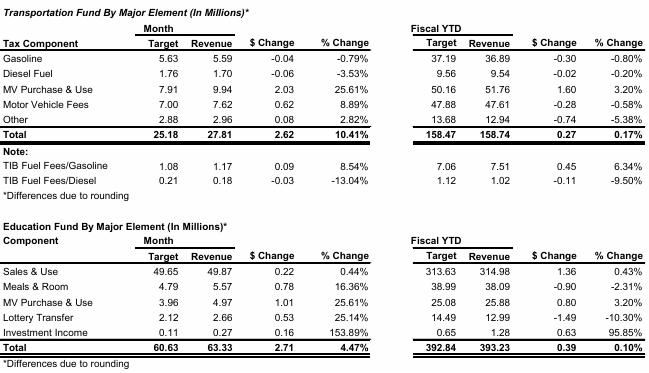
Secretary of Administration Sarah Clark has released Vermont’s revenue results for December 2025. The General Fund missed its monthly target, while the Transportation Fund and Education Fund both exceeded their monthly targets.
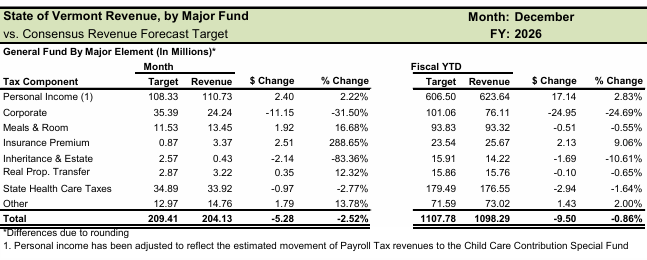
The State’s General Fund, Transportation Fund, and Education Fund receipts were a combined $295.3 million, representing collections of $0.05 million, or 0.02%, above the $295.2 million monthly target in the consensus forecast adopted by the Emergency Board at its July 2025 meeting.
Total General Fund revenues for December were $204.1 million, -$5.3 million or 2.5% below the $209.4 million monthly cash flow target, driven by a second month of significantly lagging Corporate Income Tax receipts. The Personal Income Tax continues to edge above targets, while the Meals & Rooms tax had a catch-up month. Health Care taxes continue to lag and were a concern of the state economists at the last Emergency Board meeting.
Revenues in the Transportation Fund were $27.8 million, representing collections of $2.6 million or 10.4% above target, bouncing back from calendar-impacted revenue totals in December.
Monthly Education Fund revenues of $63.3 million were $2.7 million, or 4.5%, above their December cash flow target of $60.6 million, with all five major components performing ahead of monthly consensus targets.
1.29.2026. Vermont DOL. https://www.vtlmi.info/
To support vital journalism, access our archives and get unique features like our award-winning profiles, Book of Lists & Business-to-Business Directory, subscribe HERE!