

A Weekly State House Recap By Maggie Lenz and Gwynn Zakov (on behalf of Atlas Government Affairs and Garnet Government Relations)
Spreadsheet Fortune Tellers
On Friday, the Vermont Emergency Board, commonly referred to as the E-Board, met to hear from the state’s economists and formally adopt the Consensus Revenue Forecast for the General, Transportation, and Education Funds. The E-Board is made up of the Governor and the chairs of Senate Appropriations, Senate Finance, House Appropriations, and House Ways & Means committees. Revenue forecasts are adopted twice a year, in January and July, and they play a central role in the budget process. The economists use complex economic models to estimate how much money the state is likely to collect over the next few years, giving lawmakers a framework for how much the state can reasonably spend.
So what was the big takeaway this time? Vermont is doing… pretty much… ok. State revenues are tracking almost exactly where the economists thought they would be six months ago, with only minor adjustments across the board. It is the budgetary equivalent of a “that’ll do.”
That relative stability stands out given the broader national picture. Vermont continues to benefit from very low unemployment at 2.6 percent, the third lowest rate in the country. At the same time, there are some clear warning signs. Tourism is down, driven largely by a 35 percent drop in Canadian border traffic linked to trade policy tensions. Lottery sales have fallen by about 10 percent, and corporate tax collections are roughly $25 million lower than expected.
Economists painted a cautious picture of the national economy. Overall economic growth slowed to about 2 percent in 2025, down from 2.8 percent in 2024. Much of that growth has been driven by heavy investment in artificial intelligence, which has added an estimated $10 trillion in market value. That concentration creates risk because a large share of recent growth is tied to a bubble-like investment. Tariffs have pushed inflation back up to roughly 2.7 to 2.8 percent, above the Federal Reserve’s 2 percent target. Manufacturing employment has fallen by about 70,000 jobs since April. Consumer confidence has dropped to levels typically seen around recessions. And the Trump Administration's aggressive anti-immigration tactics have reduced the labor supply in key sectors like healthcare, construction, and technology. Taken together, these federal policies are expected to reduce overall economic growth by about half a percentage point.
For Vermont specifically, the revenue outlook remains fairly stable through fiscal year 2027. Personal income tax collections are running 2.8 percent above targets. Sales and use tax revenues are about 0.4 percent above expectations. Motor vehicle purchase and use taxes are up 3.2 percent. The biggest concern is not an immediate drop in revenue, but a structural issue that begins in fiscal year 2028. A federally mandated reduction in the Hospital Provider Tax rate will reduce healthcare revenues by between $16.8 million and $24.7 million each year. Because healthcare revenues flow into the General Fund, that reduction creates a deficit that grows annually. This more than projection or a worst case scenario being floated. It is federal law, and it represents real dollars disappearing from the budget.
Fiscal year 2028 is shaping up to be the real inflection point, particularly when viewed alongside the longer-term effects of federal trade, immigration, and tax policy. We will get a clearer sense of what this means for Vermont as the Legislature begins its work on the 2027 budget this session, starting from the Governor’s proposal, which he will present to them on Tuesday, January 20.
To be clear, balancing the 2027 budget will still require difficult choices. But the real migraines will set in for lawmakers as they begin weighing whether and how to adjust policies now in preparation for what could be a rough 2028 and beyond.
Curiosities: a weekly peek at the odd and intriguing happenings under the Golden Dome
The Resurrection of Michael Wave
The State House, the people’s house, belongs to everyone and it belongs to no one. It is not an office building in the traditional sense. Most lawmakers and staff do not have private offices. Lobbyists, legislative attorneys, committee assistants, pages, interns, agency officials, reporters, the House and Senate clerks, copy room personnel, food service staff, the Capitol Police, custodial crew, the Sergeant at Arms team, the Lieutenant Governor, and legislators (for example) all share the same limited space, hour upon hour, day after day.
People make it work by claiming space informally and learning the rhythms of the building. A hallway bench becomes your office for an afternoon. The balcony above the House Chamber becomes a conference room. The cafeteria serves as the main hub where people wait, regroup, charge devices, prep for testimony, debrief meetings, try to catch the right person at the right moment, and sometimes eat. Similar to a high school, the cafeteria has its own social geography. There is a section of tables that are occupied almost exclusively by Republicans. Another section is always claimed by the labor unions. The nonprofits have their own section. You get it.
Amy Shollenberger, who owns and manages a prominent Vermont public affairs firm called Action Circles has been working in the State House for over 20 years. Like many people who work in the State House she brings her lunch from home. And for years there was a communal microwave sitting just outside the cafeteria that she and all the other bag-lunchers used to heat their food.
Beyond the practical value, the microwave created one of the few organic pauses in the day. Standing there for a couple of minutes gave people a chance to talk without an agenda. “You’re not even necessarily talking about a bill or a policy issue,” Amy said. "It's more about ‘how’s your day going?’ ‘What do you have for lunch today?’ Those little moments are actually really important.”
Vermont’s legislative process has always depended heavily on relationships. But over the last decade there has been a notable shift away from the social culture. Amy described a time when it was normal to see policymakers, lobbyists, and staff hanging out together after the day wrapped. There were dinners, karaoke nights, and evenings out dancing. It was not unusual to see a Democratic house member dancing with a Republican senator, or a lobbyist singing karaoke with someone who had just voted against their bill earlier that day. People disagreed sharply on policy and then let their hair down and had a nice time together. Those relationships did not serve to eliminate conflict, but they did impact how conflict played out. When tensions rose, people were more willing to listen and stay in conversation. “That’s how collaborative policymaking happens,” Amy said. “Not because people agree, but because they trust each other enough to stay in the conversation.”
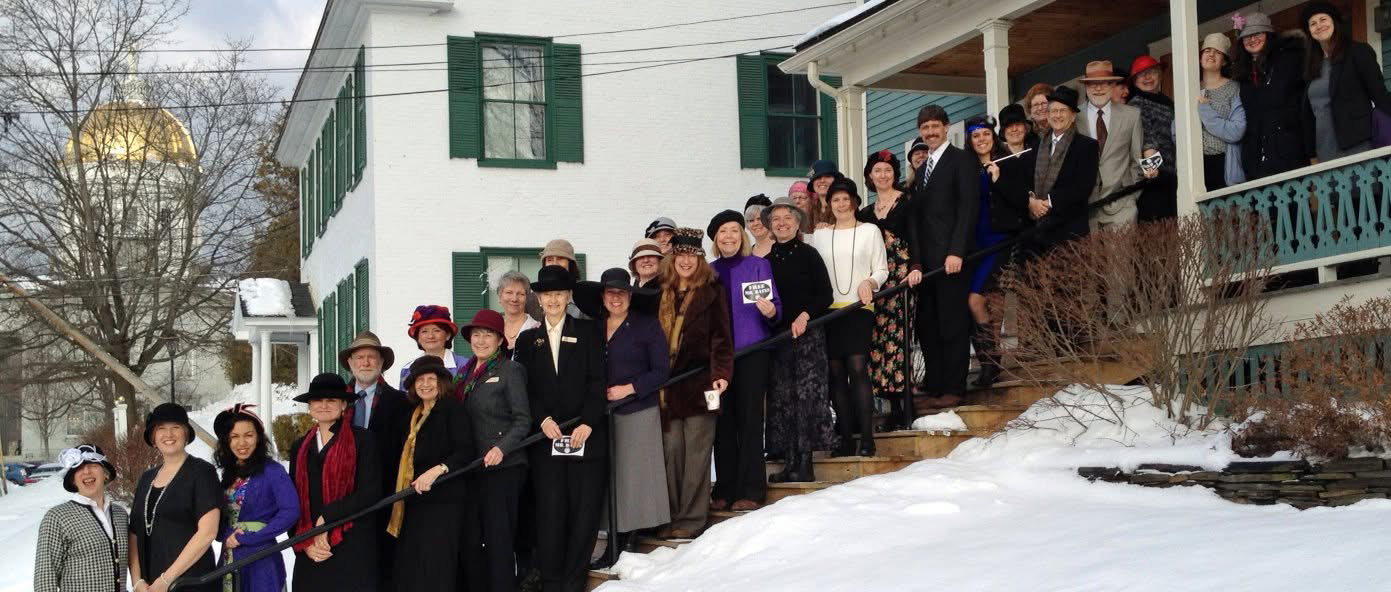
There were also intentional efforts to build community inside the building itself. Amy helped organize lighthearted events that had nothing to do with current policy work. One year they held Hats On for Women’s Suffrage. A sizable crowd of State House people gathered for breakfast at the offices of lobbying firm MMR, donning vintage hats, and walking back to the State House together afterward. As a nod to the moment, the State House Curator created a display honoring women leaders in Vermont that day which became a permanent exhibit. Another year was Olympic Day, with red, white, and blue outfits, fake gold medals, and one House Rep dressed in full figure skating regalia. “It was something funny and enjoyable that we all got to do together,” Amy said. “It was very bonding.”
Over time, that culture changed. COVID disrupted long-standing rhythms and new lawmakers entered the building without ever experiencing the informal social life that once defined the State House. This biennium security protocols tightened noticeably with TSA-style checkpoints appearing intermittently at the entrance and signs posted around the building warning against leaving bags unattended. Set against a backdrop of heightened political polarization, increasingly toxic public discourse, and real concerns about political violence, none of that is unreasonable. But for advocates who often carry an entire office floor in a backpack and spend long days camped out in shared spaces, the cumulative effect in Amy’s estimation has been a growing sense that shared space is shrinking. And that people in her line of work feel less at home in the building than they once did.
All this context matters for what happened next. In December during renovations to the cafeteria area the microwave was removed without explanation. At first people assumed it was temporary. But when the renovations ended and the microwave did not return, Amy asked a legislator who used it regularly to look into it. The answer was that it was not coming back. It had been moved to a locked legislative lounge and accessible only to people with badge access.
After everyone had returned to the State House for the 2026 session, members of the Microwave Caucus tried to raise the issue quietly through individual conversations. When those conversations failed to deliver a microwave, Amy’s instinct for making-a-point-without-making-an-enemy kicked in. “I was sitting in the cafeteria with a few other advocates and a legislator,” she said. “We were all talking about how frustrating it was. And I suggested we make a shrine in its absence.” She sent word to other people who regularly used the microwave and told them that if they were coming in the next day they should bring something to place on the shrine. And they did. One person wrote an Ode to the Microwave. Someone else made a sign that read “Rest in Power, Michael Wave.” Amy brought flowers. Someone stayed late and taped everything up.
Throughout the next couple of days people stopped to look at the shrine. Some came in with items from home to add. Others stumbled across it and contributed spontaneously. Someone brought a Day of the Dead candle. Paper cranes were folded and set out in tribute. A sage stick was added. People laughed, took pictures, and talked. “It wasn’t aggressive,” Amy said. “We weren’t targeting anyone. We weren’t telling people to complain. It was just a way to show that this mattered to us.” Some of the people who added to the shrine had never used the microwave and did not even know it had existed before then.
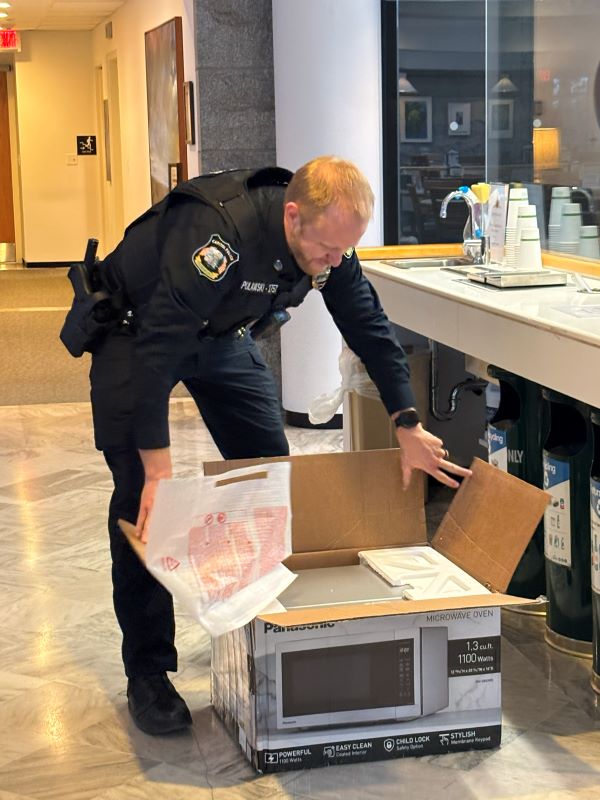
Last week, within a week of the shrine’s inception, a new microwave arrived. It was unboxed and installed after-hours by Capitol Police.
For Amy and many others, the work done in the State House is ultimately about relationships. Policy is shaped not only through hearings and floor votes but through trust built over time and the ease of ordinary conversation. When those moments of shared humanity disappear, the work becomes more brittle. When those moments are defended even in small and slightly absurd ways, something essential is restored. Or at least collectively remembered. In this case, shared humanity is a communal State House microwave. You stand there, waiting for your lentils to heat up, and ask the person next to you about their life.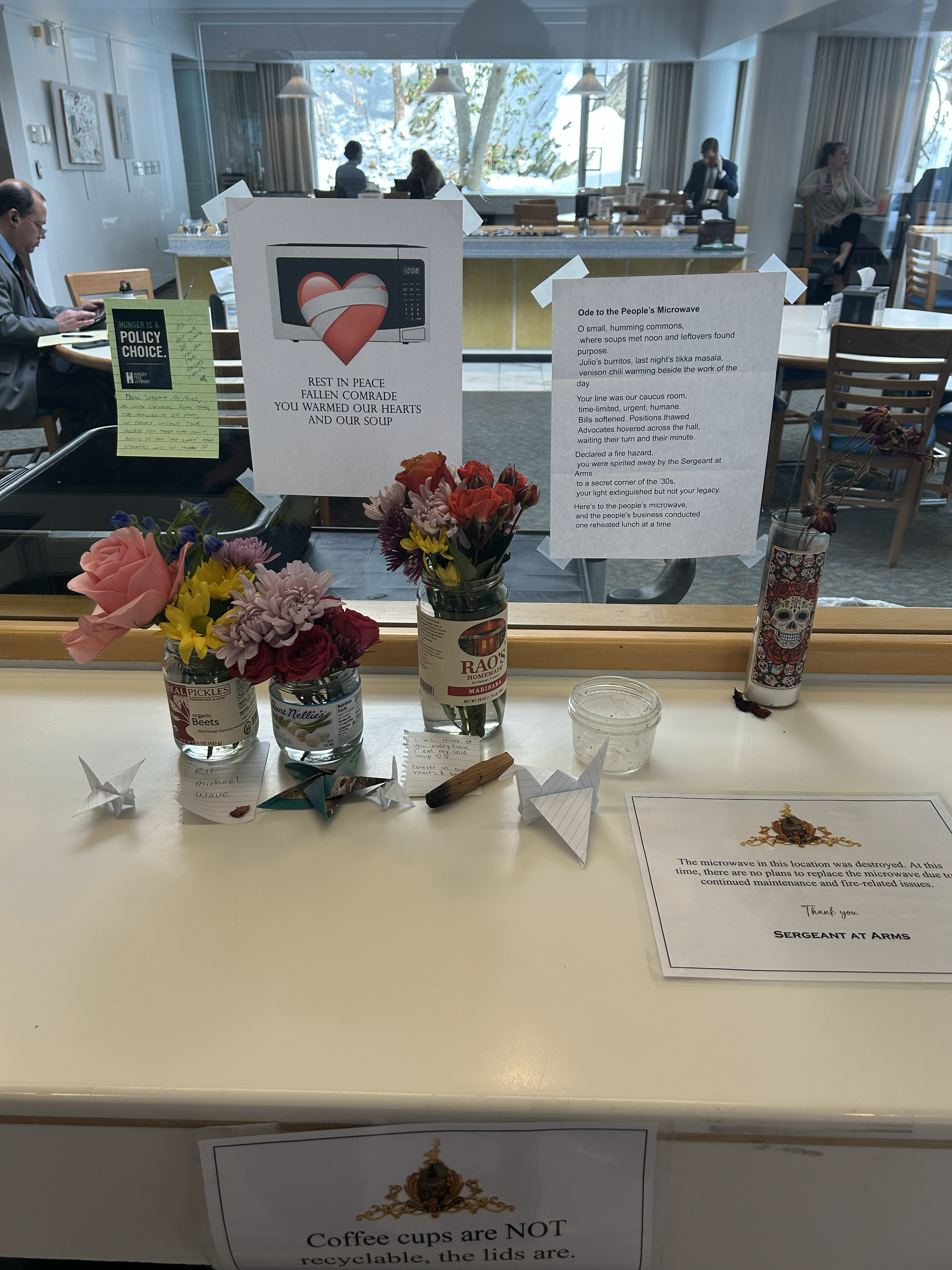
Ode to the People’s Microwave (Author unknown)
O small, humming commons,
where soups met noon and leftovers found
purpose.
Julio’s burritos, last night’s tikka masala,
venison chili warming beside the work of the
day.
Your line was our caucus room,
time-limited, urgent, humane.
Bills softened. Positions thawed.
Advocates hovered across the hall,
waiting their turn and their minute.
Declared a fire hazard,
you were spirited away by the Sergeant at
Arms
to a secret corner of the ’30s,
your light extinguished but not your legacy.
Here’s to the people’s microwave,
and the people’s business conducted
one reheated lunch at a time.
To support vital journalism, access our archives and get unique features like our award-winning profiles, Book of Lists & Business-to-Business Directory, subscribe HERE!
 Vermont Business Magazine