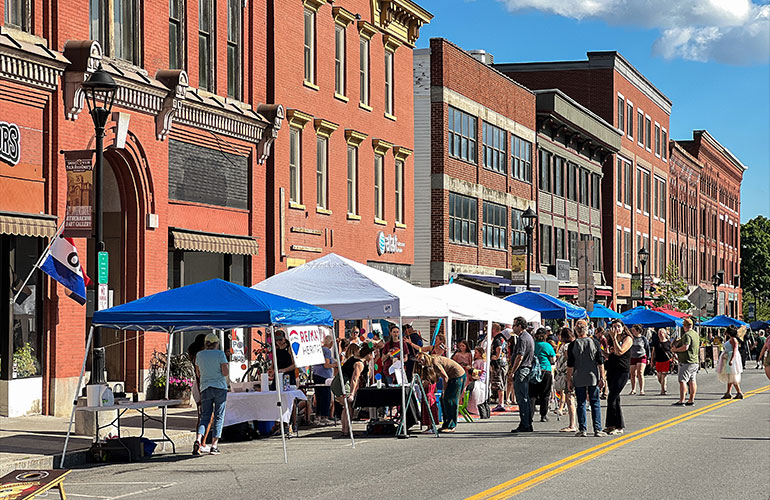
Photo: Downtown St. Johnsbury sidewalk sale. Photo courtesy St. Johnsbury.
Caledonia, Essex and Orleans counties economic overview
by Olga Peters, Vermont Business Magazine
“If there’s a prettier place in New England, I don’t know where it is,“ observed Rick Ufford-Chase, as he prepared for the Newport City Council’s Nov. 18 meeting.
It was a significant night for Ufford-Chase, who, in addition to being an elected councilor, serves as executive director of Newport Downtown Development, an organization working with partners and volunteers to revitalize, preserve and promote historic downtown Newport.
At the Nov. 18 meeting, the Council voted to release a draft version of the town’s enhanced master plan for public comment. Ufford-Chase said the ambitious plan includes proposals to redevelop several blighted areas, improve public infrastructure, create a new truck route and build more than 300 affordable and market-rate housing units over the coming decade.
Newport Downtown Development initiated work on the enhanced plan in February, collaborating with VHB, a South Burlington-based civil engineering consulting and design firm. According to Ufford-Chase, Newport has undergone nearly 20 reports, studies and intensive community engagement processes in the past 15 years. These initiatives have resulted in some changes, including the modernization of the city’s zoning. However, the accumulation of plans has fostered a perception within the community that Newport is “studied to death“ without tangible progress.
“We know who we are. We do not need another study that tells us that we live in a beautiful spot in the world, and we should look to the lake,“ Ufford-Chase said.
In Ufford-Chase’s view, the gaping hole in the downtown area, a remnant of the failed EB-5 project, contributes to a pervasive sense of blight.
In 2015, there was initial optimism when Bill Stenger and his development group broke ground on a $100 million biomedical facility called AnC Bio in Newport. This project was part of a larger EB-5 visa program, which aimed to attract foreign investment for economic development projects in exchange for U.S. residency opportunities. However, the Jay Peak EB-5 program, of which AnC Bio was a part, collapsed under allegations of fraud by the federal government against its owners, Ariel Quiros and Stenger.
“There’s plenty of people with good spirits here who want something to happen, but we’ve got to create the conditions that will allow and encourage development of the things we want,“ Ufford-Chase said.
If the public engagement process is successful, he added, NDD will initiate a search for developers interested in collaborating with Newport to transform the ambitious plan into reality.
Ufford-Chase emphasizes the necessity of establishing public incentives to attract private investments. One potential incentive is the creation of a tax increment financing district. TIFs are a financing mechanism designed to stimulate development in blighted areas by utilizing the increased tax revenues generated from rising property values to fund public projects. These projects can include sewer system upgrades, brownfield mitigation and public parking garages. In the case of the site downtown, the enhanced master plan proposes constructing a below-grade public parking garage to create a platform for a potential six-story building with commercial and residential spaces.
“That empty block created in the EB-5 scandal has been sitting empty for eight years,“ Ufford-Chase said. “My perception is that if a developer could figure out how to make the numbers work, they would have done it by now. But they can’t. And the reason they can’t is because the current environment we live in really demands public infrastructure support to make the numbers pencil out for developers.“
Newport, echoing the experience of many Vermont communities, holds a nostalgic memory of a more prosperous past. Ufford-Chase recalls that 50 years ago, the city was a bustling economic hub, with Main Street lined with thriving businesses in the 1950s and 1960s. However, since the 1970s, the city has faced a decline in population and housing. Many older residents, who personally witnessed the city’s former vibrancy, now observe a Main Street marred by a demolished block, vacant buildings, and structures that have outlived their usefulness.
This contrast fosters a perception of decay, according to Ufford-Chase. To counter this decline, the enhanced master plan proposes a diverse mix of housing options to accommodate residents of all income levels, aiming to revitalize the downtown area and create a sustainable economic environment for local businesses.
“It’s a commitment to helping people who live here believe that if they put their heart and soul into something, change can happen, and that it’s not change that will chase them out,“ he said. “We’re not building this primarily for visitors. If we’re successful, visitors will want to come here because we protected the character of this community, and the people who have always lived here will still feel like it’s their home.“
“Renewal,“ “re-imagining,“ “revitalization“ and “renaissance“ were once frequently used to describe the economic prospects of the Northeast Kingdom. However, interviews conducted for this article reveal a prevailing concern among residents about their ability to thrive in the region they cherish.
The Northeast Kingdom’s three northeastern most counties — Orleans, Caledonia and Essex — encompass approximately 2,000 square miles. Economic indicators in these counties generally lag behind statewide averages. For instance, U.S. Census Bureau data shows that per capita income in the three counties — $31,891 in Essex, $34,365 in Orleans and $36,604 in Caledonia — falls below the state’s average of $41,680. Additionally, poverty rates in these counties range between 12% and 13%, surpassing the state’s rate of 9.7%.
Building Collaborations
Loralee Tester, the new executive director of the Northeast Kingdom Chamber of Commerce, characterizes the people of the Northeast Kingdom as resilient and dedicated to mutual support. She envisions the chamber’s primary role as a facilitator for collaboration among the region’s diverse business sectors.
Tester has already initiated discussions with the Manufacturing Collaborative in Randolph and Vermont State University to establish a manufacturing roundtable. Her upcoming focus is to engage with members of the outdoor recreation and creative sectors, recognizing the creative sector’s significant contributions and potential for growth in the region.
Tester also highlights the issue of potential underemployment among many Northeast Kingdom residents. While acknowledging the importance of attracting new residents, she emphasizes the equally vital need to provide quality job opportunities for the existing workforce within the Northeast Kingdom.
“We all know the problems. What are we going to do? Can we make some real, concrete action plans?" she said.
Tester’s husband, Shawn Tester, president and CEO at Northeastern Vermont Regional Hospital, has directly observed the impact of the region’s housing shortage on local employers. He notes that many potential hires for the hospital have reported difficulties in finding suitable housing. Additionally, Weidmann, a Switzerland-based insulation manufacturer, is undertaking a $40 million expansion at its St. Johnsbury location and will require additional employees, further highlighting the need for increased housing options in the region.
“Every single sector is struggling because they want to hire people, but there’s no place for them to live,“ Shawn Tester said.
Weidmann & Mascoma
In November, Mascoma Community Development secured a $13 million new markets tax credit allocation to fund the expansion of Weidmann Electrical Technology in St. Johnsbury. This project aims to meet increased demand for large power transformer insulation while creating opportunities for career advancement and income growth in northern Vermont.
MCD’s financing will enable Weidmann to expand its transformer board manufacturing capacity and build a finished goods storage facility, generating and preserving quality, accessible jobs. Weidmann’s commitment to ongoing education and skill development is evident in its substantial investments in new programs for the benefit of both the organization and its employees.
The project enjoys strong support from the local community and elected officials, who have already made significant public infrastructure investments, such as a $12 million upgrade to the town water treatment plant. These investments foster a mutually beneficial relationship, allowing St. Johnsbury and Weidmann to grow together.
“Mascoma Community Development is pleased to provide NMTC funding to support the Weidmann expansion, which will have a significant positive impact on the people and economy of St. Johnsbury and the surrounding region,“ said MCD Chief Investment Officer Michelle LeClair. “The expansion will not only allow Weidmann to meet increased demand for its products but also to continue their commitment to current and future employees through training and job opportunity.“
MCD is a community development entity established by Mascoma Bank that creates impactful jobs in highly distressed, low-income rural and minor-urban communities. MCD also targets downtown redevelopment projects that help revitalize communities and provide services to residents.
Weidmann, established in 1969 at its current location in St. Johnsbury, is a leading manufacturer of transformer insulation. As part of the family-owned Weidmann Group, the company operates as a global supplier of engineered products and services across the electrical, medical and fiber technology sectors. The Weidmann facility in St. Johnsbury is one of three transformer insulation facilities in North America and provides board production for the entire region.
The Weidmann project is estimated to retain 300 jobs and create 67 new jobs upon completion. The company has a history of collaborating with local colleges and technical schools to provide training opportunities for employees. It provides in-house and external training for employees, encourages growth from within, and established an in-house leadership program in 2022.
In addition to support for its employees, Weidmann has volunteered in community service projects or partners with local fundraising events like Relay for Life and the Alzheimer’s Walk. In the last five years, it has donated over $250,000 to local nonprofits, contributed to Northeastern Vermont Regional Hospital’s West Wing Project, and supported youth development programs, particularly those focusing on STEM education.
A Renaissance in St. Johnsbury
St. Johnsbury exemplifies a community where tenacity is yielding positive outcomes. A decade ago, the downtown area was vacant. However, through several successful redevelopment initiatives, new businesses like Spoon Thawee Thai Cuisine, 98 Mill, Boule Bakery and Javier Bill’s Almost Authentic Mexican Food have revitalized the downtown.
Local entrepreneur Brendan Hughes contributed to this resurgence by establishing St. Johnsbury Distillery in 2017, acquiring an existing rum distillery known as Dunc’s Mill. In addition to rum, the distillery now produces gin, vodka and seasonal liquors. This entrepreneurial spirit reflects the prevailing “ethos“ of determination and progress within the community.
“There’s such an ethos that’s involved in St. Johnsbury and the greater Northeast Kingdom that people are really dedicated to the area that they love,“ Hughes said.
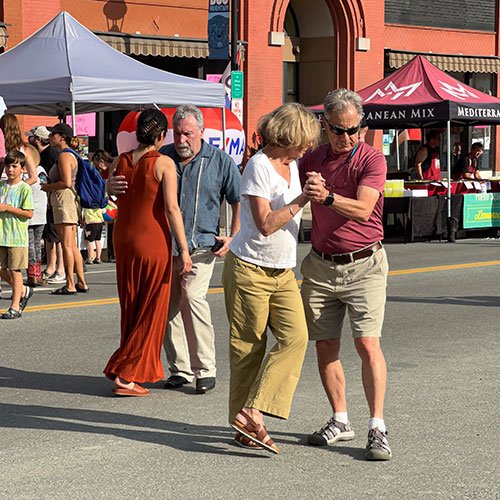
Photo: St. Johnsbury in the summer. Photo courtesy St. Johnsbury.
He said the distillery experiences annual growth despite the challenges posed by COVID. The company opened its tasting room and restaurant above the distillery at the end of 2020. Since then, it has renovated the entire kitchen to establish a destination restaurant and tasting room.
Hughes expresses his passion for entrepreneurship, remarking, “Interestingly, I initially thought I was going to be a dentist.“
He studied biology and chemistry and had worked as a dental assistant for about four years. “But when it came time to apply to dental school, I also applied to this master’s program at the University of Notre Dame, which focused on entrepreneurship, especially for people with STEM backgrounds,“ he said.
Combining a desire for business ownership with a background in biology, purchasing a distillery becomes a logical step. Hughes, president and co-founder of the distillery, is one of five owners. The company employs four full-time and 14 part-time employees.
In addition to his role at the distillery, Hughes serves as the president of the St. Johnsbury Chamber of Commerce’s board of directors and as a member of the St. Johnsbury Selectboard. He is also a recipient of VermontBiz’s 40 under 40 award.
Hughes envisions the distillery and related businesses as catalysts for the local economy, attracting more people to relocate to St. Johnsbury.
“We all understand that if there are more options in our area, more people will come. So the pool of customers also increases with the number of opportunities and the different businesses in town,“ he said.
Chamber Executive Director Gillian Sewake reported that St. Johnsbury had a successful year despite the summer 2024 flooding. She noted the city’s strong position, with minimal vacant retail storefronts in its downtown core.
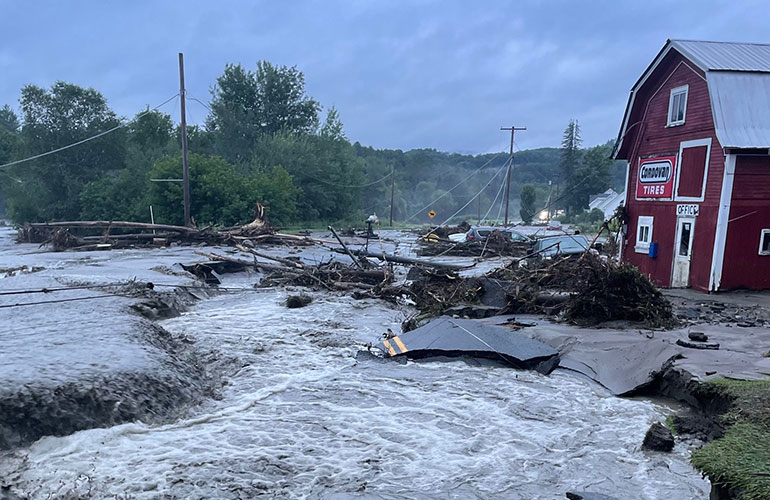
Photo: July flooding in St. Johnsbury. Photo: VTrans.
Sewake attributes St. Johnsbury’s renaissance to ongoing collaborations between municipal and community leaders. She emphasized the municipality’s significant role in redeveloping key projects, such as the New Avenue Building, which contributed to the downtown’s revitalization.
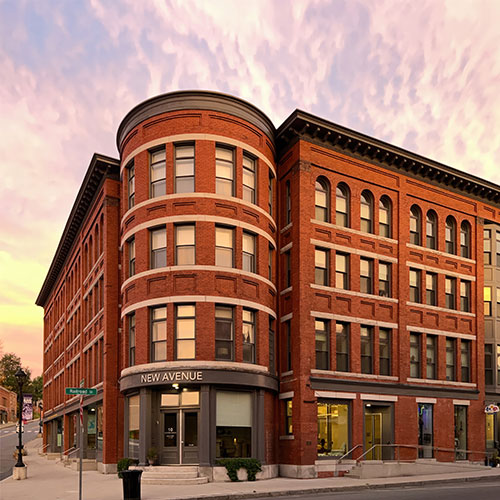
Photo: New Avenue Building, St. Johnsbury. Photo courtesy St. Johnsbury.
The New Avenue Building, located at a prominent intersection, now offers affordable apartments and commercial space, replacing a previously dilapidated structure.
“We are seeing a lot of demand for retail and commercial space here in St. Johnsbury, and this summer, particularly, we did see the visitation and patronage that was really up from previous years,“ Sewake said.
At the time of publication, Sewake was still collecting the chamber’s 2024 statistics. However, she said that over the past four years, St. Johnsbury has seen a net increase of 34 new businesses. Many of these business owners are young entrepreneurs launching their passion projects.
“I think partnership is really what’s made a huge difference here in St. Johnsbury in terms of moving past some of the challenges we’ve been facing,“ Sewake said.
Master Planning at VTSU
Vermont State University is undergoing a master planning process of its own for its five campuses. Interim president David G. Bergh estimates that this project will span 10 to 15 years. Preliminary assessments indicate that VTSU campuses have an overbuilt capacity of roughly 30%.
“Our campuses were built in a very different era, with different teaching and learning modalities, technologies and student residential preferences,“ Bergh said.
Vermont State University is committed to maintaining all five of its campuses: Castleton, Johnson, Lyndon, Randolph and Williston. However, the university will prioritize investments in spaces essential for student learning, teaching and on-campus housing.
Bergh believes there are opportunities to creatively repurpose any buildings deemed nonessential, including potential leasing or selling.
“What I’ve been saying in our campus conversations is that there’s an element of this that is sort of go, go, go, and then wait, wait, wait,“ he said.
VTSU representatives have actively engaged with community leaders around each campus, including recent meetings in the Lyndon area. Bergh noted that the top priority for everyone was increasing housing options.
One suggestion was to develop temporary housing for new employees until they could find permanent local housing. Additionally, students have expressed a preference for apartment-style on-campus housing with one-year lease options.
Community and school leaders are interested in creating opportunities for VTSU students, such as work placements or internships. The university has seen positive enrollment growth, with a significant increase in incoming first-year students.
The Lyndon campus, known for its atmospheric science, outdoor education, and restorative justice programs, attracts students from outside Vermont. VTSU has also expanded Lyndon’s nursing program.
Bergh pointed out that many young people in the country are drawn to the Vermont lifestyle. He optimistically refers to out-of-state students as “future Vermonters.
“I think we’re attuned to the needs of rural students, particularly in places like Lyndon,“ he said. “But we’re also looking to bring more students from outside the region to that campus.“
A Busy Season at Jay Peak
Director of Communications Dehlia Wright credits Jay Peak’s strength to its location, staff and local communities.
In an email, Wright said the four-season resort had a strong 2023-24 season “made better by a tremendously strong second half“ fueled by heavy April snows and the total solar eclipse.
“Our expectations are that every single year is going to be wonderful; you have to be an optimist to succeed in the ski business,“ she said.
Optimism remains crucial for outdoor recreation in light of challenges like summer flooding and climate change. For instance, the Agency of Transportation is still repairing flood damage to the Lamoille Valley Rail Trail, with portions closed since July 30.
Two rounds of flooding in 2023 damaged 157 sites along the 93-mile trail, including surface material washouts, embankment failures and damaged culverts and bridges. However, Jay Peak has so far avoided direct weather impacts, with natural snow totals remaining consistent over the past decade.
“Still, we’re doing our part to mitigate potential climate impacts by executing programs like our electric boiler system in our Hotel Jay,“ Wright said.
Visitation numbers have been on the rise, according to Wright. “We’ve seen both winter and summer numbers escalate across the last five to six years,“ she said.
Jay Peak is also grappling with the state’s housing shortage. In response, the resort has converted some vacation rental properties into worker housing.
“This is not a long-term sustainable strategy, but we have no choice,“ Wright explained.
She added, “We offer more, and arguably better, workforce housing than anyone in the Eastern ski industry, and this has improved our ability to attract and retain talent.“
New Projects for the NEK
Like much of Vermont, the Northeast Kingdom faces a shortage of workers and affordable housing. David Snedeker, executive director of the Northeastern Vermont Development Association, pointed out that younger workers are not replacing aging workers at the same rate.
However, Snedeker emphasized that job opportunities are available. Approximately six manufacturers in St. Johnsbury and Lyndon could hire 200 to 300 new employees, including positions at Weidmann, which is undergoing a $40 million expansion.
“But the question is, where are these people going to live?“ Snedeker said. “Even some of their corporate-level people have to live outside of the region.“
Snedeker mentioned that a few housing developments are in their initial stages. NVDA’s brownfields mitigation program is actively supporting RuralEdge Housing and Community Development, the regional affordable housing provider, as well as for-profit developers on these projects.
Snedeker expressed enthusiasm for the Yellow Barn Business Accelerator project on Route 15 in Hartwick. This two-story, 40,000-square-foot facility aims to support food-based businesses and is projected to create 25 new jobs.
Cabot Creamery’s flagship retail location has already moved in, and the Center for an Agricultural Economy’s Business Accelerator is located next door. Current tenants include Food Connex, a farm-to-buyer delivery organization, and Jasper Hill Farm’s e-commerce fulfillment operations.
Affordability is a key concern for business owners, Snedeker noted. With the upcoming legislative session, he’s keeping a close eye on the clean-heat standard, which he believes could increase costs, particularly for fossil fuel dealers. Businesses also have ongoing needs for better access to capital and more commercial space in the 5,000- to 10,000-square-foot range.
North Country and Northeastern Vermont Regional pledge to preserve services
NVDA staff are actively managing the Municipal Technical Assistance Program, which supports smaller communities that may lack resources. Snedeker explained that the program originated from the Vermont Community Index, which ranked communities based on their perceived needs, such as proximity to a college, number of municipal staff and available infrastructure.
The Northeast Kingdom had a high concentration of high-need communities. NVDA staff have been meeting with towns to identify priority projects, such as Westfield’s goal of creating a public wastewater system to facilitate town growth.
The state recently announced the award recipients for the Municipal Energy Resilience Program, a Vermont Department of Buildings and General Services initiative focused on towns’ weatherization and energy retrofit needs. Snedeker reported that 39 municipalities in the Northeast Kingdom will receive funding.
Following this year’s flooding, some towns have decided to allow business buyouts. In the past, towns resisted buyouts to preserve their tax base. However, with some businesses facing repeated flooding, towns like Lyndonville have reconsidered their stance.
“You can’t make people keep suffering, because this is going to keep happening more and more,“ Snedeker said.

Photo: Senator Welch and Admiral Levine accessing flooding in Lyndonville. Courtesy photo.
Feeling Misunderstood
Tester, of the Northeast Kingdom Chamber, conveyed that many area residents feel misunderstood by state decision-makers. She believes this misunderstanding of rural communities is a pervasive issue throughout Vermont.
Tester recounted experiences in meetings with lawmakers and decision-makers where negative comments were made about rural Vermont. She shared an anecdote from a Vermont Chamber of Commerce event where a guest speaker referred to Vermonters as either “urban dwellers“ or “cave dwellers“ — a derogatory comment aimed at rural residents.
“I think that ends up being really problematic for this region,“ Tester said. “People are just feeling frustrated and unheard.“
In Tester’s view, rural communities possess excellent assets that have developed over decades as a reflection of their community. Yet, these institutions must constantly justify their existence. She points to two independent high schools, the Lyndon Institute and St. Johnsbury Academy, as assets that have served almost every local child for more than 100 years.
Tester, a graduate of Lyndon Institute and currently president of the school’s board of trustees, shares this frustration.
“Every year, we have to fight just to exist because the powers that be don’t believe in private education,“ she lamented.
According to Tester, these schools do not discriminate, adhere to all regulations and effectively educate their students, yet they still face constant scrutiny from Montpelier. She believes this stems from a lack of understanding within the state government about how their decisions can hinder, rather than help, communities.
In addition to these concerns, there’s anxiety about how legislation like the Clean Heat Standard might increase costs for small businesses.
“In the Northeast Kingdom, it’s easy for folks to cross the border into New Hampshire and shop at bigger grocery stores,“ Tester said. “But when this happens, the community just dies.“
Sewake highlighted the irony that the quintessential image of Vermont — rolling hills, beautiful lakes, active farms, outdoor recreation, and picturesque downtowns — is often a reflection of the Northeast Kingdom. However, she agrees with Tester that this region is often misunderstood.
This disparity was evident during the pandemic and the summer flooding, where the Northeast Kingdom received less support and media attention compared to areas like Montpelier and Barre. Sewake and Tester encourage more Vermonters to visit the Kingdom and experience its unique offerings firsthand.
“The Northeast Kingdom is the most distilled essence of what you think of when you think of Vermont,“ Sewake said. “Everyone should come and visit, see what that’s like and support us.“
Olga Peters is a freelance journalist from southern Vermont.
To support vital journalism, access our archives and get unique features like our award-winning profiles, Book of Lists & Business-to-Business Directory, subscribe HERE!