by Timothy McQuiston, Vermont Business Magazine Vermont unemployment insurance claims fell last week but a backlog indicates that there are still tens of thousands of claims still to be processed. Layoffs and business closures due to Governor Scott's "Stay Home, Stay Safe" order because of COVID-19 have resulted in a rush of claims. The Labor Department and its 30-year-old mainframe has struggled to keep up. They have added upwards of 55 new staff. The governor said if progress on fixing the problem doesn't work this week he'll have to come up with "a creative" solution. He did not know as of yesterday what that might be.
The federal CARES Act now allows sole proprietors and independent contractors to also participate, which will further swell the numbers of officially unemployed.
On Thursday afternoon, the Vermont Department of Labor distributed its weekly report on the Unemployment Insurance claims through the division of Economic and Labor Market Information.
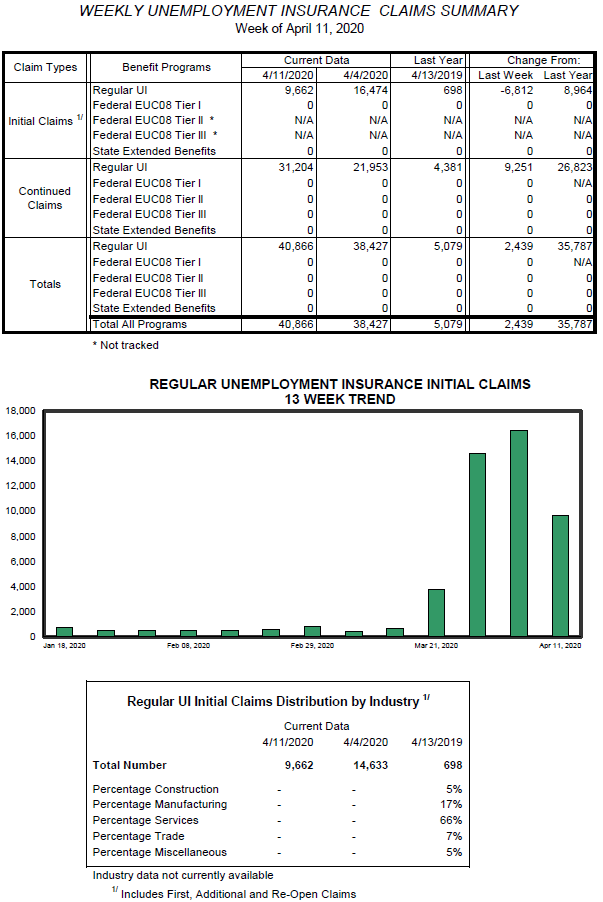
The report indicated that for the week ending April 11, 2020, the Department processed 9,662 Initial Claims and 31,204 Continued Claims. In comparison to last year, this is an increase of 8,964 Initial Claims, and 25,823 Continued Claims for the same week.
As a supplement to this report, the Department provides the following information through its Unemployment Insurance Division:
- Number of Initial Claims Processed to date since March 15, 2020: 78,098.
- At February Labor Market figures, this would increase the Vermont unemployment rate from 2.4 percent to 22.9 percent. However, because of the sole proprietor/contractor addition, this could be pushed downward somewhat. Actual numbers are not yet known.
- Number of Initial Claims between April 5-April 11: 13,511
- Number of Initial Claims for same week in 2019 (week ending April 13, 2019): 698
State officials said while claims might be late, all money owed will be paid eventually back to the actual start date.
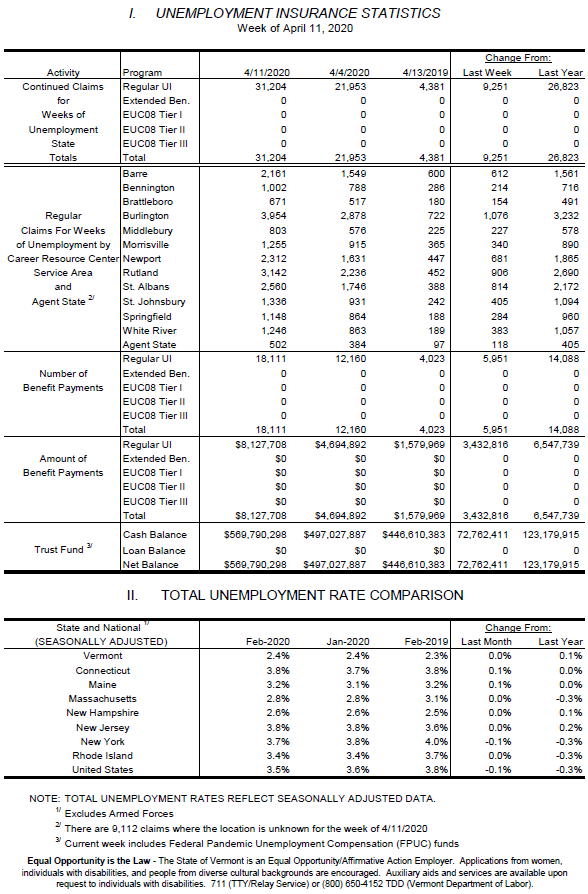
Altogether in the regular weekly report, 40,866 new and continuing claims were filed last week, an increase of 2,439 from the previous week and 35,787 more than a year ago. This four-week surge eclipses the peak of the Great Recession for the entire year in 2009 of 38,081 claims. The April 16, 2020 report can be found at http://www.vtlmi.info/weeklyUi04112020.pdf. See data tables below.
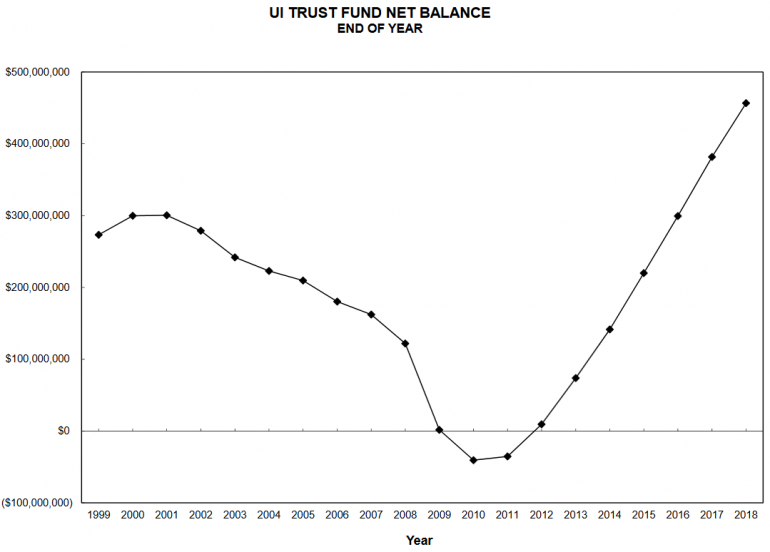
The claims back then pushed the state's Unemployment Insurance Trust Fund into deficit and required the state to borrow money from the federal government to cover claims.
Right now (see data below), Vermont has over $500 million in its trust fund and spent over $8 million on claims last week. Payments lag claims typically by a week.
The US unemployment rate for March jumped to 4.4 percent in March, the highest rate since August 2017. The US and Vermont unemployment rates are expected to keep increasing.
But with Governor Scott's order to at first close all restaurants and now all non-essential workers have been ordered home, the claims are expected to continue to mirror the spike in federal numbers, which increased by more than 6 million the last two weeks and more than 3 million the previous week.
The impact on jobs from the coronavirus (COVID-19) in Vermont on weekly unemployment claims is expected to be profound and the federal aid package will more than double current UI payments in Vermont as soon as it can be implemented. The federal government will add $600 a week to the Vermont benefit.
Nationwide, according to the US Labor Department for the week ending April 11, initial claims for state unemployment benefits were 5.2 million versus 6.6 million the previous week. (The week previous was 3.3 million. The week before that there were 282,000 claims.) Economists estimated there would be 5 million claims in the current report.
UI claims by industry last week in Vermont were not calculated.

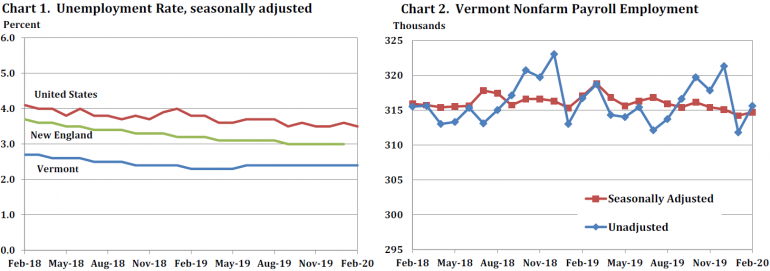
Vermont's unemployment rate for March was 3.2 percent, up from February which held at 2.4 percent. SEE STORY.
The US unemployment rate for March, released April 3, jumped to 4.4 percent, the highest since August 2017 and well above market expectations of 3.8 percent.
All these numbers of course are expected to take a precipitous turn for the worse over the next few months, especially when the April report is released in May.
Stories:
Tax revenues for February on target, hit expected over next few months
Businesses to see double-digit rate decrease in workers’ comp insurance in 2020
Tax revenues finish year nearly $60 million above targets
UI tax rates for employers fell again on July 1, 2018, as claims continue to be lower than previous projections. Individual employers' reduced taxable wage rates will vary according to their experience rating; however, the rate reduction will lower the highest UI tax rate from 7.7 percent to 6.5 percent. The lowest UI tax rate will see a reduction from 1.1 percent to 0.8 percent.
Also effective July 1, 2018, the maximum weekly unemployment benefit will be indexed upwards to 57% of the average weekly wage. The current maximum weekly benefit amount is $466, which will increase to $498. Both changes are directly tied to the change in the Tax Rate Schedule.
Vermont's minimum wage rose to $10.78 on January 1, 2019.
The Unemployment Weekly Report can be found at: http://www.vtlmi.info/. Previously released Unemployment Weekly Reports and other UI reports can be found at: http://www.vtlmi.info/lmipub.htm#uc
NOTE: Employment (nonfarm payroll) - A count of all persons who worked full- or part-time or received pay from a nonagricultural employer for any part of the pay period which included the 12th of the month. Because this count comes from a survey of employers, persons who work for two different companies would be counted twice. Therefore, nonfarm payroll employment is really a count of the number of jobs, rather than the number of persons employed. Persons may receive pay from a job if they are temporarily absent due to illness, bad weather, vacation, or labor-management dispute. This count is based on where the jobs are located, regardless of where the workers reside, and is therefore sometimes referred to as employment "by place of work." Nonfarm payroll employment data are collected and compiled based on the Current Employment Statistics (CES) survey, conducted by the Vermont Department of Labor. This count was formerly referred to as nonagricultural wage and salary employment.