

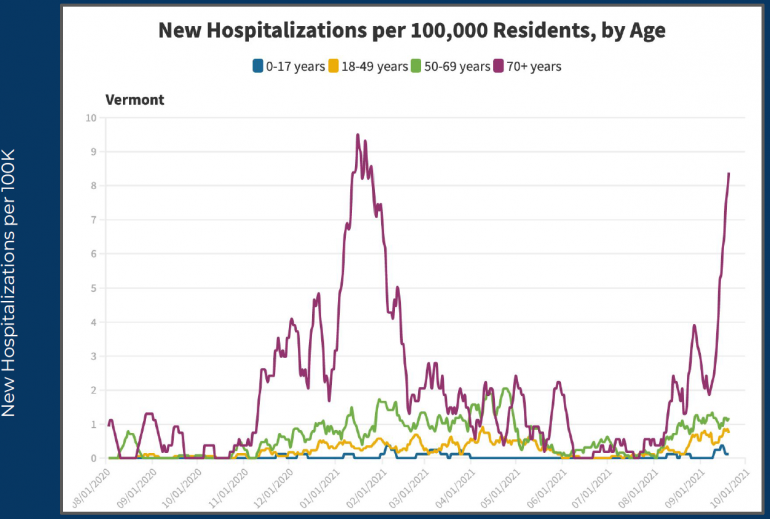
Vermont Business Magazine The Vermont Department of Health today reported 129 new cases of COVID-19 (90 Monday). While many regions of the country and world experienced a sharp increase and sharp decline of Delta variant cases in a 7-9 week window, Vermont is now into its 10th week and has shown a slower ascent and still no plateau in new cases.
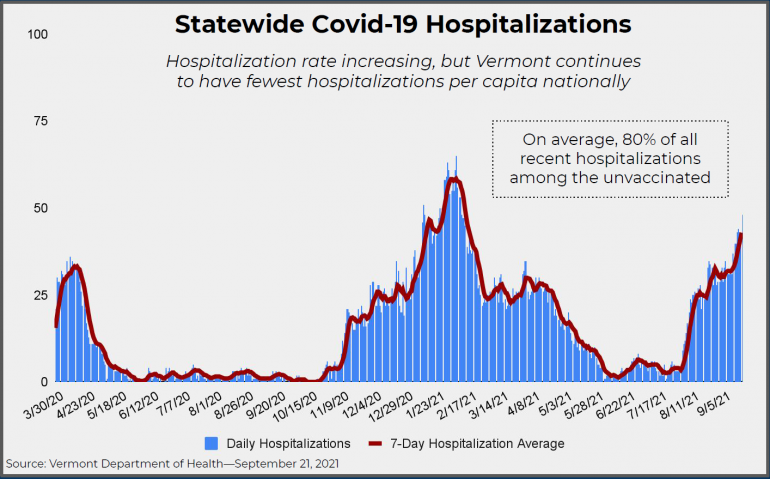
The VDH also reported today three more deaths, which now stand at 301 statewide. There are 48 people hospitalized (up two from yesterday) and 19 in the ICU (up five). Hospitalizations have been elevated by recent days, but below pandemic peaks. Vermont still has the lowest hospitalization, case count and fatality rate in the nation, and the highest full vaccination rate.
At his regular press briefing today, Governor Scott reiterated his message to Vermonters that we are now in "a pandemic of the unvaccinated." About 80 percent of hospital cases and ICU cases are of the unvaccinated, even though they represent fewer than 15 percent of the eligible population.
Nationally, COVID-19 has surpassed the death toll from the Spanish flu after World War I and is now the deadliest pandemic in US history, with 686,730 deaths.
 The governor added that he did not intend to reinstitute a State of Emergency. He said it would be bad public policy and the case counts do not warrant it, especially since the best way to fight the coronavirus is not by closing up the economy, but by getting vaccinated.
He did recommend wearing a mask indoors in crowded places. He also advised that all school districts should mandate mask wearing for students, teachers and staff.
As for schools, because of the incidence of COVID cases and the loss of in-person education, Education Secretary French is urging expanded surveillance testing in classrooms where a case might have been identified. If frequent testing turns up no further cases, then students do not have to be sent home and quarantine.
Some high schools, but not most, already have achieved an 80 percent vaccination rate, meaning only those who test positive for COVID need to isolate. However, the lower grades, where children are not eligible to get vaccinated, do not have that advantage. So he is urging testing be shifted to the lower grades.
The Education Agency has already begun a pilot program to send PCR test kits home, so enhance elementary school testing. The first schools to receive the kits will be spread out across the state. Results will be available within 72 hours.
The CDC is expected to give emergency approval for a lower-dose Pfizer vaccine to be administered to children 5-11 in October.
For those already eligible, a third Pfizer ("booster") shot could be available as early as next week, pending CDC approval. It is only for those who previously received a Pfizer dose and who are either over 65 or at a high risk for serious illness.
Still, Human Service Secretary Mike Smith said this would still represent about 113,000 Vermonters.
Health Commissioner Levine expects the pandemic will become an endemic virus, like the common cold eventually, with people getting an annual flu shot to combat it. He said COVID-19 will always be with us, but as more people build up immunities from the vaccine and/or contracting the virus, it will become less dangerous.
The state will also begin requiring all state employees who have not been vaccinated to wear a mask and get tested regularly. This is a mandate. Only one school in the state (Canaan) does not require masks. The governor would like to see not only all schools to require either vaccines and masking, but all public and private employers. This is expected to boost vaccination rates and lower infection rates.
The governor also announced today that the hotel housing program for the homeless will be extended (he called it a pause in terminating it) for another 30 days in order for all the various agencies to further coordinate a plan of action.
There are still 541 families in the program.
Speaker of the House Jill Krowinski issued the following statement following Governor Scott’s decision to extend the deadline for General Assistance Emergency Housing (GA), the program essential to housing people with disabilities, those experiencing homelessness and other vulnerable individuals:
“Leading up to the GA housing deadline, which would have forced more than 540 households to leave hotels and motels, legislators have received an outpouring of concern and frustration from our constituents and Vermonters across the state insisting upon an extension to keep families and individuals housed, as well as a better solution to this crisis. The administration, legislature, and our community advocates worked together last spring to create a plan for the future of the GA program, but it was a much different time in the pandemic. At this time, when we are seeing the Delta variant continue to impact communities in all 14 counties, it would be disastrous to put people in the precarious position of scrambling to find new living situations during a statewide housing shortage.
“I thank the Governor and his staff for making the important decision to extend the deadline for housing assistance and to give the Department for Children and Families and our community partners more time to identify housing solutions for those in need. As Vermonters, we have, and continue, to do our part to work together and find creative solutions to support each other and keep our communities healthy and safe throughout the pandemic. It is more critical than ever to think outside the box and look into any and all housing opportunities during the next 30 days.
“I firmly believe that it is important that we continue to monitor the situation as we approach the extension deadline, and further extend the deadline if we believe we need more time to create housing solutions. We know that we have the funds to support this population, and it is imperative that we remain nimble and innovative in the ways we transition our most vulnerable Vermonters to permanent housing with support services.
“Again, I thank the Governor for extending the emergency housing deadline for those most in need. We have the opportunity to make significant progress in developing long-term housing for those most in need, and working together, I know we can do it.”
Senate President Pro Tem Becca Balint issued the following statement following Governor Scott’s decision to extend the deadline for General Assistance Emergency Housing (GA), the program essential to housing people with disabilities, those experiencing homelessness, and other vulnerable individuals:
“I am relieved that the governor announced a 30-day extension for the GA Emergency Housing program. Hundreds of Vermonters literally have nowhere to go. If we end this program now with no additional planning, vulnerable Vermonters will be heading into the woods with tents. That’s the reality of the situation on the ground.
"When a compromise plan was put in place months ago, the stakeholders at the table didn’t know we’d be in the midst of an intense surge in Covid-19 cases. They didn’t know that the ongoing health crisis would impact our region’s housing to such an extent that we’d have virtually no housing available in many communities. It is not enough to offer extra money to these homeless Vermonters to find permanent housing if there is no housing available.
"This much-needed pause will give the work group a chance to explore other possible options. The landscape has changed, and the stakeholders and the administration all need to go back to square one and explore all avenues to keep people safely housed as we head into the colder weather.”
Scott said the program is not sustainable as is. He said the state still needs facilities and a plan for permanent housing. Plus, there is less capacity as the lodging establishments around the state prepare for the winter tourism season. And one of the major facilities used for the program during the pandemic (the Holiday Inn in South Burlington) is now closed for renovation.
Those who are able to find other housing outside the state hotel program can still get a one-time payment of $2,500 to help them move and pay things like a security deposit. There are also other ongoing financial assistance programs for low-income renters.
Governor Phil Scott Discusses Latest Covid-19 Trends
At his weekly press conference, Governor Phil Scott today delivered the following remarks.
Click here to view the full press conference, including additional remarks from Health Commissioner Mark Levine, MD, Education Secretary Dan French, Human Services Secretary Mike Smith, and the state’s weekly data and modeling presentation from Financial Regulation Commissioner Michael Pieciak.
To find out where to get a free, safe and effective COVID-19 vaccine today, visit healthvermont.gov/myvaccine.
Transcript of Governor Scott’s remarks:
Good afternoon. As you heard late last week, a technical glitch with an IT vendor delayed some case reporting for the days of September 9 through September 17. That issue has been resolved but some cases that should have been reported earlier were delayed and were instead reported throughout last week. So that does make our day-to-day case outlook a little murky, as you will hear from Commissioner Pieciak in a few minutes.
Regardless, we know we have had case counts in the 100s to 200s over the last week and our hospitalizations have ticked up slightly. However – and this is important because I’ve seen some misunderstanding here – hospitalizations are still below our peak. I went back to my notes and confirmed we had days in February where we were in the mid-60s.
What we also know is these upticks are being driven more and more by the unvaccinated, which account for about 80% of hospitalizations and 84% of those in the ICU. For example, yesterday, of the 47 in the hospital, 46 were adults and 35 of those adults are eligible to be vaccinated but are not.
We also see the gap between the vaccinated and unvaccinated widening when it comes to cases. And in recent weeks, around 75% of cases are among those age 18 and over.
As has been said before and I’ll say it again, this is now a pandemic of the unvaccinated – primarily unvaccinated adults who are eligible, and it is adults who are at the most risk of severe outcomes.
So, the most important step we can take as a state is to get as many Vermonters vaccinated as possible.
And if you’re still on the fence or just haven’t found the time, please look at this data and do some soul searching. Because vaccines are safe and effective and they’re the absolute best path – not just for yourself but for your family and friends and the rest of us – so we don’t move backwards or need new restrictions.
***
Now, I know there are some who would like to see more restrictions put in place, which I’ll remind you, would require a State of Emergency.
I’ll also remind you that broad restrictions had harmful impacts in other areas like people not addressing their healthcare needs, isolation of older family members, remote learning and business closures that put people out of work.
And I would like to make clear what we are doing right now:
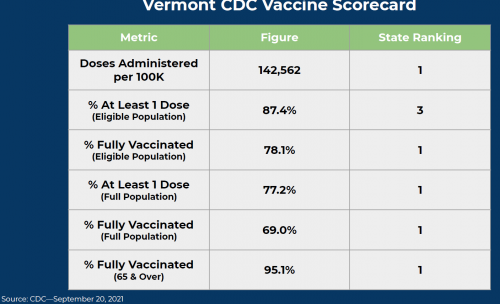
As our data shows, the vaccine is the best tool we have in the toolbox and is a gamechanger. From the beginning, we took quick action to vaccinate as many Vermonters as possible and, as a result, we have the most fully vaccinated population in the country at 78.1%. And 87.4% of those eligible have started vaccination.
And we aren’t done yet.
To set an example and in hopes of encouraging more to get vaccinated, we’ve implemented a policy effective this week that all state employees must either be vaccinated or wear a mask and test. Remember, we have about 8,000 state employees. I also continue to urge employers and schools to adopt a similar policy while we await more details on the President’s proposal for vaccine requirements.
On masking, we also have some measures in place.
First, every school but one has a masking requirement, which means we effectively have a mask mandate in schools.
Next, as we’ve discussed many times, if you are not vaccinated, you should absolutely wear a mask when indoors with people from outside your household. And you should think about other protective measures like avoiding crowds and getting tested. And, as the Health Department has recommended, while we are still seeing this Delta wave, vaccinated Vermonters should wear a mask when in crowded indoor settings.
We also continue to offer a lot of testing options, and while I know some are seeing delays – which we’re working on – the fact is we are still among the top five states in testing and are frequently at the very top. And we’re always looking for ways to make this process better and faster.
Now, I understand these are not state mandates, but they are actions that have an impact.
Again, for broad mandates I’d need to declare a state of emergency and the data still doesn’t support that step. What’s more, I do not think it is the right approach and my team has not recommended it.
We are not in the same place we were six months ago, and neither are Vermonters, who have been re-evaluating their risks because of the vaccine.
And we simply cannot be in a perpetual State of Emergency. It sets a dangerous precedent and would be an abuse of my authority, given that vaccines are proving to be so effective in protecting people.
***
The fact is COVID-19, like the flu, is here to stay. So, we need to use the tools we have and what we’ve learned to help people make smart decisions at the individual level.
Things like staying home when sick and getting tested if you think you could have been exposed, especially if you are planning to visit someone who is vulnerable, like an older relative or someone with a severe illness.
It also includes understanding who the most vulnerable are; who is actually at risk of having a severe case; and also how vaccines are significantly reducing risk – because they are.
For example, I know some continue to only look at case counts. And I get it. For many months before vaccines, cases were all we talked about. It was the most effective way to communicate the risk of hospitalizations, long term care outbreaks and deaths. But now, with vaccines, those rates are decreasing, which means risks are changing.
It’s clear we need to show how its changing so Vermonters have more information and can continue to do their part to protect those who are most vulnerable and make smart choices.
So, our team is currently looking to compare key pre-vaccine data points to our current situation to help Vermonters see how things are actually improving, even with Delta, because of the vaccines. And over the next several weeks, we will be sharing what we find with you.
Knowing this has always been a virus that most often harms senior citizens with underlying conditions and had a big impact on our long-term care facilities, we’ll be starting with a look at how outbreaks and outcomes have changed there, which Dr. Levine has discussed at these briefings in recent weeks.
While this is data we’ve looked at throughout the pandemic, our focus is on better comparing what we see today to what we saw before we had the protection of vaccines.
After we present the long-term care data we’ll present other updates, including more details on declining hospitalization and fatality rates, some more information on factors and conditions that make people vulnerable, and other useful information.
In the meantime, please get vaccinated, watch the health department guidance, and pay attention to what you are doing so we can get through this Delta wave and continue to move forward.
VDH: Vendor IT 'glitch' that delayed case reporting is resolved
The IT glitch discovered last Thursday has been resolved. The glitch caused a delay in reporting of cases since September 9, with cases too low and then seeming to spike. The cumulative number of cases, however, is unchanged.
But the recent surge in cases and deaths attributed to the Delta variant remain high. The Delta surge was expected to plateau by now in Vermont, as it has in other countries.
Vermont has the highest vaccination rate and the lowest hospitalization rate in the United States. At this time, VDH believes the IT issue has been resolved.
| Date positive result reported | Number of cases that would have been reported earlier without glitch | ||
| September 10 | 0 | ||
| September 11 | 8 | ||
| September 12 | 3 | ||
| September 13 | 80 | ||
| September 14 | 37 | ||
| September 15 | 109 | ||
| September 16 | 0 |
The Health Department tracks and monitors the time it takes from when specimens are collected for testing to when the results are reported to the department by the Broad Institute of MIT and Harvard. The glitch involved EllKay, an IT vendor working for Broad.
For the period of August 1 to September 15, the average turnaround time from specimen collection to reporting was 1.86 days. Review of the data from the past week showed a notable increase in the turnaround time that began with specimens collected on September 9. As announced at the Governor’s September 14 press briefing, the state began an investigation into the situation.
The Agency of Human Services, including the Health Department, and together with the Agency of Digital Services, are actively working to assess the impacts and monitor the situation.
EllKay is currently conducting a root cause analysis. Once that is done, we should have a better idea of the scope and its impact on case reporting over these days.
VDH will keep the public informed, including providing updated numbers, as we learn more.
Health officials reiterated that because the Delta variant passes from person to person so easily, it is especially important for everyone to follow these basic prevention steps:
- Get vaccinated as soon as you are eligible
- Wear a mask when in public indoor settings
- Stay home if you feel sick
- Get tested if you have any symptoms, may be a close contact, or have taken part in activities that could put you at risk, such as large gatherings
- Wash your hands regularly
In addition, people who do test positive, or think you might be a close contact of someone who did, can take action even before they hear from the Health Department. Visit healthvermont.gov/covid-19 so you can act right away to protect yourself and to prevent further spread.
Cases among children 5-14 continue to grow, as cases among the general Vermont population have declined (this age group is not yet available for a vaccination, though they could become eligible soon from the CDC).
Those who are fully vaccinated have seen case rates going down, while those who are eligible but not vaccinated or not fully vaccinated are seeing case rates and hospitalizations still increasing.
See full Department of Financial Regulation report HERE.
The young adult age bands from 18 to 29 continue to show the lowest rate of vaccination, despite college students achieving a 94.7 percent vaccination rate (all 16 institutions reporting with a total of 28,624 students).
In the 70-74-year-old age band, 100 percent of eligible Vermonters have been vaccinated. In all, according to the CDC, 87.4 percent of eligible Vermonters have been vaccinated, with 78.1 percent fully vaccinated.
Meanwhile, Secretary French is urging school staff to get vaccinated to reduce COVID-19 transmission. He said Tuesday that COVID-19 in schools is a reflection of the virus in the community. Children under 12 are not yet eligible for any COVID vaccine, leaving them susceptible to catching the disease, and then transmitting it.
He added that social distancing is not a solution, as sufficient indoor capacity is not available in most schools. He also said that in-person education is the best way to meet educational and social/emotional goals, especially for younger children.
Wearing a mask has been an effective way to reduce the chance of transmission and state guidance urges all school districts to require masks and to continue in-person education.
French said the evidence from last year was that remote learning resulted in poor educational attainment and a loss of social connections for students.
He said surveillance testing and contact tracing would continue to be deployed statewide to try and stay ahead of outbreaks.

COVID-19 Fall Contact Tracing Process
PreK-12 schools will conduct internal contact tracing investigations when a student or staff was present in school or was at a school event while infectious. Schools may learn of these school exposures when a family or staff notifies school administrators directly or when the Health Department identifies an exposure during contact tracing and alerts the school. When schools learn of an exposure, schools will:
1. Verify the student or staff was at school while infectious.
2. Identify all vaccinated and unvaccinated close contacts in the school setting.
3. Meet with the Health Department as needed to review the situation, conduct an exposure risk assessment and discuss close contact determinations.
4. Notify close contacts at the school of their exposure using the “quarantine letter” provided by the Health Department and provide testing guidance as needed. This letter includes guidance for both vaccinated and unvaccinated close contacts. The Health Department will not follow up with close contacts that the school notifies, unless there is a need identified by the school for specific scenarios (e.g. need for translation services, family or staff unwilling to share vaccination status with school, etc.).
5. Provide a line list to the Health Department with information about all vaccinated and unvaccinated close contacts identified.
Strategies to Improve the Efficiency and Effectiveness of the Contact Tracing Process
The purpose of these strategies is to help strike an operational balance between public health and educational goals: we want to keep students safe from COVID-19 but also maximize their ability to attend school.
One approach to striking this balance is to identify close contacts as quickly as possible. Another approach is to recommend testing instead of quarantining when the exposure status is unknown.
Determination of Vaccination Status
Under CDC and Vermont guidelines, vaccinated close contacts who are asymptomatic are not required to quarantine. Schools may use local vaccination status information to determine if individuals are vaccinated. The process for obtaining vaccination status information was outlined in the memo Calculating A School's Vaccination Rate. Schools should ensure they obtain proof of vaccination as outlined in this memo.
Recess
The risks to students outside are far less than when they are indoors. A school should notify families of a potential exposure during recess/outdoor time and make testing recommendations for 3-5 days after the potential exposure, but not put students in quarantine unless clear close contact has been identified. A template letter for these potential exposures is available on the Health Department’s PreK-12 Schools page. If teachers/playground monitors can easily identify close contacts (Maggie and Jo always play together closely), those students should be put in quarantine.
Lunchroom
Whole lunchrooms should not be automatically quarantined. A risk assessment should include physical proximity to a suspected case. Anyone within 6 feet of an infectious person for 15 minutes or more is considered a close contact. Seating charts for lunchrooms will minimize the number of students who are identified as close contacts. When possible, classroom groups should be maintained during lunchtime.
Siblings
A sibling to a close contact is not a close contact just because they are a sibling. In these situations, a sibling should not be quarantined unless identified as a close contact themselves to a verified case.
Music
Review the COVID-19 Contact Tracing Framework for High-Risk Activities in PreK-12 for an understanding of the relative risks involved in music activities, and for understanding how the size of the room and the distance between musicians can impact the identification of close contacts. Larger rooms such as auditoriums can minimize close contacts.
School Buses
Entire buses of students should not be automatically quarantined. A risk assessment should include physical proximity to a case on a bus, and to what extent there was consistency in mask wearing while riding. Anyone within 6 feet of an infectious person for 15 minutes or more is considered a close contact. Having seating charts for buses will minimize the number of students who are identified as close contacts. Opening bus windows in accordance with prior year guidance will help mitigate transmission.
Seating Charts
Classroom seating charts should be maintained for all instructional spaces in classrooms where students are under 12 years old and updated on a weekly basis.
Recommendations for Communications
Protecting the medical privacy of students and staff is important. These recommendations are intended to balance the needs for privacy protection and clear, communications, when there is a positive COVID-19 case in your school community:
• When communicating with your school community, take steps to ensure the positive person’s identify is protected.
• Do not use names OR any other information that could be identifying including the positive person’s role in the facility, information about the activities the positive person participates in, whether the positive person has siblings, etc.
• Consider using the phrase “a member of our learning community tested positive” when communicating with the school community.
School Mask Recommendations
COVID-19 Prevention Strategies for the Opening of Schools
Stay Home When Sick
School health personnel should use the COVID-19 in Pediatric Patients Flow Chart (Pre-K – Grade 12) Triage, Evaluation, Testing, and Return to School in partnership with pediatric providers and families to guide medical decision-making.
Students and staff who are sick should stay home. This is the most important prevention message.
All students and staff should stay home if they:
• Show symptoms of COVID-19;
• Have a fever (temperature greater than 100.4°F); or
• Are currently in quarantine due to close contact with an individual with COVID-19 or in isolation due to testing positive for COVID-19.
If symptoms begin while at school, the student or staff member should be sent home as soon as possible, and the individual should be isolated from other staff and students until they can go home.
Masks
To allow school districts time to calculate the percentage of currently eligible students who have received two doses of a two-dose vaccine, schools should require universal masking for all students and staff when indoors until October 4, 2021. Currently, all Vermonters ages 12 and older are eligible to be vaccinated.
After October 4, 2021, masks should no longer be required for all those eligible for vaccination when the vaccination rate (two doses of a two-dose vaccine) among students is equal to or greater than 80% of the school’s currently eligible population.
Masks should be required indoors for students younger than 12, who are not eligible to be vaccinated at this time.
Masks, when required, may be removed when needed for instructional or operational purposes.
Masks are currently required for all passengers on buses per federal regulation, regardless of age or vaccination status.
Masks should not be required outdoors.
Guidance will be updated when vaccine eligibility expands.
Surveillance Testing and Contact Tracing
Surveillance testing will be offered to schools for both students and staff.
Schools should continue to participate in contact tracing as requested by the Health Department.
More information on what to do when there is a positive COVID-19 case in PreK-12 schools, childcare centers, camps and out of school programs and contact tracing can be found on the Vermont Department of Health website.
Today's vaccination and COVID-19 case dashboards are below.
Governor Scott has announced a series of walk-in vaccination clinics that will be open at schools and other sites across Vermont this week for anyone age 12 or older. See full list below.
Just walk-in or visit www.healthvermont.gov/MyVaccine to make an appointment. You can also call 855-722-7878.
Human Services Secretary Mike Smith said that there are still many testing sites around the state, but urged people to make an appointment, preferably online, to avoid wait times.
The vaccination sites listed below also offer additional doses for those currently eligible based on guidance issued by the Centers for Disease Control and Prevention. Some primary care providers and pharmacies are also offering additional doses. Check with your doctor or pharmacist for more information.
Dr Levine expects more information from the FDA soon on those "third doses" for the general population soon. The FDA advisory panel is meeting September 17 on whether to recommend the Pfizer vaccine for the third (“booster”) dose of Comirnaty (COVID-19 Vaccine, mRNA) in individuals 16 years of age and older. The Moderna and Johnson & Johnson vaccine boosters are still in development.
Dr Levine also expects positive news soon on vaccines for children under 12, who are all currently ineligible for any COVID-19 vaccine.
Vaccination Clinics
Governor Phil Scott also announced today a series of walk-in vaccination clinics that will be open at schools and other sites across Vermont this week for anyone age 12 or older. Just walk-in or visit www.healthvermont.gov/MyVaccine to make an appointment. You can also call 855-722-7878.
The vaccination sites listed below also offer additional doses for those currently eligible based on guidance issued by the Centers for Disease Control and Prevention. Some primary care providers and pharmacies are also offering additional doses. Check with your doctor or pharmacist for more information.
Here are the vaccination sites available this week:
Hazen Union High School, 126 Hazen Union Drive, Hardwick
Manchester Elementary, 80 Memorial Ave, Manchester
Springfield Town Hall (Selectmen’s Halls), 96 Main Street, Springfield
Wednesday, September 22
Cavendish Fire Department, 2153 Main Street, Cavendish
1311 Barre Montpelier Road, Berlin
Waterbury Ambulance, 1727 Guptil Road, Waterbury Center
North Country Union High School, 209 Veterans Ave, Newport
St. Albans City Elementary School, 29 Bellows Street, St. Albans
Thursday, September 23
Barre Town EMS, 4 McLaughlin Road, East Barre
Health Care & Rehabilitation Services Hartford, 49 School Street, Hartford
Burr and Burton Academy, 57 Seminary Ave, Manchester
North Country Junior High School, 57 Junior High Drive, Newport
Friday, September 24
1311 Barre Montpelier Road, Berlin
Newport Waterfront Plaza, Newport
Waterbury Ambulance, 1727 Guptil Road, Waterbury Center
Champlain Valley Union High School, 369 CVU Road, Hinesburg
Morristown Elementary, 548 Park Street, Morristown
Springfield High School, 303 South Street, Springfield
Saturday, September 25
Morefest at the Moretown Elementary School, 940 VT Route 100-B, Moretown
New England Street Food Festival at the Kampfires Campground, 792 U.S. Route 5, Dummerston
Canaan High School, 99 School Street, Canaan
Grand Isle Elementary School, 224 U.S. Route 2, Grand Isle
Sunday, September 26
Ascutney Outdoor Club, 499 Ski Tow Road, West Windsor
Lake Region High School, 317 Lake Region Road, Orleans
Spaulding High School, 155 Ayers Street, Barre
Monday, September 27
Barre Town EMS, 4 McLaughlin Road, East Barre
Rescue Inc. Division 1 Station, 541 Canal Street, Brattleboro
Academy School, 860 Western Ave, Brattleboro
Edmunds Middle School, 275 Main Street, Burlington
The EDGE Sports & Fitness, 142 West Twin Oaks Terrace, South Burlington
More ways to get your free vaccine:
Make an appointment for a free vaccine
You can also walk-in at CVS, Hannaford Food and Drug, Walmart, Walgreens, Price Chopper/Market 32, Rite Aid, Shaw’s Supermarket, or Costco or get an appointment with Kinney Drugs, CVS, Walgreens, Northfield Pharmacy, or UVMMC Outpatient Pharmacies.
| DATE | SITE | TIME | TOWN | VACCINE TYPE |
|---|---|---|---|---|
| 09/28 | School Clinic: Hartford High School 37 Highland Ave. |
9:00 am - 12:00 pm | White River Junction | Pfizer (first or second dose) |
| 09/28 | School Clinic: Milton Elementary School 42 Herrick Ave. |
4:00 pm - 8:00 pm | Milton | Pfizer (first or second dose) |
| 09/29 | EMS Clinic 1311 Barre Montpelier Rd. (behind Burger King) |
2:00 pm - 7:00 pm | Berlin | Pfizer (first or second dose) |
| 09/29 | EMS Clinic Waterbury Ambulance 1727 Guptil Rd. |
1:00 pm - 7:00 pm | Waterbury Center | Pfizer (first or second dose) |
| 09/29 | School Clinic: Mount Mansfield Union High School 211 Browns Trace Rd. |
9:00 am - 5:00 pm | Jericho | Pfizer (first or second dose) |
| 09/29 | School Clinic: Colchester Middle School 425 Blakely Rd. |
9:00 am - 5:00 pm | Colchester | Pfizer (first or second dose) |
| 09/30 | School Clinic: Essex High School 2 Educational Dr. |
9:00 am - 5:00 pm | Essex Junction | Pfizer (first or second dose) |
| 09/30 | School Clinic: Rutland High School 22 Stratton Rd. |
9:00 am - 5:00 pm | Rutland | Pfizer (first or second dose) |
| 10/01 | EMS Clinic 1311 Barre Montpelier Rd. (behind Burger King) |
2:00 pm - 7:00 pm | Berlin | Pfizer (first or second dose) |
| 10/01 | EMS Clinic Waterbury Ambulance 1727 Guptil Rd. |
9:00 am - 6:00 pm | Waterbury Center | Pfizer (first or second dose) |
| 10/01 | School Clinic: Mt. Abraham Union High School 220 Airport Dr. |
2:00 pm - 8:00 pm | Bristol | Pfizer (first or second dose) |
| 10/01 | School Clinic: Bellows Falls Union High School 406 High School Rd. |
2:00 pm - 8:00 pm | Westminster | Pfizer (first or second dose) |
| 10/04 | School Clinic: Woodstock High School 100 Amsden Way |
9:00 am - 5:00 pm | Woodstock | Pfizer (first or second dose) |
| 10/04 | School Clinic: Randolph Union High School 15 Forest St. |
9:00 am - 5:00 pm | Randolph | Pfizer (first or second dose) |
| 10/04 | School Clinic: Twin Valley Middle and High School 4299 VT-100 |
9:00 am - 5:00 pm | Whitingham | Pfizer (first or second dose) |
| 10/05 | School Clinic: Green Mountain Tech Center 738 VT-15 |
9:00 am - 5:00 pm | Hyde Park | Pfizer (first or second dose) |
| 10/06 | School Clinic: Oxbow High School 36 Oxbow Dr. |
9:00 am - 5:00 pm | Bradford | Pfizer (first or second dose) |
| 10/06 | School Clinic: Brattleboro Union High School 131 Fairground Rd. |
9:00 am - 5:00 pm | Brattleboro | Pfizer (first or second dose) |
| 10/06 | School Clinic: Bellows Free Academy Fairfax 75 Hunt St. |
9:00 am - 5:00 pm | Fairfax | Pfizer (first or second dose) |
| 10/07 | School Clinic: Bellows Free Academy Fairfax 75 Hunt St. |
9:00 am - 5:00 pm | Fairfax | Pfizer (first or second dose) |
| 10/07 | School Clinic: South Burlington High School 550 Dorset St. |
9:00 am - 5:00 pm | S. Burlington | Pfizer (first or second dose) |
| 10/08 | School Clinic: Middlebury High School 73 Charles Ave. |
9:00 am - 5:00 pm | Middlebury | Pfizer (first or second dose) |
| 10/08 | School Clinic: Blue Mountain High School 2420 US-302 |
2:00 pm - 8:00 pm | Wells River | Pfizer (first or second dose) |
| 10/08 | School Clinic: St. Johnsbury Academy 1000 Main St. |
12:00 pm - 4:00 pm | St. Johnsbury | Pfizer (first or second dose) |
| 10/09 | School Clinic: Richford Junior/Senior High School 1 Corliss Heights |
2:00 pm - 8:00 pm | Richford | Pfizer (first or second dose) |
| 10/09 | Indigenous Peoples' Day Rocks! Mayo Events Field 80 Weeks Hill Rd., Quiet Path Endpoint |
10:30 am - 1:00 pm | Stowe | Johnson & Johnson (single dose) |
| 10/09 | School Clinic: St. Johnsbury Academy 1000 Main St. |
12:00 pm - 4:00 pm | St. Johnsbury | Pfizer (first or second dose) |
| 10/09 | School Clinic: U32 High School 930 Gallison Hill Rd. |
2:00 pm - 8:00 pm | Montpelier | Pfizer (first or second dose) |
| 10/11 | School Clinic: Missisquoi Valley Union High School 175 Thunderbird Dr. |
9:00 am - 2:00 pm | Swanton | Pfizer (first or second dose) |
Vaccination & COVID-19 Dashboards