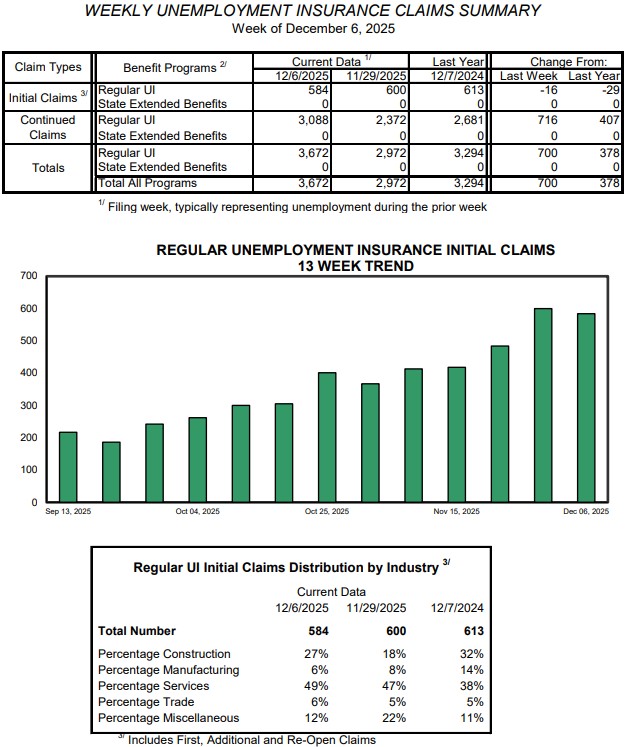
by Timothy McQuiston, Vermont Business Magazine Vermont weekly unemployment claims are at their usual and relatively high level for the holiday season. For the week ending December 6, 2025, new claims were 584 and have steadily increased since mid-September. New claims were down 16 from the week before and down 29 from last year at this time. Claims were 186 in September. Claims, which tend to be lowest in the summer, were 181 at the end of September 2024. Claims tend to rise and fall around the holidays with temporary work hires and layoffs.
Meanwhile, the Federal Reservice Bank lowered interest rates as expected 25 basis points, in a split vote, with one Trump appointee calling for 50 basis points and two others voting for no change. Employment data indicates weakness, as inflation fell one-tenth to 2.8%. While the inflation mark is higher than the 2.0% Fed target, Fed governors appear to have weighed the economic uncertainty greater than the inflation level (the Fed raised rates seven times in 2022 from 0.25% to 4.5% to combat spiking inflation while the underlying economy remained strong; the Fed could decide that the reverse is the case now and cut rates).
Adding to the uncertainty mix, Fed Chair Jerome Powell said the economy was relatively strong, which would have suggested that the rate not change given the inflation number. Powell's term ends early next year. The cut decreased the Fed’s federal funds rate down to a range of 3.50% to 3.75%, the lowest it has been since 2022. There is general consensus that the rate will not come down at the next meeting. The stock market at first jumped at the news and the Dow surged, before falling back today as AI values fell.
See below.
In Vermont for the weekly labor UI claims report, manufacturing accounted for 6% of the total, down 2 points from the previous week. Manufacturing overall has become a smaller part of the Vermont economy over the last 25 years and that trend appears to be continuing. The Service industry, which typically accounts for the most claims, last week reported 49% from the previous week, up 2 points. Construction was 27%, up 9 points.
For the week, Vermont total unemployment insurance claims were 3,672 (up 700 for the week and up 378 from this time last year).
According to the US Department of Labor, for the week ending December 6, the advance figure for seasonally adjusted initial claims was 236,000, an increase of 44,000 from the previous week's revised level. The previous week's level was revised up by 1,000 from 191,000 to 192,000. The 4-week moving average was 216,750, an increase of 2,000 from the previous week's unrevised average of 214,750.
Reuters reported that the number of Americans filing new applications for unemployment benefits increased by the most in nearly 4-1/2 years last week, but the surge likely does not suggest a material weakening in labor market conditions, as the claims data are volatile around this time of year. The larger-than-expected rise in initial weekly jobless claims reported by the USDOL reversed the sharp drop in the prior week, which had pushed filings to a three-year low.
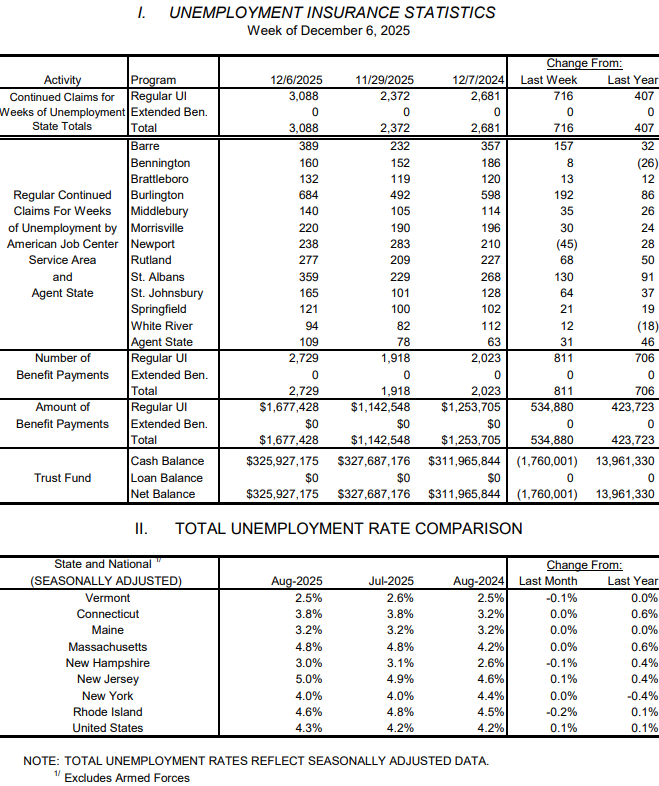
The Vermont Unemployment Trust Fund is well capitalized. As of the most recent data, there was $327.7 million in the Trust Fund, down nearly $1 million from the previous week (as claims are paid out on one side, employers are contributing to the fund on the other). The pre-pandemic Trust Fund balance on March 1, 2020, was $506.2 million.
The US DOL has resumed collecting labor information following the end of the government shutdown.
Vermont’s unemployment rate held at 2.5% in September as numbers sour

The Vermont Department of Labor on Thursday reported the seasonally adjusted unemployment rate for September 2025 was 2.5%. This reflects no change from August’s revised estimate. However, the Labor and Employment indicators both fell.
Vermont has the second lowest rate in the nation, tied with Hawaii and five-tenths below South Dakota. California is highest at 5.6%. The comparable United States rate in September was 4.4 percent, an increase of one-tenth of one percentage point from the revised August estimate.
The civilian labor force participation rate was 64.4 percent in September, a decrease of two-tenths of one percentage point from the prior month’s revised estimate.
The government shutdown from October 1 to November 12, 2025, the longest in U.S. history, disrupted labor data accrual.
Markets
The Dow, S&P and NASDAQ finished the week on a sour note with notable losses despite the Fed cut on December 10. The S&P was down (-1.07%) to 6,827.41, the Dow was down (-0.51%) to 48,458.05-245.96 and the always jittery NASDAQ was down (-1.69%) to 23,195.169.
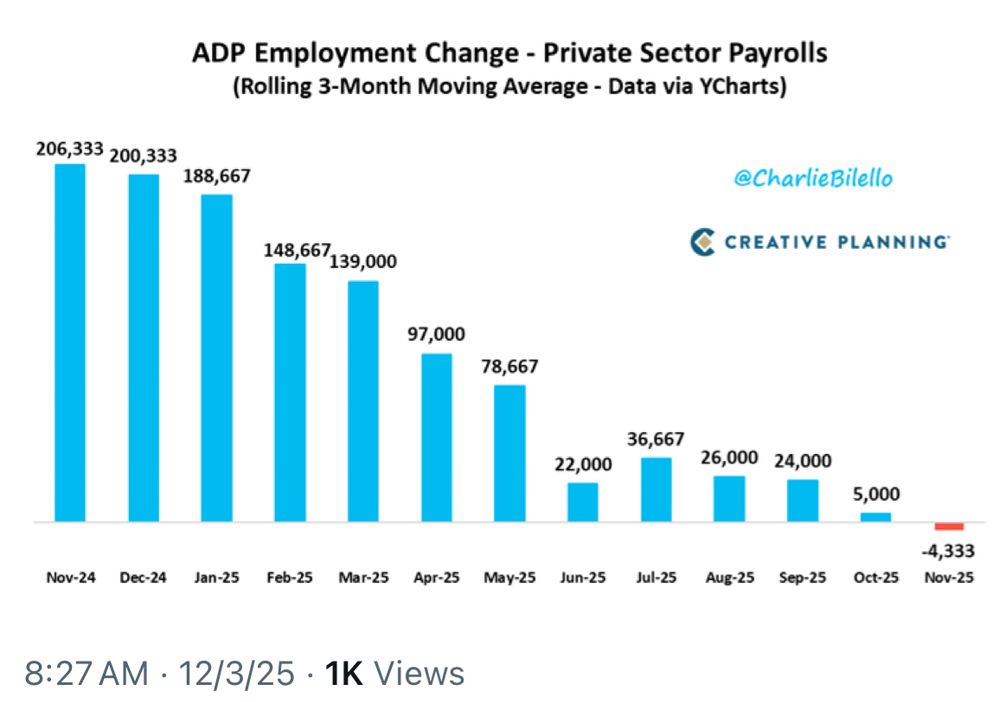
Investors focused on a report from job placement firm Challenger, Gray & Christmas showing announced job cuts in November from U.S. employers moved further ahead of 1 million for the year as corporate restructuring, artificial intelligence and tariffs helped pare job rolls. On Wednesday, numbers from ADP revealed a surprising slump in private payrolls, "The US lost an average of 4k private-sector jobs per month over the last 3 months (ADP data), the first 3-month decline since the 2020 recession.”
Mounting signs that the labor market is softening has led Wall Street to be convinced the Fed will cut rates a quarter percentage point at its December 10 meeting, the last of the year. Markets are pricing in an 89% chance of a cut next Wednesday, far higher than just a couple weeks ago, according to the CME FedWatch tool.
To support vital journalism, access our archives and get unique features like our award-winning profiles, Book of Lists & Business-to-Business Directory, subscribe HERE!