by Timothy McQuiston, Vermont Business Magazine Today, the Vermont Department of Labor reported the seasonally adjusted unemployment rate for September 2025 was 2.5%. This reflects no change from August’s revised estimate. However, the Labor and Employment indicators both fell.
Vermont has the second lowest rate in the nation, tied with Hawaii and five-tenths below South Dakota. California is highest at 5.6%. See data tables below.
The civilian labor force participation rate was 64.4 percent in September, a decrease of two-tenths of one percentage point from the prior month’s revised estimate.
The comparable United States rate in September was 4.4 percent, an increase of one-tenth of one percentage point from the revised August estimate.
The government shutdown from October 1 to November 12, 2025, the longest in U.S. history, disrupted labor data accrual.
Commissioner’s Message
“Following the end of the federal shutdown, the monthly data releases for Vermont’s labor market can resume. This release covers data for September 2025, and additional releases for the remaining months of 2025 will be issued in January 2026.
“In the September data, the household survey shows continuing downward pressure on the Vermont labor force,” said Kendal Smith, Vermont Department of Labor Commissioner. “The Department is continuing its ongoing workforce development and training activities statewide. These include services for job seekers, such as assistance with résumé preparation and interview skills, as well as services for employers, including hosting job fairs and screening candidates. Recently, the Department hosted a successful statewide part-time job fair that connected 230 jobseekers with over 30 employers representing retail, logistics, healthcare, manufacturing, food service and more, and we will be offering other such activities in the New Year.”
At the governor’s press conference on Wednesday, Administration Secretary Sarah Clark said that the state’s return-to-work order for state employees does not appear to have led to more resignations, as numbers are actually fewer than last year. Also, the state is experiencing fewer resignations than expected. All this suggests that people are hanging onto their jobs (“job hugging”), which is also indicative of national data across industries. Also on Wednesday the Federal Reserve Bank lowered interest rates by 25 basis points (0.25%) in response to a softening job market, while GDP is expected to grow.
The seasonally adjusted Vermont data for September show the Vermont civilian labor force decreased by 651 from the prior month’s revised estimate (see Table 1). The number of employed persons decreased by 634 and the number of unemployed persons decreased by 17. No changes were statistically significant in the seasonally adjusted series.
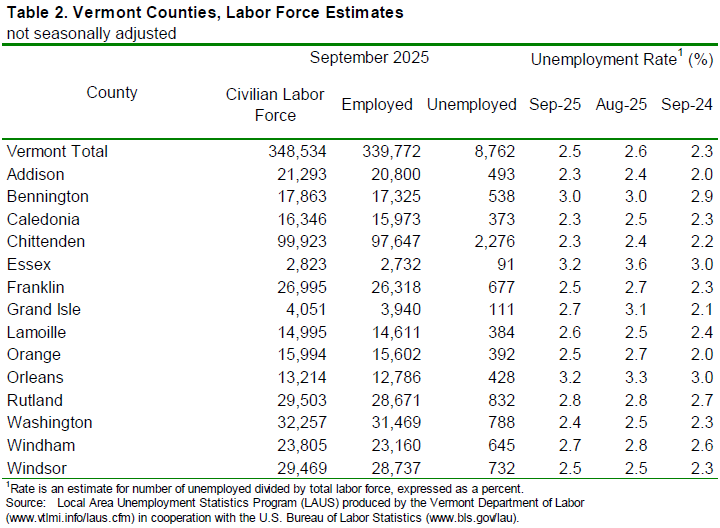
The September unemployment rates for Vermont’s 14 counties ranged from 2.3 percent in Addison, Caledonia, and Chittenden Counties to 3.2 percent in Essex and Orleans Counties (note: county unemployment rates are not seasonally-adjusted – see Table 2). For comparison, the September unadjusted unemployment rate for Vermont was 2.5 percent, a decrease of one-tenth of one percentage point from the revised unadjusted August level and an increase of two-tenths of one percentage point from a year ago.
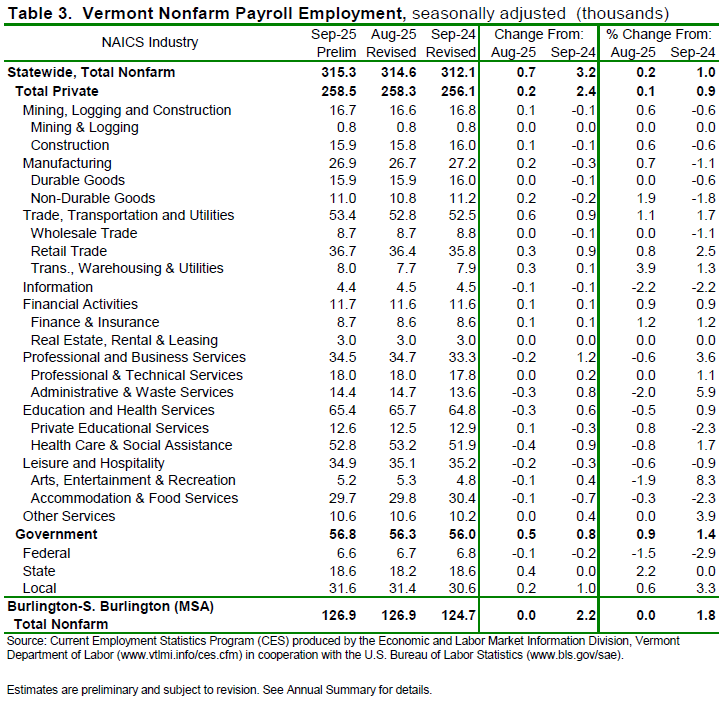
Seasonally Adjusted (Table 3)
The seasonally adjusted data for September reported an increase of 700 jobs from the revised August data. There was an increase of 500 jobs between the preliminary and the revised August estimates due to the inclusion of more data. The seasonally adjusted over-the-month changes in September varied at the industry level.
The industries with a notable increase were: Transportation, Warehousing, and Utilities (+300 jobs or +3.9%), State Government (+400 jobs or +2.2%), and Non-Durable Goods Manufacturing (+200 jobs or +1.9%). The industry with a notable decrease was Administrative & Waste Services (-300 jobs or -2.0%).
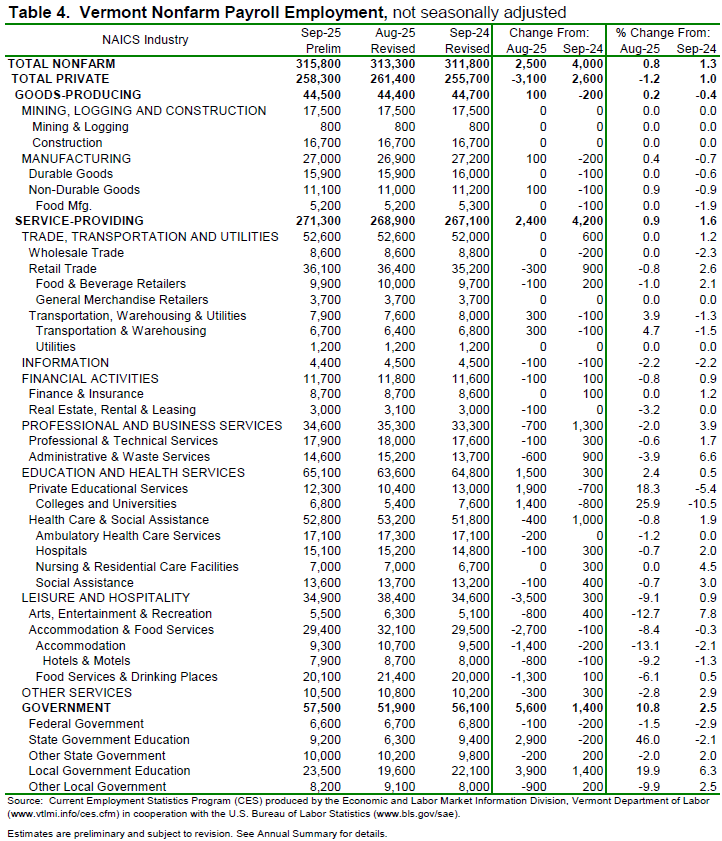
Not-Seasonally-Adjusted (Table 4)
The preliminary ‘not-seasonally-adjusted’ jobs estimates for September showed an increase of 2,500 jobs when compared to the revised August numbers. As with the seasonally adjusted data, this over-the-month change is from the revised August numbers which experienced an increase of 700 jobs from the preliminary estimates.
The broader economic picture can be seen by focusing on the over-the-year changes in this data series. As detailed in the preliminary not-seasonally-adjusted September data, Total Private industries increased by 2,600 jobs (+1.0%) over the year and Government (including public education) employment increased by 1,400 jobs (+2.5%) in the past year.
The Unemployment and Jobs Reports for October and November do not have a release date at this time; please visit https://www.vtlmi.info/ for latest information.
BLS note on LAUS geography and data changes in 2025: https://www.bls.gov/lau/geography-and-data-changes-in-2025.htm
Unemployment Rates for States
| State | September 2025 rate | Rank |
|---|---|---|
|
South Dakota |
2.0 | 1 |
|
Hawaii |
2.5 | 2 |
|
Vermont |
2.5 | 2 |
|
North Dakota |
2.6 | 4 |
|
Alabama |
2.8 | 5 |
|
Montana |
3.0 | 6 |
|
Nebraska |
3.0 | 6 |
|
New Hampshire |
3.0 | 6 |
|
Wisconsin |
3.1 | 9 |
|
Maine |
3.2 | 10 |
|
Oklahoma |
3.2 | 10 |
|
Wyoming |
3.3 | 12 |
|
Georgia |
3.4 | 13 |
|
Utah |
3.4 | 13 |
|
Virginia |
3.5 | 15 |
|
Tennessee |
3.6 | 16 |
|
Idaho |
3.7 | 17 |
|
Indiana |
3.7 | 17 |
|
Iowa |
3.7 | 17 |
|
Minnesota |
3.7 | 17 |
|
North Carolina |
3.7 | 17 |
|
Connecticut |
3.8 | 22 |
|
Kansas |
3.8 | 22 |
|
Maryland |
3.8 | 22 |
|
Mississippi |
3.8 | 22 |
|
Arkansas |
3.9 | 26 |
|
Florida |
3.9 | 26 |
|
West Virginia |
4.0 | 28 |
|
Colorado |
4.1 | 29 |
|
Missouri |
4.1 | 29 |
|
New Mexico |
4.1 | 29 |
|
Pennsylvania |
4.1 | 29 |
|
Texas |
4.1 | 29 |
|
Arizona |
4.2 | 34 |
|
New York |
4.2 | 34 |
|
Illinois |
4.4 | 36 |
|
Louisiana |
4.4 | 36 |
|
South Carolina |
4.4 | 36 |
|
Delaware |
4.5 | 39 |
|
Rhode Island |
4.5 | 39 |
|
Washington |
4.5 | 39 |
|
Alaska |
4.7 | 42 |
|
Kentucky |
4.7 | 42 |
|
Massachusetts |
4.7 | 42 |
|
Ohio |
4.8 | 45 |
|
Michigan |
5.1 | 46 |
|
New Jersey |
5.2 | 47 |
|
Oregon |
5.2 | 47 |
|
Nevada |
5.3 | 49 |
|
California |
5.6 | 50 |
|
District of Columbia |
6.2 | 51 |
|
Note: Rates shown are a percentage of the labor force. Data refer to place of residence. |
||
Last Modified Date: December 11, 2025
To support vital journalism, access our archives and get unique features like our award-winning profiles, Book of Lists & Business-to-Business Directory, subscribe HERE!