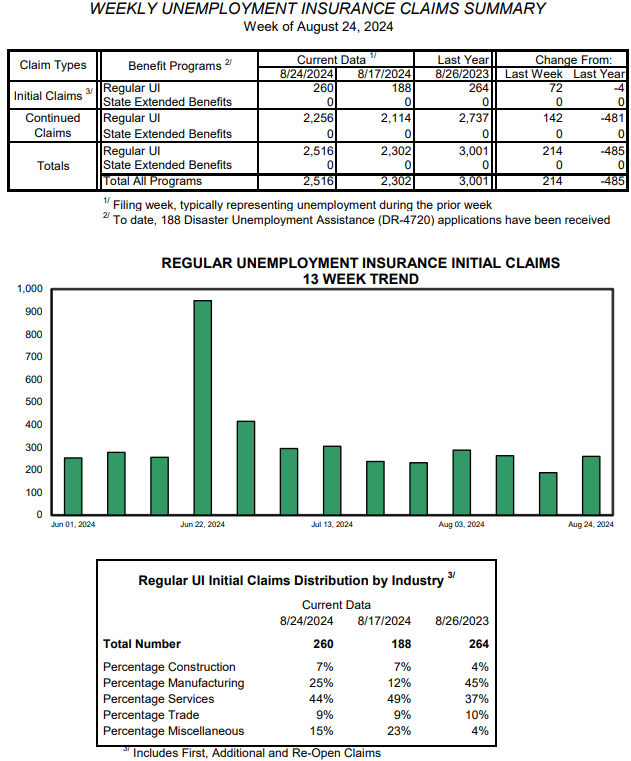
by Timothy McQuiston, Vermont Business Magazine Weekly unemployment claims increased last week after falling to their lowest levels since before the pandemic the week before. For the week ending August 24, 2024, new claims were 260, which is a typical of summer low.
Meanwhile, unemployment claims and hiring have stalled nationally, and the stock market recovered after stumbling as the Federal Reserve Bank decided not to lower interest rates in early August. The Fed Chair Jerome Powell indicated last week that the time has come to cut rates as employment nationwide has slowed.
In Vermont, the Service industry accounts for the most claims this week with 44%, down from 49%. Manufacturing accounted for 25% of claims, up from 12%.
See tables below.
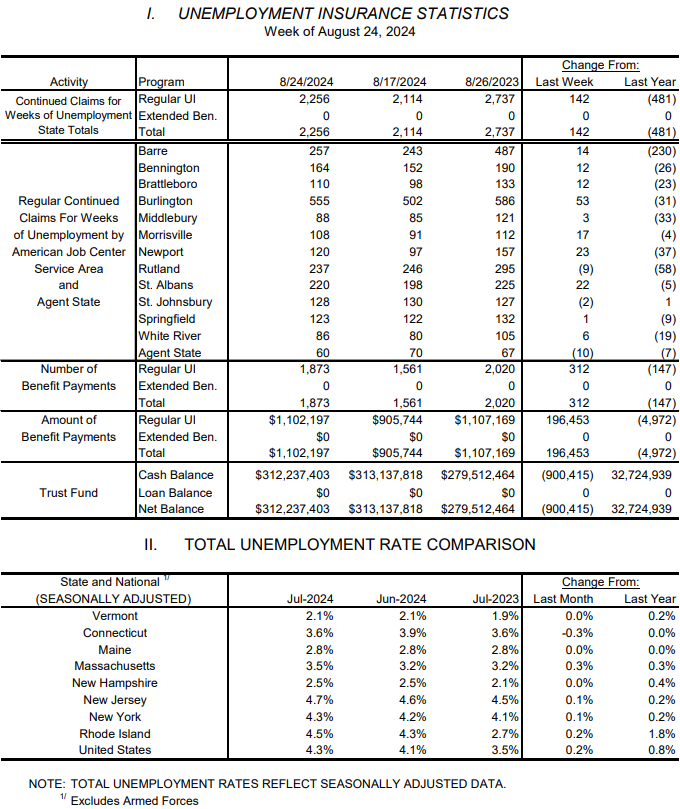
For the week, initial unemployment insurance claims were up 72 for the week and down 4 from this time last year. Meanwhile, the state unemployment rate remains near historic low levels as employment and the labor force have increased (2.1 percent in July 2024).
Vermont has the second lowest jobless rate in the nation. South Dakota is lowest at 2.0 percent and Nevada is highest at 5.4 percent.
The comparable United States rate in June was 4.3 percent, an increase of one-tenth of one percentage point from the revised May estimate.
The civilian labor force participation rate was 65.7 percent in July, no change from June’s revised estimate.
For new and continuing UI claims, there were a total of 2,516 claims, up 214 from the week before and 485 fewer than last year.
USDOL approves disaster unemployment assistance benefits for Vermonters in disaster areas
In the week ending August 24, the advance figure for seasonally adjusted initial claims was 231,000, a decrease of 2,000 from the previous week's revised level. The previous week's level was revised up by 1,000 from 232,000 to 233,000. The 4-week moving average was 231,500, a decrease of 4,750 from the previous week's revised average. The previous week's average was revised up by 250 from 236,000 to 236,250.
Job growth has softened but layoffs have not increased. Meanwhile, inflation has fallen and corporate profits and the stock markets have rebounded. The Dow Industrial Average is at its historic high and the S&P 500 has posted its fourth consecutive positive month.
For all that, and with inflation "ebbing," the Federal Reserve is expected to cut interest rates in September after declining to do so July 31, which disappointed investors. However, with renewed positive results, the Fed cut rates only by 25 basis points instead of 50 (or one-half percent. The Fed had raised rates by 525 basis points in 2022 and 2023 up to 5.5 percent to offset inflation).
The Vermont Unemployment Trust Fund is well capitalized. As of last week, there was $312.2 million in the Trust Fund, down $900,000 for the week (as claims are paid out on one side, employers are contributing to the fund on the other). The pre-pandemic Trust Fund balance on March 1, 2020, was $506.2 million.
To support vital journalism, access our archives and get unique features like our award-winning profiles, Book of Lists & Business-to-Business Directory, subscribe HERE!