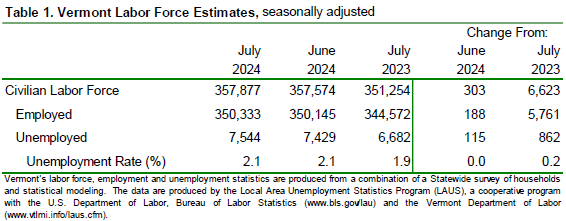
by Timothy McQuiston, Vermont Business Magazine Today, the Vermont Department of Labor released data on the Vermont economy for the time period covering July 2024. According to household data, the seasonally adjusted statewide unemployment rate for July was 2.1 percent. This reflects no change from the prior month’s revised estimate. The civilian labor force participation rate was 65.7 percent in July, no change from the prior month’s revised estimate. Vermont has the second lowest jobless rate in the nation. South Dakota is lowest at 2.0 percent and Nevada is highest at 5.4 percent.
Michael Harrington, Vermont Labor Commissioner said: “According to the Bureau of Labor Statistics, Vermont has an estimated 17,000 open jobs, down from the historic highs set in 2021 and 2022 when openings were regularly above 20,000. Today’s numbers look more like those we saw pre-pandemic, from 2018 and 2019, when the most pressing barrier to economic growth in Vermont was a shrinking labor force. As the population has grown in recent years, and the number of open jobs has slightly decreased, many individuals are approaching retirement, creating additional opportunities for job seekers of all backgrounds and experiences.
"With more than two open jobs for every unemployed Vermonter, there are abundant employment opportunities across the State, and the Department of Labor is just a call or click away. To learn more about the Department’s workforce services or to find a Vermont Job Center near you, visit https://labor.vermont.gov/workforce-development.”
The comparable United States rate in July was 4.3 percent, an increase of two-tenths of one percentage point from the revised June estimate. The seasonally-adjusted Vermont data for July show the Vermont civilian labor force increased by 303 from the prior month’s revised estimate (see Table 1).
The number of employed persons increased by 188 and the number of unemployed persons increased by 115. None of the changes were statistically significant in the seasonallyadjusted series. The July unemployment rates for Vermont’s 17 labor market areas ranged from 1.7 percent in White River Junction to 2.8 percent in Bennington and Derby (note: local labor market area unemployment rates are not seasonally-adjusted – see Table 2).
For comparison, the July unadjusted unemployment rate for Vermont was 2.1 percent, no change from the revised unadjusted June level and an increase of three-tenths of one percentage point from a year ago.
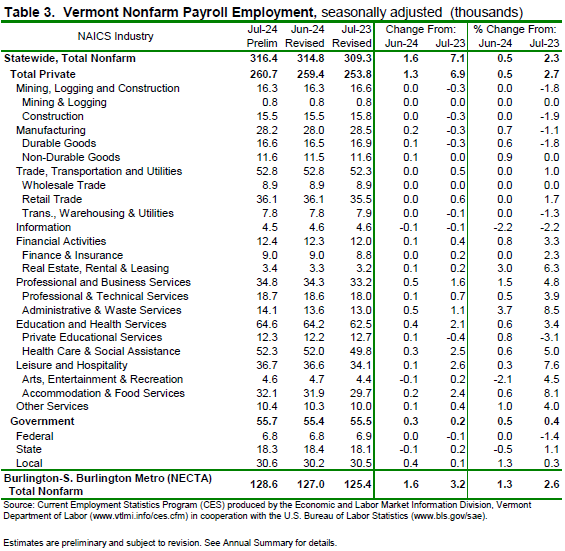
Seasonally-Adjusted (Table 3) The seasonally-adjusted data for July reported an increase of 1,600 jobs from the revised June data. There was an increase of 800 jobs between the preliminary and the revised June estimates due to the inclusion of more data.
The seasonally-adjusted over-the-month changes in July varied at the industry level. Industries with a notable increase included: Administrative & Waste Services (+500 jobs or +3.7%) and Local Government (+400 jobs or +1.3%). No industries had a notable decrease.
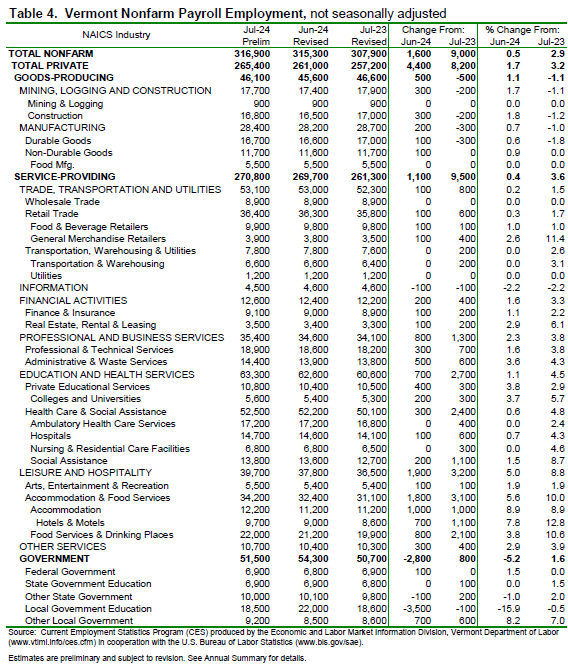
Not-Seasonally-Adjusted (Table 4) The preliminary ‘not-seasonally-adjusted’ jobs estimates for July showed an increase of 1,600 jobs when compared to the revised June numbers. As with the seasonally-adjusted data, this over-the-month change is from the revised June numbers which experienced an increase of 200 jobs from the preliminary estimates. The broader economic picture can be seen by focusing on the over-the-year changes in this data series.
As detailed in the preliminary not-seasonallyadjusted July data, Total Private industries increased by 8,200 jobs (+3.2%) over the year and Government (including public education) employment increased by 800 jobs (+1.6%) in the past year. The Unemployment and Jobs Report for August is scheduled to be released on Friday, September 20, 2024 at 10:00 a.m.

| State | July 2024(p) rate |
Rank |
|---|---|---|
|
South Dakota |
2.0 | 1 |
|
Vermont |
2.1 | 2 |
|
North Dakota |
2.2 | 3 |
|
New Hampshire |
2.5 | 4 |
|
Nebraska |
2.6 | 5 |
|
Mississippi |
2.7 | 6 |
|
Virginia |
2.7 | 6 |
|
Alabama |
2.8 | 8 |
|
Iowa |
2.8 | 8 |
|
Maine |
2.8 | 8 |
|
Maryland |
2.8 | 8 |
|
Hawaii |
2.9 | 12 |
|
Wyoming |
2.9 | 12 |
|
Tennessee |
3.0 | 14 |
|
Wisconsin |
3.0 | 14 |
|
Montana |
3.1 | 16 |
|
Kansas |
3.2 | 17 |
|
Minnesota |
3.2 | 17 |
|
Utah |
3.2 | 17 |
|
Arkansas |
3.3 | 20 |
|
Florida |
3.3 | 20 |
|
Arizona |
3.4 | 22 |
|
Georgia |
3.4 | 22 |
|
Pennsylvania |
3.4 | 22 |
|
Idaho |
3.5 | 25 |
|
Massachusetts |
3.5 | 25 |
|
Oklahoma |
3.5 | 25 |
|
Connecticut |
3.6 | 28 |
|
North Carolina |
3.7 | 29 |
|
Missouri |
3.8 | 30 |
|
Colorado |
3.9 | 31 |
|
Louisiana |
3.9 | 31 |
|
South Carolina |
3.9 | 31 |
|
Indiana |
4.0 | 34 |
|
New Mexico |
4.0 | 34 |
|
Delaware |
4.1 | 36 |
|
Oregon |
4.1 | 36 |
|
Texas |
4.1 | 36 |
|
West Virginia |
4.2 | 39 |
|
New York |
4.3 | 40 |
|
Michigan |
4.4 | 41 |
|
Alaska |
4.5 | 42 |
|
Ohio |
4.5 | 42 |
|
Rhode Island |
4.5 | 42 |
|
Kentucky |
4.7 | 45 |
|
New Jersey |
4.7 | 45 |
|
Washington |
4.9 | 47 |
|
California |
5.2 | 48 |
|
Illinois |
5.2 | 48 |
|
Nevada |
5.4 | 50 |
|
District of Columbia |
5.5 | 51 |
|
Footnotes |
||
|
Note: Rates shown are a percentage of the labor force. Data refer to place of residence. Estimates for the current month are subject to revision the following month. |
||
Last Modified Date: August 16, 2024
To support great journalism, access our archives and get unique features like our award-winning profiles, Book of Lists & Business-to-Business Directory, subscribe HERE!