

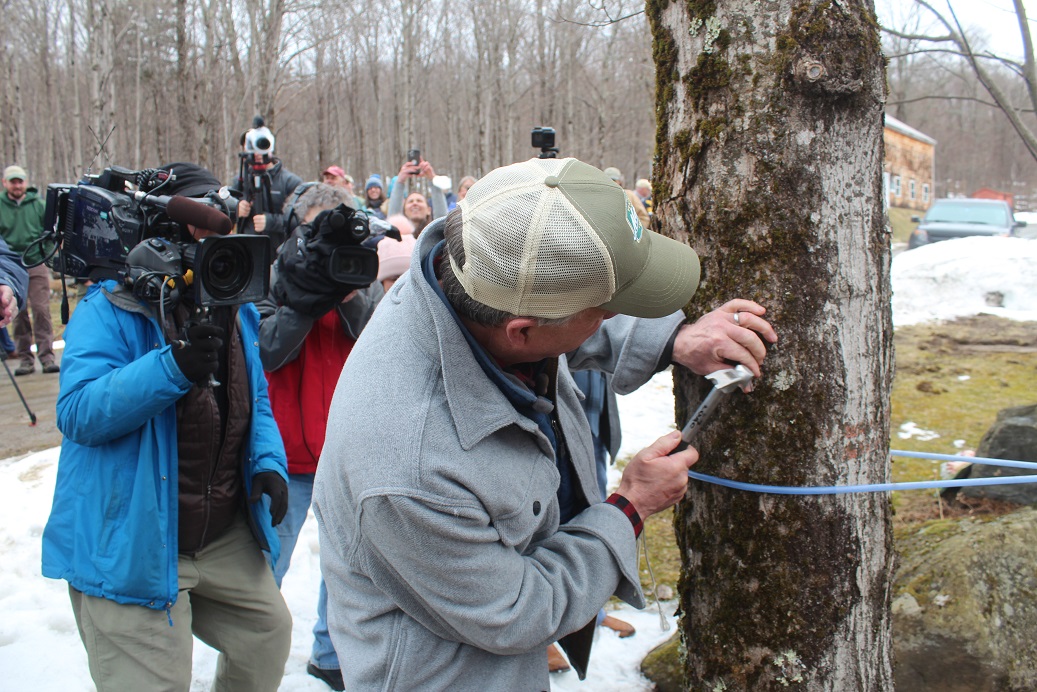
Annual “First-Tapping” Event Celebrates the Significance of Vermont’s Maple Industry
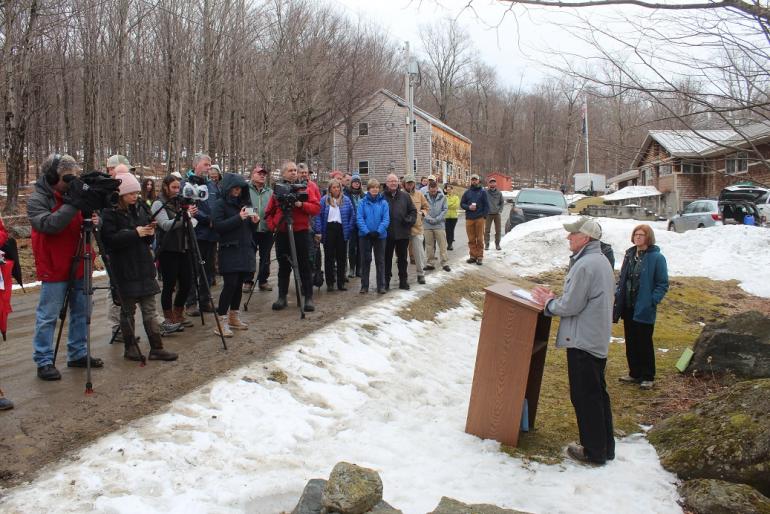
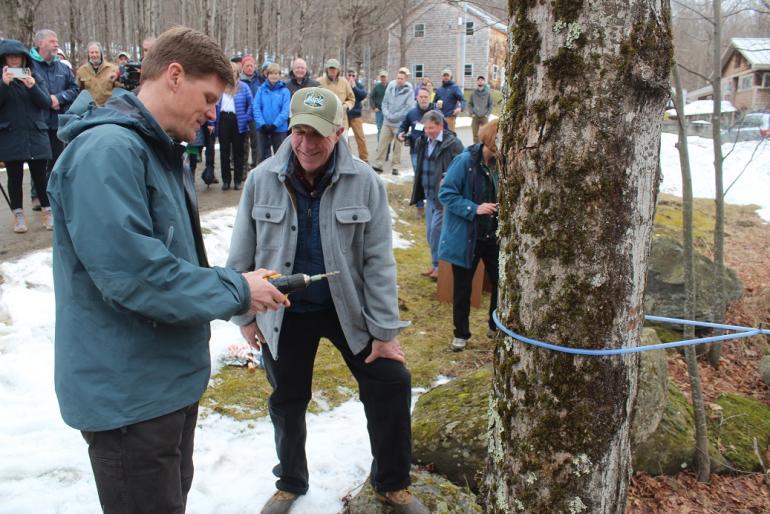
Vermont Business Magazine Framed by the Green Mountains blanketed in winter snow and the maple wood of Underhill, Vermont Governor Phil Scott kicked off the 2022 Vermont Maple Season by tapping the unofficial “first” maple tree at the University of Vermont Proctor Maple Research Center (PMRC).
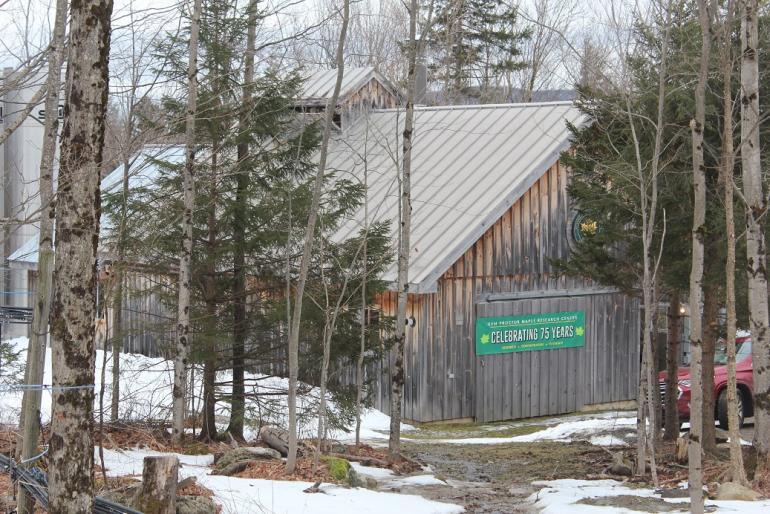
While Vermont’s maple industry is celebrated for its world-renowned quality, taste and nationwide leading annual production, the event also celebrated the important contributions of the Underhill facility to Vermont’s maple producers over the past 75 years. From growing the ability to tap trees and boil maple sap utilizing leading-edge technology to studying the potential impacts of climate change on the state’s maple trees, the Research Center is widely recognized in the industry as playing an important role in the cultural growth and economic importance of the traditional agricultural crop.
“Our maple industry leads the nation, supports our economy and strengthens the Vermont brand, while the Proctor Maple Research Center at UVM reinforces that,” said Governor Scott. “With the strong brand recognition of Vermont Maple comes a responsibility to keep our standards at the highest level, and our maple producers have been doing that for decades with the help of the Proctor Maple Research Center.”
Established in 1947, PMRC is renowned as an international leader in basic and applied research on maple trees and maple production. Throughout its history, UVM maple scientists have worked in the lab, the sugarhouse and around the state to understand the issues facing maple producers and help advance the science to solve them.
"We are proud of our long history in maple research, demonstration and outreach at the University of Vermont and pioneering contributions of UVM maple scientists," said Leslie Parise, dean of the UVM College of Agriculture and Life Sciences, home to PMRC. "We look forward to continuing to better understand the most pressing issues facing Vermont maple producers and advancing the science to address them."
“Vermont continues to lead the nation in maple syrup production, with nearly half of the country’s maple syrup coming from our state’s family farms,” Vermont Agency of Agriculture, Food and Markets Secretary Anson Tebbetts said.
The Vermont Sugar Makers Association is holding the 2022 Maple Open House Weekend over two weekends this year. Visit https://vermontmaple.org/events/ for more information.
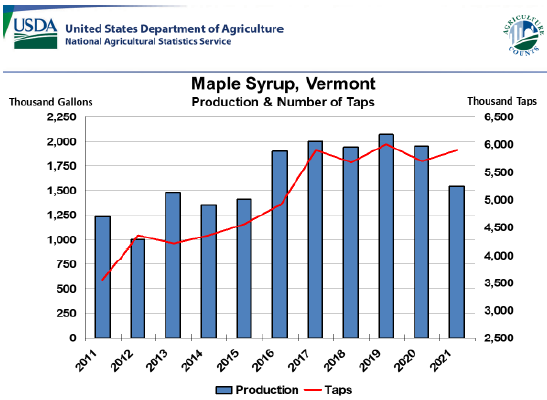
2021 maple syrup production was down 21% in Vermont
The 2021 Vermont maple syrup production totaled 1.54 million gallons, down 21% from the previous year, according to the USDA’s National Agricultural Statistics Service, New England Field Office. Vermont remained the top producing state in the Nation.
Vermont maple syrup producers put out 5.90 million maple taps in 2021, an increase 4% from the 2020 total. Yield per tap is estimated to be 0.261 gallon, down from 0.342 gallon from the previous season. Location played a significant part in individual production. The earliest sap flow reported was January 25 in Vermont. On average, the season lasted 28 days, compared with 38 days in 2020.
 Vermont’s 2020 value of production totaled $52.7 million, down 9% from the previous season. The average retail price per gallon was up 2% at $45.50 per gallon.
“Mother Nature was the story in 2021,” Vermont’s Ag Secretary Anson Tebbetts said after the numbers were released last year. “Vermont maple producers were faced with wild weather changes, ups and downs, starts and stops. But as always Vermont producers rode the waves and produced another national leading high quality crop. We are proud of our sugar makers who are producing a natural sweetener that’s being served at breakfast, lunch and dinner.”
Vermont has led the US. in the number of maple taps every year since 1916 and was only out produced in 1926 and 1918. In 2003 Vermont had 2.12 million taps and has been steadily increasing to 5.90 million in 2021.
Annual production prior to 1935 was typically between 1 million and 1.4 million gallons. This dropped to around 200,000 to 300,000 gallons in the 1970’s. Since 2003 Vermont’s maple syrup production has increased from around 500,000 gallons to 1.54 million gallons in 2021.
March 7, 2022 | Underhill, VT – Vermont Agency of Agriculture, Food & Markets
