by Timothy McQuiston, Vermont Business Magazine Weekly unemployment claims last week were virtually unchanged and continue to hold at a high level. This is happening in Vermont and nationally. This is generally explained by more people getting back into the system as the new federal economic relief plan has both extended the unemployment insurance benefits and increased the payout. However, economists also suggest the new year is off to a sluggish start.
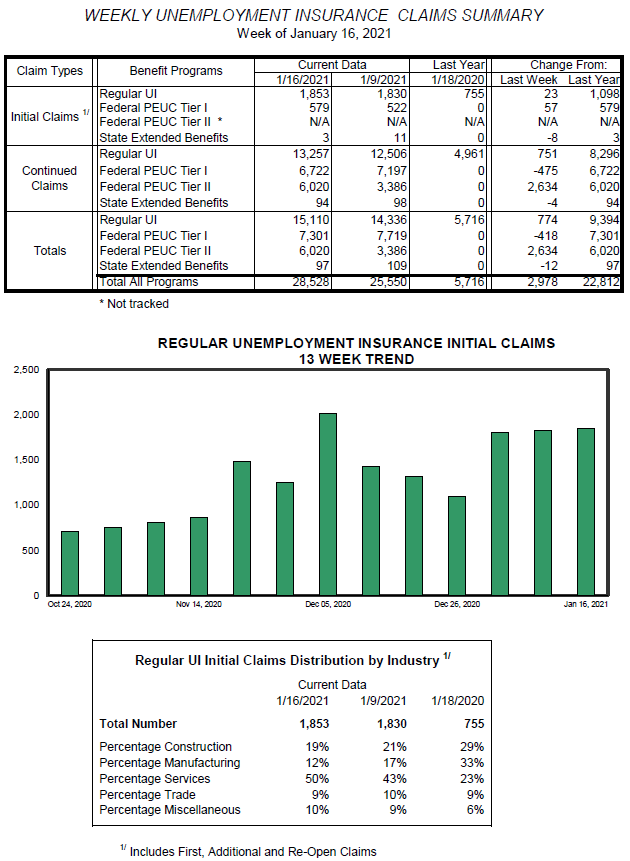
Claims in Vermont last week increased by 23 to 1,853 (up 1,098 from the same time last year, which was before the pandemic hit).
As for the week's ongoing jobless claims, for the week ending January 16, 2021, the Labor Department processed 15,110 claims, up 774 from the previous week and 9,394 more than the same time last year.
As for further comparison, initial Vermont claims for the week of March 21, 2020 (the first full week of the pandemic in Vermont), were 3,784, up 3,125 from the week of March 14.
Labor Commissioner Michael Harrington said at Governor Scott's media briefing last week that the new federal stimulus and unemployment money will help Vermonters, even though the unemployment rate is on paper at the same level as it was just before the pandemic led to historic unemployment levels.
He said at the Friday briefing that the new round of UI stimulus has also brought a new round of fraud. He said this is largely not due to individuals trying to game the system, but from organized entities making a widespread effort.
He said that some of these criminal enterprises that swiped personal identification during the Equifax breech three years ago waited for the right time to use the information to defraud the UI system.
For those who are filing, this includes 12,506 on regular UI, 10,310 on PEUC and 8,429 on PUA, and 98 on extended benefits as of January 9, 2021, according to VDOL.
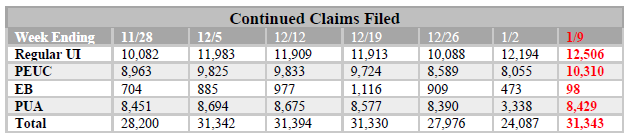
VDOL table as prepared for the Legislature. Click HERE to see full report.
More than $3 trillion in pandemic relief, including CARES Act with the first round of PPP, helped the third quarter grow at a record pace of 33.4 percent.
US GDP had its worst quarter on record in the second quarter as it fell 31.4 percent in that April-June period; the next worst was in 1921, which led to the Great Depression.
As for the direct stimulus payments that went to all adults ($600 individual, $1,200 household) starting just before New Year, the governor said that will inject about $350 million into the state economy right away on top of the unemployment benefits.
Those with direct deposit accounts listed with the IRS have already their stimulus. Those receiving paper checks should get them soon if they have not already.
Scott said the new, $1 trillion stimulus plan includes help for businesses with a new PPP plan but does not include more flexibility for budgetary relief or allowance for states to use unemployment trust funds to further extend benefits.
Most of this round of pandemic relief is in the form of a new round of PPP administered by the SBA, so Vermont small businesses should contact their lender and get the application in or at least ready to go, because it is on a first-come, first-served basis with finite funding available.
President-elect Joe Biden has proposed a $1.9 trillion recovery plan. It includes another round of direct payments of $1,400, an increase in weekly UI benefits to $400, plus $400 billion to fight COVID-19, among other measures.
It does not include the same high level of discretionary funds for state governments that the CARES Act provided, when Vermont got $1.25 billion.
Between the $3 trillion-plus in the first rounds of pandemic relief, plus the $900 billion in December and this proposed $1.9 trillion, total federal relief would be in excess of $6 trillion.
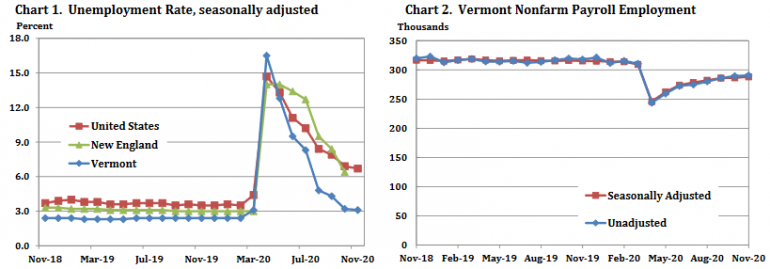
Meanwhile, the state unemployment rate, which was the lowest in the nation before the pandemic, then spiked during the pandemic, has retreated and is now the lowest in the nation and back to its pre-pandemic level, which is not really that good of a thing.
The VDOL points out that the US Census modeling has not caught up with the reality of the pandemic and Vermont's 3.1 percent unemployment rate portrays a rosier economic picture than what actually exists.
Harrington has previously said that the real unemployment rate is more in the 5 percent range, and if it included the PUA, the rate is likely more in the 6-8 percent range.
He and Scott said that while the data the US Census collects is not erroneous, they disagree with the methodology the federal government is using given the altered behavior of people during the pandemic.
They said people have left the workforce for reasons related to the pandemic, like for personal safety or childcare, which then lowers the total Labor force, which works as the denominator in the calculations, thus lowering the unemployment rate.
The PUA claims are not included in the unemployment rate calculation.
The PUA benefits in some cases are more advantageous. PUA claimants also can get partial payments even if they have some income.
Scott has also extended his Emergency Order until February 15. He has said that he will continue to extend the Order as long as necessary and that we are "only half-way through" the impact of the novel coronavirus.
Also, there is still about $30 million left over in Vermont from the $1.25 billion CARES Act federal funds. Scott said because of the new CARES package that they will have until the end of 2021 to fully allocate that money. He said he will work with the Legislature on how to deploy those funds. But, again, they cannot be used for budgetary relief.
After a spike of claims at the beginning of the pandemic, followed by a steep decline as the economy began to reopen in April, initial unemployment claims fell consistently since the beginning of July before flattening over the last couple months. And now have climbed consistently the last couple of months.
Claims hit their peak in early April. At that point, Governor Scott's "Stay Home" order resulted in the closing of schools, restaurants, construction and more, while many other industries cut back operations.
The official Vermont March unemployment rate was 3.1 percent, but the April rate was 15.6 percent, which is the highest on record. The Vermont unemployment rate in May fell to 12.7 percent.
The US rate fell to 7.9 percent in September from 8.4 percent in August from 10.2 percent in July from 11.1 percent in June and in May from 13.3 percent. The US April rate was 14.7 percent, the highest rate since its was first calculated in 1948 and the highest unofficially since the Great Depression of about 25 percent.
Nationwide, according to the US Labor Department for the week ending January 16, initial claims for state unemployment benefits totaled 900,000, down from 965,000 and slightly better than expectations. They were 787,000 the previous week. Claims right now are running higher than they have been since last summer
Early on in the pandemic, US claims reached 5.2 million and 6.6 million claims. Just prior to the steep job loss, there were 282,000 claims on March 14.
The Pandemic Unemployment Assistance (PUA) has added to the ranks of those receiving benefits, but is not counted in the official unemployment rate. The PUA serves the self-employed who previously did not qualify to receive UI benefits and might still be working to some extent.
As for regular UI claims in Vermont, during the Great Recession for the entire year in 2009, claims spiked at 38,081 claims.
The claims back in 2009 pushed the state's Unemployment Insurance Trust Fund into deficit and required the state to borrow money from the federal government to cover claims.
Right now (see data below), Vermont has $239.9 million in its Trust Fund and saw the fund decrease by a net of $2.8 million last week. Payments lag claims typically by a week. Balance as of March 1 was $506.2 million.
Vermont at the beginning of the pandemic had more than double the UI Trust Fund it did when the economy started to slide in 2007. It went into deficit and the state had to borrow money from the federal government to pay claims. Some states like California are already in UI deficit because of the COVID crisis.
Scott said the UI fund is not expected to run out under current projections, which is why he wants permission from the federal government to use it for extended benefits now.
"We are in a much healthier position than many other states," Labor Commissioner Harrington has said.
Given the Trust Fund's strong performance and the burden of unemployment taxes on employers, Governor Scott reduced the UI tax on businesses. He also announced that starting the first week of July, the maximum unemployment benefit to workers will increase about $20 a week.
Stories:
Tax revenues soar with one-time money
Unemployment benefits extended with authorization of federal relief bill
Unemployment rate falls to pre-pandemic level of 3.1 percent
Over $100 million in recovery grants awarded, still more available
Businesses to see double-digit rate decrease in workers’ comp insurance in 2020
Tax revenues finish year nearly $60 million above targets
UI tax rates for employers fell again on July 1, 2018, as claims continue to be lower than previous projections. Individual employers' reduced taxable wage rates will vary according to their experience rating; however, the rate reduction will lower the highest UI tax rate from 7.7 percent to 6.5 percent. The lowest UI tax rate will see a reduction from 1.1 percent to 0.8 percent.
Also effective July 1, 2018, the maximum weekly unemployment benefit will be indexed upwards to 57% of the average weekly wage. The current maximum weekly benefit amount is $466, which will increase to $498. Both changes are directly tied to the change in the Tax Rate Schedule.
The Vermont Department of Labor announced Thursday, October 1, 2020 an increase to the State’s minimum wage. Beginning January 1, 2021, the State’s minimum wage will increase $0.79, from $10.96 to $11.75 per hour. The calculation for this increase is in accordance with Act 86 of the 2019 Vermont General Assembly. It tracks inflation.
This adjustment also impacts the minimum wage of “tipped employees.” The Basic Tipped Wage Rate for service or tipped employees equals 50% of the full minimum wage or $5.88 per hour starting January 1, 2021.
The Vermont Department of Labor has announced that the state is set to trigger off of the High Extended Benefits program, as of October 10, 2020. This determination by the US Department of Labor follows the recent announcement of Vermont’s unemployment rate decreasing from 8.3% in July to 4.8% in August.
Vermont's minimum wage rose to $10.78 on January 1, 2019.
The Unemployment Weekly Report can be found at: http://www.vtlmi.info/. Previously released Unemployment Weekly Reports and other UI reports can be found at: http://www.vtlmi.info/lmipub.htm#uc
NOTE: Employment (nonfarm payroll) - A count of all persons who worked full- or part-time or received pay from a nonagricultural employer for any part of the pay period which included the 12th of the month. Because this count comes from a survey of employers, persons who work for two different companies would be counted twice. Therefore, nonfarm payroll employment is really a count of the number of jobs, rather than the number of persons employed. Persons may receive pay from a job if they are temporarily absent due to illness, bad weather, vacation, or labor-management dispute. This count is based on where the jobs are located, regardless of where the workers reside, and is therefore sometimes referred to as employment "by place of work." Nonfarm payroll employment data are collected and compiled based on the Current Employment Statistics (CES) survey, conducted by the Vermont Department of Labor. This count was formerly referred to as nonagricultural wage and salary employment.
UI claims by industry last week in Vermont are similar in percentage to those from a year ago, though of course much higher in number in each industrial category.