


Current News
by tim
Governor Douglas will join with the families of fallen Vermonters, veterans, state leaders and others to celebrate the groundbreaking of Vermont’s new Global War on Terror Memorial at the Vermont Veterans’ Memorial Cemetery.
During the ceremony the Governor will also present a Gold Medal of Remembrance to the child of a Vermonter who made the ultimate sacrifice in service to our nation fighting in Global War on Terror. The Gold Medal of Remembrance is issued by the White House Commission on Remembrance.
WHAT: Memorial Day Groundbreaking Ceremony for Vermont’s Fallen Heroes Global War on Terror Memorial
WHEN: Sunday, May 30, 2010 – 3:00 p.m.
WHERE: Vermont Veterans’ Memorial Cemetery, 487 Furnace Road, Randolph Center
by tim
The Centers for Disease Control and Prevention’s (CDC) National Healthcare Safety Network (NHSN) has released its “First State-Specific Healthcare-Associated Infections Summary Data Report”, which gives an overview of where the country stands in efforts to prevent central line-associated bloodstream infections (CLABSI). The report is based on both national and state-specific CLABSI data collected by NHSN.
The NHSN report looked at CLABSI data from January – June 2009. During that time, Vermont hospitals reported CLABSI rates that were among the lowest of the seventeen states that were included in the report, and that were significantly lower than the report’s standardized infection ratio baseline of 1.0. Vermont’s ratio for the period reported was 0.27.
by tim
Vermont Governor Jim Douglas yesterday (May 27, 2010) vetoed H485, An Act Relating to the Use Value Appraisal Program. The governor said in his veto message that H485 greatly undermines the original intent of the Current Use program, is complicated, highly nuanced, difficult to understand, administratively complex and needlessly and unfairly increases three taxes.
Governor Douglas has supported the Current Use program since he voted for the program s inception as a member of the House in the 1970 s. I continue to support the Current Use program, and believe that it has provided great benefits to our state. It is unfortunate that the General Assembly chose to raise taxes unnecessarily and punitively on the stewards of Vermont's working landscape in an effort to address the perceived misuse of the program. A more calibrated approach is required to achieve the desired objectives, he concluded.
by tim
Governor Jim Douglas announced yesterday that he would allow S88, An Act Relating to Health Care Financing and Universal Access to Health Care in Vermont, to become law without his signature.
“Vermont is recognized as a national leader in health reform, we are the healthiest state in the nation and we are in the midst of implementing significant changes from the federal health care reform bill,” said Governor Douglas. “To spend time and money studying a new model that cannot be implemented until at least 2017 is counterproductive. Further, the drug sample reporting provision adds burdensome new regulations that are unnecessary and could make it difficult for low-income Vermonters to receive needed medications. These sections do not represent meaningful reform; rather they detract from the serious work ahead.”
by tim
By Art Edelstein. Vermont Business Magazine. May, 28, 2010 _ A multi-part health care bill (Senate 88) became law yesterday when Governor Douglas declined to either sign it or veto it, thus letting it become law without his signature. The health care bill, S88, passed both houses of the Vermont Legislature on May 11, the last day of the 2010 session.
The legislation would support aspects of the state's ongoing attempt to keep health care costs in check and lead to universal access for all Vermonters. However, two provisions of the bill irked the governor enough to cause him to threaten a veto, instead he chose to let it become law. Once a bill reaches his desk, the governor has five days to sign it into law or veto it. If he does neither, the bill becomes law without his signature at the end of the five days.
by tim
During the morning and evening commutes on Thursday, May 27, Amtrak Police, Transportation Security Administration (TSA) personnel and law enforcement officers from federal, state, local, rail and transit police agencies are being deployed at passenger rail and transit stations throughout the Northeast as part of an exercise of counterterrorism and incident response capabilities.
by tim
Sen. Bernie Sanders (I-Vt.) said today that the United States must learn a profound lesson from the BP oil catastrophe in the Gulf of Mexico and make certain we protect our oceans from future disasters and transform our energy system away from fossil fuels.
Sanders introduced legislation that would ban offshore drilling along America’s ocean coastlines and increase fuel efficiency in American cars.
The measure would prohibit drilling in the Pacific and Atlantic oceans and along Florida’s gulf coastline. A moratorium on drilling in those areas that Congress approved every year since 1982 lapsed in 2008.
Sanders’ bill also would set a fuel economy standard of 55 miles per gallon, up from an average of 35 mpg that American car makers must achieve by 2030 under current law.
by tim
Senate leaders have appointed U.S. Senator Patrick Leahy (D-Vt.) as one of the 12 Senate conferees who will negotiate the final form of the landmark financial reform legislation that now has passed the Senate and the House in different forms. The conferees will meet in June.
by tim
The Vermont Yankee nuclear power station automatically shut down yesterday at approximately 3:25 pm. The plant was at 70 percent of its normal output after restarting from its refueling and maintenance outage. Plant systems responded safely as designed. Plant technicians are investigating the cause of the shutdown. Initial indications are that the shutdown was caused by a problem 345KV switchyard located outside the plant. There has been no release of radiation. The plant will be restart after the problem has been identified and repairs have been completed.
Source: Vermont Yankee. 5.26.2010
by tim
Vermont Senators Patrick Leahy and Bernie Sanders and Congressman Peter Welch announced Wednesday that three Vermont towns will receive grants for the improvement of public safety services through the purchase of equipment and upgrades. This funding comes from the US Department of Agriculture (USDA) under the American Recovery and Reinvestment Act of 2009.
This Recovery Act funding is provided through USDA Rural Development’s Community Facilities program, which helps finance essential community facilities for public use in rural areas. The funding for Vermont, is part of $33 million in funding assistance USDA Rural Development is providing to 74 community facility public safety projects in 26 states across the country. Through this program, USDA ensures communities can provide essential public safety infrastructure to rural families.
Below is a list of the Vermont recipients:
by tim
Governor Jim Douglas today signed into law a $595 million transportation bill at the Miller Brook Bridge project in Stowe. The fiscal year 2011 transportation budget contains record spending for bridge rehabilitation and repair, as well as record or near record sums for other transportation programs, including rail and paving.
“These investments continue the strong commitment we’ve made to our physical infrastructure in recent years,” Governor Douglas said. “This transportation budget will generously fund many priorities, such as paving, bridges and rail, and create jobs across the state. I thank Chairman Mazza, Chairman Brennan and the Transportation committees, as well as Secretary Dill and his team at AOT, for their strong commitment to Vermont’s physical infrastructure.”
by tim
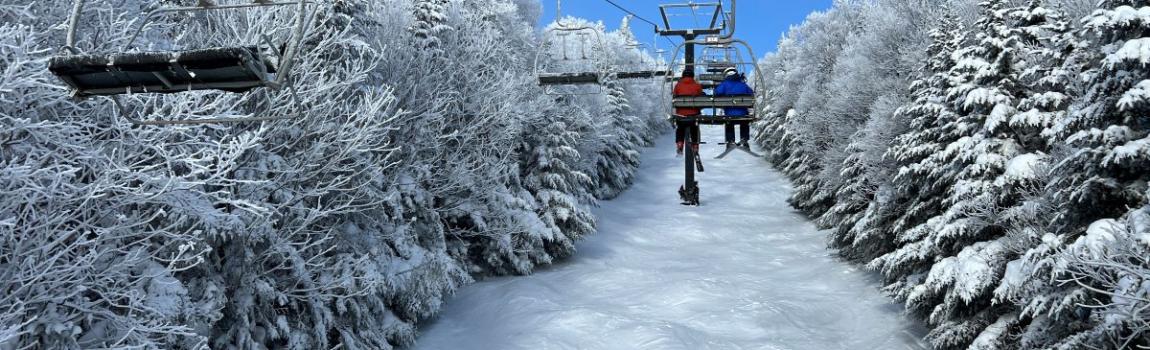
With temperatures reaching record highs throughout much of the region, Stratton Mountain Resort celebrated the occasion, not with beach towels, but with skis and a snowboard.
The attached photo and video comes from the setup for the first annual Mountain Mayhem Rail Jam, held on Sunday, May 30 at Stratton Mountain Resort. The snow chute was carved from the same 22 foot superpipe that Olympians Hannah Teter and Louie Vito rode at the U.S. Open Snowboarding Championships in March.
Clearly the best way to beat the heat was on the snow!
Source: Stratton. 5.26.2010