






Current News
by ayla
Vermont Family Network (VFN) partnered with restaurants around the state to raise money for children with special needs. The Fundraiser took place February 1-14 and a portion of sales for specials identified by each participating restaurant were donated directly to Vermont Family Network to help support the work that the organization does with Children and families with special needs across the state. During the two-week period, the 10 restaurants raised $2,428.00 to support the state-wide non-profit organization.
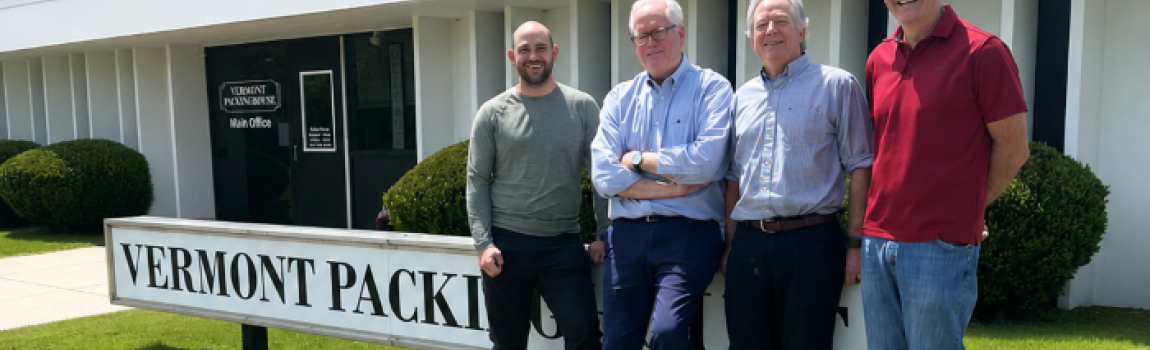
Area restaurants present a check to Vermont Family Network in the amount of $2,428.00 for proceeds raised during the organization’s Valentine’s Fundraiser in February. In the photo from left: Katelynn Audette, Trade Duke’s; Bob Conlon, Leunig’s Bistro; Sarah Hammitt, Trader Duke’s; Jeff Morton, Vermont Family Network; Jeff Bushey, The Windjammer Hospitality Group. Photo courtesy of Vermont Family Network.
by ayla
The Vermont Agency of Agriculture, Food, and Markets (VAAFM) is reporting the first case of Porcine Epidemic Diarrhea virus (PEDv) in the state. The positive diagnosis occurred on a swine operation in Rutland County on March 26th, 2014.
PEDv is a coronavirus that affects pigs only and is similar to Transmissible Gastroenteritis. It does not make people sick and it does not affect other species of livestock. PEDv does not affect pork safety and pork remains completely safe to eat.
The first detection of this disease in the U.S. occurred approximately one year ago, and since then it has impacted over 4,000 premises in 27 states. The Vermont case represents the first confirmed positive premises in Vermont. The most common sign of PEDv in swine is severe diarrhea, and mortality rates in pre-weaning piglets approach 100%. Older animals generally survive the infection but can shed the virus in their feces and through their respiratory tracts for an extended period.
by tim
by Timothy McQuiston, Vermont Business Magazine The Vermont Public Service Board on Friday (March 28, 2014) approved the Memorandum of Understanding (MOU) reached between Entergy and the State of Vermont back in December. The decision to approve the MOU keeps in place the overall Settlement Agreement in which Entergy Vermont Yankee (Entergy VY) agrees to advance steps in decommissioning the plant sooner than otherwise would be required, and to establish a separate $25 million site restoration fund.
by ayla
by John Herrick, vtdigger.org The Vermont Senate on Thursday passed a bill designed to raise money to offset the cost of implementing the state’s universal recycling program.
The money raised by S.208 will go to small haulers in underserved regions of the state that will need equipment and facilities’ upgrades to comply with the phase-in of state’s universal recycling law, which will ban many materials from the state’s landfill over the next few years.
by ayla
by Hilary Niles, vtdigger.org Republicans balked at increases in the state’s budget and what they deemed an over-reliance on one-time money in a heated debate Thursday night in the House Chamber.
Rep. Don Turner, R-Milton, minority leader of the House, told his colleagues that this year’s budget growth is not sustainable because half of the money used to balance the budget and cover a $70 million gap between state revenues and state spending is from one-time monies. Turner said the fiscal year 2016 budget gap will be as large or larger than this year’s.
“Although this is less than the budget others proposed, this budget is still much more than the state can afford,” Turner said.
The budget passed on second reading, 91-46.
by ayla
Related Company: Entergy Nuclear Vermont Yankee LLCGovernor Peter Shumlin Friday afternoon expressed his support for the decision of the Public Service Board to approve the Memorandum of Understanding (MOU) reached between Entergy and the State of Vermont back in December. The decision to approve the MOU keeps in place the overall Settlement Agreement in which Entergy Vermont Yankee (Entergy VY) agrees to advance steps in decommissioning the plant much sooner than otherwise would be required, and to establish a separate $25,000,000 site restoration fund.
by ayla
While April 1 signals the end of the Winter Manure Spreading Ban imposed by the Accepted Agricultural Practice Regulations (AAPs), the continued presence of snow pack on farm fields will present a challenge to farmers who wish to start spreading manure as soon as the ban is over. The AAPs require that all agricultural wastes be managed in order to prevent adverse impacts to water quality. That means that while it is legal to spread manure once the Winter Ban is over, manure must still be applied in a way that does not result in runoff of manure to surface water or across property boundaries. Once the snow begins to melt, manure can be carried away to the low points in the landscape.
To help you remain in compliance with the AAPs, the Agency of Agriculture strongly recommends the following:
▪ If you still have room in your manure pit, wait until snow is off the fields before you spread manure.
▪ If you must spread manure before snow is off the fields:
by ayla
Starting in fall 2014, Johnson State College will offer a new Certificate of Proficiency in Accounting, a program designed to help Vermonters meet new state licensure requirements for accountants without having to enroll in graduate school.
The program emerged in response to Vermont’s adoption of interstate equivalency standards for CPAs and a change in state licensure rules that make it easier for accountants to practice in other states. Starting in July 2014, Vermont accountants will need a bachelor’s degree and a total of 150 college credits, including 42 credits in accounting-related classes, and one year of experience. Under current regulations, Vermont accountants need only 120 college credits – a bachelor’s degree – along with two years of experience.
by tim
by Hilary Niles vtdigger.com House lawmakers rejected an attempt to stave off cuts in the federal food stamp program before approving the miscellaneous tax bill Thursday.
Rep. Paul Poirier, I-Barre, (photo right) proposed raising taxes for people in the state’s two highest income brackets to collect an additional $10 million to fund the 3SquaresVT nutrition assistance program. His effort was defeated on a roll-call vote of 115-28.
During the debate, Poirier implored his colleagues to restore the food stamp benefits cut by Congress.
“One out of every six Vermonters is dependent on some kind of financial help to put food on the table,” Poirier said.
His figures were based on a one-month snapshot of 3SquaresVT, the state’s Supplemental Nutritional Assistance Program. Thirty-four percent of all food assistance recipients are under 18 years old. The average monthly household benefit was $243 before the program was cut last year.
by tim
Again driven by a steep drop in the number of unemployed, along with a gain in employment, the Vermont jobless rate fell again and remains the lowest rate east of the Mississippi. The Vermont Department of Labor announced today that the seasonally-adjusted statewide unemployment rate for February 2014 was 3.7 percent. This represents a decrease of three-tenths of a percent from the January rate of 4.0 percent. The comparative national average was 6.7 percent, which was up one-tenth of a percent from January. February 2014 data represents the fifth consecutive reported monthly decrease to the statewide unemployment rate in Vermont. Vermont’s unemployment rate was the fourth lowest in the country.
by tim
The US Census Bureau has reported that the fastest-growing county in Vermont between July 1, 2012, and July 1, 2013, was Chittenden County, whose population rose 0.64 percent over the period. Chittenden County was followed by Lamoille (0.62 percent), Caledonia (0.23 percent), Grand Isle (0.16 percent), and Orleans (0.15 percent) counties.
With respect to numerical growth, Chittenden County added 1,014 people over the period, more than any other county in the state. It was followed by Lamoille, which grew by 155 people, Caledonia (73), and Franklin (50) counties.Chittenden County is the most populous county in Vermont, with 159,515 residents, followed by Rutland and Washington counties.
by tim
by Morgan True vtdigger.com The Vermont Senate gave preliminary approval Thursday to a wide-ranging bill aimed at moving the state’s health care reform agenda forward.
Absent direction from the Shumlin administration, the Senate has endeavored to identify what areas of health care reform it can further this session, as well as target areas that need more study.
“(This bill) is the culmination of the work to date, not only in the Senate Finance Committee, but several other committees of jurisdiction, and perhaps, I think, our best judgment at this time as it relates to achieving the vision of a universal and unified (health care) system,” said Sen. Tim Ashe, D/P-Chittenden, chair of Senate Finance, who spearheaded crafting of the legislation.