




Current News
by tim
State agencies and local partners are gearing up for summer cyanobacteria monitoring on Lake Champlain. Annual monitoring efforts by the Vermont Department of Health, the Department of Environmental Conservation and the Lake Champlain Committee (LCC) will be guided by new advice from the EPA on blue-green algae toxins in drinking water.
“We welcome the new science-based guidance from EPA, and will use it to determine the appropriate advisory level to protect the health of Vermonters,” said Health Department State Toxicologist Sarah Vose, PhD.
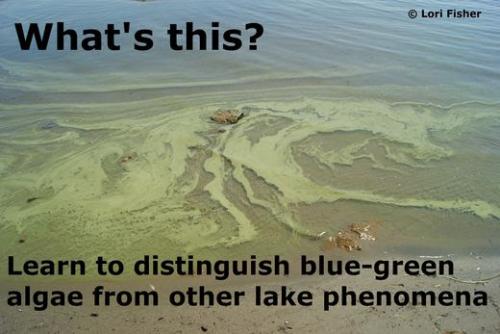 Courtesy Lake Champlain Committee
by tim
Ticks are a lot like weeds: They survive winter’s freezing temperatures, heavy snowfall and lack of sunshine. These resilient critters can carry pathogens – microorganisms such as bacteria, viruses and parasites – that cause illness.
“Ticks are abundant in all parts of the state. Using bug spray and doing daily tick checks should be part of every Vermonter’s routine,” said Erica Berl, an infectious disease epidemiologist for the Vermont Department of Health. “The earlier you remove a tick, the less likely you are to become sick.”
Thirteen different tick species have been identified in Vermont, but only four are known to carry pathogens that cause disease in humans.
by tim
The Vermont Division of Emergency Management & Homeland Security and its state and local partners will take part in a biennial graded exercise of its radiological response plan on Wednesday May 13th. The drill will test the state's ability to respond to a hostile action event at or around the Vermont Yankee Nuclear Power Plant in Vernon beginning at approximately 9 am and continuing until mid-afternoon.
by tim
Lincoln Renewable Natural Gas, LLC (LincolnRNG) of Montpelier today filed a petition with the Vermont Public Service Board for a Certificate of Public Good to construct and operate a renewable natural gas plant. The LincolnRNG plant would produce the renewable natural gas (RNG) from dairy farm manure and other organic fuel sources. RNG is interchangeable with conventional natural gas and may be used as an alternative heating and vehicle fuel. LincolnRNG will sell most of the RNG produced by the plant to Middlebury College, to replace the College’s current use of a substantial volume of #6 heating oil.
by tim
The Department of Environmental Conservation’s Compliance and Enforcement Division today announced that it formally settled an environmental violation involving Wright Brothers Recycling, Inc. The company operates a full service metal recycling and salvage yard in Newport, Vermont. The settlement includes an $8,000.00 penalty.
by tim
by John McClaughry “Galloping Gertie” was the nickname given by construction workers to the infamous Tacoma Narrows Bridge, in the state of Washington. It got its nickname even before it opened to traffic, because of a major design failure. It allowed modest wind pressure to make the roadway visibly oscillate both side to side and end to end. In November 1940, four months after its opening, a crossways 40 mph wind started Gertie galloping, and within minutes it spectacularly collapsed into Puget Sound.
A good case can be made that the worst design failure disaster in Vermont history is the Vermont Health Benefits Exchange, Vermont Health Connect (VHC).
The Affordable Care Act of 2010 authorized the federal government to spend billions to underwrite the creation of health insurance exchanges in the states, and create a backup Federal exchange. Only 17 states, including Vermont, took advantage of this offer.
by tim
Governor Peter Shumlin issued the following statement after the Senate gave preliminary approval to H.35, legislation to clean up Vermont’s waterways, including Lake Champlain. As was the case in the original House bill, the Senate version, scheduled for a third reading in the Senate Tuesday, would raise $8 million through a 0.2 percent surcharge on the property transfer tax, which is paid by the real estate buyer.
“I want to thank the Senate for passing a strong bill today that will clean up Lake Champlain and other waterways and strengthen Vermont’s economy. I made this a priority in January because Vermont’s waterways bind Vermonters tightly to our state and inspire others to put down roots here. Cleaning them up is not only important to who we are as Vermonters, it is integral to the state’s environmental and economic health. Both the House and the Senate have now acted to do that, and I look forward to signing a strong water quality bill into law.”
by tim
Vermont's hospital leaders and Lieutenant Governor Phil Scott joined staff from several departments at Central Vermont Medical Center this morning to kick off Hospital Week - a week of celebrating the Vermonters who dedicate their lives to taking care of their neighbors, while highlighting the role of hospitals and health care reform in building healthier communities and a strong economy.
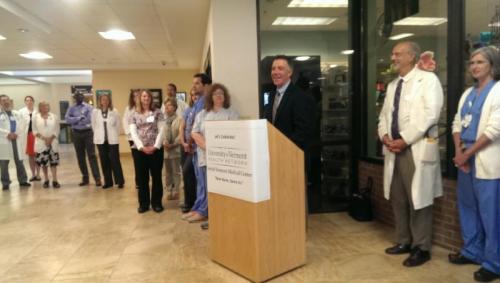 Lieutenant Governor Phil Scott stands with staff at Central Vermont Medical Center.
by tim
On Saturday at approximately 10:45 am, Vermont State Police Royalton Troopers and White River Valley Ambulance personnel responded to a stretch of train tracks running parallel to Vermont 12A in the Town of Braintree for a report of a train/pedestrian collision. The pedestrian was pronounced dead by rescue personnel at the scene. He was later identified as Kevin Kenyon, 25, of Braintree.
An Amtrak passenger train had been traveling south on the tracks when it struck Kenyon. The collision occurred in the vicinity of 3658 VT12A. The male was alone and appeared to have been walking on the tracks, with his back to the on-coming train.
Train personnel took emergency measures but were unable to stop in time to avoid the collision. The male did not appear to respond to the approaching train.
No train passengers, personnel, or other persons were injured.
by tim
Sugarbush Resort has been named a recipient of the annual Sustainable Slopes Grant Program, a National Ski Areas Association program aimed at funding sustainability projects and improving snowmaking and climate adaption at U.S. ski areas. The resort received a cash grant for a four-stream waste receptacle to start the implementation of a program to increase its diversion rate for recyclables, food scraps, liquids, and trash. The resort is one of four recipients of the grant, along with Alta Ski Resort (UT), Arapahoe Basin (CO), and Alpine Meadows (CA).
The grant is expected to help the resort meet its goal of reaching a 50% diversion rate (waste kept out of landfills) in three years, and in turn reach its NSAA Climate Challenge goal of reducing its greenhouse gas (GHG) emissions by 5%.
Sugarbush hopes to implement these waste receptacles all around the resort, but will start by focusing on cafeterias and food and beverage outlets – the largest generators of waste.
by tim
by AARP State Director Greg Marchildon Without a doubt, the Vermont Gas pipeline project has stirred up plenty of controversy. There’s environmental impact challenges, troubling property rights issues and even the fracking debate, but little has been said about who is paying the freight on this monumental undertaking. Current ratepayers! Over the next 35 years, ratepayers will have to pony up over $270 million in additional rates to pay for what is now at least a $153 million endeavor. All of this is justified by a claim that the overall public good is being served. That rationale is questionable at best.
by tim
A new health sciences degree completion program planned for this fall at the University of Vermont will be an undergraduate major offered entirely online. UVM’s Health Sciences degree completion program is designed for undergraduates and working adults interested in health careers not specific to patient care. The online program is for students who previously earned at least one year of college credit but did not complete a baccalaureate degree.
Offered by the UVM College of Nursing and Health Sciences in collaboration with UVM Continuing and Distance Education, the program prepares students for non-clinical careers in a variety of healthcare fields including public health, environmental health, and animal health, as well as for post-baccalaureate professional health programs. The major emphasizes field experience through formal internships, research, and local or global service.