






Current News
by tim
by Mike Smith It has been a dismal month for Donald Trump’s presidential aspirations and for the political prospects of the party whose nomination he has all but secured. First, Trump’s campaign gets sidetracked with controversial issues that are of the candidate’s own making. He picks a fight with a judge who rules against him in a court case involving fraud charges against Trump University, and also with Governor Susana Martinez, a popular Republican governor who doesn’t support him. He later decided to weigh in on the Orlando nightclub massacre but then utters a string of confusing statements that undermine his already dubious leadership credentials and even his support from the National Rifle Association.
by tim
Vermont Business Magazine Weekly unemployment claims spiked last week, as they typically do in June after school ends and education employment falls. Following this spike there is usually a fall and then a leveling off at a relatively low level of under 500 claims for the duration of the summer. However, last week's increase is greater than usual. Spikes of this magnitude generally are seen after the Christmas layoffs and transitions between seasons. For the week of June 18, 2016, there were 996 claims, up 540 from the previous week's total and 235 more than they were a year ago. By industry, claims more than doubled in the Miscellaneous category.
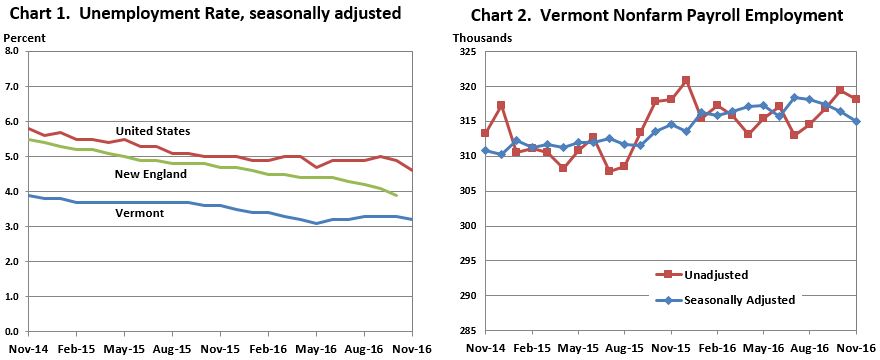 Altogether 4,663 new and continuing claims were filed, an increase of 376 from a week ago, and 155 more than a year ago.
by katie
Vermont Business Magazine - The Vermont Teddy Bear Company announces its 35th Anniversary celebration, taking place this Saturday, June 25th. “This anniversary is a testament to our community, our customers and our employees who have helped our company grow and thrive over the last thirty-five years,” says Bill Shouldice, Chief Executive Officer of the Vermont Teddy Bear Company. “We are thrilled to be able to celebrate this milestone with all of them.”
 Vermont Eddy Bear presidential candidates.
by katie
Vermont Business Magazine - Marie Shutts, Operations Director at the Bennington Area Chamber of Commerce, has been appointed to the Southwest Vermont Supervisory Union's ACT 46 study committee. According to Matt Harrington, Executive Director of the Chamber, Shutts will sit on the committee as a representative of the Bennington Chamber and its over 350 business members.
Harrington stated, “The Chamber is interested in “cradle to career” readiness in our area students and future citizens of Bennington as a way to improve and grow our community. We believe by strengthening our local educational system, better preparing and supporting our students as they go through the various stages of school, we can eventually strengthen the workforce. The focus on education and workforce readiness will provide greater growth and achievement in every child, leading to economic revitalization and an improved quality of life for Bennington.”
by katie
Vermont Business Magazine - Senator Patrick Leahy (D-Vt.) Thursday commented on a new agreement reached between Senate Agriculture Committee Chairman Pat Roberts (R-Kansas) and the panel’s ranking member, Senator Debbie Stabenow (D-Mich.) for a bill to institute mandatory national GMO labeling. Their bill would nullify Vermont’s GMO labeling law, which takes effect on July 1. Leahy notes that a bill by Roberts and Stabenow would not be able to reach the President’s desk for signing by July 1. The House is now in recess until July 5.
by katie
By Louisa Schibli & Janice Shade, Co-Founders, Milk Money L3C - Small business owners, whether they own a startup or a long-established family business, will inevitably need to seek outside funding at some point, or several points, during the life of their business. Funding could be needed to get off the ground, expand services or locations, build a team of trusted employees, or simply to add new equipment.
Most entrepreneurs’ first thought may be to seek traditional sources such as a business loan from credit union or bank. Traditional financing is a great option, however, it is not a fit for every business or for every scenario. Fortunately, entrepreneurs also have alternative financing resources locally, thanks to innovative and forward-looking laws and regulations in Vermont.
by tim
by Rob Miller, CEO of VSECU Imagine a strategy that could transform a country’s poorest regional economy into one of great wealth and prosperity. An approach that could build a community that produces more than 9 percent of that country’s Gross Domestic Product (GDP), 12 percent of its exports, and 30 percent of its patents, while only comprising 7 percent of its population. This scenario is no fantasy. It’s the realty in Emilia Romagna, Italy. What’s their secret? A thriving cooperative economy. Their success is largely attributed to the region’s commitment to building co-ops and employee-owned firms since 1950. In fact, co-ops now account for 30 percent of Emilia Romagna’s GDP.
by katie
Gubernatorial candidates Matt Dunne, Peter Galbraith, Bruce Lisman, Sue Minter, and Phil Scott will participate in a forum focused on “Community Health and Support Services” in Burlington on Monday, June 27. The event is presented by Vermont Care Partners, The Vermont Association for Mental Health and Addiction Recovery, the VNAs of Vermont, the Vermont Association of Area Agencies on Aging, the Community of Vermont Elders, and Vermont PBS.
by katie
Vermont Business Magazine - According to first quarter analysis of Callahan & Associates’ Return of the Member (ROM) scoring system, University of Lake Michigan, Deere Employees Credit Union, River Valley Credit Union, PCM Credit Union, and Credit Union of Vermont take the top spots for their respective peer groups; with Deere Employees holding the top overall score for the fifth consecutive quarter.
ROM attempts to capture all aspects of a member’s relationship with their credit union, and Callahan has altered and re-weighted this member-value metric over the years to reflect the evolution of the credit union industry and the ever-changing 5300 Call Report. The ROM calculation considers three core credit union functions: Return to Savers (savings), Return to Borrowers (lending), and Member Service Usage (product usage).
by katie
Vermont Business Magazine • Sterling College has been awarded $225,000 from The Endeavor Foundation to further develop its Global Field Studies curriculum. The grant will allow the environmental stewardship college to develop new Global Field Studies, including two-week, four-week, and semester-long global study opportunities.
“Our mission of environmental stewardship education demands that students understand complex environmental and social issues in a global context,” said Sterling College President Matthew Derr. “The Global Field Studies program supports the broadening and deepening of students’ learning and research, so our graduates can be effective environmental stewards in a diverse and complex world.”
He continued, “This grant comes at a moment in history when our mission and vision for environmental stewardship education is paramount to addressing the challenges facing humanity and the natural world.”
by tim
New program combines building efficiency, renewable heat, and solar power
Vermont Business Magazine Vermonters will spend over $2 billion on fossil fuels this year, money that is leaving the state instead of growing the local economy. Cutting invisible energy waste can go a long way towards changing this equation. Reducing home energy use is important to Vermonters, but many don’t know where to get started or how to make the best energy saving investments. That’s the basis for Zero Energy Now, a new program from the nonprofit Building Performance Professionals Association of Vermont (BPPA-VT).
by tim
 Vermont Business Magazine A new Vermont rule effective May 1 prevents invasive insects from piggybacking into the state on untreated firewood. As summer camping season arrives, visitors to Vermont should be prepared to buy firewood in-state or be able to verify that imported firewood is heat-treated to USDA-approved standards. The Vermont Department of Forests, Parks, and Recreation already urges all campers and homeowners to purchase wood locally. The new rule strengthens protection of Vermont’s forests by reducing the likelihood that invasive pests and pathogens, such as the emerald ash borer and Asian longhorned beetle, will enter the state.