

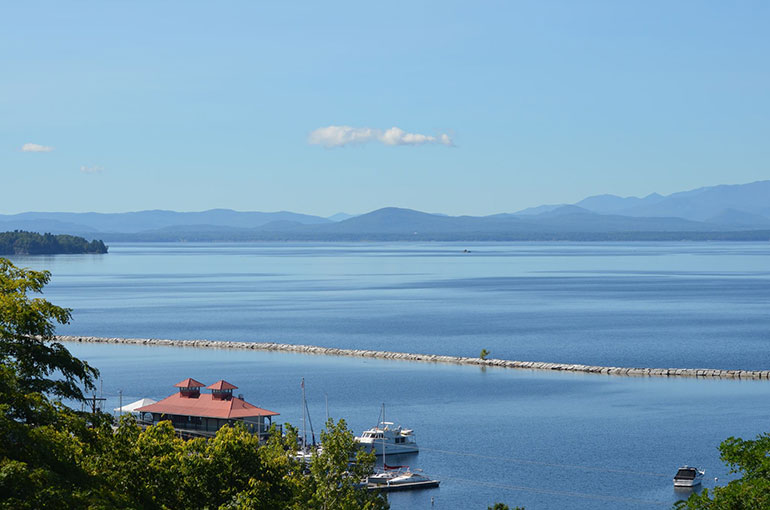
Photo: View of Lake Champlain from Battery Street in Burlington. VermontBiz photo.
by Timothy McQuiston, Vermont Business Magazine
Chittenden County is younger than the rest of the state and wealthier than the rest of the state. It’s the only county in Vermont with a median household income higher than the statewide average. It has major universities, a major airport and a major hospital. The county’s economy and the strength of these organizations are crucial to the wellbeing of the entire state.
And while Hinesburg is the new Williston and Williston is not the old Williston and South Burlington has become a vastly different place than it was just a few years ago, just as Winooski has, the heart of Chittenden County is in Burlington.
Overall, Chittenden County’s economy in 2026 is broadly stable, with many sectors experiencing continued growth, though rising costs and structural pressures are creating challenges for households, employers, and developers.
Businesses report strong sales, but inflation in goods, services, and energy, combined with a tight labor market for skilled trades, is forcing both companies and families to operate more conservatively. The county continues to outperform the rest of Vermont, but high interest rates and limited housing inventory are constraining the real estate market, despite recent positive signs and more housing coming soon.
Office and retail spaces remain in post-pandemic adjustment, which is a nice way to say that there’s been much turnover and, still in the office market, much vacancy.
Housing remains the region’s most pressing issue. There is a significant shortage of workforce and middle income housing, and while new state programs are expected to help, meaningful increases in supply are not anticipated until 2027–28.
Several major projects in Burlington, Williston, and South Burlington are underway, but many remain in planning or early development phases. Those rising construction costs and interest rates are slowing progress and have even postponed projects
The most optimistic news on the rental housing market comes from an article by Carly Berlin for Vermont Public and VTDigger (“Burlington-area rental market cools off, bringing some relief for tenants.” June 9.)
In that article, they describe aggressive building in recent years has provided supply even as demand appears to wane. Those conditions would naturally cause landlords to reduce rents. In Burlington, the vacancy rate had bottomed out to below ½ of 1 percent, a stunning number
Despite these pressures, the rental market is beginning to cool after years of extreme tightness. Vacancy rates have risen to just over 3%, approaching a healthier balance. A surge of new units—more than 800 in 2024 and over 500 in 2025 — has increased supply, particularly at the high end of the market.
This has led to price reductions, incentives, and more competition among landlords. However, the need for deeply affordable housing remains acute, with long wait lists and rapid leasing of new income restricted units. Developers continue to advance hundreds of permanently affordable rental and shared equity homes across the county.
Another issue affecting new building is interest rates. Inflation and supply issues can slow down a project, but developers counting on low interest rates from just a few years ago to finance their projects can no longer do so.
The gleaming apartment buildings in, say the City Center area of South Burlington, benefited in part by beginning their process during the age of historically low interest rates. That golden age ended with the end of the COVID-19 pandemic as the economy bounced back to life starting in 2021. Vast amounts of federal money fueled the recovery and an inflationary spike.
Projects already funded or now self-funded or receiving government assistance are still moving forward.
In contrast to rental properties, single-family home ownership is less dependent on supply and demand and relies a lot on seller intent. If a seller doesn’t get the price they want, they tend to sit on the property until they do, unless they’re compelled to sell. Prices are almost never lower than what they bought it for, even in a recent sale. If the market is down, home prices will remain flat, even for an extended period. Right now demand for single-family homes is still strong and prices keep moving up.
But the days of sight-unseen, no inspection and no-negotiation are over.
The industrial sector is experiencing mixed conditions. High interest rates and global uncertainty have slowed real estate activity and capital expansion, but most manufacturers and technology firms continue to grow, often increasing production without expanding physical space.
Major employers in advanced manufacturing and aviation are contributing to regional momentum, and federal CHIPS Act investments are expected to be a significant catalyst. (A caveat here is the semiconductor shares on Wall Street suffered at the end of June as the over-heated market based on data center needs re-balanced.)
Labor force constraints remain a central challenge in Vermont. Participation and employment numbers are down (the Labor Force fell again in May by 1,233 from April and by 9,768 in a year), and demographic trends suggest the state cannot rely on population growth alone to rebuild its workforce.
Expanding technical and trades education is seen as essential to meeting employer needs and strengthening long-term competitiveness.
Tourism remains a billion dollar industry for the county, though visits from Canada have declined. Hotel occupancy is improving, and local leaders emphasize the importance of marketing and restoring confidence in downtown Burlington, which is benefiting from new events, infrastructure improvements, and a renewed sense of vitality.
Major development projects in Burlington (Great Streets in downtown Burlington in particular and the extensive redesign and construction at Exit 16 on Interstate 89 in Colchester (Costco exit) serve as painful reminders of needed infrastructure projects.
Downtown Burlington has lost several retailers and restaurants. The concept, of course, is that downtown will come roaring back, much as the Faneuil Hall/Quincy Market and Big Dig (early 1990s into 2000s) projects did in Boston, and even the controversial remake of Church Street in Burlington did in the 1980s. Now 50 years later Boston is having to undertake a major revitalization on the Hub’s hub.
Higher education and health care—two pillars of the regional economy—are undergoing significant transitions. University enrollment has dipped, and federal support is tightening. The regional health system is implementing major restructuring, including the elimination of 142 positions, to address substantial financial losses and long-term sustainability concerns.
Relatively new leaders at the University of Vermont (Dr Marlene Tromp) and Dr Stephen Leffler (UVM Health) are both in their first year. Both face the need to tighten their finances under more constrained funding sources. Federal funding has become uncertain at UVM health, including UVM Medical Center, and the hospital system that spans Vermont and Upstate New York has seen costs rise just as reimbursement rates have fallen.
Champlain Parkway
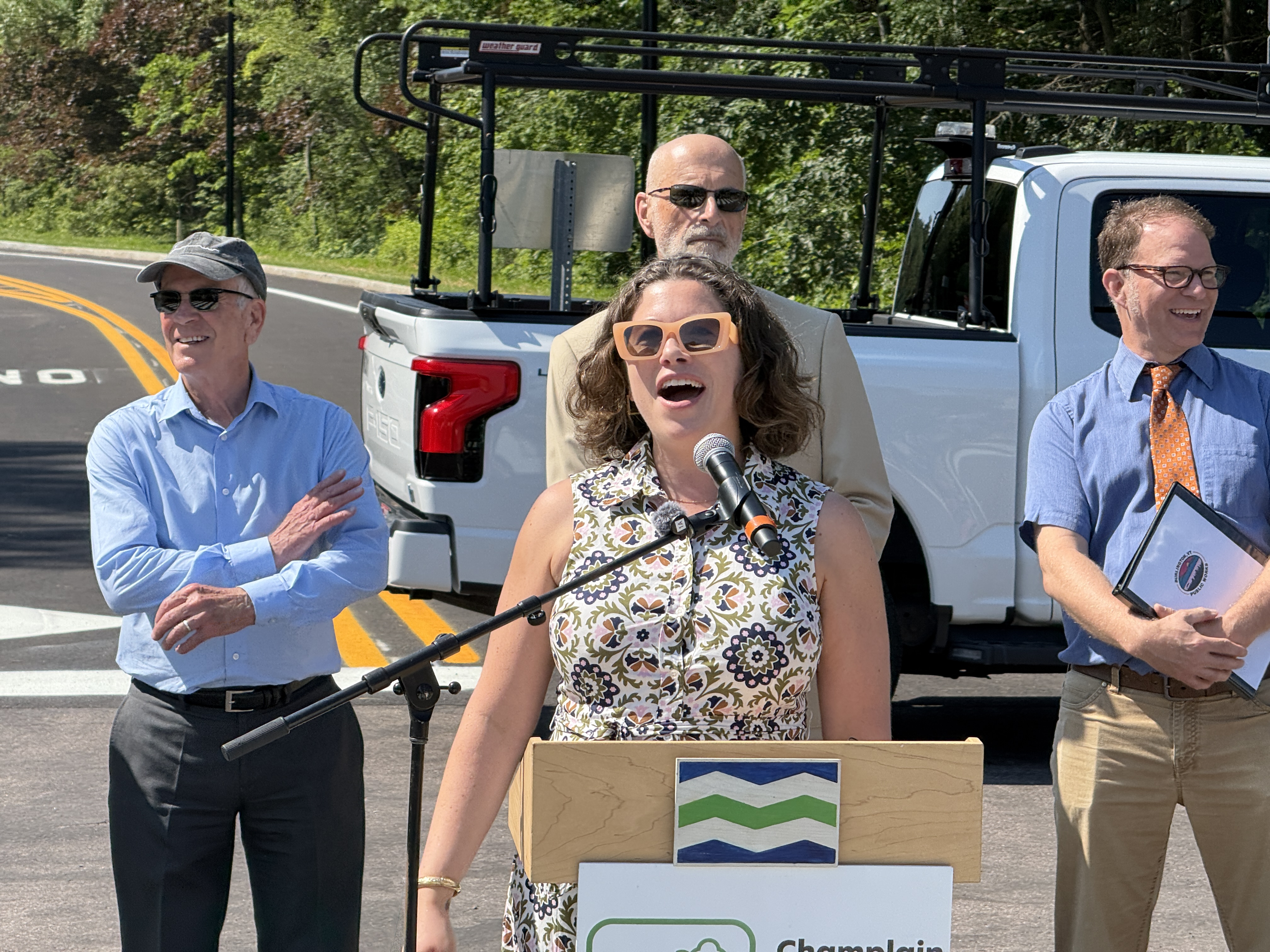
The completed Champlain Parkway was celebrated on June 29, after 61-years. Leading the celebration was Burlington Mayor Emma Mulvaney-Stanak, from left, US Senator Peter Welch, Transportation Secretary Joe Flynn and Burlington Public Works Director Chapin Spencer. VermontBiz photo.
Across the county, large scale infrastructure and redevelopment projects—from the South End Innovation District to the Champlain Parkway—are reshaping the physical and economic landscape. These efforts aim to support housing growth, improve mobility, and strengthen downtown, contributing to what Mayor Emma Mulvaney-Stanak said is a broader sense that Burlington is entering a new phase of adaptation and reinvestment.
The Champlain Parkway is a two-lane, 25 MPH road that will also accommodate pedestrians, cyclists, visitors and residents. Connecting the South End with downtown, this project will alleviate traffic on neighborhood streets while providing an opportunity for everyone to safely navigate all 2.8 miles of roadway. Additional enhancements to the streetscape include stormwater improvements, buried utility lines and pedestrian actuated signalization.
The Parkway connects I-189 in South Burlington at Shelburne Road in an arch to reconnect at Pine Street in Burlington's South End. The original plan was to bypass Pine Street entirely and connect to Battery Street. But the Barge Canal Superfund site required a new route and subsequently helped hold up the entire project despite part of it being completed and abandoned.
Separately there are on-going talks with Vermont Rail to extend the road and alleviate Pine Street choke points. Those plans are still in the negotiation phase.
Officials agreed the current road is not perfect, but that it makes a major advancement in local transportation and is complete, which is a considerable achievement.
All in, Public Works Director Chapin Spencer said the project has cost $84 million. First conceived by the state in 1961 and as a high-speed, four-lane highway by 1965, the city took it over in 1998.
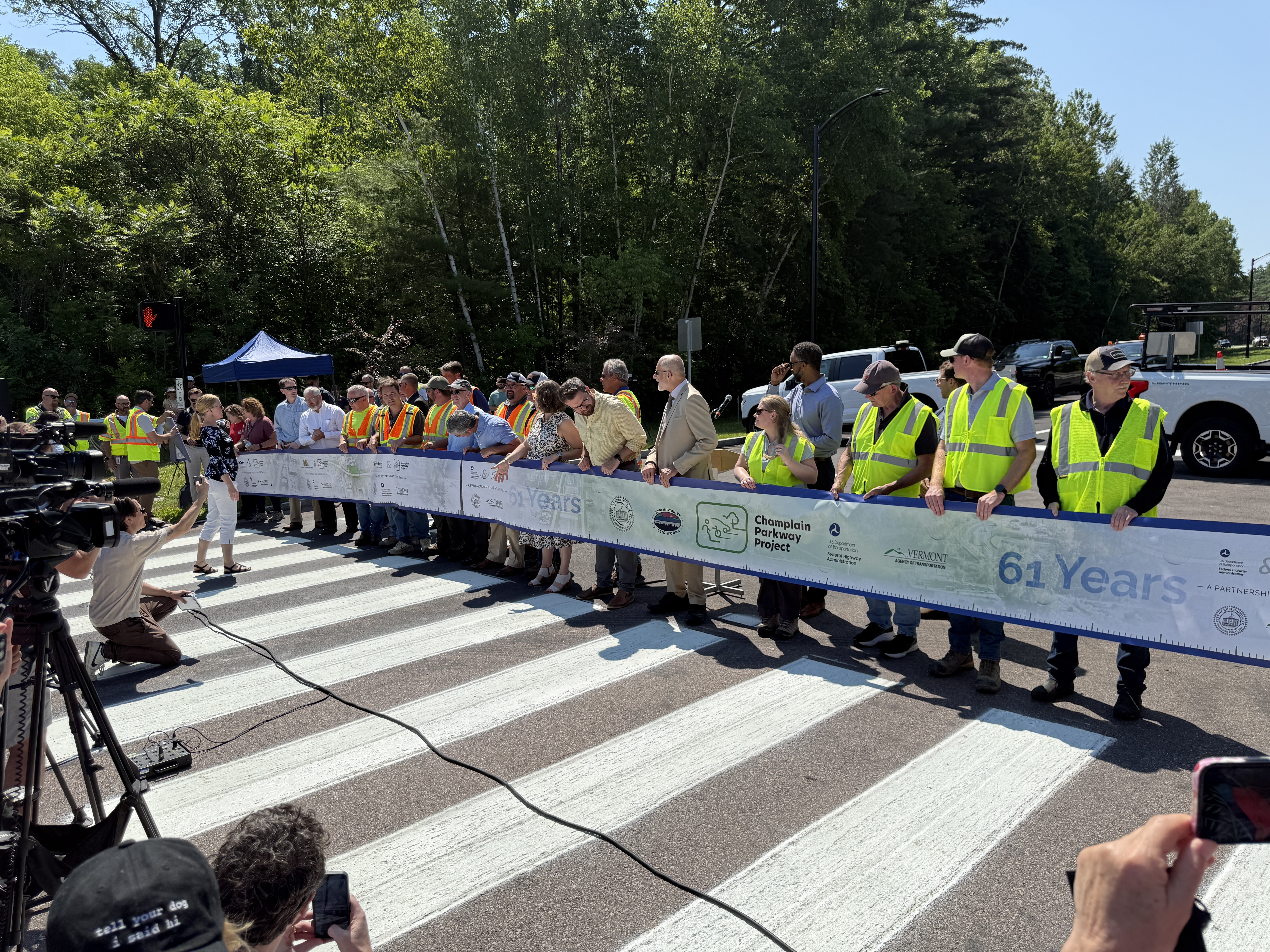
The timeline extended beyond the width of the road. VermontBiz photo.
The County Economy
“The county's economy continues to remain stable with many economic sectors experiencing strong growth, said Frank Cioffi, president of the GBIC (Greater Burlington Industrial Corporation.)
“While many economic sectors experience strong sales growth, rising costs for almost everything force families and businesses to be as conservative and resourceful as possible. Increasing costs of goods and services, rising and volatile energy costs and a very tight labor market for skilled tradespeople affect materials, construction costs and the cost of almost everything.”
“The nature of work continues to change, Cioffi said. “It is unlikely that our state can birth or grow our way out of the currently smaller labor force. Many people will work past traditional retirement ages and continue participating in the workforce. And as a labor market and education strategy Vermont has the opportunity and the imperative to modernize its high school and post high school curriculum offerings in career, technical and trades education and training.”

Photo: Frank Cioffi, executive director, GBIC. Courtesy photo.
Michael Monte, President & CEO, of the Champlain Housing Trust, said: “It looks healthy, but there are several issues to pay attention to. BETA is hiring, but UVM enrollment is down, UVM Medical Center just laid off a number of people, tourism is down, and new immigration from both within and outside the United States is down. Plus there is the national economy with high inflation rates, high interest rates and higher costs to construct anything. So there are some dark clouds on a mostly stable economy.”

Photo: Michael Monte, president & CEO, Champlain Housing Trust. Photo: Baldwin Photography
Said Catherine Z. Davis, President & CEO of the Lake Champlain Chamber, based in Burlington: “The economy in Chittenden County remains strong. Chittenden County accounts for about a third of Vermont’s total employment and a higher proportion of wages earned. We’ve seen some good wage growth as well as steady economic expansion. The regional economy is also diversified, which is good. We are seeing investments happening and employment numbers are strong so I am optimistic.
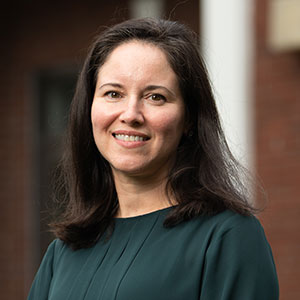
Photo: Catherine Z. Davis, president & CEO, Lake Champlain Chamber of Commerce. Courtesy photo
“It’s not something we can take for granted. As the economic engine of Vermont, it is important that we’re focused on growing the economy here while also growing opportunity in every region of the state. There is plenty of opportunity to go around if we make sound decisions.”
Davis said: “Big infrastructure projects are great long term investments but they do make the day to day of running a business really tough so seeing some of these big projects wrap up very soon will be great (including Great Streets in downtown Burlington, Champlain Parkway, Burlington Square, aka CityPlace).
“We’re very focused on three things: driving growth, expanding our workforce, and making some key investments for the future. The median age in Chittenden County is younger than Vermont's by a good amount. To have a healthy economy and be a place where people can thrive, we need to be a place where young professionals can envision building a life - that means good career choices, the ability to purchase a home, and raise a family. All of the Lake Champlain Chamber’s work, whether it’s our convention center study, our advocacy work, or the programming investments we make is focused on driving, developing and protecting the economy.”
As for UVM, “UVM has an excellent leader in Dr. Marlene Tromp,” Cioffi said. “Over the past year she worked with the entire University Community to craft a strategic plan for the future of UVM and she is now embarking upon implementing the plan. Under her leadership UVM will continue to be a great university of and for Vermont.”
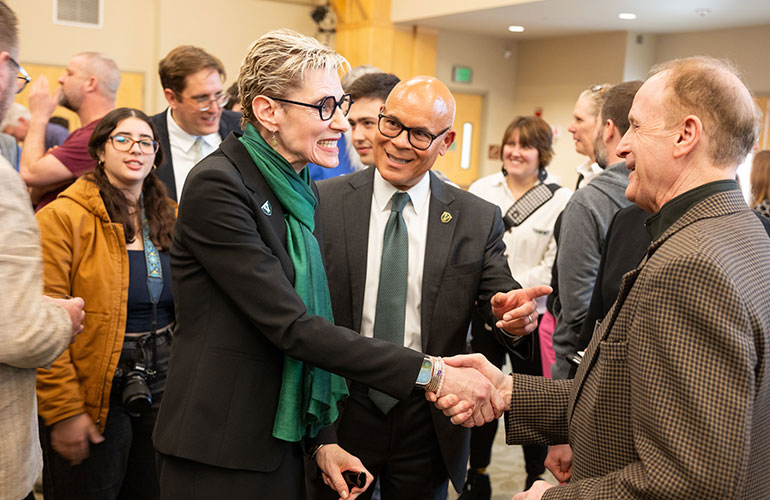
Photo: Frank Cioffi congratulates Dr. Marlene Tromp. Courtesy photo
Housing
How do rental vacancies and housing inventory increases impact the local housing market?
Michael Monte said: “The increased rental vacancies and inventory do not impact the need for us to continue to provide affordable rental and home ownership. It may stabilize prices in the marketplace and that is good for everyone, but we still see a significant need for more affordable housing.
“The high cost of construction and higher interest rates make everything we do more expensive and impact our need to leverage other resources to continue to provide affordable rental and home ownership. It impacts CHT and every other developer who is building housing.
“The funding that has been available is good and we are grateful for these resources. But the level of funding and its impact that occurred during COVID had a phenomenal impact on our ability to provide more housing, and that level of funding will be dropping dramatically over the next year.
“We have about 80 permanently affordable shared equity homes in various stages of development, from Swanton to Burlington to Hinesburg – several in collaboration with Green Mountain Habitat for Humanity.
“And we’ve always believed that communities need more than housing to be vibrant. We just helped Feeding Champlain Valley with their expansion of their facility in Burlington and we are working on the redevelopment of the O’Brien Community Center in Winooski, a $24 million redevelopment and expansion for the City’s library and the Community Health Centers health and dental clinics.
“I believe we are making progress (on housing), but the need is great and on many different fronts. There is a need for more one bedroom apartments as household sizes decrease but also larger family homes for recent immigrants who have larger families. Special populations need a specific type of housing. This is particularly true for homeless households who really represent a wide variety of needs. There are the needs of the DDHI community (Developmental Disabilities Housing Initiative). And we need a wider range of home ownership affordability.
“While there has been a lot of investment over the past several years allowing us to move a housing development pipeline that is varied and more substantial than we’ve ever seen, there’s more in front of us. Put quite simply, for working Vermonters and people with the lowest incomes, the job is not done. That’s going to take a sustained level of both prioritization and funding to see it through.”
Cathy Davis said: “As you saw with the rental vacancy rates released recently, we’ve made some progress in the rental market. That’s great but opportunities for people to buy and set down roots affordably is still a major gap in the market. We shouldn’t let off the accelerator on building rental but we really need to build more single family homes that middle income families can afford.”
GBIC’s Cioffi said: “While the Chittenden County housing market remains stable, there continues to be a very low inventory of homes for sale which continues to affect home values. Interest rates and housing prices have created a more challenging residential real estate market. The office and retail markets are still undergoing major post-COVID era adjustments.”
“There is a huge need for workforce and middle income housing throughout our state. We believe that Governor Scott's priority of creating more middle income and workforce housing and the new Community Housing Infrastructure Program (CHIP) will significantly and positively impact the acceleration of housing growth in our region and statewide. However the CHIP program is just becoming operational, and we do not expect seeing increased middle income housing become available until 2027-28. Major projects in Burlington, Williston and South Burlington are in various stages of planning, permitting, site development and construction phases.”
Burlington
While major infrastructure projects are coming together and plans for a major housing project in the South End is off to a promising start, the long-awaited completion of Burlington Square formerly CityPlace has run into issues that will put off completion until as late as December 2027.
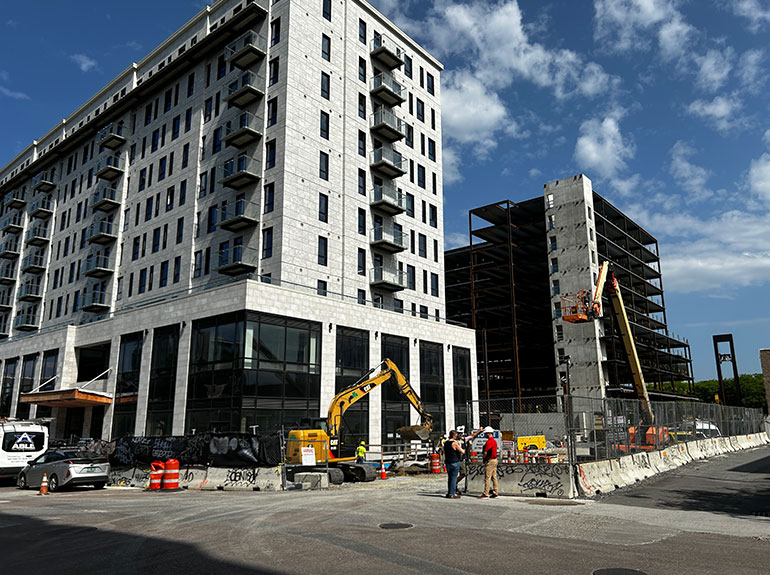
Photo: The North and South towers at Burlington Square, formerly known as CityPlace, take shape. The development is expected to open in 2027. VermontBiz photo.
In May, the Burlington City Council approved the Fourth Amendment to CityPlace ARDA 2.0.
The amendment was required as requested by the developers as they could not meet the current deadline. While the South Tower with its hotel and rental units and its 10 stories is a shining example of the new Burlington, the North Tower, with mostly housing, is still a work in progress.
The extension was approved and any penalties were waved because the mayor’s office, the Council and nearly everyone in Burlington and the county and the state wants the project completed.
The North Tower, well under construction, will feature 364 total housing units, 73 of which are designated as affordable housing to meet inclusionary zoning laws. Their new deadline is December 31, 2027.
Kara Alnasrawi is the Director of Burlington’s Community & Economic Development Office (CEDO).
She had a blunt presentation for councilors and Mayor Emma Mulvaney-Stanak:
“This is not exactly the place we all want to be in right now. Neither the developers nor the city…
“This project in the heart of our downtown I feel very strongly is so close to the finish line. It is in a little bit of a fragile state. As you all know, it’s been decades in the making.
“Our request here is to assist the developers in getting this across the finish line. That entails an extension of the delivery of the Inclusionary Zoning Units. The maximum extension is to December 31, 2027. However, we do expect TCOs (temporary certificates of occupancy) will be issued, some as soon as June 2027. So one year from now.
“And I want to reiterate that no certificates of occupancy, permanent or temporary, will be issued without the inclusionary zoning units(affordable housing) permits. So we will not be having any more market rate units hit the market before we see inclusionary zoning units.”
Alnasrawi said: “We had discussed that some of their financing was in jeopardy. They need this extension to lock down the funding on the North Tower, which they hope to have in the next few weeks. As the director of CEDO, this is not my favorite position to be in.
“I will say, however, that when we sign these development agreements, like we will be signing with SECORD, these are living and breathing documents. They are documents that react to market conditions, whether we like that or not, that is the reality, this is not a project that is fully, federally funded in any way. That funding has dried up. So CEDO is in the business of bringing forth public/private partnerships, where we need to be sensitive to our private sector partners and understand how the economy and market condition are impacting them.”
SECORD (South End Coordinated Redevelopment) project) is in the development phase and will be built on what is now a massive parking lot off Lakeside Avenue in Burlington’s South End.
It’s envisioned as a massive, sustainable, mixed-use neighborhood being built on a 13-acre former industrial site. The project aims to add over 1,000 to 1,200 new homes. The first phase will include 204 housing units (122 one-bedrooms, 49 studios, and 33 two-bedrooms), of which at least 20% will be affordable.
The first $100 million phase will be all-electric and utilize geothermal technologies and mass-timber construction. TIF funding will help with infrastructure costs and the project, supported by the city, Champlain College, CHT and Ride Your Bike, LLC, also received $8 million from the state Treasurer’s 10% in Vermont housing initiative.
Ground breaking could begin as early as this September with the phased development taking several years to complete.
As for Burlington Square, the project has face many iterations. The center section of the former mall was demolished in 2018 and laid bare for several years until a new ownership group restarted the project in November 2022. The front facing section on Church Street and the former Macy’s on the west end (and now former Burlington High School) remain undeveloped and have a different ownership structure.
“The local developers leading the redevelopment of downtown Burlington are doing a great job; their project will have a tremendously positive impact on downtown Burlington,” Frank Cioffi said.
The mayor said at a press conference in late June on Church Street that: “Over the last several months, I've heard it from residents, business owners, and visitors alike,” said Mayor Mulvaney-Stanak. “There is a growing sense that Burlington is turning a corner. The energy is back. Confidence is returning. This city is moving forward.”
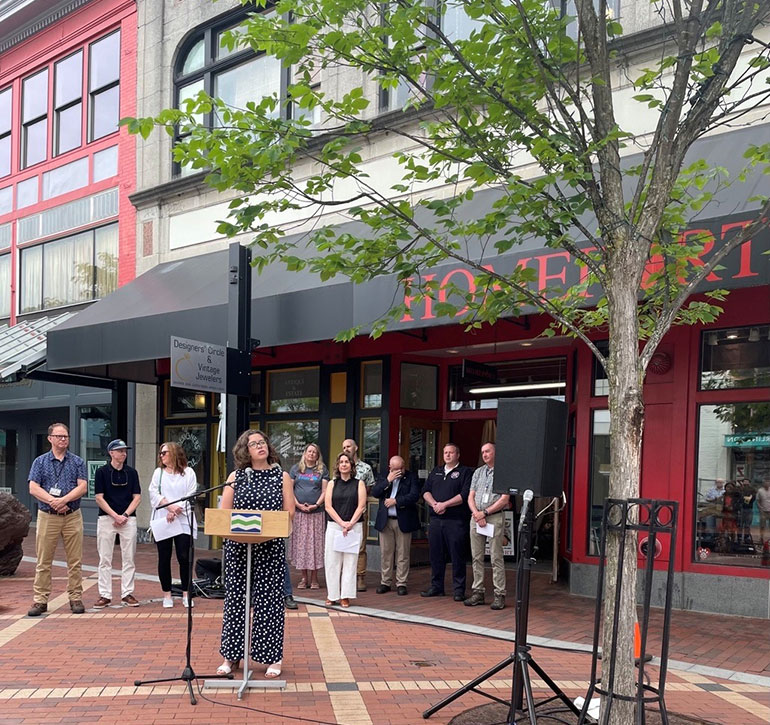
Photo: " Burlington is Back", Mayor Emma Mulvaney-Stanak on Church Street. VermontBiz photo
She also addressed long-standing safety and security concerns from residents, businesses and visitors.
“Community safety requires more than policing alone,” the mayor said. “Our approach recognizes that lasting progress comes from addressing challenges from multiple angles, and we are beginning to see meaningful results.”
The mayor also highlighted the impact of major infrastructure projects that are beginning to transform the city.
The Great Streets Main Street Project and the Champlain Parkway represent generational investments designed to improve mobility, support housing growth, strengthen downtown, and enhance Burlington’s long-term sustainability.
“For years we talked about what these projects would mean for Burlington,” Mulvaney-Stanak said. “Now we are beginning to see the benefits.”
The mayor also recognized the resilience of downtown businesses that navigated years of construction and disruption, including Bar Renée, which opened during the height of the Main Street reconstruction project.
“Opening a new business under any circumstances is a leap of faith,” the mayor said. “Opening one during a major construction project takes extraordinary commitment and belief in the future. As Main Street emerges renewed, we look forward to the next chapter of downtown – one in which businesses like Bar Renée will help lead the way, bringing energy, community, and new life to the area.”
In addition, The Great Streets Main Street project boasts a modern sewer system bypassing the 160-year-old ravine sewer, a new foundation exists for more housing and modern commercial development. Wider sidewalks and shorter crossings enhance the downtown experience for families and visitors. More trees, gardens, and subsurface stormwater infiltration help protect our environment. Enhanced lighting, new public art, outdoor seating and a protected bike lane ensure Burlington’s Main Street remains Vermont’s Main Street – open and welcoming to everyone.
The city will host a Block Party on July 17 & 18 to celebrate its (almost) completion after a long and for some businesses, visitors and residents, a painful process.
"This is a celebration of everyone who helped shape Burlington's new Main Street," said Burlington Mayor Emma Mulvany-Stanak. "From the businesses that persevered through construction to the City team, contractors, artists, residents, and community partners who brought this vision to life, the Block Party is an opportunity to rediscover downtown, support our local businesses, and experience the energy of our beautiful new Main Street."
Industrial Development
“Interest rates are affecting capital and facility expansions in our region. Industrial real estate activity has also slowed somewhat due to costs and concerns about global economic uncertainty,” Frank Cioffi said.
“But most industrial employers in our region and state are growing and are finding ways to increase production without expanding physical facility space.
“Our region and state have been fortunate to host many globally renowned manufacturers and technology businesses producing goods and services in Vermont and they continue to grow every year.
“BETA Technologies' phenomenal growth and investments have been a great asset to our region and our state.
“Also planned CHIPS Act-related investments at GlobalFoundries will be a significant economic catalyst for our region and our state.”
Tourism
Cathy Davis said: “The visitor economy in Chittenden County is a billion dollar industry so it is incredibly important to both the region and the state’s economies. Plus, visitors help maintain so many of the amenities that we locals love to enjoy. We continue to see fewer visits, understandably, from our neighbors in Canada.
“This summer and fall are showing signs that hotel occupancy is bouncing back after a couple of tough years but that is not a given and we need to invest significantly in marketing the region because other nearby states haven’t seen the downward trend we have. Downtown Burlington really feels like itself again.
“Our visitor division, Hello Burlington, just launched a new campaign called “Don’t Dream It B. it.” and it’s really about celebrating this beautiful city and the region we are all lucky to call home. “People need to stop the chatter and get downtown and enjoy it. Get out on the lake, hear some live music, check out Burlington’s beautiful new Main Street and remember why you love this jewel of a place.”
The Future
“We continue to work with our region's key employers to understand their ongoing needs for remaining competitive in their Vermont locations,” Frank Cioffi said
“A top GBIC public policy priority for the next two years will be encouraging our state to create more access to career technical and trades education in high schools and for adults. When “over 50% of our high school graduates do not pursue higher education, then our high school educational system must provide more education and training in skill sets that lead to jobs in key economic sectors. If done correctly, this could significantly strengthen our labor market and help in retaining and growing excellent employment opportunities.”
Cathy Davis said of a proposed UVM Arena/Convention Center: “Am I confident it will happen? Well the Champlain Parkway is about to officially open so I’ve learned to never say never when it comes to big projects in Vermont – they just take us decades longer than they should. I am hopeful that the stars align for the UVM Arena and we are in the second phase of a project studying the feasibility of a convention center. The two projects together would bring incredible new opportunities to the region for locals and the economy alike.”
Cioffi said, “Consolidation across all industry sectors will continue to evolve. Dynamic change and innovation will be the only constant. That really could be an asset for great places like Vermont as people in many economic sectors can work remotely from where they want to live.”
To support vital journalism, access our archives and get unique features like our award-winning profiles, Book of Lists & Business-to-Business Directory, subscribe HERE!
 Vermont Business Magazine