

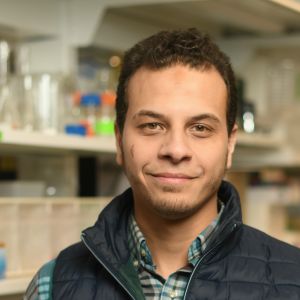
Osama Harraz, Ph.D., Bloomfield Professor in Cardiovascular Research and assistant professor of pharmacology at the Robert Larner, M.D. College of Medicine at the University of Vermont, has been selected as a 2026 Pew Scholar in the Biomedical Sciences, The Pew Charitable Trusts announced today.
With this distinction, Harraz joins a cohort of 21 early-career scientists nationwide pursuing innovative research in health and medicine. He is the third researcher in UVM history to receive this honor.
Additionally, Harraz is one of a subset of the Pew Biomedical Scholars named as the Kathryn W. Davis Aging Brain Scholars. Supported by the Kathryn W. Davis Peace by Pieces Fund, Aging Brain Scholars' research will increase our understanding of the processes and conditions of the brain as we age.
"I am honored to be named a 2026 Pew Biomedical Scholar. This award provides critical support to pursue bold, high-risk questions at the interface of vascular and neural biology, with the goal of uncovering new approaches to combat neurodegeneration. It also connects our lab to an exceptional community of innovative scientists whose creativity and collaboration continually drive discovery,” said Harraz.
Scholars were chosen from 211 applicants nominated by leading academic institutions and researchers throughout the United States. This year’s cohort includes scientists who are harnessing new technology to examine human health and behavior, studying the building blocks of immunity, and engineering new methods to protect and treat disease.
"Dr. Osama Harraz is exactly the kind of scientist the Pew Scholars Program was designed to support. In just four years at UVM, he has built a nationally recognized research program on the mechanisms of cerebral blood flow, secured funding from the National Institutes of Health, the American Heart Association, and the Chan Zuckerberg Initiative, and delivered over 40 invited lectures at institutions including Harvard Medical School, Vanderbilt, and UCLA. His election as a Pew Scholar is a testament to the transformative promise of his science — and a signal to the field that the next major breakthroughs in cerebrovascular disease may well come from Burlington, Vermont,” said Mark Nelson, Ph.D., University Distinguished Professor and chair of pharmacology at the Robert Larner, M.D. College of Medicine.
As a Pew Scholar, Harraz will receive four years of flexible funding to support foundational research. His lab will investigate the biological mechanisms that protect naked mole rats from neurodegeneration. This work can help scientists develop new medicines for humans to prevent cognitive decline and neurological diseases such as Alzheimer’s and Parkinson’s.
“Unlike humans and other mammals, naked mole rats can survive prolonged periods of low oxygen—hypoxia—without sustaining brain damage,” said Harraz. “They also exhibit a natural resistance to neurodegeneration, which makes them a unique model for studying these processes.”
Harraz and his team have observed that, compared to mice, naked mole rats have a unique brain vascular system—which could provide their neurons with a more robust blood supply. Using advanced imaging of the structure and function of the brain vasculature in naked mole rats, the scientists will examine whether this enhanced vascular architecture protects their brain from hypoxia by increasing blood flow, particularly to highly active neurons with greater oxygen demands.
The research will also identify genes and molecular pathways that contribute to neurodegeneration resistance. Findings from this work could lead to new strategies to preserve healthy brain function.
“Scientific discovery is moving at a rapid pace, and now more than ever we need curious and creative researchers leading the charge,” said Lee Niswander, Ph.D., a 1995 Pew scholar and chair of the program’s national advisory committee. “These new biomedical scholars are prepared to meet that challenge, and I look forward to watching their research unfold.”
This year’s class of early-career, junior faculty joins a legacy of more than 1,000 scientists who have received awards from Pew since 1985. During their time as scholars, they will have opportunities to meet annually with fellow Pew-funded scientists to forge connections and cultivate community across a wide variety of disciplines.
Harraz earned his bachelor’s and master’s degrees from Alexandria University, Egypt, and his Ph.D. degree from the University of Calgary in Canada, where he studied ion channels in brain blood circulation. While in graduate school, he received the Vanier Canada Graduate Scholarship, one of the country’s most prestigious doctoral awards. He completed postdoctoral training at the University of Vermont, where he identified a phospholipid regulator that controls distinct signaling modalities in brain capillaries.
Established in 2021, the Harraz Lab at the Larner College of Medicine focuses on brain vascular ion channels and signal transduction pathways that regulate blood flow, with the goal of understanding how these processes are disrupted in disease. This research is supported by the National Institutes of Health, the Chan Zuckerberg Initiative, and the Bloomfield Professorship.
Research like this has contributed to the University of Vermont’s designation by the Carnegie Classification of Institutions of Higher Education as an R1 institution, placing it in the top tier of research universities in the U.S.
About the Larner College of Medicine at the University of Vermont
Founded in 1822, the Robert Larner, M.D. College of Medicine at the University of Vermont is the seventh-oldest medical school in the nation. The college is dedicated to developing exceptional physicians and scientists by offering innovative curriculum design, state-of-the-art research facilities, and clinical partnerships with leading health care institutions. The college’s commitment to excellence has earned national recognition, attracting talented students, trainees, physicians, and researchers from across the country and around the world. With a focus on inclusive excellence, the Larner College of Medicine prides itself on cultivating an environment that uplifts and supports
its faculty and student populations while advancing medical education, research, and patient care in Vermont and beyond. uvm.edu/larnermed
About The Pew Charitable Trusts
Founded in 1948, The Pew Charitable Trusts uses data to make a difference. Pew addresses the challenges of a changing world by illuminating issues, creating common ground, and advancing ambitious projects that lead to tangible progress.
To support vital journalism, access our archives and get unique features like our award-winning profiles, Book of Lists & Business-to-Business Directory, subscribe HERE!
 Vermont Business Magazine