

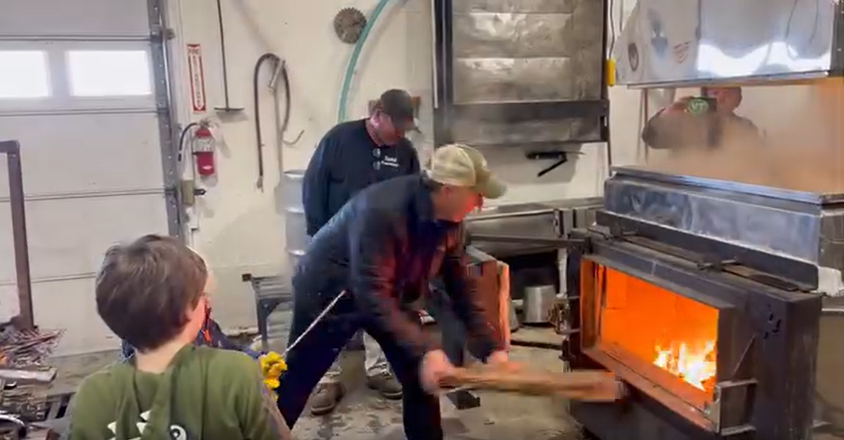
Governor Scott feeds the flames of an evaporator in Canaan in April. VAAFM photo.
USDA releases statistics today, including 2025 Maple Syrup revenue over $100 million
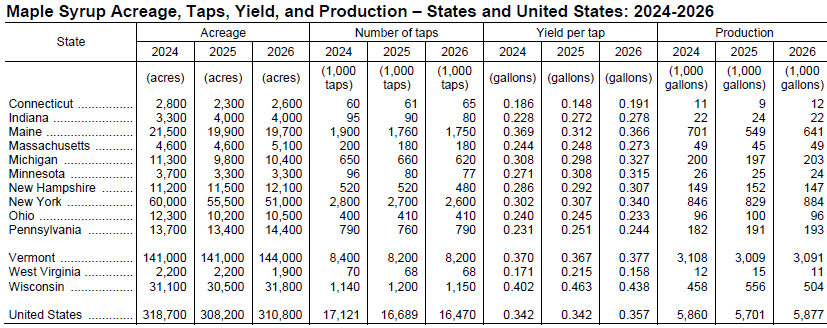
Vermont Business Magazine The USDA National Agricultural Statistics Service (NASS) reported today that 2026 Vermont maple syrup production totaled 3.091 million gallons, once again leading the nation in this category producing more than 50% of the nation’s maple. This follows 2 years of similar output in 2024 (3.108) and 2025 (3.009 million).
“Maple production is an important part of Vermont’s identity and economy,” said Governor Phil Scott. “These impressive results reflect the hard work and dedication of Vermont’s sugarmakers, which is key to keeping Vermont at the top of the charts in maple production.”
Vermont continues to top the nation in maple syrup production. Vermont maple syrup producers deployed 8.2 million maple taps in 2026, and the yield per tap is estimated to be 0.377 gallons, bettering the output of the 2025 season. Many maple producers experienced traditional winter conditions from New Years Day through mid-March. Large snowstorms were few, but temperatures remained fairly consistent, allowing snowpacks to build up in the sugar woods. Mid-March through April temperatures permitted many sap runs that started and stopped with some cold days, but on the whole were more consistent than recent years.
“We are proud of Vermont’s maple producers and all they do to produce a world-class product. Their commitment, innovation, and hard work continue to set the standard for excellence. Once again, Vermont leads the nation in maple production, and we thank our producers for their dedication to this iconic industry,” said Vermont Agriculture Secretary Anson Tebbetts.
|
2026 Maple Season By the Numbers |
|
|
Total Production |
3.091 million gallons |
|
Number of Taps |
8.2 million |
|
Yield Per Tap |
0.377 gallons |
|
2025 Revenue |
$102 million |
|
2025 Average Retail Price |
$51.40 |
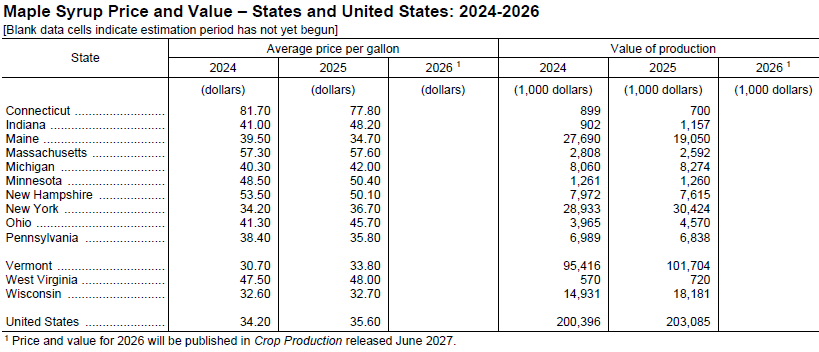
Included in this NASS reporting is the revenue for Vermont’s 2025 maple season. The value of maple syrup production totaled $101,704 million in 2025, up $6 million from 2024. The average retail price per gallon in 2025 was $51.40 per gallon.
Vermont has led the U.S. in the number of maple taps every year since 1916 and was only out produced in 1926 and 1918. In 2003 Vermont had 2.12 million taps and has steadily increased that number to 8.4 million in 2024. Annual production prior to 1935 was typically between 1 million and 1.4 million gallons. This dropped to around 200,000 to 300,000 gallons in the 1970’s. Since 2003 Vermont’s maple syrup production has increased from around 500,000 gallons to 3.108 million gallons in 2024.
According to the Vermont Maple Sugar Makers’ Association, Mother Nature put on another show this sugaring season—another winter with lots of snow, a really warm March, and a season bookended by windstorms in some counties. Another reason Vermont’s sugar makers are continuous innovators and optimists! By March, Vermont had already experienced temperatures that were below average for December, January and February, making this the coldest winter since 2014-2015.
By the end of January, Jay Peak had recorded over 300” of snow and plenty of sugar makers pulled out their snowshoes for tapping. In stories from sugar makers across Vermont, there are some similarities between the 2025 and 2026 seasons - a late start for many, lots of snow while tapping, and no snow while pulling taps. In data gleaned from VMSMA’s annual member crop survey, producers reported an average crop year across the state. Given the amount of snow that kicked off the season and the limited number of warm, spring-like days in March, that’s pretty good news.
Tuesday, March 10th stands out as a record breaker in many areas and when folks across the state experienced really strong sap flows as the temps soared up to 70 degrees.
Through VMSMA’s survey, 41% of responding sugar makers reported an average crop year, but almost as many reported either an above average or record breaking year (37%). About 23% reported a below-average year, down from 25% last year. That variation is often due to the intersection of specifics like location, temperature, slope, and the microclimates of individual sugarbushes. It’s interesting to note that once again those reporting above-average crops came from 10 different counties - Windsor, Franklin, Chittenden, Caledonia, Orleans, Lamoille, Washington, Windham, and Bennington —a geographically wide swath of the state.
Meanwhile, 24% of respondents noting a below average year were in Chittenden County, with Washington and Lamoille not far behind at 16%. Compare that to folks who reported record breaking crops this year - 36% of which were in Chittenden County (the same county that reported most of the below average crops).
Many Vermont producers noted changing up equipment or trying “new to them” set ups this season, with good results - from sap ladders and filter presses and vacuum sensors, to pumps and getting started with vacuum and RO.
Some producers transitioned from sap only to syrup production or were on their own in the sugarhouse for the first time. Lots of changes, lots of optimism and curiosity about those changes, and opportunity in between sap runs to tinker.
In general, Vermont producers noted big sap runs with freeze ups in between, with things loosening up on that really warm day across the state in March. Many noted making darker syrup first this year.
One producer summed it up nicely, “This season was fast and furious!”
Many survey respondents also noted strong sap runs and high-quality syrup production this year. Best practices for sugarbush health and syrup quality will continue to be a major focus of VMSMA’s work with producers and research partners. Looking ahead, VMSMA’s efforts will emphasize climate resilience, syrup quality and food safety, forest health, and operational best practices grounded in current and ongoing research.
A few anecdotes from around the state:
- “Very cold, long winter meant extended periods with no runs (all of January and February) then in March it would run for several days straight with no break and then freeze up for several days straight, making it challenging from a schedule and sleep standpoint. Also as a result of the deep cold we experienced more frozen lines and equipment than normal including lines buried underground. Otherwise pleased with the sap quality and sugar content.” - Sugar maker from Addison County
- “Had some of the biggest runs ever in a 24 hour period.” - Sugar maker from Orleans County
- “Extreme snow depth, later start, big runs then no activity, input costs up vs price paid for syrup sales” - Sugar maker from Caledonia County
The Vermont Maple Sugar Makers’ Association (VMSMA), founded in 1893, is one of the oldest agricultural organizations in the United States and represents over 750 members. The VMSMA helps to promote and protect the branding and quality of pure Vermont maple products and to serve as the official voice for Vermont sugar makers. Our members take great pride in maintaining a prosperous maple industry, diverse and healthy forests, and a working landscape that future generations will enjoy. Vermont sugar makers produce over 3 million gallons of maple syrup annually (generally over one half of the production in the United States). More information at www.VermontMaple.org.
The ‘Crop Production’ report and all other NASS reports are available online at www.nass.usda.gov.
June 11, 2026 | Montpelier VT – VAAFM
To support vital journalism, access our archives and get unique features like our award-winning profiles, Book of Lists & Business-to-Business Directory, subscribe HERE!
 Vermont Business Magazine