

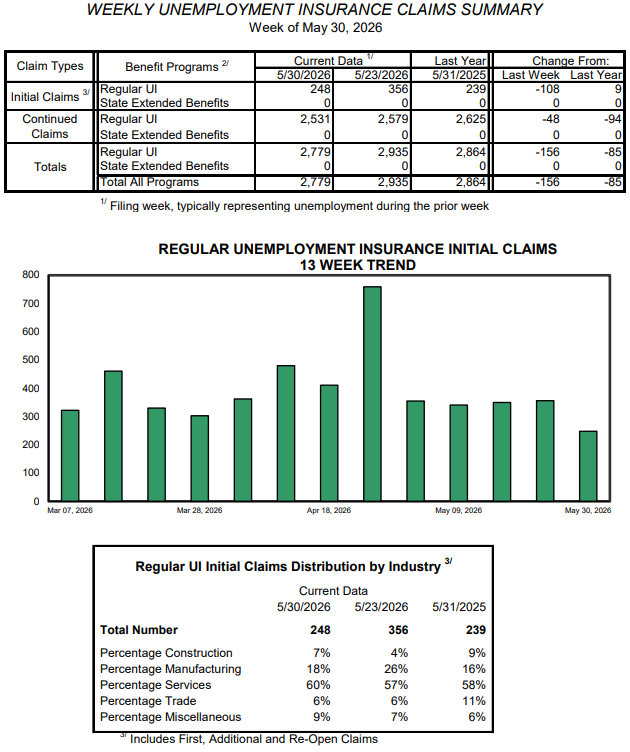
by Timothy McQuiston, Vermont Business Magazine Vermont initial weekly unemployment claims fell last week to their lowest level since the end of last summer. For the week ending May 30, 2026, the Vermont Department of Labor reported that there were 248 new claims, down 108 from the previous week and up 9 from last year at this time. The end of the winter tourism season typically brings a flurry of layoffs; claims had spiked in April. Summer hiring typically reverses that trend. Meanwhile, total claims this week were 2,779, down 156 from the week before and down 85 from last year at this time. Initial claims, which tend to be lowest in the summer, were 186 in September 2025.
Nationally, stocks fell sharply on Friday after several rollercoaster weeks, as chip stocks cratered. The DOW fell 1.3%, the S&P fell 2.6% and the Nasdaq fell a whopping 4.2%. Th markets are expecting big things with the SpaceX IPO scheduled for next week. The future of oil prices remains uncertain depending on the latest news about Iran, but gasoline prices reached four-year highs of over $4.50 over the last month before edging down this week. They are still at their highest since summer 2022. US GDP saw a solid, but lower than expected, increase of 2% for the first quarter, as inflation remained over 3% in April.
The hike in inflation is unlikely to cause the Fed to raise or lower interest rates until at least later this year. The Fed will next meet June 16-17. Inflation (which could cause the Fed to raise rates) is weighed against softening economic conditions (which could cause a lowering of rates). The US DOL issued a strong hiring report Friday, with the US adding 172,000 jobs.
In Vermont for the weekly labor UI claims report, manufacturing accounted for 18% of the total, down 8 points from the previous week. Manufacturing overall has become a smaller part of the Vermont economy over the last 25 years and that trend appears to be continuing. The Service industry, which typically accounts for the most claims, last week reported 60% from the previous week, up 3 points. Construction was 7%, up 3 points.
In the week ending May 30, the advance figure for seasonally adjusted initial claims was 225,000, an increase of 13,000 from the previous week's revised level. The previous week's level was revised down by 3,000 from 215,000 to 212,000. The 4-week moving average was 214,750, an increase of 6,500 from the previous week's revised average. The previous week's average was revised down by 750 from 209,000 to 208,250.
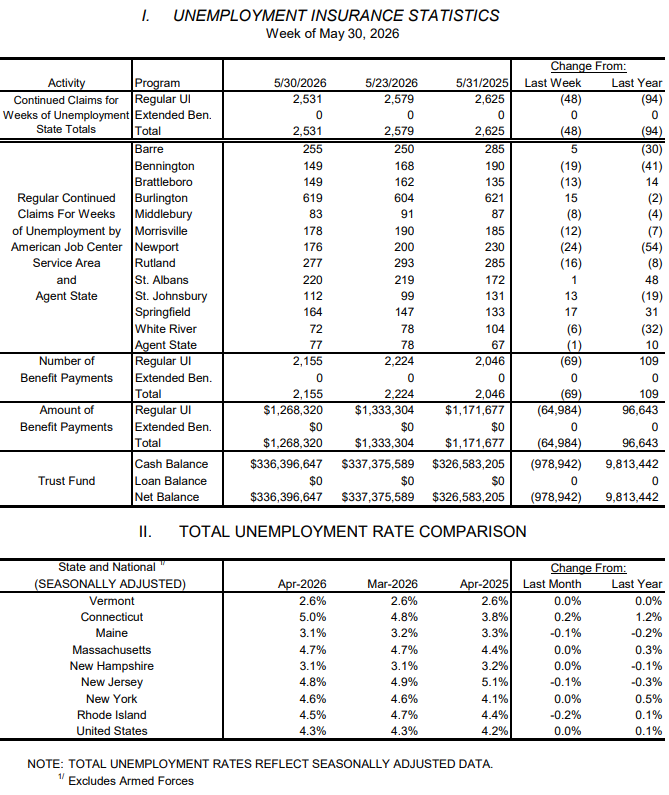
The Vermont Unemployment Trust Fund is well capitalized. As of the most recent data, there was $336.4 million in the Trust Fund, down $1 million from the previous week (as claims are paid out on one side, employers are contributing to the fund on the other). The pre-pandemic Trust Fund balance on March 1, 2020, was $506.2 million.
GF exceeds revenue targets, led by Personal Income Tax
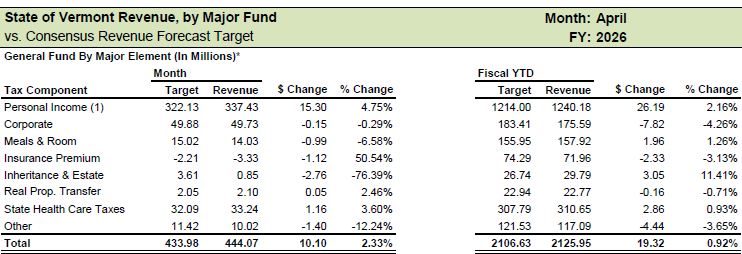
For April 2026, the General Fund and Transportation Fund exceeded their monthly consensus targets while the Education Fund missed its monthly target.
The state’s General Fund, Transportation Fund, and Education Fund receipts totaled $537.6 million, exceeding the $529.3 million monthly consensus target by $8.3 million, or 1.6%.
Total General Fund revenues were $444.1 million, which is $10.1 million, or 2.3%, above the $434.0 million monthly consensus cash flow target. This result was driven primarily by the better than expected performance by the Personal Income Tax (+$15.3M, or 4.7%, above consensus expectations) – partially offset by underperformance in April Estate Tax receipts (-$2.8M, or 76.4% below target) and to a lesser extent, the Meals & Rooms Tax, Telephone Tax, Beverage Tax, and Bank Franchise Tax.
With two months left in the fiscal year (ending June 30), the GF is ahead of targets by over $19 million, or nearly 1%.
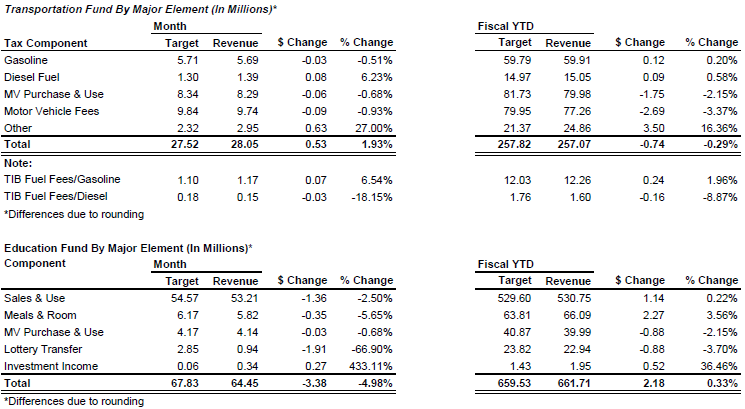
Transportation Fund revenues exceeded their April consensus target of $27.5 million by $0.5 million, or 1.9%, reaching $28.1 million in total. Cumulative Transportation Fund receipts continued to remain $0.7 million, or 0.3%, below their year-to-date consensus target.
Category performance was mixed: with Diesel Tax and Other Fees revenues performing above consensus expectations, while Gas Tax, Motor Vehicle Fees, and Motor Vehicle Purchase & Use tax underperformed.
Education Fund revenues for April were $65.5 million, falling $2.4 million, or -3.5%, short of the $67.8 million monthly target. With the exception of Investment Income, no category met its monthly target.
The largest underperformers were the Meals & Rooms Tax (-$0.3 million, or 5.7% below target) and the Lottery Transfer (-$1.9 million, or 66.9% below target). Even so, cumulative Education receipts remained slightly above cumulative consensus expectations at $3.2 million, or 0.5% above cumulative consensus expectations.
According to Secretary Clark: “Despite substantial macroeconomic turbulence, state revenues have held up well. With two months remaining in the fiscal year, the General Fund and the Education Fund are tracking above their consensus revenue targets year to date, and the Transportation Fund is only slightly below target. We are watching revenues closely as the year comes to a close.”
Vermont’s unemployment rate held at 2.6 percent in April
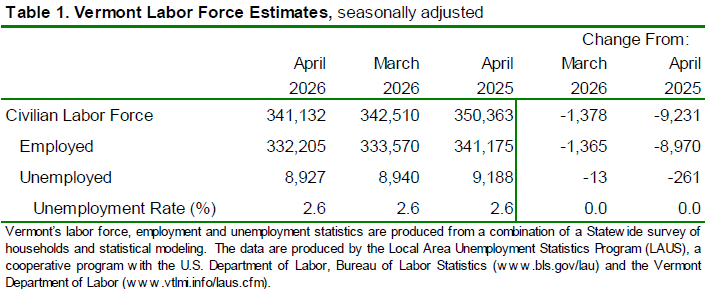
The Vermont Department of Labor has released the April 2026 seasonally adjusted statewide unemployment rate, which was unchanged at 2.6%. This was the result of the Labor Force and Number of Employed both falling significantly. The civilian labor force participation rate was 62.7 percent in April, a decrease of two-tenths of one percentage point from the prior month’s revised estimate.
The comparable United States rate in April was 4.3 percent, no change from the revised March estimate. Vermont has the fourth lowest jobless rate in the nation. The lowest is South Dakota at 2.2% and the highest is a tie among California, Delaware and Nevada at 5.3%.
“The size of Vermont’s labor force continues to steadily decline even as higher costs put pressure on household budgets across the state. While the Department can’t solve those broader economic challenges, we can support individuals looking to increase their income,” said Kendal Smith, Commissioner of the Vermont Department of Labor. “For some, this may mean working with a Workforce Development specialist to assess skills and identify opportunities with higher earnings potential. For others with some extra time, they may need support finding a solid part-time job to supplement household income. Individuals and employers alike are encouraged to contact the Department at https://labor.vermont.gov/workforce-development to learn more about how we can work together.”
The seasonally adjusted Vermont data for April show the Vermont civilian labor force decreased by 1,378 from the prior month’s revised estimate (see Table 1). The number of employed persons decreased by 1,365 and the number of unemployed persons decreased by 13. The changes to the labor force and number of employed persons were statistically significant in the seasonally adjusted series.

The April unemployment rates for Vermont’s 14 counties ranged from 2.2 percent in Chittenden County to 5.3 percent in Orleans County (note: county unemployment rates are not seasonally adjusted – see Table 2). For comparison, the April unadjusted unemployment rate for Vermont was 2.8 percent, an increase of two-tenths of one percentage point from the revised unadjusted March level and no change from a year ago.

Seasonally Adjusted (Table 3)
The seasonally adjusted data for April reported a decrease of 900 jobs from the revised March data. There was a decrease of 300 jobs between the preliminary and the revised March estimates due to the inclusion of more data. The seasonally-adjusted over-the-month changes in April varied at the industry level. There were no industries with a notable increase. The industries with a notable decrease were: Professional & Technical Services (-700 jobs or -4.0%), Accommodation & Food Services (-500 jobs or -1.6%), and Construction (-200 jobs or -1.2%).

Not-Seasonally-Adjusted (Table 4)
The preliminary ‘not-seasonally-adjusted’ jobs estimates for April showed a decrease of 2,000 jobs when compared to the revised March numbers. As with the seasonally adjusted data, this over-the-month change is from the revised March numbers which experienced no change from the preliminary estimates. The broader economic picture can be seen by focusing on the over the-year changes in this data series. As detailed in the preliminary not-seasonally-adjusted April data, Total Private industries decreased by 700 jobs (-0.3%) over the year and Government (including public education) employment decreased by 400 jobs (-0.7%) in the past year.
To support vital journalism, access our archives and get unique features like our award-winning profiles, Book of Lists & Business-to-Business Directory, subscribe HERE!
 Vermont Business Magazine