


A Weekly State House Recap By Maggie Lenz and Gwynn Zakov (on behalf of Atlas Government Affairs
and Garnet Government Relations
This is the end, my friend.
The 2026 Vermont legislative session ran past its expected close, and the reason wasn't a mystery. The three biggest issues, education reform, the statewide property tax rate and the FY27 budget all needed to be untangled. None of them could really land without the others, and all three had to clear a bar that mattered more than any vote count in either chamber. They had to be something Governor Scott would sign.
Scott had made his position clear months ago. He wanted an education reform bill that actually implemented Act 73, not a study of it. He wanted a budget that didn't spend money Vermont didn't have. And on property taxes, he wanted real relief, not a token gesture. The legislature had its own ideas about what was sound policy and what was possible. The extended session was the product of those two positions finding each other slowly, over weeks of negotiation.
What emerged at the end of session was a set of compromises that neither side would call perfect but both could live with. H.949, the yield bill, uses $104.9 million in one-time general fund money to buy down property tax rates in FY27, bringing the average statewide increase to about 3.5 percent. That's a significant improvement over the 7 percent increase projected back in December, and it's the number Scott was pushing hard to reach. The circuit breaker, which helps low-income homeowners offset their property tax burden, got its first update since 1997, raising the income limit from $47,000 to $50,000 and increasing both the municipal and education property tax credits. Renters received a temporary boost to the renter credit as well, with the maximum jumping from $2,500 to $3,250 for one year. Neither of those changes is flashy, but for the Vermonters they reach, they matter.
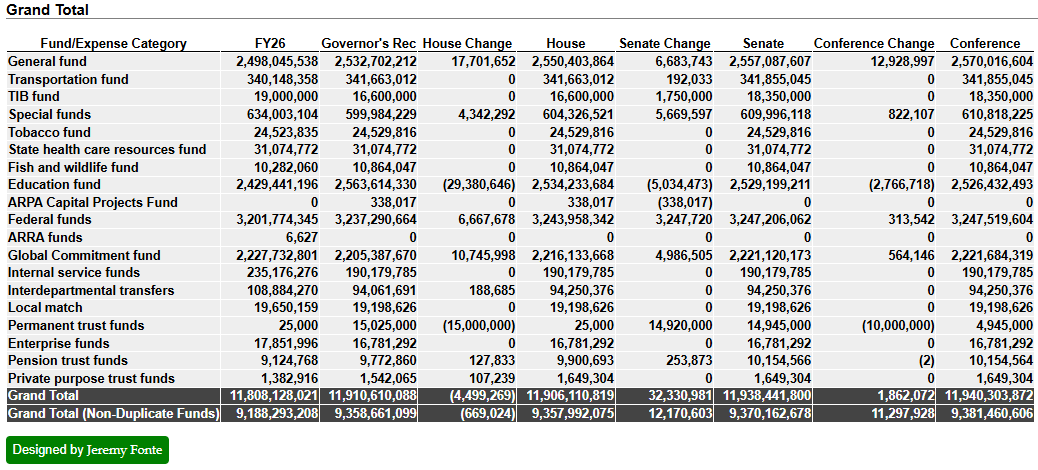
The FY27 budget, H.951, passed its committee of conference with a unanimous 6-0 vote. The final conference agreement totals roughly $9.4 billion in non-duplicate funds, up from $9.2 billion in FY26, with the general fund portion landing at about $2.57 billion. The committee prioritized primary care, food assistance, housing, and economic development. That translated into funding for free and referral clinics, Meals on Wheels, the Vermont Food Bank, the Vermont Housing Improvement Program, and rural economic development programs, among others. The budget also sets aside contingency funds specifically to respond to federal funding shortfalls, a precaution that reflects the uncertainty coming out of Washington right now.
The transportation bill, H.944, wrapped up in the final days as well, totaling roughly $360 million when combining the Transportation Fund and Transportation Infrastructure Bond Fund appropriations. Its most significant policy change is a mileage-based user fee for battery electric vehicles, taking effect January 1, 2027, at 1.4 cents per mile. The Transportation Fund has been under serious pressure for years, with fuel tax revenues stagnating as vehicles get more efficient and more Vermonters and visitors drive EVs. The fee is designed to make sure EV owners contribute to the roads they drive on, replacing the existing flat infrastructure fee with a charge tied to actual miles traveled. Plug-in hybrids are expected to be folded in by 2029, with the Agency of Transportation tasked with bringing a plan back to the legislature. The bill also directed an additional $1.7 million into state highway paving, a small but important response to a backlog that has the state paving roughly a third of what it should be each year.
When the work was done, Governor Scott came to the House floor to address the chamber, as is tradition at the close of session. Scott's broader message was consistent with what he has said all session. Vermonters want affordability, practicality, and common sense. They want to feel safe, have good schools, access to health care, and enough left over at the end of the month to get by. He acknowledged that neither he nor the legislature got everything it wanted, but said that is how compromise works. On education in particular, he said this biennium marked the first time the state had honestly confronted the long-term sustainability of the system rather than treating its problems as something another year of additional spending could manage. Structural problems, he said, require structural solutions.
It was a fitting close to a session that tested everyone in it. The hard work isn't finished. The one-time money used to buy down property taxes this year won't be there next year, education reform has many unknowns ahead, and the Transportation Fund's structural problems remain largely unsolved. But the session ended with the governor and the legislature having reached agreement on the things that mattered most, and with a shared acknowledgement that the work ahead is going to be just as hard.
Shiny Objects
Last week we wrote that a deal on the education bill appeared to be in hand and that the ending might not be the contentious one everyone had predicted. That is how it played out. The Legislature adjourned for the year at 7:46 on Friday evening, with a negotiated education bill heading to the Governor's desk for a peaceful signature rather than a drawn out veto fight.
It is worth remembering how the session opened to appreciate where it closed. In January, and up until last month even, the Governor said he would veto the budget unless lawmakers delivered mandatory school district consolidation. The Legislature was doing real planning for a government shutdown because of this. But none of that happened. The Senate passed its version 27-2 on Tuesday, a conference committee finished near midnight Thursday, the Senate cleared the final bill without a roll call, and the House sent it to the Governor 125-10. As in past years, the Legislature also used more than $100 million in one-time money to buy down property taxes, knowing it may be setting up the same cliff it spent the spring warning about.
The Governor spent the entire biennium insisting on forced mergers, and he gave that up because legislators told him there were not the votes for mandatory maps in either caucus. That happened because ordinary Vermonters, the farmers, landowners, and working families we wrote about this spring, organized, showed up, and made forced consolidation politically impossible. But the merger fight was the shiny object. While everyone was watching whether the state would draw mandatory district maps, the thing that quietly wound up as the meat of the bill, and that may really squeeze small schools, is the new foundation formula. Forced mergers were the threat people could see and organize against while the formula slipped in the door mostly unnoticed.
Here is what the formula actually is. Today, Vermont funds schools from the bottom up. Local voters approve their district's budget, and the state, through the annual yield bill, translates that spending into a property tax rate. The key feature of that system is that the decision about how much a school spends sits with the community that votes on it. The foundation formula inverts that. Instead of starting with what a district chooses to spend, the state sets a base dollar amount per student, then adjusts it up for students who cost more to educate, and that figure becomes what the district is funded to spend. The decision moves from the local school board and the town meeting floor to Montpelier. The Legislature, not the voters, sets the number.
A small school spreads its fixed costs, the building, the heat, the principal, the bus routes, across very few students, without an economy of scale. Under the current system, a community that wants to keep that school open can vote to fund it and pay for it on the property tax. Under a foundation formula, the district only receives the formula amount and they can only raise locally a limited amount above the formula. So they will have to close the school, or merge into a larger district to gain the scale the formula is trying to reward. That is consolidation by moolah rather than by mandate, and it reaches exactly the schools that just won the merger fight.
The bill moves implementation up a year, to July 1, 2029. The bill requires is that the Legislature first receive a foundation formula report and a merger committee facilitator report, and then enact legislation expressing clear legislative intent to address a list of outstanding issues with the formula, among them how to handle sparsity, geographic cost differences, special education, career and technical education, pre-K, and the legacy collective bargaining agreements and capital debt districts carry. Several of those questions, sparsity and geographic cost in particular, are the very ones that determine whether small rural schools survive the formula.
And it is not only the small rural schools that have reason to watch this new funding system with concern. Modeling the Joint Fiscal Office (JFO) circulated this spring, comparing what districts spend now against what the formula would generate showed a big hit to districts of all sizes. The modeled Burlington and Winooski district showed a loss of roughly $19.7 million. Champlain Valley showed about $14.4 million in reduced funding. Essex Westford and South Burlington each came in around $6.3 million less than current spending, and the Mount Mansfield and Buels Gore grouping about a $5.5 million loss. The caveats are worth stating clearly: JFO ran the analysis on fiscal year 2026 data, used simplified assumptions for some of the student weights, and applied a proposed district map the Legislature has not adopted, which is why the analysts called the results illustrative rather than predictive.
The formula does not feel inevitable to everyone, yet. Sen. Russ Ingalls, (R-Essex) one of two no votes in the Senate, said he was fairly sure Vermont would see Bigfoot before it saw a foundation formula. Rep. Peter Conlon, (D-Cornwall) the outgoing House Education chair, said nearly all of the change now rests on future legislatures, and that the state is where it is because it has been reluctant to act on a demographic shift it can plainly see.
While it feels like the end of this session should be the final chapter in a protracted, emotional fight, it is more likely to be the end of the first installment. Education costs are growing faster than the revenue that funds them, enrollment is falling rapidly, and property taxes are skyrocketing. Everyone understands the math. The hard part has been telling communities that their schools have to change, and this session found a way to do that without saying it out loud. It declined to force mergers and instead passed a formula that, if it arrives on the terms now in statute, will press on the same small schools from a different direction.
The Gentleman from Coventry
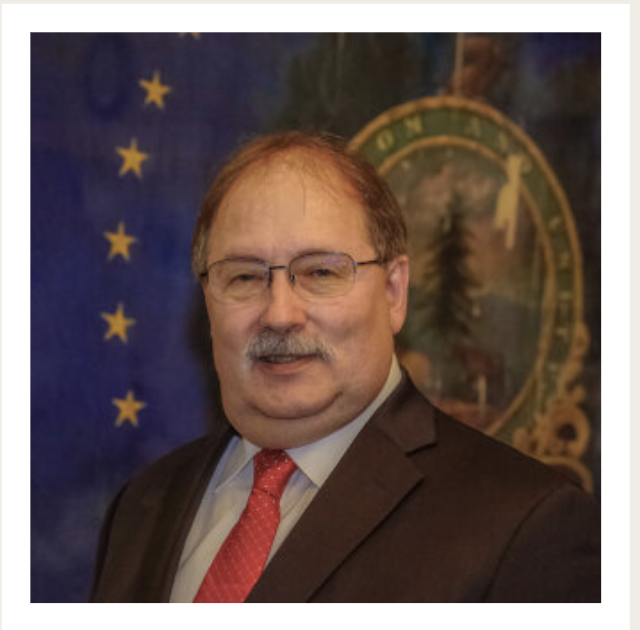
With adjournment came the departure of Rep. Mike Marcotte, a Republican from Coventry, who held an unofficial title of ‘nicest man in the building’.
A businessman and store owner from the Northeast Kingdom, he spent the better part of two decades in the House and chaired the Committee on Commerce and Economic Development, the panel that handles the state's economic development and business policy. For years, Marcotte was the only Republican to Chair a committee in the House (he became one of two this biennium after Republicans picked up more seats than previously held). He was first named to the Commerce chair by Speaker Mitzi Johnson and kept there under Speaker Jill Krowinski, after serving as the committee's vice chair for years before that.
Marcotte's career is its own argument for how the place is supposed to work. He did the job without sharp elbows, treating a first-week page, a newly elected legislator, or a junior lobbyist the same as he treated a fellow chair, and generally staying on good terms with people who disagreed with him. That is rarer than it should be, and it is a good part of the reason a Democratic Speaker kept handing a Republican the Chair.
The building will be a little less kind, and a little less neighborly, without him in it. We wish him well, and we suspect we are not the only ones who will miss seeing him in the State House.
To support vital journalism, access our archives and get unique features like our award-winning profiles, Book of Lists & Business-to-Business Directory, subscribe HERE!
 Vermont Business Magazine