

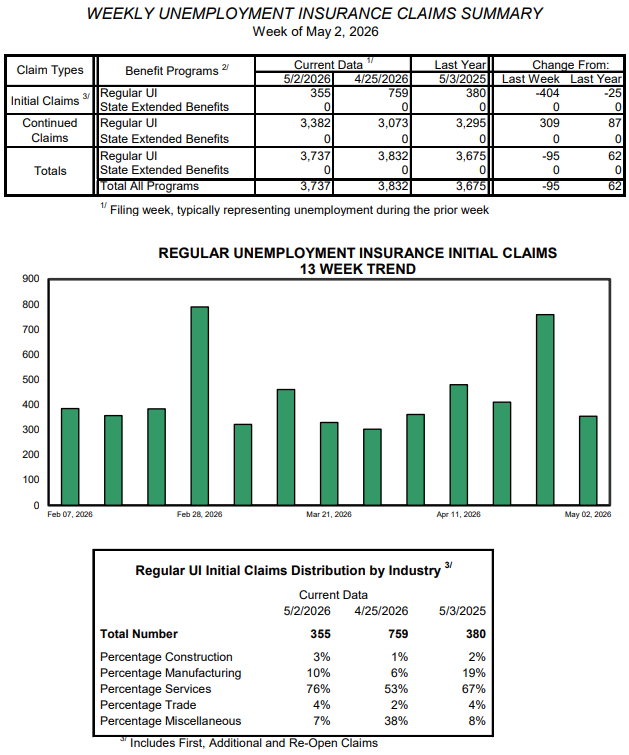
by Timothy McQuiston, Vermont Business Magazine Vermont initial weekly unemployment claims decreased by more than 400 last week after a seasonal spike last week. For the week ending May 2, 2026, the Vermont Department of Labor reported that there were 355 new claims, down 404 from the previous week and down 25 from last year at this time. New claims had leveled off at under 400 after the holiday season. The end of the winter tourism season typically brings a flurry of layoffs. Meanwhile, total claims this week were 3,737, down 95 from the week before and up 62 from last year at this time. Initial claims, which tend to be lowest in the summer, were 186 in September 2025.
Nationally, stocks generally were up by the end of the week on a strong jobs report after recent wild swings depending on news from the Middle East. The future of oil prices remains uncertain but gasoline prices reached four-year highs of over $4.50 this week. US GDP saw a solid, but lower than expected, increase of 2% for the first quarter, as inflation remained over 3% in March.
The Fed, which met in April, left interest unchanged, as expected. The Fed will next meet June 16-17. However, it is likely that the Fed, with dissent from both sides, will hold rates where they are as they continue to take a wait-and-see approach on the economy and inflation.
In Vermont for the weekly labor UI claims report, manufacturing accounted for 10% of the total, up 4 points from the previous week. Manufacturing overall has become a smaller part of the Vermont economy over the last 25 years and that trend appears to be continuing. The Service industry, which typically accounts for the most claims, last week reported 76% from the previous week, up 23 points. Construction was 3%, up 2 points.
Nationally, in the week ending May 2, the advance figure for seasonally adjusted initial claims, according to the US DOL, was 200,000, an increase of 10,000 from the previous week's revised level. The previous week's level was revised up by 1,000 from 189,000 to 190,000. The 4-week moving average was 203,250, a decrease of 4,500 from the previous week's revised average. The previous week's average was revised up by 250 from 207,500 to 207,750.
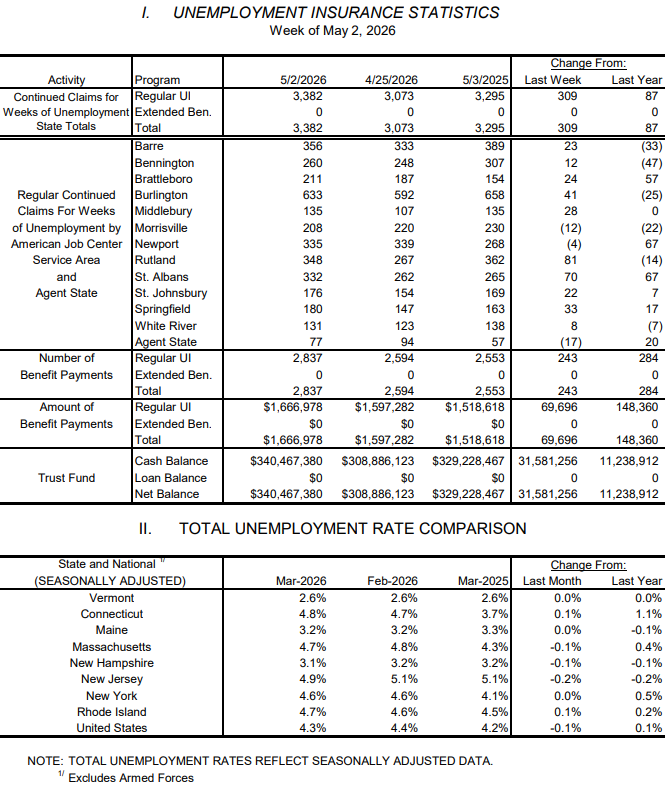
The Vermont Unemployment Trust Fund is well capitalized. As of the most recent data, there was $340.5 million in the Trust Fund, up $31.6 million from the previous week (as claims are paid out on one side, employers are contributing to the fund on the other). The pre-pandemic Trust Fund balance on March 1, 2020, was $506.2 million.
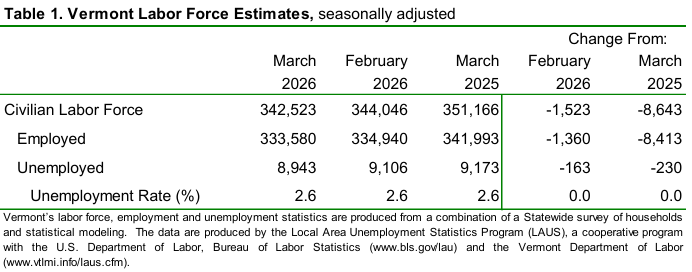
The Vermont Department of Labor has reported that the seasonally adjusted statewide unemployment rate for March was 2.6 percent. This reflects no change from the prior month’s revised estimate, as based on household data. The comparable United States rate in March was 4.3 percent, a decrease of one-tenth of one percentage point from the revised February estimate.
The seasonally adjusted Vermont data for March show the Vermont civilian labor force decreased by 1,523 from the prior month’s revised estimate (see Table 1). The number of employed persons decreased by 1,360 and the number of unemployed persons decreased by 163.
The Labor Force is down 8,643 workers from March 2025 and employment is down 8,413 jobs. The drop in the Labor Force offsets the drop in Employed, which accounts for there being no change in the unemployment rate. Total unemployed decreased 230 for the year. None of the changes were statistically significant in the seasonally adjusted series.
The civilian labor force participation rate was 62.9 percent in March, a decrease of three-tenths of one percentage point from the prior month’s revised estimate.
Vermont has the fourth lowest jobless rate in the nation, with South Dakota lowest (2.3%) and Delaware highest (5.4%).
See tables below.
“Every year, March is a period of transition in Vermont – not only because of the weather but also because of seasonal industries. The over-the-year data for March 2026 gives a preliminary indication of a strong winter hiring season for Leisure & Hospitality businesses,” said Kendal Smith, Commissioner of the Vermont Department of Labor. “Looking forward, many industries will be ramping up hiring activities as the weather improves. To support these hiring efforts, the Department has multiple hiring events this month. To learn more about these events, as either a jobseeker or a hiring employer, you can visit https://www.vermontjoblink.com/events for the most up to date information.”
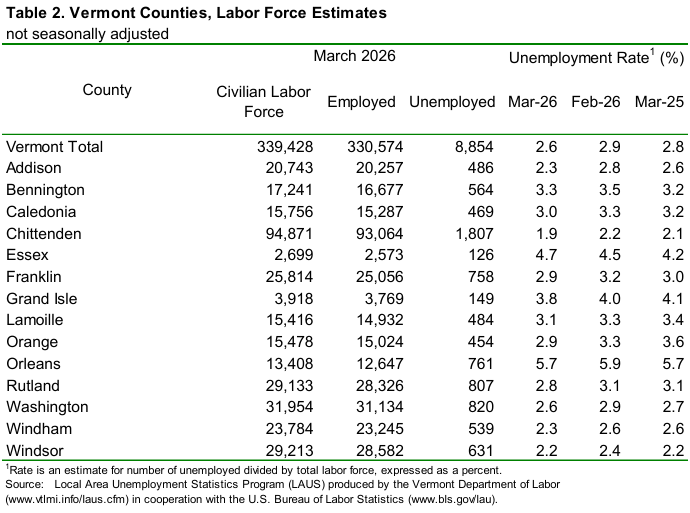
The March unemployment rates for Vermont’s 14 counties ranged from 1.9 percent in Chittenden County to 5.7 percent in Orleans County (note: county unemployment rates are not seasonally-adjusted – see Table 2). For comparison, the March unadjusted unemployment rate for Vermont was 2.6 percent, a decrease of three-tenths of one percentage point from the revised unadjusted February level and a decrease of two-tenths of one percentage point from a year ago.
Vermont tax revenues exceed targets in March
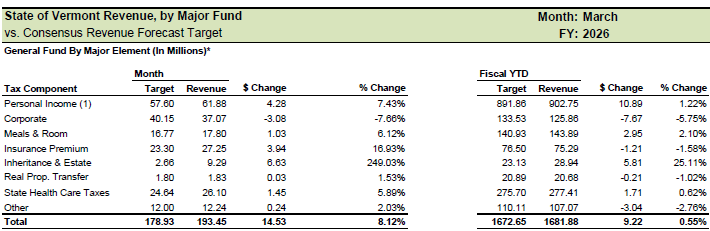
The General Fund, Transportation Fund and Education Fund all exceeded their respective monthly consensus cash flow target in the state’s March 2026 revenue results, according to the Vermont Agency of Administration. The Personal Income, Gas, Meals & Rooms and Sales taxes all had a strong month.
The state’s three major funds were a combined $282.79 million, exceeding the $263.11 million monthly consensus target by $19.68 million, or 7.5%.
Total General Fund revenues for March totaled $193.45 million, $14.53 million, or 8.1%, above the $178.93 million monthly consensus cash flow target. All major components except the Corporate Income Tax exceeded their targets. The Personal Income and Meals & Rooms taxes continue to drive General Fund performance, with combined receipts $13.84 million above their year-to-date consensus target.
Revenues in the Transportation Fund exceeded the $26.28 million March target by $3.06 million, or 11.7%, yielding $29.34 million. The Gasoline and Diesel taxes were above target for the month and are now ahead of their cumulative targets for the fiscal year.
Monthly Education Fund revenues of $59.99 million were $2.09 million, or 3.6%, above the March cash flow target of $57.9 million. A combined $2.66 million in above-target receipts from the Sales & Use Tax, Investment Income, and the Meals & Rooms Tax offset a $0.57 million underperformance in the Motor Vehicle Purchase & Use Tax and Lottery Transfer. Year-to-date receipts are $5.56 million, or 0.9%, above their $591.7 million consensus target.

According to Administration Secretary Clark: “The March revenues represent the first time this fiscal year that all three funds have simultaneously exceeded their monthly targets. Both the General and Education funds are ahead of their cumulative consensus target, while the Transportation Fund remains slightly more than one half of one percent below target.”
To support vital journalism, access our archives and get unique features like our award-winning profiles, Book of Lists & Business-to-Business Directory, subscribe HERE!
 Vermont Business Magazine