

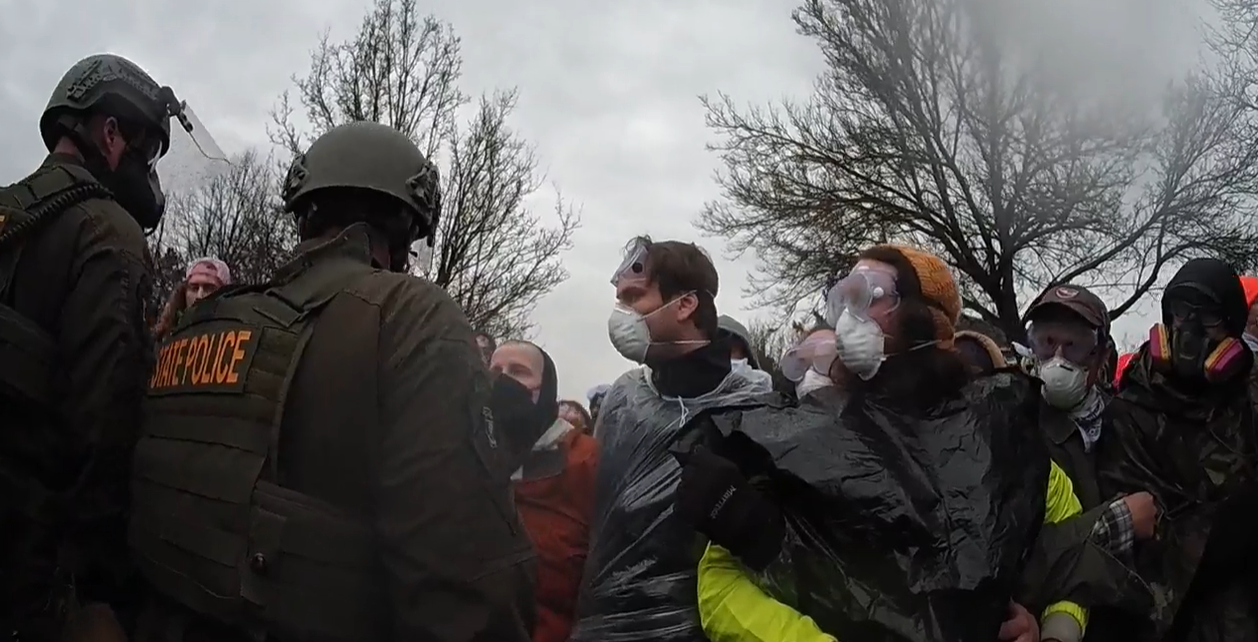
VSP screenshot from 547 Body Cam 34m13s_Redacted.
WATERBURY, Vermont (Friday, April 17, 2026) — The Vermont State Police has released material connected to the March 11, 2026, federal police action on Dorset Street in South Burlington, to which state troopers were later called to assist with public safety.
Today’s release includes a complete after-action report, about 60 hours of video footage from troopers’ body-worn cameras, and a statement from Public Safety Commissioner Jennifer Morrison.
In Public Safety Commissioner Jennifer Morrison's statement (see below), she said, "I determined that the allegations of excessive force by members of the Vermont State Police were not supported." She said neither her office nor the State Police were informed of action by federal agents beforehand, despite prior requests to federal immigration officials to alert the state if there were to be such an action.
She said the troopers determined that they needed to create a "buffer" between federal agents and protesters in order to protect the protesters, especially in light of the two shooting deaths in Minneapolis involving federal agents. The state had also requested that federal agents not use gas and impact munitions.
Morrisson said that in order to protect protesters and create a buffer between them and federal agents, VSP removed protesters to allow the federal agents to access the residence on Dorset Street and serve the federal warrants. She said local law enforcement does not have jurisdiction over federal law enforcement.
"If it had not been for the presence of Vermont law enforcement at the scene, the events of March 11 would have resulted in a direct physical confrontation between federal agents and the crowd," she said. "Vermont law enforcement largely achieved the public safety goal of avoiding serious bodily injury or death on March 11. However, the insistence by federal agents to execute this warrant against the advice of state and local law enforcement is unprecedented in Vermont and undermined community safety and trust."
She added: "In my 36 years as a law enforcement professional, I have never witnessed a multi-agency operation in which one agency is so far out alignment with others. The disregard for collaboration and community safety that we saw from the ICE SRT on March 11 represents not only a deviation from accepted norms, but an unprecedented challenge to the integrity of law enforcement as a whole."
The full report and images are available for review and download from the Vermont State Police’s Dropbox account. This link will remain active for 90 days; anyone who needs access to these materials after three months should download the files before the link expires.
The state police will have no further comment on this matter.
Introduction to After Action Report
April 17, 2026.
Commissioner Jennifer Morrison
Vermont Department of Public Safety
The events in South Burlington on March 11 deeply affected many people in Vermont. Following this event, people have sought clarity about the role of state and local law enforcement at the scene of the federal immigration enforcement action that day, or at any similar events in the future. This After Action Report (AAR) details the role of the Vermont State Police at the scene on March 11. In the interest of maximum transparency, the Department of Public Safety is also making available the body worn camera footage from Vermont State Police members at the scene.
The events on March 11 occurred within the broader context of the federal immigration enforcement operations in Minneapolis and other cities earlier this year. After the events in Minneapolis, Vermont law enforcement officials determined that they needed a plan to prevent the physical confrontations seen in Minneapolis from happening in Vermont. This plan is based on three principles:
• First, Vermont law enforcement will support people’s right to peacefully protest.
• Second, Vermont law enforcement cannot stop federal officials from enforcing federal laws.
• Third, the presence of Vermont law enforcement at the scene of federal immigration enforcement actions may be necessary to protect public safety.
In the aftermath of the federal enforcement operations in Minneapolis, Vermont law enforcement leaders met with federal immigration officials located in Vermont and the Boston field office to discuss our public safety concerns regarding any immigration enforcement actions in Vermont and to express our expectations regarding communication and public safety planning with state and local law enforcement. Despite these efforts, federal authorities did not inform Vermont law enforcement ahead of their actions on March 11. Rather, Vermont law enforcement reacted to the scene without any preplanning or communication from federal authorities.
The information below and contained in this report provides more details about the response by the Vermont State Police on March 11. Below I address the role of state and local law enforcement at the scene, the Fair and Impartial Policing Policy in Vermont, complaints relating to use of force by Vermont State Police members, and recommendations and next steps.
I. The Role of State and Local Enforcement at the Scene
Vermont law enforcement does not enforce federal immigration law or assist with civil immigration enforcement. However, Vermont law enforcement has a responsibility to respond to large gatherings that may escalate into physical conflict. Based on events across the country, impromptu protests at active federal immigration enforcement actions are volatile and have led to confrontations between federal agents and the public, posing a risk of serious injury or death. For this reason, Vermont law enforcement may respond to protect public safety and reduce the risk of harm to people and property.
Vermont law enforcement’s response on March 11 began in this crowd control capacity and evolved when federal agents announced their plan to obtain and execute a judicial warrant. During the course of the day, federal agents communicated to Vermont law enforcement that they were going to execute this warrant despite the unpredictable environment and against Vermont law enforcement’s advice to reconsider. Federal agents also communicated to Vermont law enforcement that their plan was to move the crowd away from the front door themselves and they were prepared to use less lethal tools like gas and impact munitions to do so. Details of this exchange are on pages 21 to 23 of the report.
Vermont law enforcement immediately determined that this plan posed an unacceptably high safety risk to the crowd. The use of gas and impact munitions could seriously harm people in the crowd, the crowd could easily panic and people could be trampled, and the unstable environment could escalate quickly and result in the use of deadly force by federal agents. In fact, federal agents from the same federal department used deadly force weeks earlier in Minneapolis.
Vermont law enforcement clearly communicated these concerns and objections to federal agents, but federal agents insisted that they intended to execute their judicial warrant with or without the presence of Vermont law enforcement. This put Vermont law enforcement in an extraordinarily difficult situation: they could either stand by knowing that federal agents would physically conflict with people blocking the entrance to the residence, or Vermont law enforcement could place themselves as a buffer between the federal agents and the crowd.
The Vermont State Police chose to act as a buffer between federal agents and the crowd to reduce the risk of physical harm to all involved. Whatever the merits of their case, federal agents obtained a judicial warrant to enter the residence and therefore had a lawful basis to move up to and through the entrance to the house. Under these circumstances, Vermont law enforcement moved noncompliant and resistant individuals away from the entrance of the residence to maintain separation between federal agents and the crowd. If it had not been for the presence of Vermont law enforcement at the scene, the events of March 11 would have resulted in a direct physical confrontation between federal agents and the crowd.
Vermont law enforcement largely achieved the public safety goal of avoiding serious bodily injury or death on March 11. However, the insistence by federal agents to execute this warrant against the advice of state and local law enforcement is unprecedented in Vermont and undermined community safety and trust. At the end of this introduction, I explain the steps I will be taking to address the conduct of federal agents on March 11.
II. Vermont's Fair and Impartial Policing Policy
All Vermont law enforcement agencies are required to follow a Fair and Impartial Policing (FIP) Policy. This policy generally prevents officers from inquiring about people’s immigration status during routine law enforcement encounters like vehicle stops. I was personally involved with developing this policy more than sixteen years ago. This policy was never intended to prevent law enforcement officers from ensuring public safety at large gatherings or protests. Those who have claimed that the actions of state and local law enforcement on March 11 constitute a violation of the FIP policy have failed to consider the extraordinary public safety risk posed by the circumstances.
The actions taken by the Vermont State Police on March 11 were based on the public safety risk at the scene, not the nature of the federal laws being enforced by federal agents. The need for law enforcement crowd control is based on public safety risk, and that risk is heightened when there is a foreseeable risk of physical confrontation between opposing groups at a turbulent gathering. The decision to act as a buffer between federal agents and protesters was based on this safety risk. Vermont’s Fair and Impartial Policing Policy does not prohibit officers from protecting public safety under these circumstances. No Vermont law enforcement policy requires officers to stand by and ignore a significant and easily foreseeable public safety risk.
III. Complaints Relating to Use of Force by Vermont State Police Members
In my role as Commissioner, I am responsible for overseeing and imposing discipline for misconduct by sworn members of the Vermont State Police. This process is governed by statute and managed by a dedicated investigator in the Office of Internal Affairs. Under statute, the State Police Advisory Commission also advises me on misconduct allegations and discipline. This group is composed of appointed members of the community from across Vermont. At the end of any internal affairs investigation, governed by policies and statute, I determine whether to pursue discipline against individual troopers based on the facts of each case.
The Office of Internal Affairs received 25 complaints relating to the March 11 event. Fifteen complaints were read from a common script. There were seven non-scripted anonymous complaints that refer to five allegations (three complaints related to the same allegation). There were three non-scripted complaints where the person left contact information. As of April 17, three complaints (one anonymous) were sufficiently specific to allow the Office of Internal Affairs to review the complaint and compare body camera footage to the allegation. Two individuals were interviewed by the Director of Internal Affairs.
These complaints were reviewed by the Office of Internal Affairs, me, and the State Police Advisory Commission. After review, and with the input of the State Police Advisory Commission, I determined that the video footage of the three allegations did not demonstrate violations of the Vermont State Police use of force policy. Rather, the video evidence revealed that the actions by the VSP members were reasonable and proportional under the totality of the circumstances.
Law enforcement crowd control efforts can result in physically moving noncompliant or actively resistant people by pushing and pulling individuals away from an area being cleared. The protests on March 11 were particularly volatile because some people were physically obstructing federal officers from executing a judicial warrant and refused repeated orders to disperse and move. Under these circumstances, I determined that the allegations of excessive force by members of the Vermont State Police were not supported.
We listened to the legislative testimony by community members at the Vermont Statehouse on March 31 and reviewed any specific allegations of misconduct against Vermont State Police members made at that hearing. Other than the incidents described above, all allegations of misconduct raised at that hearing were determined to either not be supported by the body worn camera footage or were mistakenly attributed to Vermont State Police members.
IV. Recommendations and Next Steps
In addition to the recommendations in this After Action Report, I want to emphasize the need to improve communication and public safety planning among all parties for any event like this in the future. I believe all of us have an obligation to communicate with each other in a manner that reduces polarization and confusion. Public safety will be advanced if we turn down the volume of our rhetoric and remember that we have shared goals and values in Vermont.
Since March 11, I have reached out to federal authorities to address communication and safety planning for any future immigration operations in Vermont. It is my expectation that federal authorities work with Vermont law enforcement leaders to improve coordination and communication going forward so Vermont law enforcement may more effectively serve its public safety function.
I also strongly encourage federal leadership with Immigration and Customs Enforcement (ICE) to closely evaluate the impact of their actions on community trust and public safety. On March 11, Vermont law enforcement leaders quickly determined that the public safety risk posed by the planned federal enforcement action was unacceptably high. However, federal agents rejected this assessment. Going forward, federal leadership should improve their collaboration with state and local law enforcement regarding the assessment process for the public safety risks posed by their own enforcement actions. This especially applies to federal leadership with the ICE Enforcement and Removal Operations (ERO) and their Special Response Team (SRT).
In my 36 years as a law enforcement professional, I have never witnessed a multi-agency operation in which one agency is so far out alignment with others. The disregard for collaboration and community safety that we saw from the ICE SRT on March 11 represents not only a deviation from accepted norms, but an unprecedented challenge to the integrity of law enforcement as a whole. The resulting erosion of public confidence threatens to undo years of progress in community relations, placing all officers, regardless of agency, into a more volatile and distrustful environment going forward. The decisions made by ICE agents on March 11th have created tension and distrust that local and state police are left to manage.
To this end, I am sending this report to senior representatives at the Department of Homeland Security and requesting a meeting with them to express my concern about the actions of ICE on March 11 and my hope for change going forward. I have already met with ICE ERO supervisors in Vermont and at the Boston field office.
I have also reached out to protest leaders and civil liberty and advocacy organizations to request open lines of communication going forward. I hope these leaders will work with me and my team to improve planning and communication for any similar events in the future. I also encourage protest leaders and civic organizations to educate protesters about the difference between peacefully protesting, civil disobedience, and obstructing or assaulting law enforcement officers. We welcome peaceful protesting and try to accommodate voluntary arrests for civil disobedience when feasible. However, physically obstructing any law enforcement officers from executing a judicial warrant and assaulting law enforcement officers is unacceptable and should be publicly denounced by all civic and government leaders.
Many people in Vermont strongly disagree with current federal immigration enforcement policy. Disagreement with federal policy should be addressed through existing political and legal processes, not by obstructing or assaulting law enforcement officers in the streets.
It is my hope that these remarks and the attached After Action Report address the public’s questions and concerns relating to the events on March 11. In the coming days, additional information may emerge and will be carefully reviewed. We welcome anyone who wishes to file a complaint or a compliment to visit this page: https://vsp.vermont.gov/internalaffairs.
Sincerely,
Jennifer Morrison
Commissioner
Vermont Department of Public Safety
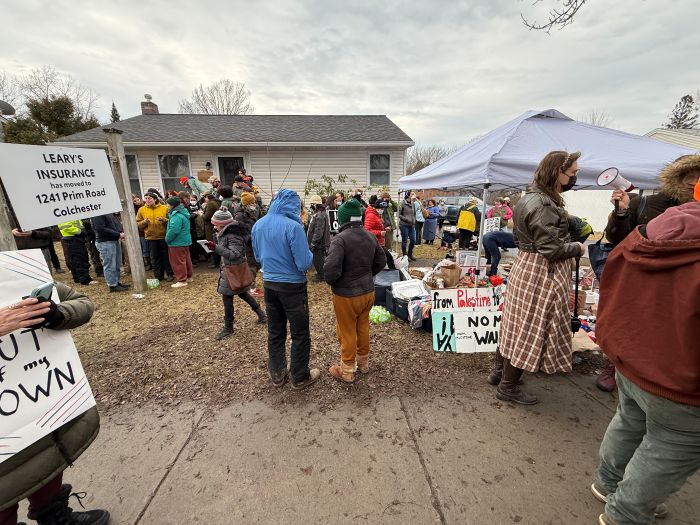
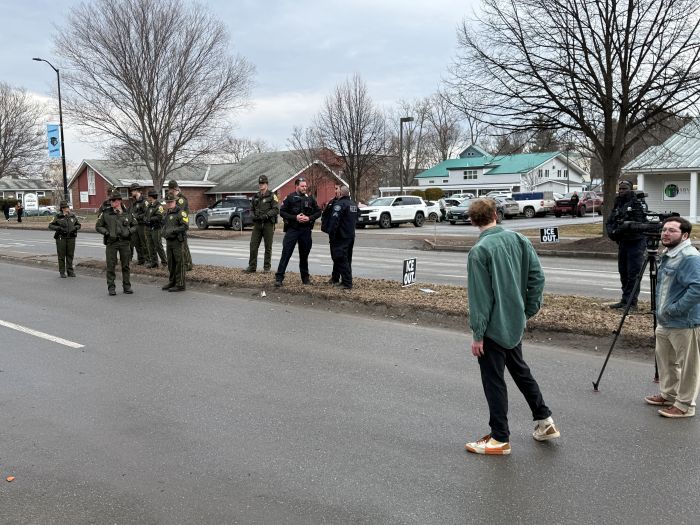
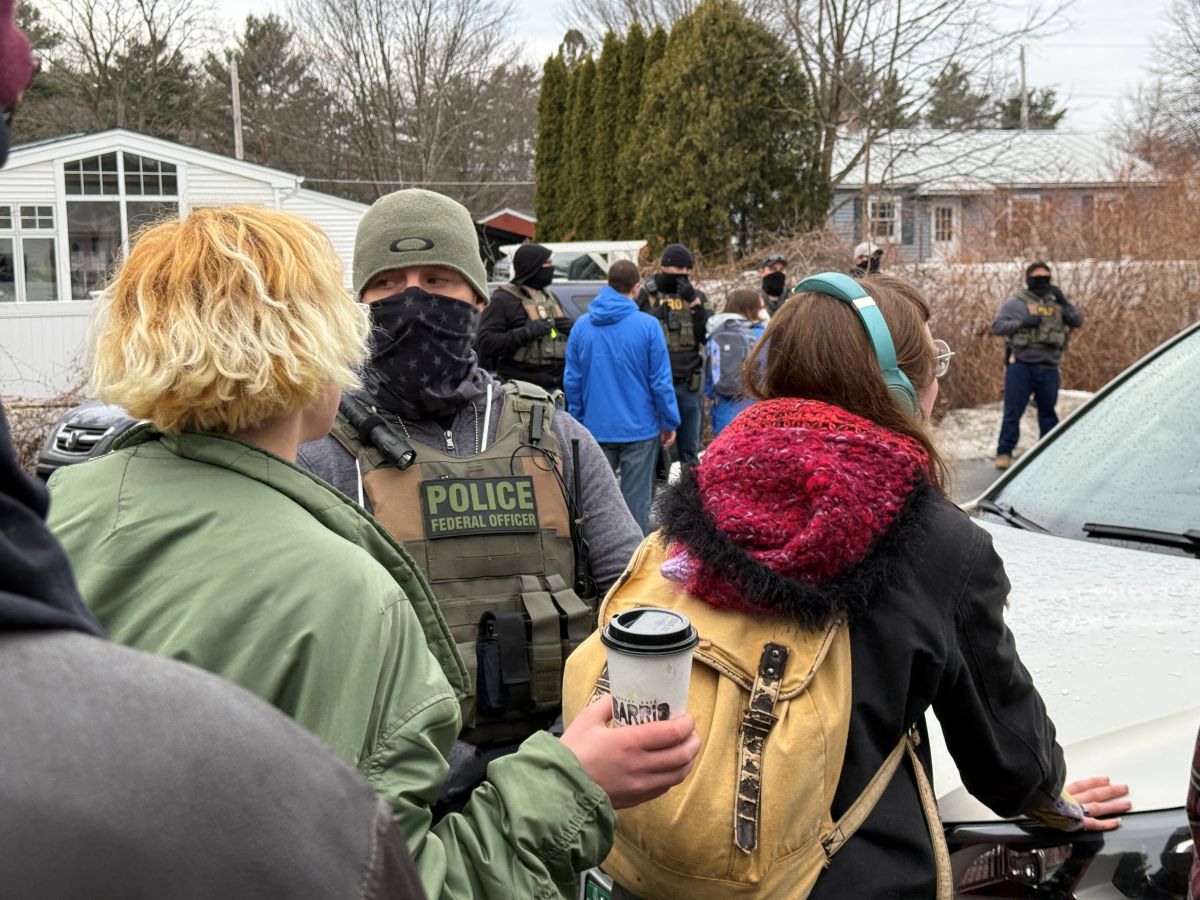
Top, protesters block the front door of the house on Dorset Street in South Burlington prior to the federal warrant being served. Middle, Vermont State Police observe the scene on the afternoon of March 11. Bottom, protesters and federal agents wait behind the house before the warrant was served. VermontBiz photos.
To support vital journalism, access our archives and get unique features like our award-winning profiles, Book of Lists & Business-to-Business Directory, subscribe HERE!
 Vermont Business Magazine