

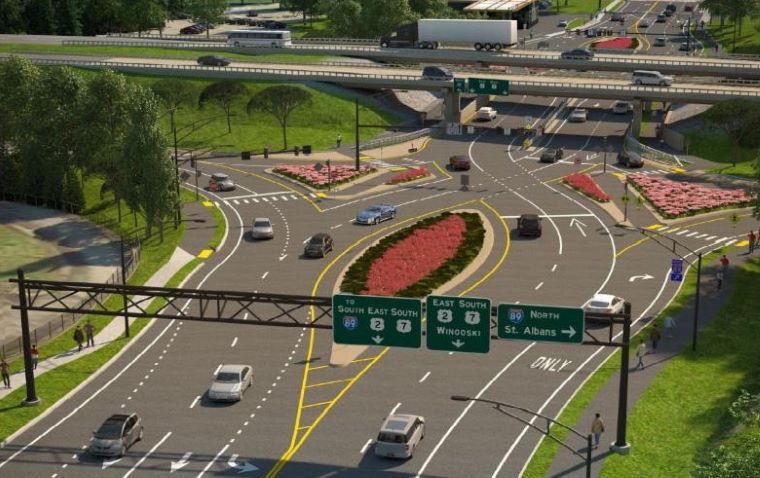
The reconfiguration of interchange at I-89 exit 16 in Colchester (Costco/Water Tower Hill) as diverging diamond interchange. The AOT rendering shows how the traffic crosses from right to left. The project, which began in 2023, is expected to be finished sometime in 2027.
by C.B. Hall, Vermont Business Magazine
This year, the list of the Vermont Agency of Transportation's construction projects (sidebar) includes numerous jobs that had been scheduled for last year. What's going on?
In a joint hearing held by the House and Senate transportation committees in January, AOT's secretary, Joe Flynn, provided a partial answer to that question when he presented the Scott administration's transportation budget proposal - with a deficit of approximately $33 million on the revenue side.
To plug the hole, the proposal calls for instituting the following economies: $5.4 million saved with revision of budgetary assumptions and deferral of construction and maintenance projects, $7.5 million by eliminating 62 staff positions; $8.1 million in miscellaneous other cuts, and $12.1 million gained by shifting available federal funds from project allocations to administrative functions.
At a recent press conference in mid-April, Governor Phil Scott advocated just sticking with higher registration fees on electric vehicles instead of going to a fully mileage way for all vehicles to raise transportation revenue. He noted that such a system would increase complexity, plus there is a question of how to rectify interstate travel. Scott said that the state should take a wait-and-see approach for now.
Rep. Matt Walker (R-Swanton), who chairs the House Committee on Transportation told VermontBiz that the delaying of projects "is going to happen at a little higher level than it did" in FY 2025-26. He termed the moving of the $12.1 million "an accounting conversion that's only used in the most difficult of times." According to AOT, the mechanism has only been resorted to once since 2004.
"Because of the funding issue we are in a situation that some projects will be delayed in going out to bid until after the fiscal year changes or until funding becomes available," Walker said, while emphasizing that delays in road work stem from many causes. "The state will look at their overall spending and entire network of projects and slow down or delay projects without abandoning them. Construction and planning timelines will likely be extended."
In addition to routine maintenance, he said, fundamental upgrades to the state's highway system also take a hit when money gets tight. He referred to the dust gathering on plans for three major rebuilds, on U.S. 5 in Putney, U.S. 7 between Brandon and Pittsford, and Vermont 78 between Swanton and Alburgh.
"The cost is beyond the financial means at this point."
"Not even on the list," he added, is a fourth major rebuild, which would upgrade Vermont 22A, That highway, which traverses the southern Champlain Valley, has elicited attention because of its high truck volume and accident rate. Vergennes residents have meanwhile expressed their hopes for a bypass that would keep the route's loud and fumy truck traffic away from the city's downtown.
See list of 2026 VTrans projects below.
"It's A Battle"
With fuel-tax receipts declining as fuel efficiency increases and more and more hybrid-electric cars hit the roads, it's no surprise that AOT and the legislature are grappling with tough decisions about what to do - or not to do - as revenues fall short of needs.
Asked about how to remedy the situation, Tom Kavet, who consults for the legislature on budgetary matters, posed the options in classic business terms. "There are lots of different ways they in general can raise revenue - or they can get more efficient in how they spend, so they get productivity gains."
Walker attributed the budgetary crunch to inflation but stressed the decline in fuel-tax receipts, too. “Vermonters are saving 65 million gallons of motor vehicle fuel each year. Normally that would return about 32 cents on the gallon, or $22 million, to the transportation fund. You stack that up for two years, three years, four years, and you've got a significant drop in gas tax revenue."
As how to remedy that shortfall, he mentioned a mileage-based user fee for electric vehicles, and additional registration fees for hybrids, among other possibilities.
At the municipal level, he pointed out, the growing popularity of local-option sales tax increments - which raise the tax from six to seven percent - has provided some help in maintaining local infrastructure, roads included. Of 19 municipal ballot proposals for the local option, 13 were passed at this year's town and city meetings, according to Josh Hanford, director for intergovernmental relations at the Vermont League of Cities and Towns.
"Municipal projects that were expecting funds from the agency haven't been getting them," Hanford said. "Construction costs have escalated something like 60 percent in the last five years. There just isn't enough money to support the project needs. So that's resulted in projects getting pushed out a few years."
The delays put towns in uncomfortable spots. He mentioned that the City of Barre ultimately felt forced to scrape together funding to repair part of its Main Street - which is also a state highway - when AOT put off the project. In Royalton, he said, a bridge across the White River, closed in 2024, awaits a replacement now scheduled for 2028.
"Fixing the transportation fund does not help fix the town budgets," Walker put it. "We still have to work on help for the town highway and bridge repair budgets.
"Year to year, it's a battle."
"Whether you drive to work or school, you ride a public bus to work or school, or you walk to work or school - it's all transportation," Hanford said. "It should be a concern to all Vermonters, all municipalities. There's no real solution in the works."
Asked to articulate the best long-term solution to the state's inability to keep pace with the need to maintain and improve the state's transportation infrastructure, Transportation secretary Joe Flynn pointed to the administration's call for recouping $10 million of the fifty-plus million that his agency collects annually in motor vehicle purchase-and-use taxes but, under the existing law, then transfers to the Agency of Education. That proposal would draw down increasing portions of the inter-agency transfers over the next five fiscal years, so that AOt would thenceforward retain all the funds.
That move may not sit well with defenders of the state's public school system, for which expenditures of just over $3 billion need to be financed, per the governor's budget proposal.
Quoted in a Vermont Public story, Rep. Emilie Kornheiser (D-Brattleboro), who chairs the House Committee on Ways and Means, commented that “to just move money from the education fund means that we’re going to be paving the roads on the backs of … our property taxpayers... I don’t think that’s what Vermonters are asking us to do."
Flynn defended the zeroing out the transfers to the Agency of Education by comparing that option to an alternative budget put forward in a bill introduced by the House Committee on Appropriations. The latter bill would only reduce the amount of the transfers by about one-sixth, which, Flynn said, would deprive his agency of $11 million, $23 million, and $34 million in the 2028 to 2030 fiscal years respectively, and $47 million in FY 2031 and each year thereafter. Referring to federal matching funds, he said AOT "conservatively estimates that this lost Transportation Fund revenue will result in the inability to spend $275 million of federal dollars in the same time period."
Money Is Not The Only Problem
Even a brief survey of transportation projects confirms Walker's view that fiscal constraints should by no means be the only scapegoat. He pointed for example to unexpected delays in securing rights-of-way when projects require acquisition of private property. And emergencies such as the floods the Green Mountain State has absorbed in recent years force delays in other items on the to-do list.
The East-West Alternative Transportation Crossing, the pedestrian-bicycle bridge to be built across I-89 in South Burlington, offers another example of how projects can be delayed - and how difficult it can be to track the developments. VermontBiz's 2025 table of road projects listed the undertaking as commencing in August of that year, with a completion date of May 2027. As this article went to press, however, the AOT website summarizing projects statewide assigned it a start date in May of this year, with completion pushed back to May 2029. Ilona Blanchard, South Burlington's community/development manager, clarified that that time span represents a window for contract performance, within which construction would actually begin by this fall. The crossing will be operational, she said, by the fall of 2028.
Asked why the change from the timetable anticipated a year ago, she explained that the original invitation for bids had elicited only tenders "substantially above" the city's cost estimates.
"We rejected all the bids. That enabled us to talk to the contractors and understand the cost drivers." Following that value-engineering, a new request for bids went out early in March, calling for costs in the $10-25 million range for the main phase of the project.
A secondary and final phase will add certain connections, including access from the city's Quarry Hill neighborhood and a link to a separate project that will add a separated, bidirectional bicycle-pedestrian route along the south side of Williston Road eastward as far as White Street. In addition, the city is planning to extend the path still farther east to Hinesburg Road, also known as Vermont 116.
Taken together, the projects will provide well-earned relief to the plucky bicyclists who have long tempted fate along one of Vermont's most dangerous stretches of roadway - which, where it crosses the interstate, accommodates an average of 40,148 motor vehicles daily, according to AOT data.
"We are very excited to get started on construction," Blanchard said.
Champlain Parkway Nearing The Finish Line
In Burlington, meanwhile, completion of the Champlain Parkway is close at hand. The final phase of the project will finish construction between Home Avenue and I-189, the route's southern terminus, as well as the "rehabilitation" of Pine Street between Kilburn and King Streets, at the parkway's north end, according to Robert Goulding, public information manager at Burlington's Department of Punic Works. He anticipated completion early this summer - "on time and on budget."
The project has seen many delays, including a long legal challenge from local opponents, since it was first proposed in the 1960s. When completed, the parkway will have cost about $80 million since 1998, when the city assumed the lead role in the undertaking. Of that total, Burlington director of public works Chapin Spencer said, the city will have contributed about $7 million, with the remainder coming from the state and federal governments.
The 2.8-mile, 25 mph parkway will provide a connector traversing the Queen City's South End between the interstate highway and downtown. The work has encompassed burial of utility lines, improvements to stormwater drainage and treatment, bicycle lanes, shared-use paths, pedestrian-activated crosswalk signals, and signal preemption for transit and emergency vehicles.
A related initiative, the Railyard Enterprise Project, will improve multimodal travel from the Pine Street segment of the parkway to Battery Street, in the city's waterfront area, with the alignment running alongside the Vermont Railway's Burlington yard. The project is currently in the early stages of right-of-way acquisition, Spencer told VermontBiz. Total costs of about $37 million are foreseen, and construction is at least three to five years away, he said.
On the other side of Burlington, another megaproject that has overcome lengthy courtroom challenges is nearing completion. That's the $22.4 million transformation of I-89's Colchester interchange into Vermont's first diverging diamond interchange - a reconfiguration that will eliminate signalization of the left turns that have caused innumerable motorists maddening waits to get from US 7/2 onto the interstate. Planning for the undertaking began in 2012, but construction did not begin until 2023. The project will also create much-needed infrastructure for pedestrians and cyclists.
A Bigger Bridge And Fewer Stuckages
Elsewhere in the state, another long-lived project will reach fruition with the completion, expected in August, of the new I-89 bridge across the Connecticut River between White River Junction and Lebanon, New Hampshire. Launched in 2020, the $53 million undertaking will provide two new travel lanes in either direction between the interchanges with I-91 and New Hampshire 10, which lie immediately at the ends of the crossing. The new lanes will create a single six-lane crossing by closing the gap between what were southbound and northbound bridges.
And on Vermont 108 in Smugglers’ Notch, AOT has had considerable success with preventing stuckages - the marooning of tractor-trailers in the narrow mountain pass when their drivers ignore all warning signs about the tortuous route ahead and render the notch as impassable as the winter snows do, until hefty wreckers arrive on the scene and dislodge the vehicle.
The stuckages averaged eight per year from 2015 through 2020, and five annually from 2021 through 2023, but dropped to one in 2024 and two in 2025, thanks to AOT's trial installation of chicanes - artificially constructed curves that mimic those in the notch and allow truckers to test whether their rigs are going to fit through on the road ahead but let them turn around easily if the vehicles flunk the test.
Henceforward the chicanes, one on each side of the notch, will be a permanent feature on the route.
| Towns, cities | Roads affected | Project description | Start date | Completion |
| Addison | VT 17 | Repaving, 8.2 miles | May | October |
| Addison to Orwell | VT 22A | Replacement of culverts, ~20 miles | April | May |
| Arlington | VT 7A | Installation of crosswalk and related improvements | May | October |
| Barnet | US 5 | Bridge repair | April | June |
| Bennington | US 7 | Bridge repair | July | November |
| Bennington | VT 9 | Replacement of Walloomsac River bridge | 2025 | August |
| Bennington | VT 67A | Replacement of culverts, 2.2 miles | April | June |
| Berlin | US 302 | Repaving, 1.9 miles | April | June |
| Bradford to Norwich | I 89 | Repaving, 22.0 miles; 2.6 miles in Fairlee not affected. | July | 2027 |
| Brandon, Pittsford | US 7 | Reconstruction of US 7, including widening, 1.7 miles | August | 2028 |
| Brattleboro | VT 9, VT 30, VT 142, US 5 | Repaving in Brattleboro village | 2025 | October |
| Bridgewater | VT 100 | Bridge replacement | April | November |
| Bridgewater | US 4 | Bridge paving | TBD | June |
| Bridgewater | US 4 | Culvert replacement | August | September |
| Brookfield | I 89 | Bridge deck replacement, northbound and southbound | April | 2028 |
| Brookfield to Bethel | I 89 | Repaving, northbound and southbound, 11.6 miles | May | November |
| Burlington | VT 127 | Crosswalk improvement at Pearl and George Sts. | April | November |
| Burlington | US 2/7 | Crosswalk improvement at Buell St. | April | November |
| Cambridge | VT 108 | Full width paving, 3.0 miles | May | June |
| Castleton | VT 4A | Repaving, 1.1 miles | May | October |
| Clarendon | US 7, VT 103 | Replacement of signals at intersection | July | September |
| Colchester | I-89 | Bridges maintenance, including paving | July | November |
| Colchester | US2, US7, I-89 | Various improvements in I-89 interchange area | 2024 | July |
| Colchester | US 2/7, I-89 | Reconfiguration of interchange 16 as diverging diamond interchange | 2023 | 2027 |
| Colchester, Essex | VT 15 | Replacement of storm drain inlets ~2 miles | 2023 | TBD |
| Colchester, Essex | VT 15 | Resurfacing, ~2 miles | May | October |
| Danville, St. Johnsbury | US 2 | Culvert replacement, ~7 miles | April | June |
| Derby | US 5/5A | Mill-and-fill, 1.4 miles | May | October |
| Derby | I-91 | Bridge repair, northbound lanes | July | November |
| East Montpelier, Barre Town | VT 14 | Repaving, 4.2 miles | April | August |
| Elmore | VT 12 | Replacement of 2 culverts | 2025 | November |
| Essex | VT 15 | Culvert maintenance at Alder Brook | December | 2027 |
| Fair Haven | VT 4A | Repaving, 1.5 miles | May | October |
| Georgia, Fairfax | VT 104A | Replacement of culverts, 4.5 miles | April | May |
| Georgia, Fairfax | VT 104A | Resurfacing, 4.5 miles | April | October |
| Hardwick to Barton | VT 16 | Repaving, 19.9 miles | July | 2027 |
| Hartford | US 4 | Rehabilitation of Quechee Gorge bridge | 2023 | October |
| Hartford, Lebanon (N.H.) | I-89 | Rehabilitation and widening of Connecticut River bridges | 2020 | August |
| Hartland | I-91 | Repair of northbound bridge | May | November |
| Highgate | I-89 | Repair of bridge, southbound lanes | August | 2026 |
| Highgate, Swanton | VT 207 | Repaving, ~7 miles | July | 2027 |
| Hinesburg | VT 116 | Improvements at intersection with Charlotte Road | May | November |
| Jay | VT 242 | Bridge repair | April | November |
| Jericho | VT 15 | Road stabilization at Mill Brook-Winooski River confluence | TBD | TBD |
| Jericho | VT 15 | Improvements in area of intersection with Lee River Road | December | 2027 |
| Londonderry | VT 100 | Replacement of two culverts | September | 2027 |
| Lyndon | I-91 | Replacement of culverts | November | 2028 |
| Milton | US 7 | Various improvements in Middle Road-Railroad Street area | May | 2027 |
| Milton, Colchester | I-89 | Repaving, 10.1 miles. southbound lanes | July | 2027 |
| Milton, Colchester | I-89 | Repaving, 10.1 miles. Northbound lanes and ramps | July | 2027 |
| Moretown to Waitsfield | VT 100 | Culvert replacement, ~13 miles | September | November |
| Moretown | US 2 | Culvert replacement | July | August |
| Moretown | VT 100B | Culvert replacement | September | 2027 |
| Mount Holly | VT 155 | Bridge replacement | August | 2028 |
| Newbury, Ryegate | I-91 | Repaving, 10 miles, northbound only, including ramps | May | October |
| Newport City | VT 191 | Bridge repair | July | November |
| Newport City, Derby | VT 191 | Repaving, 1.3 miles | May | August |
| Northfield | VT 12 | Culvert replacement | July | August |
| Northfield | VT 12 | Replacement of retaining wall | May | 2027 |
| Norton | VT 114 | Culvert replacement | March | October |
| Norton | VT 114 | Replacement of Numbers Brook bridge | April | August |
| Norwich | I-91 | Repair of railway bridge struck by vehicle | TBD | TBD |
| Pittsford | US 7 | Replacement of bridge near VT 3 junction | 2024 | July |
| Plymouth | VT 100 | Bridge replacement | April | November |
| Poultney | VT 31 | Rehabilitation of Poultney River bridge | 2025 | 2027 |
| Putney to Brattleboro | US 5, VT 9 | Repaving, total 8.3 miles | June | 2027 |
| Readsboro | VT 100 | Bridge repair and paving | July | November |
| Readsboro | VT 100 | Replacement of bridge over Deerfield River's West Branch | 2025 | 2028 |
| Richmond to Waterbury | I-89 | Repaving of southbound lanes, including ramps, 15.6 miles | July | October |
| Ripton | VT 125 | Bridge replacement | June | September |
| Rockingham WIM | VT 103 | Installation of weigh-in-motion facility | May | June |
| Royalton | I-89 | Rehabilitation of bridges over White River | 2024 | 2028 |
| Royalton, Sharon | VT 14 | Replacement of culverts, ~9 miles | April | June |
| Rutland City | US 4 | Replacement of signals at Home Depot entrance | July | September |
| Rutland Town | US 4 | Repair of two bridges eastbound and two bridges westbound | April | November |
| St. Johnsbury | US 2 | Bridge repairs | April | November |
| Searsburg | VT 9 | Bridge replacement | 2024 | October |
| Sharon | I 89 | Repair of bridges, northbound and southbound | June | November |
| South Burlington | I-89 | Culvert rehabilitation | September | November |
| South Burlington | US 2 | Creation of bike lanes, pedestrian improvements | September | 2027 |
| South Burlington to Hinesburg | VT 116 | Resurfacing, 5.9 miles | July | 2027 |
| Stowe | VT 108 | Improvements to five culverts | TBD | TBD |
| Stowe | VT 108 | Reinstallation of chicanes (artificial curves) | TBD | TBD |
| Sunderland | US 7 | Replacement of 2 culverts | August | October |
| Sutton | US 5 | Repaving, 4.0 miles | May | June |
| Swanton | I-89 | Bridge repair and repaving, northbound lanes | March | August |
| Swanton, St. Albans Town | I-89` | Repaving, southbound lanes, 4.9 miles | July | 2027 |
| Swanton, St. Albans Town | I-89` | Repaving, northbound lanes, 4.8 miles | July | 2027 |
| Townshend | VT 30 | Bridge maintenance | TBD | June |
| Troy | VT 243, VT 105 | Resurfacing, total 1.8 miles, in North Troy | March | September |
| Vershire | VT 113 | Replacement of bridge | April | 2027 |
| Wallingford | US 7, VT 140 | Replacement of signals at intersection | July | September |
| Waterbury | VT 100 | Bridge repair | TBD | June |
| Waterbury to Montpelier | I 89 | Repaving, southbound lanes only, 10.5 miles, including ramps | 2025 | August |
| Westminster to Brattleboro | I-91 | Repaving, southbound only, including ramps, 21.1 miles | August | 2027 |
| Weston | VT 100 | Bridge replacement | October` | 2027 |
| Williston | VT 2A | Various improvements at and around Industrial Ave. intersection | 2025 | October |
| Williston | VT 2A | Full-width paving, 0.9 miles | April | June |
| Williston, St. George | VT 2A | Culvert replacement, ~5 miles | April | June |
| Williston, St. George | VT 2A | Repaving, ~5 miles | July | August |
| Woodbury | VT 14 | Replacement of culvert | August | September |
| The list consists of all projects likely to have meaningful traffic impacts on Interstate, U.S., and state-numbered highways. | ||||
| Information from Vermont Agency of Transportation. Dates are approximate and subject to change. | ||||
C.B. Hall is a freelance writer from Southern Vermont.
To support vital journalism, access our archives and get unique features like our award-winning profiles, Book of Lists & Business-to-Business Directory, subscribe HERE!
 Vermont Business Magazine