A Weekly State House Recap By Maggie Lenz and Gwynn Zakov (on behalf of Atlas Government Affairs and Garnet Government Relations
The Mighty Shuffle
If there's one thing Vermonters can agree on right now, it's that their taxes are too high. Where they disagree, sometimes sharply, is what to do about it. Last week the House Ways and Means Committee advanced the annual "yield bill" setting education property tax rates, shuffled revenue between state funds, and uncovered a dispute over who gets surplus local option tax revenues. What becomes clear as you watch this play out is that for every dollar the state moves in one direction, it leaves a hole somewhere else, making the search for new revenue more complicated and requiring more creativity.
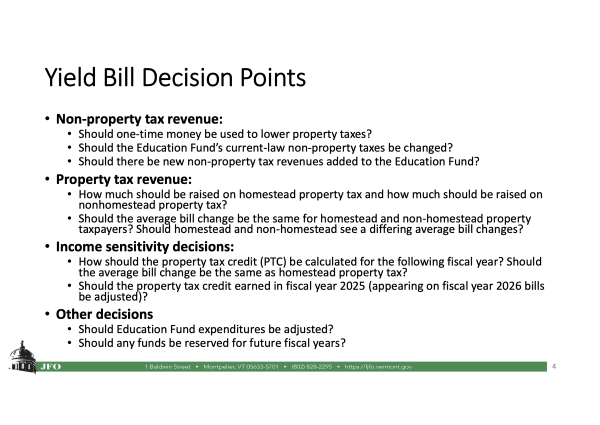
On a very close 6-5 vote, mostly along party lines, the Ways and Means Committee passed the yield bill. The committee's version lands at roughly a 7% average increase. That's painful, but a far cry from the 12% spike projected in December. The difference is about $75 million in one-time money being applied to buy down the rate. Governor Scott had proposed roughly $105 million in surplus revenue and reserves to bring the increase down to around 4%, a number revised even lower after Town Meeting Day budgets came in showing education spending growth of about 4.2%. The committee decided to split the difference, reserving around $52 million within the Education Fund to offset property tax increases in FY28.
The Governor wasted no time pushing back, saying Vermonters can't afford it and he would not accept it. He wants the full buy-down now. The committee chair and the majority of members disagreed, saying a full buy-down will create an even bigger cliff next year, with no one-time funds left to soften the blow.
The reality is that just limiting property tax growth to 5% annually over the next three fiscal years will require around $500 million in new non-property tax revenue. Education costs are growing at about 6% a year while the non-property tax revenues that feed the Education Fund from primarily sales and use taxes, grow at a modest 3%. About 80% of education spending goes to salaries and benefits, with healthcare premiums having increased 125% between FY18 and FY25. Meanwhile, enrollment has dropped from 110,000 students to fewer than 80,000. Income-sensitized and Social Security–reliant seniors make up close to one-third of Vermont's population, which leads to the fundamental question: Who pays?
In addition to the yield bill, the Ways and Means Committee was busy finalizing a miscellaneous tax bill, H.933. The 53-page bill has a lot in it, including a proposal to direct $10 million a year in Purchase and Use Tax revenues collected when Vermonters buy vehicles from the Education Fund to the Transportation Fund. It bumps the Meals and Rooms Tax allocation for education from 25% to 29%, with the General Fund absorbing the corresponding 4% reduction. It's a one-year change, with the allocation reverting next year, meaning lawmakers will be right back at this same table in twelve months. The distinction from the Governor's approach matters, though. Rather than relying on one-time transfers or potentially burdening property taxpayers to fill the Education Fund gap, the committee's version maintains a set percentage of Purchase and Use revenue flowing to education even in the long term. It's a more sustainable plumbing job, even if the underlying pipes are still leaking.
Another interesting issue in the miscellaneous tax bill relates to the PILOT Fund and local option taxes. It’s safe to say that before this session, few folks outside municipalities and state government got too excited about either. The General PILOT is a fund designed to compensate municipalities for taxes they can't collect on state-owned buildings in their community. The local option tax is a 1% tax that voters in a municipality can apply to rooms, meals, alcohol, or sales. The connection between the two is that the state keeps 25% of local option revenues and uses those funds to pay its PILOT obligations. The Ways and Means bill shifts several expenses under the Department of Taxes onto the PILOT, including parcel reappraisal payments, equalization payments, and training for assessors and listers. Since local option taxes fund the PILOT, these added obligations mean more local option tax revenue gets dedicated to property tax administration, stretching the PILOT fund to cover obligations traditionally paid from the General Fund.
Meanwhile, the transportation committees have been debating a proposal to use half the surplus in the PILOT fund to help plug transportation funding gaps. Both proposals have created a wave of concern from many arguing that municipalities have a reasonable expectation that surplus revenue generated by their taxpayers and visitors should flow back to support local needs, not plug holes in the state's General Fund. It's a small-dollar controversy in the grand scheme of Vermont's budget, but it speaks to a larger truth: when money is tight, the temptation to shuffle funds between pots without much transparency is hard to resist.
To add another layer, municipalities are contemplating, and the legislature considering, whether an additional 1% local option tax should be available, as requested this year by the town of Stowe. It's a clear sign that local budgets are struggling, with the education property tax stifling municipalities' ability to raise their own property taxes. The legislature is hesitant to open that door, fearful other municipalities will follow suit. And even if lawmakers moved forward with allowing a 2% local option tax, there's the broader philosophical debate about whether that revenue should be spread more broadly rather than concentrated in tourism-heavy towns.
Step back from any individual bill and the pattern is clear that Vermont is running out of places to find money that don't involve raising someone's taxes or shortchanging something else. The yield bill splits the difference between relief now and a cliff later. H.933 moves vehicle tax revenue to fix roads while backfilling education with restaurant and hotel tax dollars. The PILOT controversy shows what happens when the state quietly raids municipal money to cover its own obligations. And towns are voting to tax their own visitors and customers because the property tax burden has become unbearable. Every one of these moves is rational in isolation and unsustainable as a long-term strategy.
The yield bill still has a long way to go before it reaches the Governor's desk, and the tug of war between a 7% increase and a 4% increase will define much of the remaining session. But even if the Governor gets his way and applies the full buy-down this year, it's a one-year fix. The structural gap between what Vermont spends on education and what its non-property tax revenues can support isn't going away. Neither is the transportation deficit, nor the pressure on municipalities to find new revenue wherever they can. The coming weeks will test whether anyone in Montpelier is willing to move beyond the annual ritual of shuffling one-time money and start the harder conversation about what Vermont can actually afford, and who should pay for it.
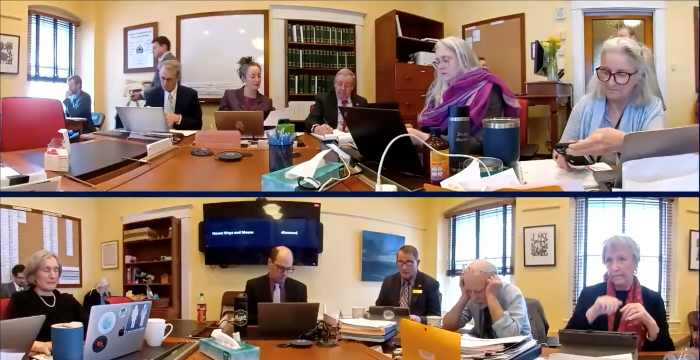
House Ways and Committee screenshot of the Committee from Thursday when they voted out the Yield bill.
Curiosities: a weekly peek at the odd and intriguing happenings under the Golden Dome
The Mechanics
Vermont’s system is meaningfully different from how most states handle school property taxes, and that difference explains a lot of the confusion people feel every March.
In most states, school funding is still largely local. A district sets a budget and applies a tax rate to its own property base. Property wealth plays a major role in that structure. A wealthier community can raise the same amount of money with a lower rate, while a less wealthy one often needs a higher rate to fund similar services. The state may provide aid, but the basic mechanics remain local.
Vermont’s current system traces back to the Brigham v. State decision, where the court found that relying heavily on local property wealth to fund schools violated the state constitution’s requirement for equal educational opportunity. In response, the Legislature passed Act 60, later refined by Act 68, creating a statewide education funding system. The core idea was that two districts spending the same amount per student should face roughly the same tax rate, regardless of how wealthy their grand list is.
The Yield Bill is how the state makes that work. Each year, lawmakers set a property yield and an income yield. These are not tax rates. They are benchmarks that determine how per pupil spending translates into a tax rate. A useful way to understand it is that the yield acts like a denominator. When the yield is higher, the same level of spending results in a lower tax rate. When the yield is lower, the same spending results in a higher tax rate. That relationship is fixed in statute and has been the backbone of the system since the early 2000s.
The Yield is the primary place where the state decides how much of the year’s education spending increase will show up in property tax bills. By adjusting the yields upward or downward, lawmakers can soften or amplify the impact of local budgets. In years with significant pressure, including this year, the Legislature has also opted to use one time money to “buy down” the rates.
This dynamic has become especially visible in recent years as education spending, declining enrollment, and structural costs have put upward pressure on per pupil spending. The yield bill does not create those pressures, but it determines how visible they are to taxpayers in any given year. It is, in effect, the state’s main tool for deciding how the system feels, even if it does not change how the system works.
What makes the yield bill difficult to follow is that it sits between local and state control. Voters approve school budgets locally, and those decisions matter. But the state ultimately decides how those decisions translate into taxes. The yields are where that translation happens. That is why two communities making similar budget decisions can still experience different tax outcomes once equalization and income sensitivity are factored in, even though the underlying structure is designed to keep things aligned over time.
The result is a system that is consistent in design but variable in experience. The rules are the same everywhere, but the outcomes depend on a mix of local spending, statewide calibration through the yields, and adjustments for property values and income. The yield bill is the point each year where the state sets that calibration, which is why it carries so much weight in the final numbers people see on their tax bills.
To support vital journalism, access our archives and get unique features like our award-winning profiles, Book of Lists & Business-to-Business Directory, subscribe HERE!