

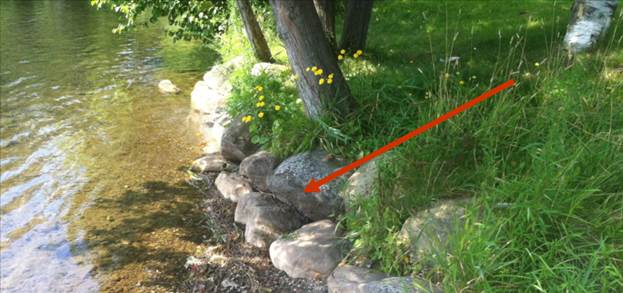
The mean water level (shown with a red arrow) is the average height of a water body over time and often marks where plants no longer grow.
Vermont Business Magazine During the spring fish spawning season, the Department of Environmental Conservation (DEC) wants to remind Vermonters that permitted lake encroachment construction projects and non-chemical aquatic plant control projects on public lakes and ponds are typically not allowed from March 15 to July 1.
“Our state’s lakes and ponds provide Vermonters with considerable benefits – from drinking water and recreation to wildlife habitat,” said DEC Commissioner Misty Sinsigalli. “During the spring fish spawning season, it is key to pause permitted projects to help support the health and breeding success of fish populations across the state.”
Examples of projects that are typically not allowed during this period include adding rock or other material to the water for shoreline stabilization (such as riprap or seawalls), boathouse reconstruction, dredging, bottom barriers, diver assisted suction harvesting, or other projects that disturb the lakebed.
Lake encroachment projects that do not add rock or concrete to the lake and that do not disturb the lakebed (like installing docks, floats, rafts, or buoys) can continue during spawning season.
“From northern pike to smallmouth bass, thousands of eggs develop and hatch between March 15 and July 1,” said Fish Program Manager James Brady with the Department of Fish and Wildlife. “Protecting and promoting fish populations means not only a healthy aquatic environment but also healthy wildlife populations, a healthy tourism economy, and a higher quality of life for those who value our state's fisheries.”
Any project that proposes work at, below, or beyond mean water level of public lakes or ponds may require a Lake Encroachment Permit. Any project that proposes to control an aquatic nuisance species within waters of the state may require an Aquatic Nuisance Control Permit. To learn about other state environmental permits, visit the Permit Navigator.
DEC staff will continue to accept and review permit applications during the spring spawning season. Staff review permit applications and assess any impacts to habitat, water quality, recreation, and other uses. After July 1, permitted construction and non-chemical aquatic plant control projects may resume or begin as identified in the permit. Permitted projects must minimize impacts to fish and wildlife habitat. Please reach out to your regional Lakes and Ponds Permit contact with questions.
If Misha Cetner is not available ([email protected], 802-490-6199), contact Laura Dlugolecki ([email protected], 802-490-6133) or James Brady ([email protected], 802-461-6507).
The Department of Environmental Conservation is responsible for protecting Vermont's natural resources and safeguarding human health for the benefit of this and future generations. Visit dec.vermont.gov and follow the Department of Environmental Conservation on Facebook and Instagram.
Vermont Agency of Natural Resources Website.
To support vital journalism, access our archives and get unique features like our award-winning profiles, Book of Lists & Business-to-Business Directory, subscribe HERE!
