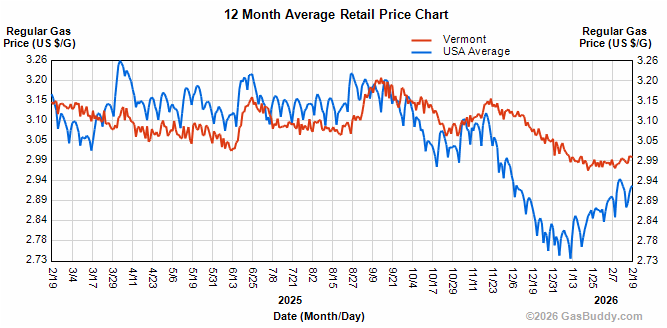
by Timothy McQuiston, Vermont Business Magazine Average gasoline prices in Vermont are $300 per gallon, up 1 cent/g from last week, up 2 cents/g from last month and down 14 cents/g from this time a year ago, according to AAA. The lowest price in the state this week was $2.74/g while the highest was $3.12/g, a difference of 38.0 cents per gallon, according to GasBuddy.
Prices are lowest in Bennington ($2.82/g) and Rutland ($2.91/g) counties and highest in Essex ($3.17/g), Washington ($3.06/g), and Grand Isle ($3.06/g), according to AAA.
Meanwhile, GasBuddy is reminding drivers to fill up on certain lower-priced days. Sundays in Vermont and avoid Thursdays if you can. See chart below.
Average gasoline prices in Burlington have risen 1.9 cents per gallon in the last week, averaging $3.04/g today, according to GasBuddy's survey of 100 stations in Burlington. Prices in Burlington are 3.7 cents per gallon lower than a month ago and stand 17.4 cents per gallon lower than a year ago.
According to GasBuddy price reports, the cheapest station in Burlington was priced at $2.88/g yesterday while the most expensive was $3.09/g, a difference of 21.0 cents per gallon.
The national average price of gasoline has risen 2 cents per gallon in the last week, averaging $2.92/g today. The national average is up 10 cents per gallon from a month ago and stands 24 cents per gallon lower than a year ago, according to AAA.
The national average price of diesel has increased 1.0 cents compared to a week ago and stands at $3.624 per gallon, according to GasBuddy.
Historical gasoline prices in Burlington and the national average going back five years:
February 16, 2025: $3.21/g (U.S. Average: $3.11/g)
February 16, 2024: $3.25/g (U.S. Average: $3.29/g)
February 16, 2023: $3.50/g (U.S. Average: $3.39/g)
February 16, 2022: $3.66/g (U.S. Average: $3.51/g)
February 16, 2021: $2.47/g (U.S. Average: $2.54/g)
Neighboring areas and their current gas prices:
Albany- $2.98/g, up 1.1 cents per gallon from last week's $2.97/g.
New Hampshire- $2.81/g, unchanged from last week's $2.81/g.
“The national average price of gasoline continues to grind higher, and while the pace of increases remains modest for now, upward momentum could accelerate in the coming weeks as refinery maintenance intensifies and the broader transition to summer gasoline begins,” said Patrick De Haan, head of petroleum analysis at GasBuddy. “However, supply-side dynamics could temper that seasonal pressure. If OPEC+ proceeds with resuming production increases following its first-quarter pause, additional barrels could cap crude oil’s upside and limit the magnitude of the spring rally at the pump. That said, geopolitical tensions—particularly between the U.S. and Iran—remain an unpredictable variable, injecting risk into the outlook and leaving prices vulnerable to sudden shifts.”
Drivers who avoid weekend fill-ups and shop around can save hundreds per year on gas
GasBuddy, North America’s trusted source for fuel savings for more than 25 years, today released new analysis identifying the cheapest and most expensive days of the week to buy gasoline in all 50 states. Based on an analysis of daily statewide fuel prices over the past year, GasBuddy found that Sunday is the most consistently affordable day to fill up in most U.S. states, while midweek, particularly Wednesday through Friday, tends to be more expensive.
While price trends fluctuate with oil markets and seasonal demand, weekly patterns remain surprisingly consistent. In most states, prices gradually rise through the week before easing into the weekend, creating a reliable window for motorists to save simply by adjusting the timing of their fill-up. Buying on the lowest-priced weekday instead of the most expensive one can save drivers 4 to 9 cents per gallon with little effort.
“Gas prices don’t just move based on global oil markets — they also follow a weekly rhythm,” said Patrick De Haan, head of petroleum analysis at GasBuddy. “For most drivers, Sunday is the safest bet for finding lower prices, while filling up mid-week can mean paying more.”

GasBuddy graphic.
States With Price Cycling See Bigger Timing Opportunities
In several states — including Michigan, Indiana, Ohio, Florida, Texas and parts of the West Coast — prices follow a more pronounced pattern known as price cycling. In these markets, prices often “reset” sharply higher on a specific day, then slowly decline over the next several days before the next spike.
In price-cycling states, the best savings often come five to seven days after a price jump, when competition drives prices back down. In these states, the gap between buying at the peak of a spike and near the bottom of the cycle can reach 15 to 45 cents per gallon or more, making timing especially important.
“These states experience sharper and more predictable weekly swings,” De Haan added. “If drivers notice a big jump, patience can pay off. Waiting several days after a spike often leads to better prices.”
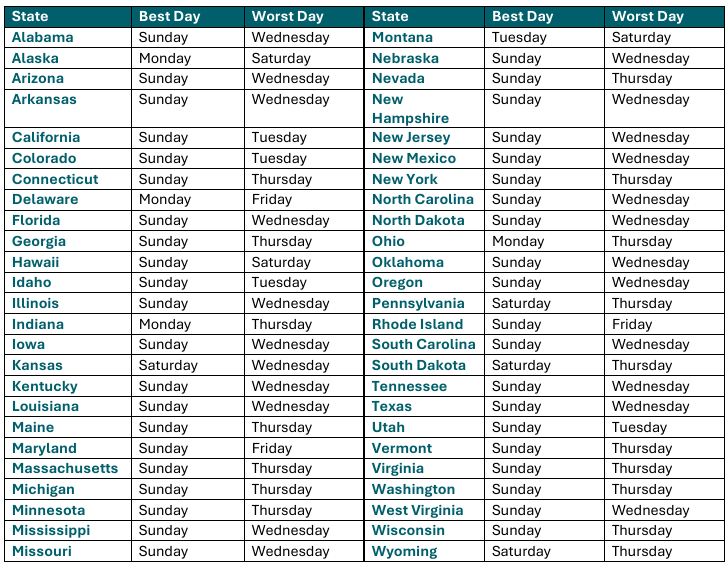
GasBuddy table.
GasBuddy notes that timing alone isn’t the only strategy. Pairing smart timing with shopping around using the GasBuddy app — which typically saves drivers 5 to 10 cents per gallon — or using Pay with GasBuddy+ at participating stations, where discounts can reach up to 33 cents per gallon, can significantly increase total savings over time. A full state-by-state breakdown of the cheapest and most expensive days of the week is available here: https://go.gasbuddy.com/best-day-2026-bystate
Methodology: GasBuddy analyzed daily statewide average gasoline prices over the past year and normalized prices within each week to identify consistent weekday pricing patterns independent of seasonal trends. Estimated savings reflect the typical difference between each state’s cheapest and most expensive weekdays and do not include additional savings from shopping around or Pay with GasBuddy+ discounts.
GasBuddy®, a PDI Technologies company, is North America’s trusted fuel savings platform, helping consumers fuel up for less for over 25 years. With over 100 million app downloads, GasBuddy delivers real-time prices at 150,000+ stations and tangible savings through Pay with GasBuddy+™. It is the most authoritative source of station-level fuel pricing data, updating averages 288 times daily from the broadest mix of inputs— spotter reports, direct station integrations, and transactional data.
To support vital journalism, access our archives and get unique features like our award-winning profiles, Book of Lists & Business-to-Business Directory, subscribe HERE!