
VAHHS photos.
by Devon Green, Sr. Vice President of Policy & Strategy, VAHHS
Vermont Association of Hospitals and Health Systems Legislative Update
If I ever got a tattoo, it will be one of the Montpelier hearts. When you have a moment, take a leisurely stroll through town to check them out. Now, on with health care!
International Physician Licensure: The Senate Health and Welfare Committee heard supportive testimony from VAHHS on S.142, which provides a pathway to licensure for physicians and medical graduates who have practiced medicine for the last three out of five years. VAHHS highlighted that hospitals are seeing a specialist shortage in addition to a primary care shortage and that this bill could help.
Green Mountain Care Board Bill: The Department of Financial Regulation (DFR) testified in support of S.190, the Green Mountain Care Board Bill, in Senate Health and Welfare. When questioned about the cost of an audit, DFR stated that the cost for auditing a complex organization is about $300-$400k. The Chair of the Senate Health and Welfare Committee noted that the Green Mountain Care Board and VAHHS and VMS were working on compromise language and that the committee will likely be taking up the bill later this week for further discussion.
Elimination or Reduction of Services: The Senate Health and Welfare Committee looked at a new draft of S.189, which would remove the Green Mountain Care Board determination on whether a service continues, but would require hospitals to notify relevant parties and hold a public meeting if they are going to reduce or eliminate services. The Green Mountain Care Board rejected the new draft and testified that the Agency of Human Services should make decisions about reduction or elimination of services. VAHHS asked the committee how either AHS or the GMCB would provide the resources necessary for hospitals to continue with services and argued that a public notification and meeting would be sufficient accountability for hospitals in their communities.
Prohibition Against Mandatory Overtime: VAHHS testified in the Senate Committee on Economic Development, Housing and General Affairs on S. 277, which limits the amount of mandatory hours nurses can work. VAHHS questioned the need for the legislation given that most hospitals have union contracts that address this issue. VAHHS also pointed out that the exemptions wouldn’t have covered something like the huge hospitalization spike in 2021 of the Omicron variant of COVID.
Recap of 2-11-26 Health Care Panel for Legislators
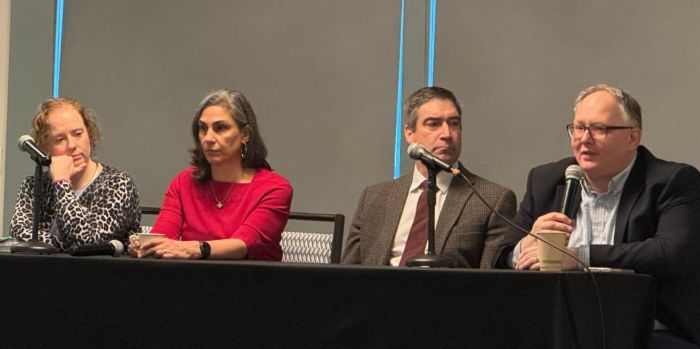
From left, Megan Sullivan, Jill Mazza Olson, Steve Leffler and Michael Costa.
Recap: Health Care Panel for Legislators
On a snowy Wednesday last week, health care leaders and policymakers braved the weather to discuss positive changes Vermonters are making to mitigate the rising costs of health care in our state. VAHHS senior vice president of policy and strategy Devon Green hosted and facilitated the panel, which included a variety of health care leaders and a representative of the Vermont Chamber of Commerce.
Michael Costa, CEO of Gifford Health Care, kicked off the discussion with what he and his team have done to both fill beds at Gifford and alleviate overcrowding at regional tertiary facilities, Dartmouth-Hitchcock Medical Center and University of Vermont Medical Center. Costa said his 25-bed facility had re-committed to providing whatever care they could before transferring patients to larger more-crowded facilities, where they might even need to wait in the emergency department for a bed.
“I stand here with a lot of optimism that if everybody's aligned and committed to taking action, we can be successful,” he noted.
Steve Leffler, MD, CEO of University of Vermont Health, who had worked at UVMHN as both an emergency department doctor and an administrator before taking the helm on an interim basis in September and as permanent CEO in January, agreed with Costa on the need for change.
“I'll be totally honest with you—it felt like we were a little off-track the last couple years; we weren't really focused on our patients, our communities and the two states that we serve,” he allowed. “Our focus since September 15 has been getting back on track, and that really means being very, very focused every single day and in everything we do on high quality care, on accessible care.”
Leffler noted that hospital collaboration is important not only to address the cost of care, but to guarantee access to care for Vermonters all over the state.
“Remember, in Vermont, every hospital is the only hospital in its health service area. Access is critically important in Vermont, in ways, and even more difficult than in big cities where you can move things around,” he said. He used recruiting doctors to provide this access as an important way his network could collaborate with smaller hospitals in the state.
“One of the biggest strengths of UVM Health Network is that we have a medical group of about 1,200 doctors. Young doctors typically want to be in a bigger group,” he explained. “So, our medical group right now is working very hard recruiting doctors who might work part-time in the academic medical center and also work part-time at, for example, Gifford, They may even cover some surgical calls at the right times,” he noted.
Jill Mazza Olson, the Vermont director of Medicaid and health systems, said the health care system is ready to make important changes.
“I think that we've created a lot of important intention for change,” she related. “I think the Oliver Wyman report, in particular, really changed the conversation about how hard everyone was willing to look at how our system was working, how our health insurers were functioning, how our hospitals were functioning, how much everything was costing, all of that. And in my experience, the tension for change is a necessary step,” she said.
She said her team offer would technical assistance and consultation to hospitals, including building a data analytics center and facilitating meetings and conversations in communities around what the changes will be.
She expressed excitement over transformation plans she and her team had received from hospitals and interesting clinical collaborations like the ones Costa and Leffler described
“We're also seeing a couple of hospitals lean in on hospice, and I'm a true believer on this. We have really left an opportunity on the table on end-of-life care. We have a great hospice benefit that people can access. If they accessed it earlier, a lot of people would have a more comfortable end of life, but also, people who are making goals-based decisions often use fewer resources.
Megan Sullivan from the Vermont Chamber of Commerce ended the panel presentation with a business perspective and spoke to the interaction and intersection of hospitals and business.
“You know your communities so well,” she said of hospitals. “I am sure many of you are board members of your local chamber and know what struggles Vermonters are having paying for health care and accessing health care. And you all are doing incredibly hard work to try and figure this out. We have to do something about the cost, because our employers are leaving the state, and they're losing employees because of this, but we also recognize that our hospitals are community anchors. And we can't throw the baby out with the bath water. And the work that hospitals have done, the amount of money that has come out of the system in a year is staggering.”
Sullivan noted that part of the Chamber’s work is supporting hospitals as businesses.
“Beyond just being healthcare providers, you're also employers. You're also developers. You're also involved in the supply chain. And if you need a particularly tricky Act 250 permit, that adds cost at a time when we're saying you have drop your costs,” she noted. “And so, we're at the table talking about how we streamline Act 250 for everybody—not just for housing, but for the developers and when we think about our medical priorities, what is that adding to the cost?”
Green thanked Sullivan and commented that Vermont’s system needed the population to expand to solve affordability issues.
“We can't cut and cut and cut our way out of this. We also need to grow as well,” she said, then opened the floor for questions.
House Majority Leader Lori Houghton, who serves on the House Health Care Committee, noted that the legislature often struggled to communicate their successes with the public and surmised that hospitals faced the same challenges. She pointed to the millions of dollars hospitals had eliminated from their budgets in recent years and fact that ordinary Vermonters focused mainly on not being able to get appointments they wanted.
“So how do you share with your communities that things will get better and that you will see a change in our assets and our affordability? Are you there yet?” she asked.
Leffler admitted the system was not quite there yet, but hospitals were working hard on how to show some good results.
“We have to show that people are getting in more quickly. We’re doing more MRIs, more CT scans. We had a record-setting first quarter for surgery, and the demand is still growing,” he explained, adding that collaboration with hospital partners could help alleviate backlogs.
“And affordability is a tricky word because what does affordability actually mean? But we have to be able to have real examples. MRIs cost 25% less than they did in 2025 at UVM Medical Center, for example,” he cited.
Costa also sympathized with Houghton’s comparison to the legislature’s common challenges. “The walls of the state house are incredibly thick, and good things are happening in there, and then nobody hears about them or understands them,” he said. “I would love if every middle schooler in Vermont and every parent of a middle schooler in Vermont knew how incredible the state is at helping young people get into nursing. We’re going to help you at every step of the career path thanks to a lot of the work that happened in house commerce.”
Edye Graning, who represents Jericho and Underhill in the House and serves on the commerce and economic development committee, posed a question prefaced by the fact that she was not an insider in the health care system or an expert in health care.
“We set up the system we have today; that is the one that we're trying to fix, right? We did that with the intention of making sure that, in a very small state, healthcare is available to all of the people in the state. Are we looking at what we have incentivized and trying to change that, too, so that we don't end up in the same place?
All panel members welcomed the question.
Olson said, “Nobody set up this system. It grew. A lot of things just sort of evolved over time. One of those is prices for care—that's partly because of how insurance companies used to reimburse for care. The prices didn’t always hit the consumers the way they hit them now, with the rise of higher-deductible health plans. Then some of our system is impacted by federal policies that we have no control over. And some of it has to do with realities like there's no hospital right now in Vermont that can live without orthopedic surgeries, because that's where the money is—that's where they get a pot of money to spend on other care for their communities. These are hard, hard decisions, hard changes. Much of the work is being led by Senator Lyons and Representative Black— really thinking about things like reference-based pricing, which is essentially making our prices more uniform and tagged to Medicare rates.”
Leffler stated, “I love (Rep. Graning’s) question, because it asks what does the future state look like? How do we get there? So, the first thing I want to say is, everyone in Vermont wants the same thing—high-quality, accessible, affordable care. We all want that; our regulators want it; our legislators want it. We want it for ourselves and our families. As hospital leaders, as state leaders, in our business community, we all are focused on that: Who pays for it? How much is it? Where do we do it? It's the big three things.
“The one thing I could worry about a little bit right now is there's tremendous amount of change happening, so all of us—the legislature, our regulators, hospitals—are doing a lot of stuff really fast, and on some of this work, like, the infusion drug bill, it is going to honestly take two or three years to see the full impact.
Costa agreed with Olson and Leffler about the pace of change.
“I mean, all of us have to manage change inside of our organizations,” he pointed out. “We can say, ‘hey, the next year or two is about efficiency and seeing if these changes work.’ Then we are rationalizing prices, and then getting into something like a global budget, knowing the trajectory we're on, and then staying with that trajectory. That gives us credibility when we stand in front of our medical groups. If we have the same message over time, it really helps us manage the pace of change in our buildings.”
Senator Virginia Lyons, Chair of the Senate Health and Welfare Committee, closed the meeting by noting there could be a whole separate panel on why the costs of healthcare are so high in the state of Vermont—including the expectations that patients have, and the relationships between patient and provider.
“I appreciate the analogy to growing,” she said. “Candidly, I think that Vermont's health system, to be successful over the next 5 or 10 years, has muscles to build. Like, can we build the efficiency muscle, which will give us the ability to collaborate more and to be really flexible across our service areas? It takes sustained effort to do that. I just think it's terrific that we are all in this room, talking in this way, and I feel like we're finally in the shell rowing in the same direction, which is something we've always wanted to do.”
2.17.2026. VAHHS https://www.vahhs.org/
To support vital journalism, access our archives and get unique features like our award-winning profiles, Book of Lists & Business-to-Business Directory, subscribe HERE!