


A Weekly State House Recap By Maggie Lenz and Gwynn Zakov (on behalf of Atlas Government Affairs
and Garnet Government Relations
A Second Wind
Remember a couple weeks ago when we wrote that there seemed to be little political will in the legislature to take up Act 250 (Vermont’s statewide land use and development law) and Act 181 (the 2024 land use modernization and housing reform law) reforms this session? Well, we were wrong. Dead wrong. Only a few days after the column ran, the Rural Caucus met with Senate Majority Leader, Sen. Kesha Ram-Hinsdale (D-Chittenden Southeast), and the Chair of the Senate Natural Resources Committee, Sen. Anne Watson (D-Washington), to discuss concerns the caucus has with Act 181 implementation, some of the larger goals the senators had with Act 181, and reforms to Act 250.
This week the Senate took the lead, and the Senate Committee on Natural Resources took initial testimony on Act 250 and Act 181 reforms, focusing on a general overview of components of Act 181 that various stakeholders sought amendments to, how Act 250 impacts statewide transportation projects, and the Tier 1A and 1B opt-in process.
Rep. Laura Sibilia (I-Dover) testified on behalf of the Rural Caucus and presented H.730, highlighting the rural impact of Act 181, urging the committee to adjust deadlines and improve notice requirements for impacted landowners. She warned that without careful support, rural Vermonters may face increased burdens and rural gentrification pressures.
Representatives from regional planning commissions (RPCs) noted that RPCs are making good progress with mapping, but there is concern that later regulatory review could unexpectedly tighten growth area boundaries and affect expected housing capacity. They stressed the importance of fine-tuning and streamlining how Act 181’s planning framework works, ensuring that the process remains responsive, clear, and capable of adapting without undue delays or confusion.
The Vermont League of Cities and Towns (VLCT) testified, urging the legislature to extend interim exemptions to Act 250 review, delay implementation of the “road rule,” and delay Tier 3 expansions and enforcement expectations for municipalities. The Vermont Natural Resources Council (VNRC) supported extensions and careful rulemaking, particularly around Tier 3 and the “road rule,” but stressed environmental considerations and the need for tailored implementation.
In a joint hearing with the Senate Committee on Transportation, the committees heard from the Vermont Agency of Transportation (AOT) on the impacts of Act 250 on state transportation projects. AOT expressed frustration with differing interpretations of whether Act 250 applies to projects, wanting more certainty so they can plan and budget effectively. They described how the federal National Environmental Policy Act (NEPA) and Act 250 often cover similar ground, but right now they must typically be completed one after the other, which adds months to project timelines.
AOT said it is losing access to staging areas because Act 250 land use rules can increase costs dramatically, in one case estimating about $2 million if staging land could not be used without extending permitting. Committee members noted that additional permitting time, between six and eight months or more, could delay construction seasons and increase project costs through inflation and lost efficiency. AOT also offered draft legislative language to make the process more predictable and less duplicative.
The week ended with a joint hearing with the Senate Committee on Economic Development, Housing and General Affairs, focusing on Tier 1A and 1B opt-in issues. VLCT testified that municipalities are only one part of a system driven by RPCs and the Land Use Review Board (LURB), and eligible growth areas are often shrinking during LURB review because of conservative interpretations of statutory “village area” definitions. In Rutland County, for example, most larger towns with water and wastewater capacity are opting into Tier 1B, while smaller towns with limited infrastructure are opting out.
Notably, Rutland City is skipping Tier 1B to pursue the broader Tier 1A exemptions. Testimony highlighted concerns that the process is lengthy, administratively burdensome, and lacks a streamlined way to amend maps once adopted. There was also discussion of whether switching from an opt-in to an opt-out system would have a meaningful impact at this stage. Finally, testimony from the Director of Planning in South Burlington raised concerns about Tier 1A municipalities automatically inheriting responsibility for all existing Act 250 permits and supported draft legislation to clarify and ease that administrative transition.
The committee is focusing on S.325, which appears to be the Act 181 and Act 250 reform bill the Senate will use as the legislative vehicle for Act 250 reforms. As of now, the bill proposes to push back numerous Act 181 deadlines, including moving the “road rule” effective date from July 1, 2026, to July 1, 2027, and Tier 3 rulemaking from February 1, 2026, to February 1, 2027.
Several other deadlines are proposed to receive six-month extensions, including the accessory dwelling unit (ADU) exemption, priority housing project exemption in downtown and growth centers, commercial-to-residential conversion exemptions, interim housing exemptions in designated areas, downtown district housing exemptions, and village center and urbanized area housing exemptions. These new deadlines would provide breathing room for all stakeholders involved, including developers, municipalities, and the LURB, but they do not make substantive changes to landowner notification requirements or the underlying policies implemented in Act 181.
It is now a near certainty that there will be an Act 250 and Act 181 reform bill this session, and it will have to move out of the Senate before the crossover deadline in early March. And that is the beauty of the legislative process. Even when things look done for, nothing is really ever dead until the final gavel falls and the legislature adjourns sine die.
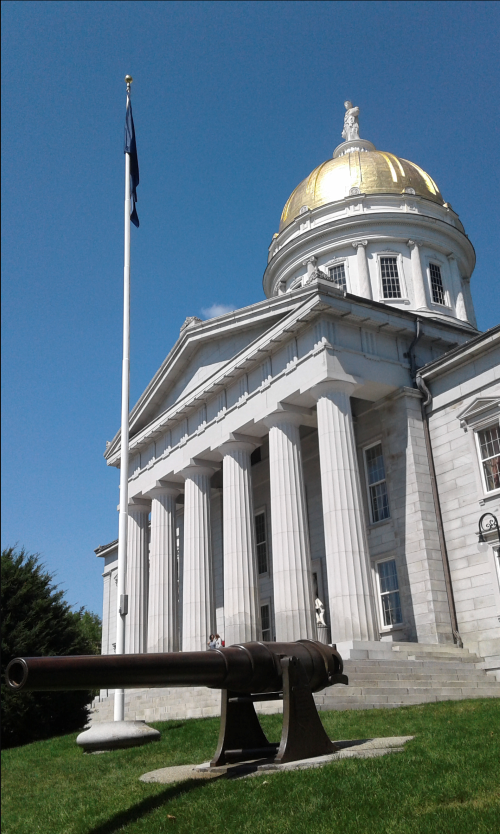
“Vermont State House Spanish cannon Montpelier VT August 2016,” Wikimedia Commons, Photo by Artaxerxes, CC BY-SA 3.0.
Curiosities: a weekly peek at the odd and intriguing happenings under the Golden Dome
Dewey Mania
On either side of the Vermont State House steps sit two large naval cannons mounted on stone bases, their barrels angled toward State Street. Most people move past them without much thought. At this point, they blend into the landscape. But step back for a moment and the question becomes obvious. Why does a landlocked state capital have seaside artillery on its front lawn? The answer lies in a stretch of months when the country could not get enough of one Vermont boy.
George Dewey was born in 1837 in a house across from the State House. His father, Dr. Julius Dewey, was a prominent physician and civic figure who helped found National Life Insurance Company. The Dewey household sat within easy sight of the Capitol dome, and George grew up in the tight orbit of nineteenth century Montpelier, attending local schools and absorbing the rhythms of a small but ambitious state capital.
As a teenager, he enrolled at Norwich University. Later biographies preserve a story from those years that has followed him ever since: Dewey and fellow cadets allegedly drove a herd of sheep into a dormitory building as a prank. Accounts differ on the details, and it survives more as campus lore than formal record, but the episode is frequently cited as contributing to his departure from the school.
In 1854, Dewey entered the U.S. Naval Academy, graduating in 1858 and building a long naval career that included Civil War service and steady advancement through the ranks. By April 1898, when the United States declared war on Spain over its colonial conflicts in Cuba and elsewhere, Dewey was Commodore of the U.S. Asiatic Squadron and was ordered to engage Spanish forces in the Philippines. Before dawn on May 1, 1898, his fleet entered Manila Bay and, over several hours, destroyed the Spanish Pacific fleet, including the cruiser Castilla. Spanish sailors were killed in the fighting, American combat losses were minimal, and the victory eliminated Spain’s naval power in the Pacific, helping bring the war to a close later that year with Spain ceding territories, including the Philippines, to the United States.
What happened at home after the victory was extraordinary. Newspapers splashed Dewey’s portrait across front pages. Sheet music publishers rushed out marches such as “The Hero of Manila,” complete with illustrated covers bearing his likeness. Families played those songs in parlors. Merchants sold commemorative plates, buttons, cigars, and other goods carrying his name. The name “Dewey” surged in popularity for newborn boys. Congress created a new rank, Admiral of the Navy, specifically for him. For a time, his reputation traveled far beyond naval circles and into daily American life. The country had found a hero, and Vermont knew he was theirs.
When Dewey returned to Montpelier on October 12, 1899, the city organized what contemporary accounts described as one of the largest celebrations in Vermont’s history. An estimated 40,000 people traveled to Montpelier. Special trains arrived from across the state, and additional track was laid to manage the crowds. Buildings were draped in bunting. A large portrait of Dewey hung from the State House, and the dome was outlined in electric bulbs. Dewey rode through town in an open carriage wearing full dress uniform while twenty five bands marched behind him. That evening, fireworks depicted the USS Olympia and scenes from Manila Bay. A towering bonfire was constructed on Capitol Hill behind the State House and set ablaze, with a young Montpelier girl, Margaret Pitkin, chosen to light it. For one day, Montpelier felt like the center of a national celebration.
Three years later, in 1902, two steel Krupp naval guns captured from Spanish ships at Manila Bay were sent to Vermont. They had once been mounted on vessels defeated in the battle, including ships such as the Castilla. The cannons were installed on the State House lawn as a tribute to Dewey’s command and his Montpelier roots.
The sheet music eventually stopped selling in such numbers. The souvenir craze faded. The cannons remained. They stand today as a durable trace of a period when a Montpelier boy, once rumored to have filled a dormitory with sheep, commanded a fleet half a world away and sparked a wave of national enthusiasm strong enough to send artillery back to Montpelier as a symbol of pride.
Cover of Brave Dewey and His Men (Down at Manila Bay), patriotic sheet music published in 1898 following Admiral George Dewey’s victory at Manila Bay. Public domain.
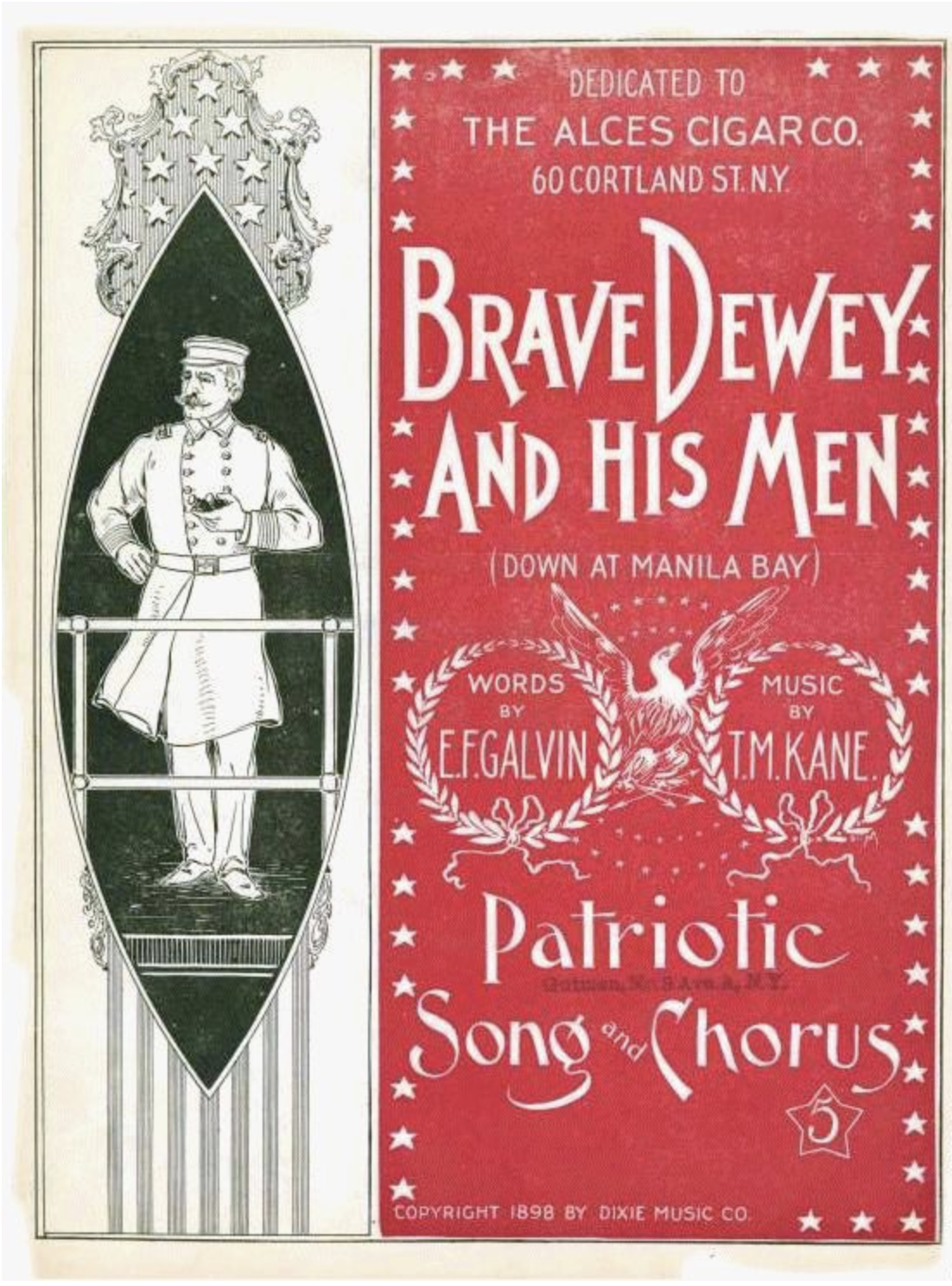
Brave Dewey and His Men (Down at Manila Bay)
Words by E.F. Galvin
Music by T.M. Kane
Published 1898
A squadron Lay at break of day with enemy in view,
[illegible] boat and tar had sailed afar a glorious deed to do.
American each ship and man, fought that eventful fray!
'Twas Dewey's fleet the foe did meet down at Manila Bay.
[Chorus]
Then raise a cheer all earth can hear, and three times three again,
The noblest tars who sail the sea, brave Dewey and his men
Then raise a cheer, all earth can hear, and three times three again,
The noblest tars who sail the sea, brave Dewey and his men!
A gallant dash, a rock, a crash, O'er guns strike faultlessly.
And Dewey brave quick orders gave, which made new history.
At cannon [illegible] our tars did shout. "Avenge the Maine today"
'All Spain now weeps, four hundred sleeps down at Manila Bay”
The Castile flag, that yellow rag, has dipped to rise no more.
The stripes and stars, and our loved tars, are masters on the shore.
Those heroes grand throughout the land are idolized today!
Our foes are slain, no more of Spain down at Manila Bay