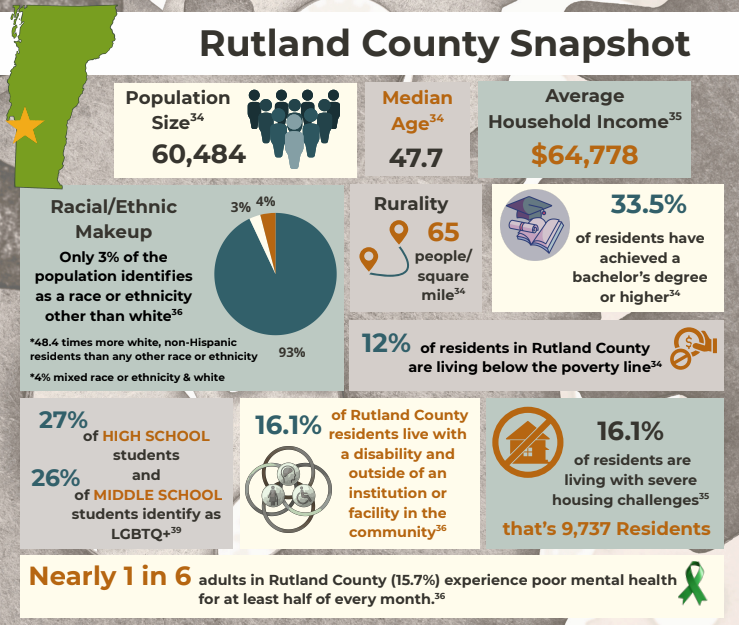
Vermont Business Magazine Social Tinkering has released their new report: Social Connection, Isolation, and Loneliness in Rutland County: A Landscape Analysis. Three years in the making, and authored by Founder Jeanette Langston and Research Specialist, Ella Kenney, the report provides a comprehensive analysis of disconnection, isolation, and loneliness, examines the populations most impacted in Rutland County, and provides an overview of the barriers that prevent meaningful connection. It concludes with an assessment of regional strengths and gaps and offers recommendations to support community well-being and help residents thrive through connection.
This data project is funded by the Bowse Health Trust and is one piece of a 3 year, multi-part project that encompassed the launch and development of Social Tinkering’s community organizing efforts to reduce and heal isolation and loneliness. This organizing work began as a way to coordinate diversity, equity, and inclusion projects and advocacy throughout the area in early 2023. The goal was to reduce costs and create cross-pollination between organizations for greater impact in growing meaningful connection. In the report, Kenney and Langston review how inequity, leading to connection barriers such as stigma and bias, can be significant reasons we are feeling disconnected from each other. These may lead to disconnection, social isolation, and loneliness in our communities, which then impact everything from people’s health and employment to the success of our economy. While isolation and loneliness can be caused by many factors, the good news is that disconnection is solvable. Langston says that, “by bringing the issues of isolation and loneliness into the spotlight, we can begin to understand the disconnection that underlies them and even feel less alone just in the simple open discussion of this. Loneliness is something we all experience and it can be very painful. Naming that out loud and beginning to talk about it is incredibly powerful for our healing.”
Over the last three years, between running Gather Together, Women’s Circle, and many other events and conversations, Social Tinkering’s team has been investigating just where to start on a county-wide connection data project. “With intentional social connection work and evaluation still being relatively new topics around the nation, we have yet to find an example of a regional analysis that we could adapt for our local use. Because of this, we had a lot of work to do just to lay out the project’s framework,” Langston says. Ultimately, the team started with this landscape analysis and added on a county-wide Social Connection Survey in October of this year. Separate from the landscape analysis, the co-authors were unable to finish compiling the results and a report on the Social Connection Survey as of yet, and are currently exploring ways to fund the completion of this part of the project in 2026.
How the Report will be Utilized
The Social Tinkering team hopes the landscape analysis will be used by advocates, organizations, and other local leaders throughout the region to support their own connection work as well as any coordinated efforts. The report may help organizations who work with the populations most at risk or who work on the related issues, to more clearly understand how isolation and loneliness is impacting the people they serve and our communities. This analysis aims to expand readers’ awareness of how disconnection is impacting us all and to deepen the understanding of the complex, deeply human challenges it presents. Langston and Kenney hope the report will inspire meaningful connections, promote healing from isolation and loneliness, and strengthen Rutland County’s ability to thrive.
Next Steps
Although Social Tinkering is dissolving due to funding issues and a re-evaluation of the nonprofit structure for the purpose of this work, both Langston and Kenney will be continuing their work on these topics in their own ways. Langston hopes this landscape analysis and their survey work could be utilized as an adaptable and replicable framework for a full statewide review. She encourages other counties and leaders across the state with interest in this project to reach out to her to explore future opportunities to expand upon this information. In the new year, Langston can be reached in her new capacity as the owner of her social enterprise startup, The Connection Studio. She can be reached at [email protected] to explore collaboration.
Kenney will continue this work as she completes her Master of Public Health (MPH) in Epidemiology and Biostatistics at Mount Sinai. Through her studies, she seeks to further develop her skills in public health research and expand her understanding of social disconnection, applying the insights she has gained throughout her time with Social Tinkering to inform effective strategies. “Research is one way we can understand the upstream factors that shape social connection and inform strategies that strengthen and promote the wellbeing of communities,” Kenney says. She looks forward to collaborating with organizations and community leaders to help foster stronger, healthier, and more connected communities.
The Social Connection, Isolation, and Loneliness in Rutland County: A Landscape Analysis will be available to read on the Social Tinkering website through the month of January at www.socialtinkering.org. It will also be sent to area nonprofits through the Project Vision email list and to key partners individually.
12.23.2025. RUTLAND, VT – Social Tinkering ~ A Human Connection Project www.socialtinkering.org
To support vital journalism, access our archives and get unique features like our award-winning profiles, Book of Lists & Business-to-Business Directory, subscribe HERE!