What Lies Beneath
by Maggie Lenz of Atlas Government Affairs
The School District Redistricting Task Force, created by the legislature earlier this year and charged with delivering up to three proposed district maps for the legislature to consider in 2026, is narrowing in on some tangible options as they approach their final stretch. They’ve had a tough assignment, but under the leadership of co-Chairs Sen. Martine Gulick (D-Chittenden Central) and Rep. Edye Graning (D-Jericho), the task force has made steady progress and stayed focused on the work as they wade through the complicated tangle of Vermont’s school governance and geographic boundaries. Our current system is less a design and more an accumulation shaped by old laws, local votes, political bargains, and whatever got grandfathered in along the way. The result is a landscape that defies easy answers.
Still, the Task Force has managed to hone in on several models they plan to evaluate more fully in the coming weeks. These include school districts aligned with career and technical education (CTE) regions, school districts based on county lines, a long-term vision anchored by regional high schools, and a shared services model that builds collaboration on top of existing structures. Each one brings different implications for equity, efficiency, local control and political feasibility. But as members of the Task Force noted, none of these models can be fully evaluated until a more fundamental question is answered. How will new districts be governed?
That is the core debate between supervisory unions (SUs) and supervisory districts (SDs). SDs have a single board, one budget and often more aligned staffing, strategy and accountability. SUs are composed of local boards and local budgets but operate through a shared central office. Vermont has used both structures for decades but the uneven results are getting harder to ignore.
The redistricting concept with the most traction right now would draw district lines based on the state’s technical center regions. In some places, those already reflect how schools work together. But in others, especially around Burlington, the scale is off. One proposed region combines Burlington and Essex into a zone of more than 22,000 students. That’s too big to meet the goals of Act 73, which envisions districts serving 4,000 to 8,000 students. The task force is already looking at how to address this.
Another model follows Vermont’s 14 counties. It looks simple, but the fit is off. The populations are uneven, with Chittenden County again accounting for a quarter of the state’s students. And school communities don’t follow county lines. Towns tuition students across borders, districts already collaborate beyond them, and few partnerships stay neatly inside one county. The map may look clean, but it does not reflect how education actually works here.
The third model is less of a map and more of a long-term vision. It imagines modernized, regional high schools as anchors, with elementary and middle schools vertically aligned underneath. The idea is to modernize buildings, broaden offerings, and create stronger pipelines for students. But it would take major investments in school construction and statewide buy-in. The task force will keep it on the table more as a north star than a plan with legs.
The last model is one for shared-services and collaboratives like the BOCES system used in New York. Vermont has one pilot underway in the Southeast. Right now, participating districts keep their boards but agree to consolidate services like transportation, staffing, and special education. It’s appealing to many because it offers scale without necessitating full governance change. But if districts disagree or pull out, there’s potentially no shared authority holding it together.
And that’s what it all comes back to. Every model rests on what lies beneath the maps. SDs bring shared oversight, unified budgets, and clearer responsibility. SUs protect local control. They’re also uniquely Vermont. They don’t exist anywhere else in the country. They exist here, yes, for local control, but they also make it more straightforward for nonoperating districts to send public dollars to independent (private) schools. Part of the governance problem includes how public funding flows into private systems. The task force isn’t just choosing maps. It’s holding up a mirror. What kind of system do Vermonters want to live with? Change is hard, especially when it involves something like local control which we’ve long treated as almost sacred.
To make these decisions even more difficult for the legislature during the 2026 session is the looming approach of their elections. Rural boards are already organizing forcefully against any form of forced merger and in support of SUs. Local control remains a powerful rallying cry as the wounds from Act 46 have not fully healed. At the same time a growing number of education officials and community leaders are saying out loud that we cannot keep doing things the way we always have. That the current system is too uneven, and the promise of equity will remain out of reach as long as governance is so fragmented.
The perennial question of whether equity and local control can truly coexist is asked often, and just as often the answer seems to be, probably not. So the real question becomes how we as a state prioritize those two values. What are we willing to give up for equity? What are we willing to give up for local control? The success of this system redesign will depend in large part on Vermonters being willing to accept change and to let go of how things have always been done.
Curiosities: a weekly peek at the odd and intriguing happenings under the Golden Dome
The Translator
When Rep. Mary-Katherine Abdel-Ghany Stone, a Democrat from Burlington, took on the role of communications lead for the Vermont House Democratic Caucus, she didn’t come with a background in politics. She came from hospital hallways, the COVID unit, the ER, the ICU. That experience shaped everything about how she works today.
“I never thought I’d be doing this,” she said, reflecting on her early jump into leadership. “I didn’t even see myself in politics until just before I ran in 2022.”
What she did see were people in crisis, people trying to be heard. What she developed was a sharp instinct for clarity, compassion, and the ability to cut through noise when the stakes are high.
Now she brings that same clarity to Vermont’s State House, leading with a communications style that is deliberate and transparent.
“We do a lot of good work in this building,” she said, “but we often get so stuck on wanting to bundle it up in the perfect package that we miss the point. Vermonters want and need to know what we are doing in ways that connect with them where they are.”
Her strategy is simple: say the thing plainly. She prioritizes clear, timely facts for the caucus and encourages members to speak in their own authentic voices, reminding them that no one knows their communities better than they do.
“We equip members with the information,” she said, “but we also take time to listen and let our message be shaped by them.”
Midway through the 2025 session, Stone found out she was pregnant. The news came in the middle of a demanding stretch of work. The fatigue and symptoms were real but not disqualifying.
“It was a challenge but not a barrier,” she said. “Knowing I am setting an example for future generations, particularly women in a role like mine, was good fuel to keep going.”
You will not find her reading from a script behind a podium. You will find her on Instagram, often in a sweatshirt, talking directly to Vermonters about what happened that day at the State House.
“At first it felt silly,” she said. “Now I treat it like a conversation with friends in my living room.”
Her hope is that Vermonters understand how much their voices matter, not just during campaign season but throughout the year.
“Lawmakers really want and need to hear from their constituents,” she said. “Those stories shape the work that comes to the floor.”
In Rep. Mary-Katherine Abdel-Ghany Stone’s world, politics does not have to feel distant. It just has to be translated clearly and in plain human terms.
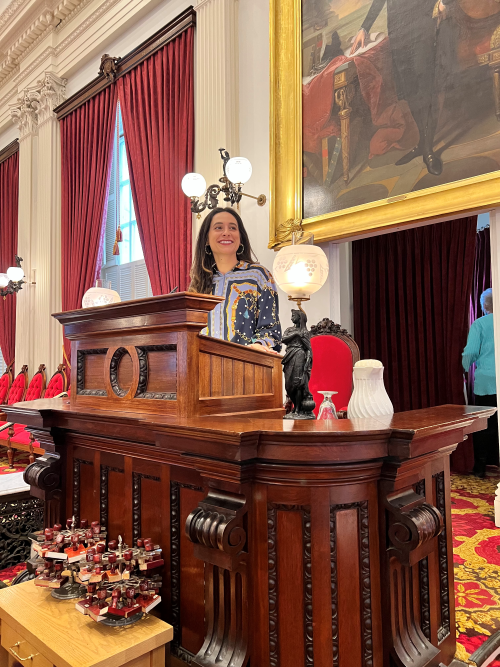
Rep. Mary-Katherine Abdel-Ghany Stone gives the first devotional of the 2025 Legislative Session
To support vital journalism, access our archives and get unique features like our award-winning profiles, Book of Lists & Business-to-Business Directory, subscribe HERE!