

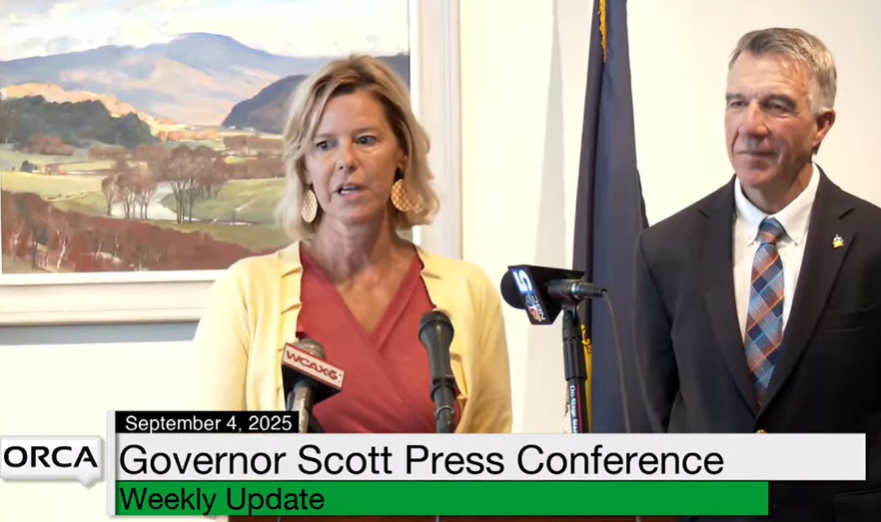
Liquor & Lottery Commissioner Wendy Knight, with Governor Scott, discussed both the $1.8 billion projected Powerball jackpot and legalized sports gambling on Thursday at the governor's wide-ranging press conference. ORCA Media screen grab.
by Timothy McQuiston, Vermont Business Magazine
Governor Phil Scott addressed a wide range of issues at his press conference Thursday, including contentious topics on the future of the Green River Reservoir, public safety in Burlington and the recent audit of the Burlington Electric Department (which found deficiencies), Canadian tourism, the federal government finally releasing $15.8 million for electric vehicle charging stations and the possible windfall from the $1.7 billion Powerball drawing on Saturday.
But he opened the presser by discussing the importance of river cleanup this month.
Scott said now is a good time to clean up the state’s waterways because of low water levels that have exposed debris from the floods of 2023 and 2024. He likened the initiative to Vermont’s Green Up Day, which occurs in the spring and encourages residents to participate in organized events or simply pick up trash during walks. Not only are the water levels lower now than in the spring, but the water is much warmer.
“Cleaning up, whether it’s in the spring or fall, isn’t just about making things look nicer. It’s also about protecting our most valuable resources, like our waterways,” Scott said.
Commissioner Misty Sinsigalli, newly appointed to lead the Department of Environmental Conservation, shared her personal reflections on Vermont’s rivers, describing them as “arteries that connect our communities.” She highlighted the ecological, recreational, and cultural significance of the state’s 20,000 miles of rivers and streams.
Director Lyn Munno of Watersheds United Vermont (WUV) outlined the role of community-based watershed groups in organizing cleanups, monitoring water quality, planting riparian buffers, and restoring floodplains.
She and Taylor Litwin from Friends of the Winooski River noted that September is ideal for river cleanups, again, due to lower water levels and also because of more stable vegetation.
Cleanup Events & Volunteer Opportunities
Several cleanup events were announced for the weekends of September 6–7 and September 13–14, including:
- Friends of the Winooski River – Montpelier (Sept. 6) and Barre (Sept. 13)
- Black River Action Team – Springfield (Sept. 6)
- Missisquoi River Basin Association – Montgomery (Sept. 6)
- White River Partnership – Royalton (Sept. 7)
- Connecticut River Conservancy – Source to Sea Cleanup (Sept. 26–27)
Volunteers were encouraged to check local watershed group websites and social media for details. Munno shared that last year, over 500 volunteers removed more than 20,000 pounds of trash from Vermont’s rivers.
Flood Recovery & Debris Removal
Scott and Sinsigalli discussed the ongoing recovery from recent floods. With water levels currently low, debris from past flooding events—including remnants from Tropical Storm Irene in 2011— is more visible and accessible.
Examples of flood-related debris included:
- Tires washed downstream from residential yards
- Propane tanks and culverts displaced miles from their origin
- Personal items such as engagement rings and statues, some of which were successfully reunited with their owners, but others that have not been.
The governor emphasized the importance of securing items near riverbanks to prevent future washouts and noted the role of community awareness in reducing intentional dumping.
He said he’s noticed less dumping in recent years.
Environmental Stewardship & Citizen Science
Sinsigalli praised the work of citizen scientists, local road crews, and conservation groups. She described a recent canoe trip on the Black River in Orleans County where she observed:
- Stream banks planted with native vegetation
- Farmers adopting conservation practices
- And like Scott, fewer tires and trash than in previous years
“River cleanups are more than just picking up litter. They’re a civic act—a commitment to the health of our communities and our waterways,” she said.
Unique Finds & Community Stories
Taylor Litwin was asked about oddities and unusual items found during cleanups:
- Oranges and grapefruits
- Teddy bears and dolls
- Microwaves and refrigerators
- Porcelain dolls from a long-defunct factory
Litwin said that volunteers compete for prizes for the “weirdest or grossest” item found, adding a lighthearted element to the serious work.
Water Scarcity & Drought Conditions
Natural Resources Secretary Julie Moore provided an update on Vermont’s rainfall deficit, noting the state is approximately seven inches behind average.
This has led to:
- Reduced capacity in shallow wells
- Increased wildfire risk
- Burn bans issued by local fire wardens
The Agency of Natural Resources has convened a drought task force to monitor conditions and coordinate response efforts.
Green River Dam & Energy Policy
The press conference also addressed the future of the Green River Dam, owned by Morrisville Water and Light.
Governor Scott and Secretary Moore discussed:
- The dam’s surprisingly good condition despite its age
- The high cost of decommissioning versus continued operation
- The economic and recreational value of the Green River Reservoir
While state ownership was deemed unlikely due to cost and operational complexity, Scott expressed hope for a collaborative solution among stakeholders.
“Everyone needs to give a little bit in order for that to happen,” he said.
A report issued this week stated that the dam and dike are in what Moore called “surprisingly good shape,” considering it was built in 1947.
The pristine reservoir the dam supports does not allow motorized boats and is a sanctuary for loons, among other wildlife.
The dam also features a small hydroelectric facility. MW&L wants to give up its license to operate the power station because it actually costs its ratepayers to operate, as the maintenance outpaces revenues.
The report found that the most cost-effective option is for the state to take over maintenance of the dam, dike and reservoir, while ceasing operation of the hydroelectric facility.
Some environmentalists want the dam removed to improve water quality and wildlife habitat, including fish migration, but that would be the most expensive option.
Scott and Moore both stated that the state does not have the funds to take over the reservoir and dam, which is the same argument made by MW&L.
It would cost $4.8 million for the state to take over the dam, with ongoing costs of . Meanwhile, by decommissioning the station, the net benefit to the state, when tax revenue and visitor spending is considered, would be $29.1 million. This would be the most overall cost-effective outcome.
Removing the dam would cost $16.4 million with a net deficit of $21.3 million. The net benefit to the state by doing nothing would be $13.7 million, with MW&L 4,000 ratepayers remaining on the hook for maintenance, while still operating the station at a loss. At the least, the utility has petitioned FERC asking for approval to decommission the station.
Lottery Revenue & Powerball Windfall
Liquor & Lottery Commissioner Wendy Knight was asked about the impact on the massive Poiwerball drawing coming Saturday. She said Vermont’s lottery revenue has increased 190% over the last week as the now $1.8 billion projected Powerball jackpot keeps growing. If a Vermonter wins, the state would receive a 6% withholding—approximately $46 million.
The ticket sales alone, even without a local winner, also benefit the state, Knight said. Last Wednesday’s sales totaled $656,000 while the week before sales were $226,000. Net ticket sales revenues go to the Education Fund, while the tax on winnings goes to the General Fund.
She emphasized that increased ticket sales benefit the state’s education fund, even if no Vermonter wins the jackpot.
Sports Wagering & Responsible Gaming
Knight also discussed the legalization of online sports wagering in Vermont.
She said the state does not consider sports betting a big revenue generator, but rather a way to control the process.
She said the online wagering generated:
- $3.5 million in revenue during the first six months of this calendar year
- $6.1 million was taken in last year
- Partnerships with the Department of Mental Health for responsible gaming programs
She said that September (the beginning of the popular NFL season) is Responsible Gaming Education Month. She said the state’s regulatory framework promotes safe gambling practices.
Electric Vehicle Infrastructure
Transportation Secretary Joe Flynn addressed federal funding for EV charging stations, explaining:
- Vermont’s rest areas cannot host commercial charging stations due to federal highway funding rules
- New York and New Hampshire can install chargers at welcome centers because they used toll revenue and private funding
- Vermont received $15.8 million in NEVI funds and is targeting 11 sites with up to 55 charging ports
Flynn clarified that for now, the federal government has waved the Buy American requirements on EV chargers because there are no domestic manufacturers of the equipment. This moratorium, for now, will only last a year.
Return-to-Office Policy
Governor Scott and Secretary of Administration Clark once again discussed the state’s plan to bring employees back to the office three days a week beginning December 1.
Reasons for bringing workers back include:
- Mentorship and collaboration
- Workforce development amid retirements
- Rebuilding workplace culture post-pandemic
Scott acknowledged that remote work had persisted longer than expected and emphasized the value of in-person interaction.
He and Clark said that there are still hurdles to overcome beyond the change in the work-from-home culture. This includes finding a way to accommodate employees who now live far from where their office will be and even how to deal with workers who live in another state.
Burlington & Public Safety
Scott responded to questions about Burlington’s public safety challenges and the city’s tense relationship with state government. He confirmed ongoing meetings with stakeholders and reiterated the state’s willingness to assist. He acknowledged that he still has not met with Burlington Mayor Emma Mulvaney-Stanak to discuss public safety issues. The mayor last month blamed the state for not doing enough to address homelessness, which, along with substance use and crime, is a major point of contention.
The city owned Burlington Electric Department has been admonished by the regulator Public Utility Commission and the state Public Service Department, for a lack of oversight in its administration. The most damning result of this was the loss of about $1 million in renewable energy credits.
At the governor’s press conference, PSD Commissioner Kerrick Johnson said he does not see the need for BED for reimburse customers at this point, but wants BED to correct the issues, which he said they intend to do. Johnson said that BED is serving its customers well.
“Burlington Electric Department’s ratepayers should be assured that there is good, reliable service and there’s a lot the management team does right,” Johnson said. “I think it’s more important going forward to ensure that there aren’t the kind of pattern of errors that we’ve seen before and we eliminate those root causes.”