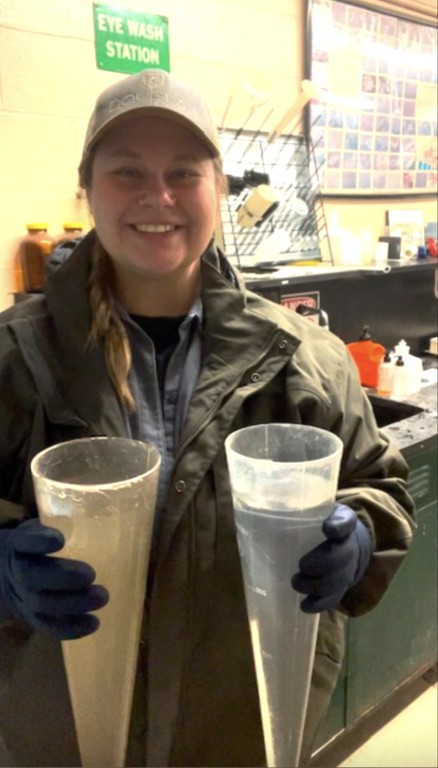
Tori Beloin working at the wastewater plant. Photo courtesy Tori Beloin
Vermont is aging and many operators are retiring. But even before this issue, there weren’t enough operators to go around.
by Maeve Fairfax, Community News Service
VermontBiz Working in a wastewater plant may seem undesirable, but Tori Beloin likes it. For the past six months, she’s been working in southern Vermont as an apprentice through the Vermont Rural Water Association.
Beloin has a bachelor’s degree in criminal justice, and before starting the apprenticeship, worked in childcare. She wanted to shift to a trade, and this program gave her an opportunity to get necessary training without needing previous experience.
“This has been the best choice I’ve ever made,” she said.
The state’s rural wastewater treatment plants are perpetually understaffed, said Allison Smith, Training Administrator at the Vermont Rural Water Association.
Vermont is aging and many operators are retiring. But even before this issue, there weren’t enough operators to go around.
“We were never flush with water and wastewater operators to begin with,” Smith said.
The Department of Labor’s Bureau of Labor Statistics estimates that 8.2% of the national water workforce needs to be replaced each year. The rural workforce tends to be older than the national median, so there’s an even higher need for workers, said Smith.
To grow the water and wastewater workforce, the Vermont Rural Water Association started their apprenticeship program in 2019. There are currently 18 apprentices in Vermont, but the organization wants to grow that number to around 25, said Smith.
The apprenticeships are a mixture of classroom learning, self-study and hands-on experience. Over the course of two years, wastewater apprentices are mentored by an operator and work in wastewater treatment plants for a total of 4,000 hours.
The hope is to build a wastewater workforce that is well-rounded and safety-oriented, and to train operators who will stay in the field after the apprenticeship, said Smith.
Jobs in wastewater generally have good pay and benefits, according to Smith. While in training, apprentices are employed by their mentor and earn a salary or hourly wage with benefits.
Smith said the work is interesting and dynamic — particularly in small plants where wastewater workers have a lot of different responsibilities.
“It’s a job that uses the five senses,” she said. “People probably think of it as being a smelly job, but we always say, especially wastewater, there’s good smells and then there’s bad smells.”
Wastewater operators can tell if the microbiology is doing its job, or if something is off, Smith said.
Beloin affirmed this, explaining that “if something is bad, you will smell it.”
“You can use a lot of your senses to really see if something’s going sour,” she said, going on to describe odors that signify different issues.
There are five grades of wastewater certification in Vermont. Passing each grade requires the operator to work a certain number of hours, meet education requirements and pass an exam. Beloin recently passed her grade two wastewater exam, which she said was a big accomplishment for her, especially since she’s only been in the program for six months and had no prior experience.
“I was really kind of geeked out over learning everything with wastewater. It’s so fascinating,” she said.
Beloin plans to continue working through the levels but will have to work two additional years before becoming eligible to take the level three exam.
Smith said she and others have observed that wastewater operators have high job satisfaction and take pride in their work.
“They realize that it’s…one of the most key elemental things that they can do to keep both the public and environment safe and healthy,” she said.
Beloin is definitely one of them.
“I just really enjoy what I do. I enjoy that it’s something different every day and there’s so much to be done and so much to learn,” she said.
Via Community News Service, a University of Vermont journalism internship
To support vital journalism, access our archives and get unique features like our award-winning profiles, Book of Lists & Business-to-Business Directory, subscribe HERE!