Report Timeframe: July 13 to July 19, 2025. Current Vermont Department of Health recommendations on preventing COVID-19.
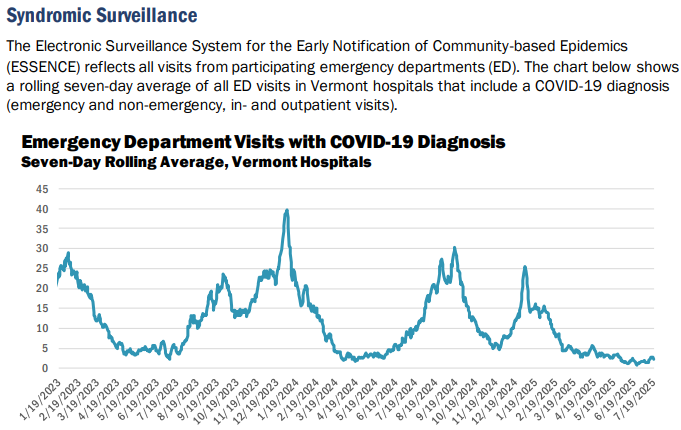
by Timothy McQuiston, Vermont Business Magazine The Vermont Department of Health reported last week that the number of COVID-19 hospitalizations remain under 5 cases statewide, after a spike last winter. Overall COVID trends are declining in Vermont and across the US. The Vermont COVID-19 pandemic death total stands at 1,301 as of July 19, 2025, with 1 reported death from the previous week (the most recent data available from the CDC). WHO also reported that global COVID-19 deaths keep declining. The VDH is no longer reporting COVID fatalities and cases in Vermont.
Wastewater testing generally indicates that COVID-19 virus levels in Vermont also fell to very low levels after they had spiked in January.
Concentrations are low/very low at all sites except Essex Junction (High) and South Burlington (Medium): Burlington, Montpelier, St. Albans, Ludlow, and Middlebury. Some week-to-week fluctuation is expected.
Most other pathogens in wastewater also show low or medium indications, with the exception of a high level of SARS-CoV-2 (COVID), Human Metapneumovirus (HMPV) and Norovirus at the Essex Junction test site. (HMPV is a virus that usually causes symptoms similar to a cold.)
The hospitalizations dataset contains day-level data reported from all Vermont hospitals each Tuesday. Reported numbers are subject to correction.
Laboratory-confirmed and diagnosed COVID-19 cases and COVID-19 outbreaks must still be reported to the Vermont Department of Health.
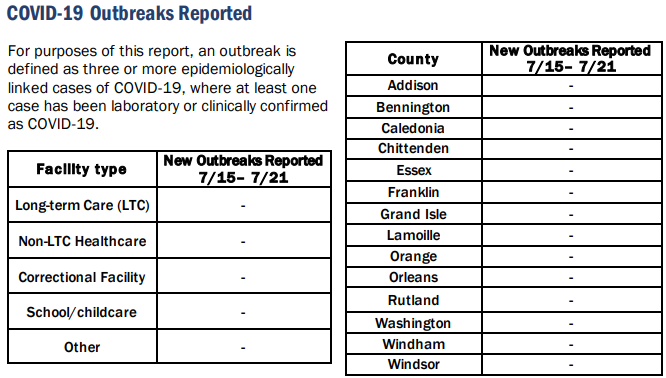
There were 0 outbreaks last week (2 the week before), with 0 in Long-Term Care Facilities and 0 in schools.
Vermont has the second lowest state fatality rate in the US (148.5 per 100K; Hawaii 113.8/100K). Mississippi (466.2/100K) and Oklahoma (461.5/100K) have the highest rates. The US average is 308.2/100K (CDC data).
There has been a total of 1,230,294 COVID-related deaths to date in the US (CDC) and 7,098,440 globally (WHO).
COVID-19 indicators have fallen to their lowest levels since early summer 2024 after very low levels that spring. Cases and hospitalizations began to rise during the summer. They peaked in late summer/early fall and again in mid-January 2025 (though well below the January 2024 peak) before falling again to their now very low levels.
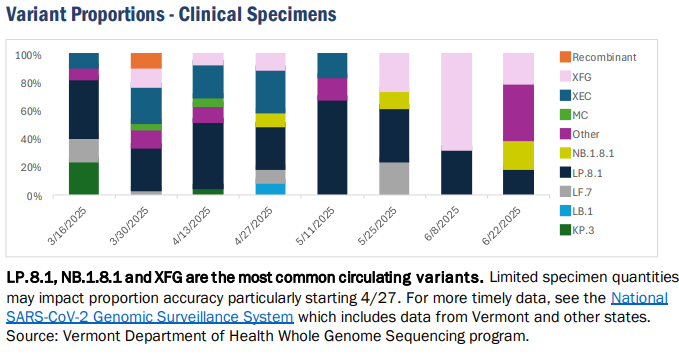
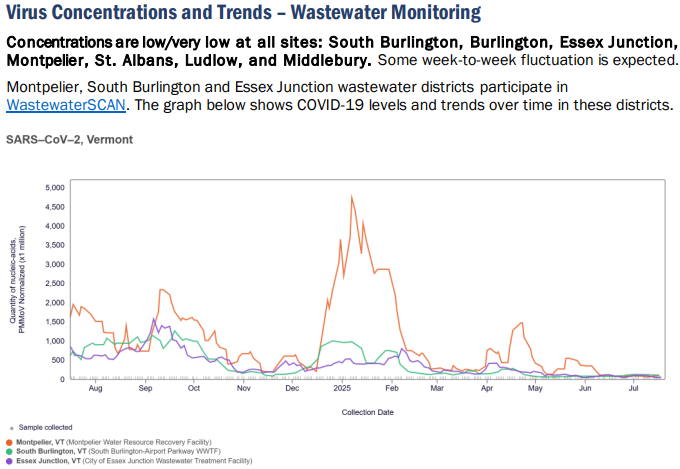
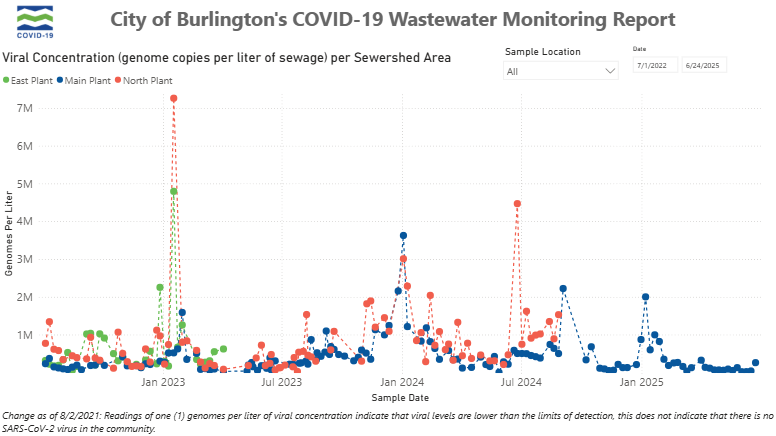
Below is the latest national and Vermont state-wide data from WastewaterSCAN. This reflects information from participating wastewater treatment plants through July 14, 2025.
SOUTH BURLINGTON RESULTS

ESSEX JUNCTION
NATIONAL RESULTS
Meanwhile, Vermont Health Commissioner Mark A. Levine MD retired at the end of March 2025. Dr. Levine, 71, of Shelburne was first appointed by Governor Scott in 2017 and is currently one of the Administration’s longest-tenured commissioners. He led his department through the COVID-19 pandemic and has served as a key advisor on public health matters. He was featured and well regarded during the governor's pandemic response press conferences at the height of the pandemic in 2020 and 2021.
Also, the new RSV immunization for babies is over 90 percent effective at preventing hospitalization. In the Pediatric Intensive Care Unit (PICU) at University of Vermont Children’s Hospital, things look different this year – specifically, fewer newborns and infants admitted in need of critical respiratory care after catching one of the season’s most aggressive respiratory viruses: Respiratory syncytial virus (RSV).
“RSV is the most common reason for children under one year old to be admitted to the hospital,” Rebecca Bell, MD, a pediatric critical care physician at UVM Medical Center. “The kids that get the sickest are the youngest kids – particularly under six months old. Every year, our PICU is full of infants critically ill with RSV infection.”
But this year, RSV-related hospital admissions for these youngest patients are down significantly, said Dr. Bell – and the reason is clear: A new monoclonal antibody prevention medication approved in July 2023 by the Food and Drug Administration.
The medication, called nirsevimab, is given via injection to infants under eight months old and uses lab-made antibodies to block RSV from infecting cells. Unlike a vaccine, the immunization provides a ready-made supply of antibody protection to babies without triggering an immune system response. Protection against severe RSV infection begins immediately.
How many Vermonters are vaccinated against COVID-19, flu, and RSV?
This dashboard includes COVID-19, flu, and RSV vaccination data for Vermont residents reported to the Vermont Immunization Registry. Check back regularly as updates are made weekly on Tuesdays.
How many Vermonters are vaccinated against COVID-19, flu, and RSV?
This dashboard includes COVID-19, flu, and RSV vaccination data for Vermont residents reported to the Vermont Immunization Registry. Check back regularly as updates are made weekly on Tuesdays.
Note: As of Feb. 19, the Health Department’s COVID-19 surveillance report will no longer include information about cases and deaths, as data reporting transitions to a format similar to other respiratory viruses like the flu.
Case data has become a less meaningful indicator of COVID-19 activity since individual cases are being reported in a very limited basis by health care settings and laboratories. The same is true for death data, as COVID-19 has shifted from being the underlying cause of most COVID-associated deaths to a contributing cause.
The department continues to monitor the impact of COVID-19 in Vermont using the most meaningful data, including emergency department visits, wastewater data and outbreaks.
See current Vermont Department of Health recommendations on preventing COVID-19.
Early Indicators
Severity Indicators
CDC | Test Positivity data through: July 19, 2025; Emergency Department Visit data through: July 19, 2025; Hospitalization data through: July 5, 2025; Death data through: July 19, 2025.
Posted: July 28, 2025 2:56 PM ET
To support vital journalism, access our archives and get unique features like our award-winning profiles, Book of Lists & Business-to-Business Directory, subscribe HERE!