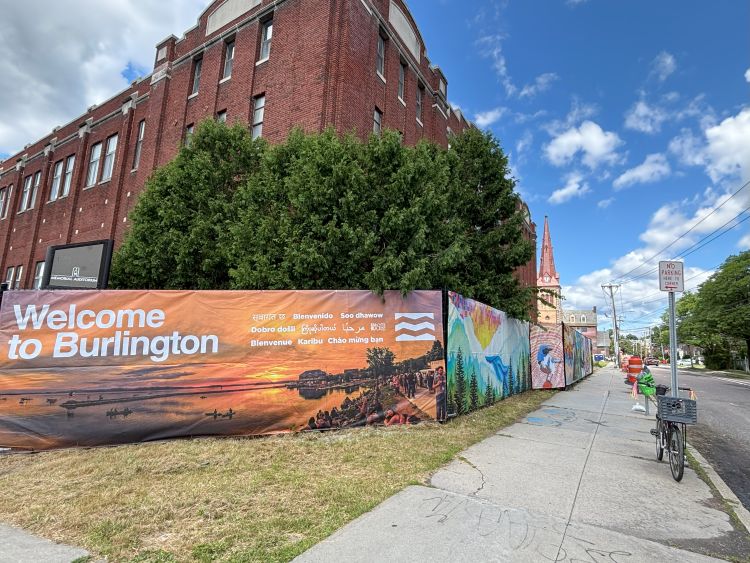
The City of Burlington in late July unveiled a 360-foot visual art installation now covering the fence around Memorial Auditorium, which showcases works from ten local artists. It also serves as a "gateway" to the city, which is undergoing several construction projects. BTV photo.
by Olga Peters, Vermont Business Magazine
Though home to just over a quarter of Vermont’s population, Chittenden County stands as the undeniable engine of the state’s economy, generating a disproportionate share of its jobs, wages and income tax revenues.
A May report compiled by former state economist Art Woolf for the Greater Burlington Industrial Corp. illuminates the county’s remarkable economic footprint and its diverse landscape, which ranges from major institutions like the University of Vermont and the UVM Medical Center to international tech giants such as GlobalFoundries and countless local businesses.
“With education, health care, tourism, successful tech companies and a wide range of other activities like the arts, it’s a strong base,“ said Michael Monte, CEO at Champlain Housing Trust.
Catherine Z. Davis, president and CEO at the Lake Champlain Chamber, believes the real difference between northwest Vermont and the rest of the state is scale.
“Fifty units of housing in one community might solve the (housing) problem,“ she said. “But 5,000 a year is what we may need.“
Despite its economic strength, the county faces challenges similar to those of its neighbors, including housing shortages and affordability, an increase in the number of unhoused people, public safety concerns, fewer visitors from Canada and uncertainty spurred by tariffs and potential federal funding cuts.
“I don’t think any of these are a surprise to anyone,“ said Kara Alnasrawi, director of Burlington’s Community and Development Office. “But we may be seeing them more intensely in Chittenden County than other counties.“
A Strong Business Climate
Investment and infrastructure are key themes in the economic activity across Chittenden County.
In downtown Burlington, the buildings within the CityPlace development are set to open after experiencing numerous delays over the years. According to the website of project architect Freeman French Freeman, the 140-foot South Tower is slated to open this summer, with the North Tower expected to open next year.
In Winooski, work is ongoing along Main Street, and city leaders are already making preparations for the Burlington-Winooski Bridge project in 2027. The bridge, built in 1928, was once used by trollies. Nearly a century later, the Agency of Transportation reports that around 25,000 vehicles and up to 2,000 pedestrians and bicyclists cross the bridge daily.
Predevelopment efforts for Burlington’s South End are expected to result in more than 1,000 new housing units, with construction slated for 2026.
GlobalFoundries, meanwhile, has announced a $16 billion investment in the expansion of its semiconductor manufacturing and advanced packaging capabilities across its facilities in New York and Vermont.
Frank Cioffi, president of the Greater Burlington Industrial Development Corp., called GF’s commitment a boon to the state’s economy.
“It is probably the best news in 25 years for the state of Vermont,“ he said.“
Cioffi added that as GlobalFoundries moves forward with its investments, Vermont must also train its workforce to fill roles at companies like GlobalFoundries. GBIC is committed to strengthening career and technical education in high schools.
According to Cioffi, more than half of Vermont high school graduates do not pursue higher education, and he believes nearly all of these graduates remain in the state. This underscores the need for communities to provide more curriculum options that “enable them to be financially independent, to provide for themselves and then hopefully a family.“
Cioffi, who chairs the board of the Vermont Center for Emerging Technologies — a nonprofit organization dedicated to supporting Vermont-based, technology-enabled businesses from start-up to scale — explained that Vermont is a pioneer in its focus on entrepreneurship and in connecting startups with essential capital. He estimates that a substantial amount, more than $100 million, in private equity is actively circulating within the region served by GBIC.
The city of Winooski’s local option tax revenue has exceeded budget estimates, according to Mayor Kristine Lott. Winooski is nearing the completion of its $28.07 million Main Street Revitalization Project, which began last year and is expected to continue into 2026.
Last year, the city marked the closing of its 20-year Tax Increment Financing district, a designated area where municipalities use anticipated increases in property tax revenue to further public improvements and encourage development or redevelopment within that area. The Agency of Commerce and Community Development reports that Winooski’s Grand List increased significantly, from $25 million in 2004 to $104 million in 2024.
The TIF provided funding for infrastructure projects, including improvements to municipal water, sewer and stormwater systems, as well as the development of the riverwalk along the Winooski River and the establishment of Rotary Park. The district also facilitated private investment, such as the construction of new buildings for the Vermont Student Assistance Corporation and the Community College of Vermont. Additionally, five housing developments contributed 438 new units to the community’s housing stock.
The TIF also contributed to funding the Downtown Master Plan. This plan encompasses new housing, a boutique hotel and a parking garage project situated at 17 Abenaki Way. The parking garage is expected to open this year.
According to Lott, the 115-room boutique hotel will open next year, and the project will be completed with the addition of 83 workforce housing units.
“We do know, though, that those businesses located along the Main Street construction route are experiencing revenue loss, and that’s a challenge we’re trying to work around,“ she said.
To counteract the negative impact on the local economy during construction, Downtown Winooski, a nonprofit organization dedicated to Winooski’s community and economic vitality, initiated a grant-funded endeavor named The Mosaic Campaign.
The Vermont Community Foundation contributed $25,000 to hire the Winooski-based marketing firm LONDONmiddlebury to launch this campaign.
Using the tagline “Temporary Routes, Permanent Progress,“ the campaign aims to inform the public about the ongoing construction in downtown. This project is set to modernize infrastructure, create more pedestrian-friendly streets, improve traffic flow, enhance streetscapes and connect Main Street to surrounding neighborhoods.
Melissa Corbin, executive director of Downtown Winooski, explained that Bernie Carr of Brandon and organizers in Middlebury — who experienced disruption redevelopments in those two downtowns — helped her realize the importance of community support for these projects. She emphasized that this support relies on residents understanding the long-term benefits of such improvements, which will ultimately make the challenging construction process worthwhile.
“The bigger picture, for me, was just people getting excited about the construction as opposed to being devastated by it,“ Corbin stated.
Carr, executive director of the Brandon Chamber, played an active role in helping his hometown manage the multi-year Segment Six downtown redevelopment project.
Corbin added, “I believe the Mosaic Campaign and the efforts that the city has been putting into it in partnership with Downtown Winooski are really helping to change that narrative.“
The Lake Champlain Chamber serves approximately 1,000 members. Davis stated that members interacting with the federal government are experiencing uncertainty and potential financial harm.
She has spoken with U.S.-based businesses that source materials domestically, and they are not concerned about tariffs and are thriving. However, she noted that a reduction in Canadian visitors has impacted hospitality-related businesses.
According to her data, border crossings between Vermont and Canada decreased by 32% from January to May this year compared to the same period last year.
“As an organization, we’re trying to be really sensitive in communicating to Canadians that we understand their situation and that they are welcome here, and we’ll be here for them,“ Davis said. “It’s tricky to navigate because they are our friends and neighbors, and in many cases, our relatives.“

The North and South towers at Burlington Square, formerly known as CityPlace, take shape. The development is expected to open in 2027. VermontBiz photo.
Collectively, Chittenden County, along with Franklin and Grand Isle, serves as the economic engine for the rest of the state, according to Woolf. In his report “The Role of Northwest Vermont in the State Economy,“ Woolf asserts that these three northwestern counties, which comprise 35% of the state population, are more important to Vermont than their population share indicates.
“They account for a larger share of jobs, income and wages than their population share,“ Woolf said. “They are growing in population and in their share of Vermont’s total economic activity, while the rest of the state’s population is virtually stagnant.“
Woolf’s numbers for northwestern Vermont also show:
Average wages are higher than the rest of the state.
The region’s contribution of income and sales taxes is higher than its share of population.
Compared to the state’s remaining 11 counties, more workers commute into northwest Vermont than its residents travel to jobs outside the three-county region.
“With a little over one-quarter of the state’s population,“ Woolf said, “Chittenden County accounts for one-third of the state’s jobs, more than 38% of all the wages earned by Vermonters and its residents contribute more than one-third of all the state’s income tax revenues.“
Cioffi added a sobering assessment of the rest of the state.
“If you look at Vermont without northwest Vermont,“ he said, “then you see an area that’s not growing either its economy or its population. That’s why Chittenden County and northwest Vermont are absolutely critical to the well-being of the state’s economy.“
Burlington, like Winooski, is facing issues with redevelopment impacts and the fallout from relations with Canada. In June, Church Street, a pedestrian area, was temporarily renamed “Canada Street“ (or “Rue Canada“) to welcome our neighbors to the north.
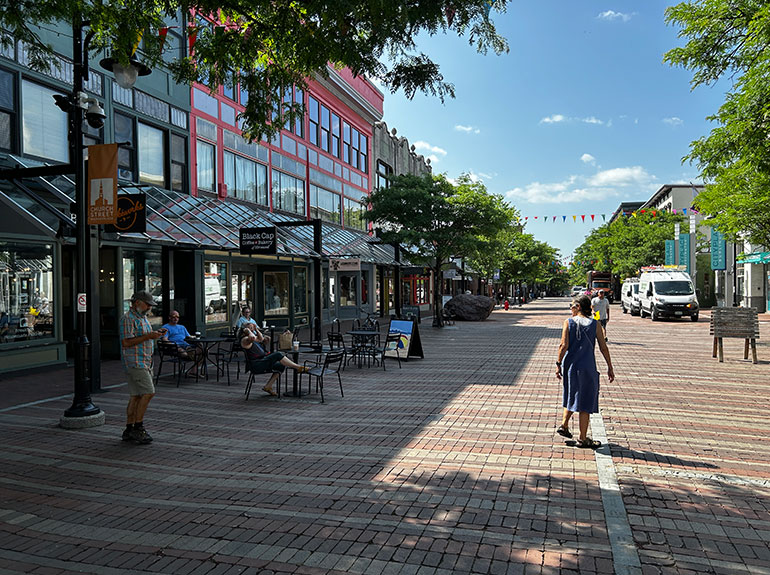
In a bid to attract its neighbors to the north, Burlington has renamed Church Street to Rue Canada through Labor Day weekend. VermontBiz photo.
Burlington’s retail hub is performing well, with only a few vacant storefronts in late June, a situation as positive as any time in the last 30 years. The most notable vacancy is due to the closing and demolition of most of the former Burlington Square Mall. However, significant redevelopment is underway there, with the Burlington Square development (recently known as CityPlace). The first phase of the new high-rises, which broke ground in 2022, is expected to be completed by the end of the summer.
That “South“ building will feature 11 stories, 53 market-rate housing units and a 150-room hotel. The larger “North“ building will comprise about 315 housing units, including some affordable units, and another hotel of similar size.
The project, slated to be completed in 2027, includes some retail and restaurants and will reconnect Pine and St. Paul streets, which were truncated when the original mall was built in the late 1970s. The center section was demolished in 2018 to make way for CityPlace.
As for housing, the former YMCA building, which relocated several years ago, is being redeveloped into housing. However, Memorial Auditorium, another long-standing eyesore located one block away, still requires a redevelopment plan. The building closed in 2016 and has been a target for redevelopment since at least the early 1990s.
In March, Mayor Emma Mulvaney-Stanak and the City Council initiated the process of restarting the redevelopment efforts.
Alnaswari told NBC5 that the Memorial Block “has been, for lack of a better word, defunct for quite a while“ and that “it’s ready to be developed and ready to have a better use than currently.“ She also stated that any redevelopment would occur in phases, and there are currently no firm plans.
Meanwhile, Main Street merchants are frustrated with an ongoing, major infrastructure project that has closed the center section in front of Flynn Theater.
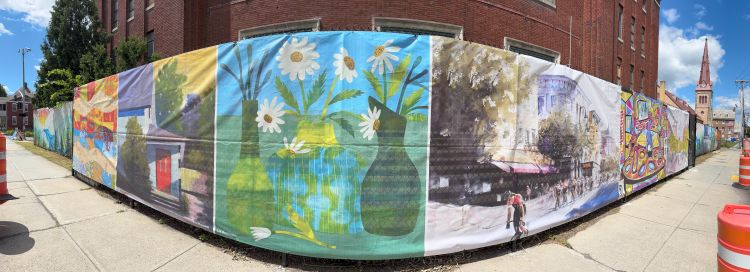
The City of Burlington in late July unveiled a 360-foot visual art installation now covering the fence around Memorial Auditorium, which showcases works from ten local artists. The once-centerpiece of downtown, and considered for redevelopment for at least the last 35 years, the building lies empty now. The artwork helps cover graffiti and presents a welcoming visage as the gateway to downtown. BTV photo.
The Burlington Business Association has been advocating for a compromise to allow downtown businesses to operate more freely, but the infrastructure project necessitates extensive excavation of Main Street and some adjoining side streets, making it unavoidable, particularly for vehicular traffic.
Kelly Devine, BBA executive director, urged her members to advocate for a plan to reopen Main Street, stating in an email, “Main Street Construction, now in its second year, has had a damaging impact on downtown Burlington. BBA, along with a dedicated group of businesses owners from Main Street, have been working with the Department of Public Works to explore options for reopening Main Street.
More Housing Coming Online
Developers have added enough new housing to raise the county’s vacancy rate to 3%, indicating good progress toward the 5% vacancy rate considered healthy by most housing experts.
Monte, of the Champlain Housing Trust, reported that 800 new units were completed last year, with another 600 expected this year and again in 2026. However, rising material and development costs have made these new units more expensive for low- and moderate-income households.
“Rents have increased probably 6% or 7% every year for the last few years,“ he said. It’s a decently high increase, in part driven from demand and partly driven by higher costs of insurance and taxes.“
According to Monte, the average monthly rent for an existing one-bedroom apartment is $1,600, while newly constructed one-bedroom units often cost $2,100 or more.
“That is causing pressure on all classes,“ he said. “I haven’t really mentioned low- and moderate-income families who are really impacted by these higher rents and this high county average.“
To address this issue, some businesses are creating employee housing. The University of Vermont Health Network, for example, built two apartment buildings and implemented an employee rent subsidy program to help retain workers who struggled with local rents or finding housing.
Building new housing, while addressing parts of the county’s housing shortage, will not entirely resolve the cost issue for low- and moderate-income households unless units are designated as permanently affordable, Monte said.
The city of Winooski has set three goals to increase housing that meets the needs and budgets of its residents: encourage and facilitate homeownership, increase affordable housing and build more units with three or more bedrooms.
Jazmine Hurley, Winooski’s housing initiative director, stated that these priorities aim to address gaps in the housing market.
“We’re trying to figure out all of the policy levers we have to encourage this through zoning regulation, incentives, programming, through our housing trust fund,“ she said. “But it’s difficult. The market is a very strong force, and it’s hard to face sometimes as a fairly small municipality.“
She also noted that the city’s large New American population often requires more bedrooms for larger families, while many other Vermont communities seek smaller units due to smaller family sizes. Developers often favor smaller apartments because they offer better profit margins.
“One of our main priorities, which is distinct from a lot of other municipalities, is trying to encourage those three-plus bedroom units — specifically affordable three-plus bedroom units — because a market-rate five-bedroom home would be quite expensive,“ Hurley said.
To support housing efforts, Winooski has created a short-term rental registry, which caps the number of non-owner-occupied short-term rental licenses that the city issues. The city is working on inclusionary zoning regulations and developing incentives.
Hurley said she is seeing progress in the number of small developments, such as triplexes. In June, Champlain Housing Trust won the bid on a city RFP to develop approximately 24 housing units on the site of the National Guard’s former armory.
Winooski adopted form-based zoning codes in 2017 to increase density and streamline the permitting process. Form-based codes prioritize a building’s structure and characteristics over its type, such as residential, commercial or industrial.
Hurley said these changes worked. More development has occurred along Main Street and East Allen Street. In the last couple of years, thanks to both state statute changes and the city’s planning commission, Winooski has increased density in every zoning district.
“We’ve increased lot coverage, decreased setbacks, decreased parking minimums and allowed more multiunits and units per building,“ Hurley said.
She added that the Chittenden County Regional Planning Commission reported Winooski has had the highest per-capita housing production in Chittenden County for the last five years. Compared to other Vermont communities, Winooski has a high percentage of renters, with approximately 65% of the population renting and 35% owning their homes.
Per Act 181, the regional planning commission is updating its land-use maps and digesting the state’s proposed housing targets released earlier this year.
In June, the planning commission reported to its board a summary of community feedback to the commission’s draft land-use maps. Community members expressed frustration and confusion about the potential Act 250 land use categories and were skeptical that public input would shape outcomes. They also expressed their limited capacity and resources to plan, develop, and build additional housing and infrastructure.
The planning commission is also working with communities to understand the state’s housing targets.
According to the state’s five-year housing needs assessment, Chittenden County’s 2050 housing targets range from 15,783 to 47,407. After considering factors such as access to municipal water and sewer, as well as the amount of working lands, the planning commission has broken the targets down by town.
Charlie Baker, executive director of the regional planning commission, said cities like Burlington, Essex Junction, South Burlington and Winooski could handle approximately 60% of the regional housing target. Mixed urban and rural towns, such as Colchester, Essex, Hinesburg, Jericho, Milton, Richmond, Shelburne and Williston, would receive approximately 36.2% of the target. The rural communities of Bolton, Buel’s Gore, Charlotte, Huntington, St. George, Underhill and Westford could expect to develop 3.8% of the target.
Baker said every community has its own goals for growth. During CCRPC community meetings, people from towns of all sizes shared concerns about the amount and types of development that might happen in their communities. He reminds them that the targets are goals rather than requirements.
“16,000 housing units is pretty much the pace that we’ve been on. So, that seems very achievable,“ Baker said. “The medium target seems like a bit of a push goal, and the high target seems like that’s interesting to think about, but realistically, probably not achievable.“
According to Monte, the majority of people accessing Champlain Housing Trust housing do well, and many transition from CHT to homeownership. He has noticed, however, that more tenants struggle with substance misuse and mental health needs.
“What we’ve noticed from five years ago is that, in addition to serving more people who are homeless or formerly homeless, there are numbers of folks who are facing mental health issues or substance abuse disorder,“ Monte said.
He added that there is a general lack of treatment and health services, noting that the designated agencies have struggled to be able to provide support.
Monte said the trust’s current projects are heavily reliant on American Rescue Plan funding, and the future when this money is no longer available is uncertain. He added that if the federal government reduces or eliminates funding for housing construction or rent subsidies, housing trusts will not be able to compensate for the shortfall.
Cioffi expressed optimism for the new Community and Housing Infrastructure Program passed by the Legislature this session. This program is a financing tool that any Vermont municipality can utilize to invest in essential infrastructure for housing development.
According to Cioffi, the CHIP program is expected to support housing projects for years to come.
Alnasrawi noted that many community conversations center on social concerns such as the housing shortage, an increase in the number of unhoused people and unmet mental health needs. These issues impact not only the community, but the regional economy as well.
“We can’t divorce them from their impact on the economy, whether it is perceived or real,“ Alnasrawi said. “If someone does not want to visit because they are feeling uncomfortable with some of the things that they’re observing at the street level, it has an impact.“
Housing, workforce issues persist
Housing and workforce shortages continue to pose significant challenges to communities. Conversations, however, have shifted their focus to the changes emerging from Washington, D.C.
Municipalities and organizations feel they’re jumping from crisis to crisis, such as tariffs, federal funding cuts and policy changes.
Cioffi noted that every new presidential administration comes with policy changes. It takes months to understand how the plans, priorities and projects of each administration are going to unfold, he added.
Cioffi understands that the shifting federal landscape is affecting local decision-making; he is also confident that business owners will continue to move forward.
“Keep in mind that if you’re a manufacturer, you have to produce products for your customers, so you still have to get those products,“ Cioffi said. “So they are progressing with what the new normal is, or the conditions of the market.“
The city of Burlington is still digesting what the Trump administration’s potential funding cuts and policy changes may mean for the services it provides to the community.
According to Alnasrawi, the city’s treasurer’s office and attorney are conducting deep reviews of city funding, potential impacts and possible responses.
“This is a game of resiliency right now, and it feels like — with regard to the federal government at least. It’s a moving target, and that’s complex and stressful for all municipalities,“ she said.
For example, under the Biden administration, Burlington received a RAISE (Rebuilding American Infrastructure with Sustainability and Equity) grant that contained a significant workforce development component. Alnasrawi, who oversaw the grant’s workforce component, said that in its application, the city wrote it intended to use the funds to support marginalized communities.
Under the Trump administration, these RAISE grants were replaced with BUILD (Better Utilizing Investments to Leverage Development) grants, which forced the city to tweak its application to meet newly adopted guidelines around DEI.
“For lack of a better word, we had to scrub our application of references to diversity and equity in the populations we were hoping to target,“ Alnasrawi said.
In recent weeks, word has come from Washington that federal Community Development Block Grants, which support state, city and county projects that benefit low- and moderate-income households, may by on the chopping block.
“One has to remember, we can’t simply raise property taxes to make up for that,“ Alnasrawi said. “There’s hope that perhaps private foundations may kick in to help fill those gaps, but we don’t know all that yet.“
Winooski is already feeling the effects of these cutbacks. Officials there were recently notified that a $1 million grant for tree work on Main Street has been revoked. Lott said she never received a full explanation of why the grant was canceled.
More concerning in Winooski, officials said, is the Trump administration’s targeting of immigrants for deportation.
“At the start of the new administration, we believed that folks who are here undocumented were at risk,“ Lott said. “Now we know that folks who are here legally are at risk as well, unfortunately.“
Winooski, which has a large immigrant population, has adopted fair and impartial policing policies that align with state policy. Though Winooski has not declared itself a sanctuary city,, Lott said, the U.S. Department of Homeland Security included the city on its May list of sanctuary jurisdictions in the United States.
In a May 29 press release, DHS Secretary Kristi Noem was quoted saying, “These sanctuary city politicians are endangering Americans and our law enforcement in order to protect violent criminal illegal aliens. We are exposing these sanctuary politicians who harbor criminal illegal aliens and defy federal law. President Trump and I will always put the safety of the American people first. Sanctuary politicians are on notice: comply with federal law.“
The department has since pulled the list from its website.
Lott said the city continues to collaborate with the state, the Attorney General’s Office and neighboring impacted cities to “navigate the unclear, changing landscape of immigration.
“We as a municipality want to be a safe space for our residents,“ she added. “But we can’t guarantee that. If federal folks come in here, we cannot stop them.“
Monte said changes to funding proposed by the Trump administration will likely impact people from all directions. Potential cuts in Medicaid, Medicare, the LIHEAP program, funding to support individuals in Head Start, food programs, counseling programs and, most importantly, the Section 8 voucher program, are beginning to manifest in unhealthy ways.
“Folks who need support are actually going to have less of it,“ he said. “There has to be a realization at the state level that additional resources are needed. The state has been generous, but it needs to step up even more.“
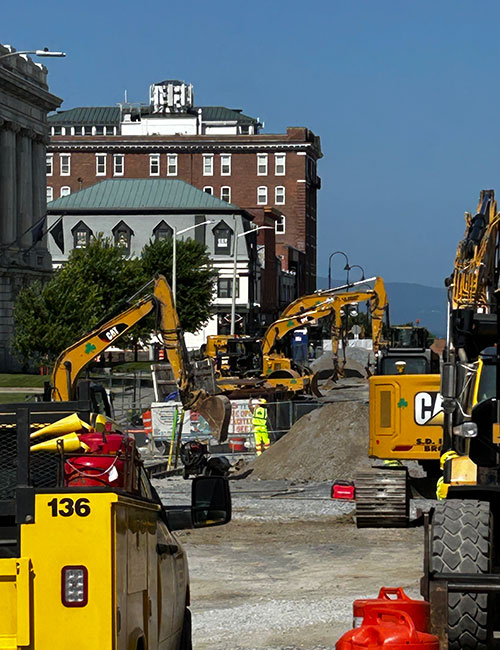
Much-needed infrastructure improvements on Main Street in Burlington have caused major headaches for downtown businesses. VermontBiz photo.
Baker explained that organizations must navigate and adhere to two distinct sets of policy directions. This is because, even with shifts in federal policy, Vermont continues to uphold and implement its own separate state-level policies.
“To be very blunt about it,“ he said, “we still have climate goals and environmental-justice goals, and we’re trying to navigate how we keep both levels of government happy and keep things moving along.“
Despite the changing political landscape at the federal level, Chittenden County businesses continue to invest and grow. “Given some headwinds that are outside of our control, the economy is really strong,“ Davis said.
She said businesses are weathering the situation thanks to skills built during the pandemic.
“For both the chamber and our members, there’s a different ability to be nimble and make quicker decisions,“ Davis said.
Sugar House Hotel Breaks Ground
Nedde Real Estate broke ground in late June on the eco-friendly Sugar House Hotel in downtown Winooski — the last major lot in the city’s 20-year downtown development project.
The 115-room facility will be part of the Marriott Tribute brand and feature a rooftop bar with views of the river, a restaurant and event space. When completed, it will be the first all-electric, LEED Platinum-certified hotel in the Marriott Global Family, utilizing no fossil fuels.
In addition to the hotel, 83 new apartments providing much-needed workforce housing will be located adjacent to the facility, along with a 270-car parking garage. The city awarded Nedde Real Estate the task to design, permit, and construct the garage, which will serve the hotel and other visitors to the area.
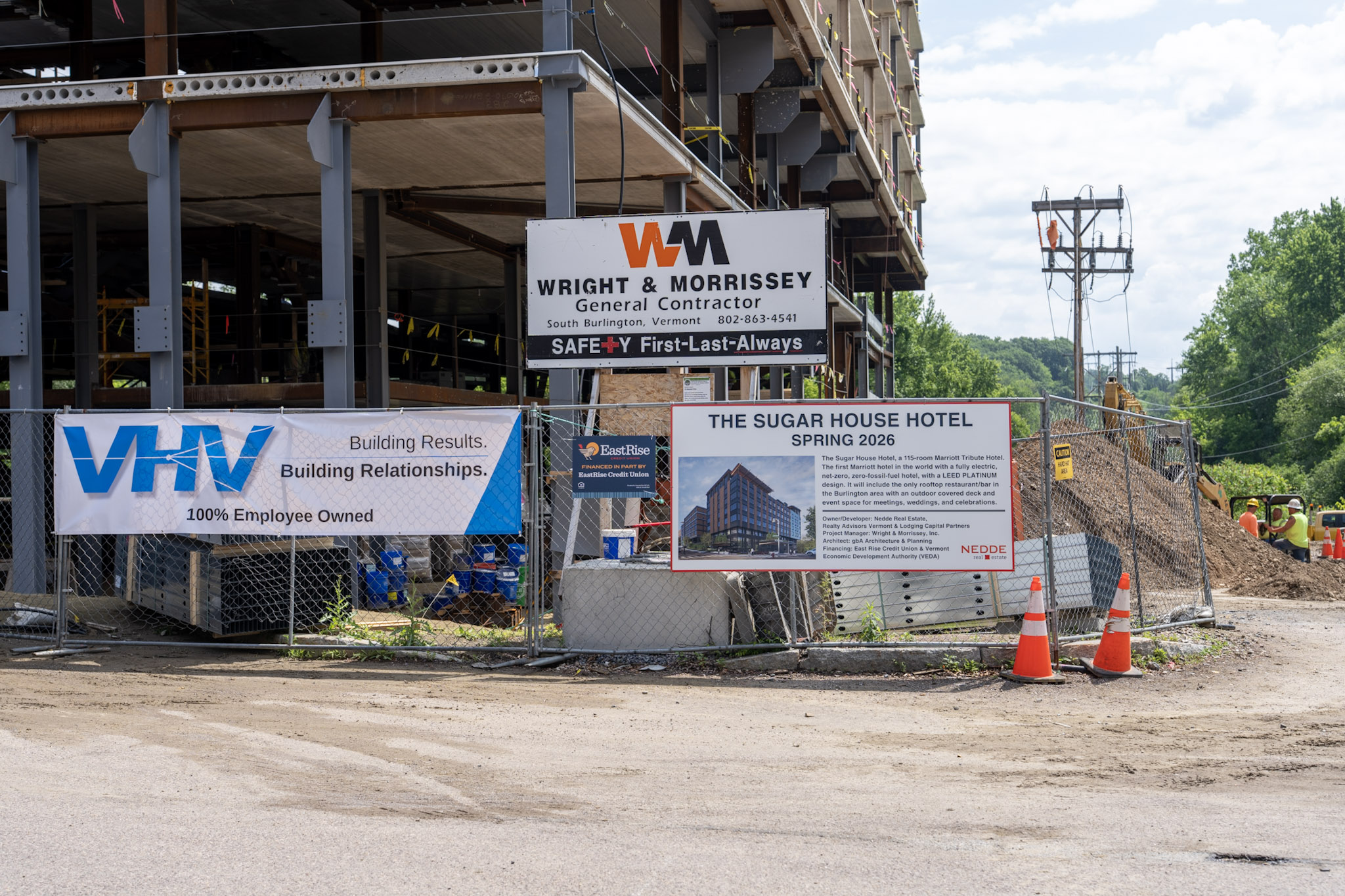
“Since the late 1990s, our community has worked toward the vision of bringing a hotel to downtown Winooski,“ Lott said. “Through smart planning and public investment, I’m thrilled to see this long-standing goal come to life with the opening of the Sugar House Hotel. With construction underway on the voter-approved parking garage, we’re making critical progress towards Winooski’s Strategic Vision and Master Plan, completing a decades-long effort to make downtown Winooski an incredible destination for residents and visitors.“
The hotel will embrace, celebrate and promote Vermont artisans and the spirit of Vermont’s strong environmental culture. In addition, guests will have the opportunity to make their own maple creemee at check-in.
“If I did not love maple creemees so much, I may have given up on this very challenging project years ago!“ said Doug Nedde, owner of Nedde Real Estate.
He singled out the city of Winooski, State Treasurer Mike Pieciak and EastRise Credit Union, the primary lender for the hotel, for their helping in making the project a reality.
“We are honored to be a part of such a unique hotel that will be an economic asset for the community,“ said EastRise CEO John Dwyer. “It will also champion environmental sustainability, which aligns perfectly with the principles of EastRise. We are proud to support a development that will undoubtedly enrich the local landscape for years to come.“
Pieciak said projects like the Sugar House are crucial to Vermont’s $4 billion tourism industry. They create much-needed jobs, contribute to the construction of workforce housing and help attract thousands of visitors to the state each year.
“Strategic investments like this create ripple effects throughout the economy and ensure Vermont remains a top tourism destination for years to come,“ he said.
The Sugar House is slated to open in summer 2026. The project architect is GBA, located across the river in the Chace Mill building. Wright & Morrissey is serving as project manager.
Investing in the Community
Davis, of the Lake Champlain Chamber, believes in the residents of Chittenden County and their ability to persevere.
“I think, especially right now, Vermont and our local communities are a place where we can make change, where we can have a positive impact,“ she said.
Meanwhile, on Wednesday evenings in Burlington, community members support their downtown with their feet — literally — in the tradition of “una passeggiata,“ an Italian tradition in which residents of all ages gather in the city square for an evening stroll.
Lisa DeNatale, a longtime Burlington resident and president of the Vermont Italian Cultural Association, and her friend Michele Asch started the evening stroll to support the downtown.
“This feels to me very homegrown, very Vermont, and I think that residential interest in supporting one’s own community rather than retreating is really helpful and can play a definitive role in bolstering the economy as well,“ said Alnasrawi.
Switchback Rebrands to Smokehouse
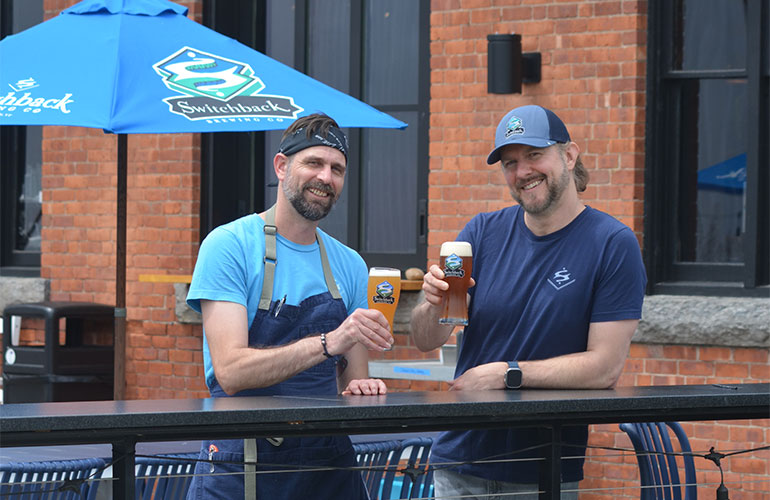
Chris Cantrell, chef, and Josh Weber, managing partner, at Switchback Smokehouse. Photo by Katie Kittell.
Burlington’s South End is experiencing a culinary renaissance, driven by significant local investment across both the personal and private sectors. The latest testament to this vibrant growth is the transformation of the Switchback Beer Garden into the Switchback Beer Garden & Smokehouse, signaling a bold new direction for the popular brewery.
This expansion of on-site food offerings with smoked specialties underscores a burgeoning trend in the area, where established businesses are innovating and new ventures are finding fertile ground.

Switchback, 160 Flynn Ave., is open Tuesdays from 5 to 9 p.m. with a limited menu, and Wednesdays through Sundays from noon to 9 p.m. It is closed on Mondays. More information is available at www.switchbackvt.com.
The rebranding of Switchback Beer Garden & Smokehouse reflects a strategic culinary shift, now primarily focused on house-smoked meats and a broadened menu of Southern-inspired dishes designed to perfectly complement Switchback’s diverse lineup of craft beers.
The updated menu boasts house-smoked specialties like brisket, pulled pork, and St. Louis ribs, all prepared in-house and served with classic sides such as maple cornbread, creamy broccoli salad, braised collard greens, and Cabot mac and cheese. Adventurous palates can also enjoy a variety of handhelds, including the Vermont Maple Hot Chicken Sandwich, Switchback’s unique spin on the Nashville Hot.
“This side of town has been craving real Southern BBQ for years, it just needed a couple of Southerners to bring it to life,“ said Managing Partner Josh Weber. “Chef, Chris Cantrell and I were both born and raised in the South, growing up on the kind of cooking that defines true Southern flavor. We saw an opportunity to evolve our restaurant into a proper Smokehouse, and we’re proud to bring that bold, slow-smoked tradition to Burlington’s South End.“
Switchback’s move further solidifies the South End as a craft beverage and dining destination. It joins its Flynn Avenue neighbor, Burlington Beer Co., in offering a full sit-down menu alongside a local brewery. Just around the corner on Pine Street, the concentration of local breweries continues, with Queen City Brewery situated next to Pizza 44, and directly across the street from Zero Gravity Craft Brewery, which features its own popular pub fare and waffles.
Olga Peters is a freelance reporter from southern Vermont. Editor Timothy McQuiston contributed to this article.
To support vital journalism, access our archives and get unique features like our award-winning profiles, Book of Lists & Business-to-Business Directory, subscribe HERE!