


Governor Phil Scott, members of the administration, legislators, community partners, and others in Fair Haven on Wednesday. Courtesy photo.
Vermont Business Magazine Governor Phil Scott, members of the administration, legislators, community partners, and others celebrated the passage of S.127, An act relating to housing and housing development (Act 69), in Fair Haven on Wednesday. The bill was signed into law on June 12, 2025. It includes the Community and Housing Infrastructure Program. CHIP will launch in 2026 with the potential for over $2 billion in housing infrastructure investment by 2035. See details below.
The bill passed late in the session, but with an overwhelming, bipartisan majority.
The CHIP section, which is the centerpiece of the law, allows up to $200 million per year of tax increment financing annually for 10 years to be spent by Vermont communities on infrastructure that will serve a public good and support the development of new housing.
Over the next decade, CHIP will create thousands and thousands of new homes. The Joint Fiscal Office projects it could add at least $380 million to the state’s flailing education fund without raising taxes or rates on existing homeowners and renters.
Joint Fiscal Office Analysis
S.127 (Act 69) – An act relating to housing and housing development, issued by the Vermont Joint Fiscal Office on June 20, 2025:
As enacted
Bill Summary This bill would establish policy directives and new programs aimed at increasing the supply, affordability, and accessibility of housing in Vermont. The bill would also establish a new tax increment financing (TIF) program called the Community and Housing Infrastructure Program (CHIP) for housing infrastructure projects.
Fiscal Summary Sections 1–3 of the bill create or make changes to programs funded in Act 27 (2025), the fiscal year 2026 Appropriations Act. Section 5 authorizes the creation of the State Housing and Residential Services Planning Committee. Certain members of this group would be eligible for per diem compensation and expense reimbursement. The bill does not contain an appropriation to support these costs.
Sections 20–22 create a new TIF program called CHIP. The Joint Fiscal Office (JFO) cannot estimate the overall or single year fiscal impact of this Program to Vermont’s statewide Education Fund due to multiple unknowns.
While CHIP has some structural similarities to the current TIF program, it also has significant differences:
- CHIP would allow municipalities to retain at least 85% of incremental municipal property tax revenues and 75%–85% (if affordability criteria in the bill are met) of incremental education property tax revenues for 20 years to support the construction of housing infrastructure. The remainder would be remitted to the Education Fund. This exceeds what’s allowed by Vermont’s current TIF program, which lets municipalities retain 85% of municipal tax increment and 70% of education property tax increment.
- The bill allows the Vermont Economic Progress Council (VEPC) to approve up to $200 million in total education property tax increment retention each year during the 10-year period VEPC is authorized to approve applications. This cap represents the total amount of Education Fund increment that projects approved each year can retain during the 20-year retention period to pay for CHIP project debt or infrastructure costs. The TIF program instead limits the number of districts that can be approved by VEPC and does not contain an increment retention cap.
There are too many unknowns across a wide range of variables to provide an estimate of the cost of CHIP to the Education Fund. The fiscal impact would depend on several factors, including:
- The “but-for test”: a determination that a project would not have happened “but for” the support of incremental tax revenues. o Projects that would not have happened without CHIP would create new taxable value for the Education Fund.
o However, as passed by the General Assembly, the but-for test would not apply to affordable housing developments – defined as developments where at least 15% units are affordable. This exemption means that incremental property tax revenues could be awarded to projects that would have happened anyway, creating forgone revenue equal to the difference between the full incremental tax revenue of the project and the amount of increment (15%) that is remitted to the Education Fund with CHIP. In other words, the full amount of property tax revenue from these projects absent CHIP would have flowed to the Education Fund.
o In addition, the but-for test allows for VEPC approval of infrastructure improvements that would have occurred in a “substantially different or less desirable manner” without CHIP. The impact of these projects depends on the difference between the incremental value of CHIP-incentivized development compared to the incremental value of the development that would have occurred otherwise.
- The type of projects approved: projects that meet certain affordability criteria would unlock an expanded 85% retention of Education Fund tax increment. More projects meeting these criteria would increase the retention of Education Fund tax increment.
o The Program places a $200 million per year (and $2 billion in total) cap on the amount of increment that can be retained by all approved projects each year during the 10-year approval window. It is unclear whether the full amount of the cap will be utilized. According to the 2025 VEPC Annual TIF Report, retired and currently active TIF districts have retained $75.9 million in Education Fund increment since 1999 and are projected to retain an additional $158.4 million through 2044.2
o CHIP project financing plans will include projections of future incremental property values and property tax rates, however, actual tax rates will depend on the real estate market and local school budgets. Potential changes to Vermont’s education funding formula could substantially affect future tax rates.
o The bill would require 60% of project development floor area to be dedicated to housing or meet the purpose of the Program. Housing in each project would need to be designated as primary housing for the entirety of the indebtedness period. This means that differing amounts of each CHIP project will be taxed as homestead and nonhomestead property.
Table 1 (below) includes a fiscal summary of programs and committees impacted by the bill as passed by the General Assembly.
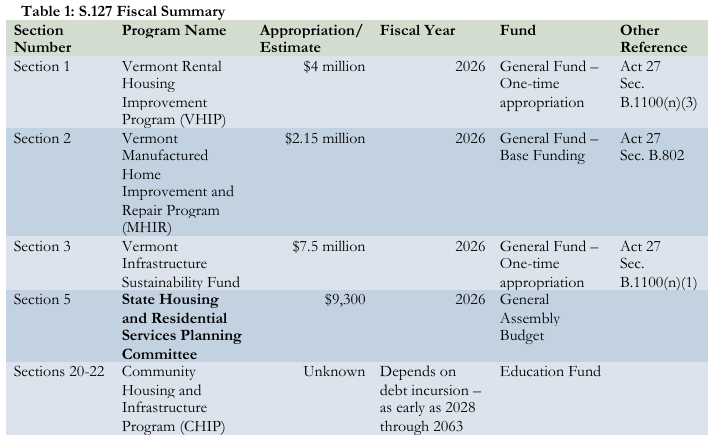
Section 1: Vermont Rental Housing Improvement Program (VHIP) VHIP provides 5-year grants or loans and 10-year forgivable loans to rehabilitate existing vacant units or structural elements affecting multiple units, build accessory dwelling units (ADUs), build new residential units in an existing or new structure, and complete repairs necessary for code compliance. Under the current program, property owners are eligible to receive $30,000 per unit for rehabilitation of 0-2 bedroom units, and $50,000 per unit for 3+ bedroom units or creation of new units.
Section 1 would adjust tenant selection requirements for grants and 5-year forgivable loans and replace tenant selection requirements for 10-year forgivable loans with a requirement that rent payments including utilities not exceed fair market rent. This section would also direct the Department of Housing and Community Development (DHCD) to establish a minimum allocation of annual VHIP funding to be set aside for 5-year grants or forgivable loans. The amount of this set-aside would be developed in consultation with the Agency of Human Services (AHS) but would not be less than 30% of annual VHIP funding. Funds set aside but not used after nine months would then become available for 10-year forgivable loans as well. This section also creates the VHIP Revolving Fund, which would receive funds repaid or returned to DHCD from VHIP grants or forgivable loans and allow DHCD to use these funds for VHIP expenditures and administrative costs. Section B.1100(n)(3) of Act 27 contains a $4 million General Fund appropriation to the DHCD in fiscal year 2026 for VHIP.
Section 2: Vermont Manufactured Home Improvement and Repair Program (MHIR) The Vermont Manufactured Home Improvement and Repair Program (MHIR) provides funding to improve existing manufactured homes, incentivize new slab placement, and for infill of more new homes. Up to $20,000 can be awarded for small-scale capital needs to help infill vacant lots with new homes. Up to $15,000 per grant can be awarded to pay for approved slabs or other site preparation, skirting, tie-downs, or utility connections. This Program was originally funded through $4 million in American Rescue Plan Act (ARPA) funding. Section 2 would permanently place the Program in statute. Section B.802 of Act 27 contains $2.15 million in funding for MHIR in fiscal year 2026.
Section 3 would create the Vermont Infrastructure Sustainability Fund, a revolving loan fund administered by the Vermont Bond Bank. Loans would be available to fund:
- Preliminary engineering and planning;
- Engineering design and bid specifications;
- Construction for municipal water and wastewater systems;
- Transportation investments; and
- Other eligible activities determined by future guidelines.
Applications would have to demonstrate that a project would create reserve capacity necessary for new housing unit development, have a direct link to housing unit creation, and be owned by a municipality throughout its useful life. Section B.1100(n)(1) of Act 27 contains a $7.5 million General Fund appropriation to the Vermont Bond Bank in fiscal year 2026 to provide initial capital for the Vermont Infrastructure Sustainability Fund.
Section 5: State Housing and Residential Services Planning Committee Section 5 would create the State Housing and Residential Services Planning Committee to generate a State plan to develop housing for individuals with developmental disabilities. The Committee would create a plan that includes: a schedule for the creation of at least 600 additional units of service-supported housing, a description of the support needs of individuals with developmental disabilities, any anticipated funding needs, and any recommendations for changes to State laws or policies that are obstacles to the development of housing for individuals with Medicaid-funded home and community-based services. The Committee would meet for not more than six meetings, submit a report to various committees of jurisdiction by November 15, 2025, and cease to exist on November 30, 2025.
Legislative members serving while the General Assembly is not in session would be entitled to per diem compensation and expense reimbursement pursuant to 2 V.S.A. § 23, paid from funds appropriated to the General Assembly. JFO estimates this would cost up to $3,000 in fiscal year 2026. Non-legislative members who are not otherwise compensated or reimbursed for their attendance would be entitled to per diem compensation and expense reimbursement pursuant to 32 V.S.A. § 1010. JFO estimates this would cost up to $6,300 in fiscal year 2026 from the budget of the General Assembly.3
Sections 20, 21, and 22: Community and Housing Infrastructure Program (CHIP) Under current law, Vermont’s TIF program allows municipalities to retain a portion of the growth in property values from the taxable value set at district creation to pay for infrastructure improvements. In other words, this means municipalities are permitted to use a portion of the taxes from incremental growth of property to pay for infrastructure improvements, instead of paying those funds to municipal and state education property taxes. The difference between the original taxable value and the current taxable value in a TIF district is called the incremental value or increment. Currently, there are 10 active TIF districts in larger Vermont municipalities.
Sections 20 and 21 would create CHIP, a TIF program that would similarly allow municipalities to retain growth in incremental property tax revenues; however, the parameters of the revenues as well as their use would differ. Under the existing TIF program, districts can retain 85% of municipal property tax increment and 70% of education property tax increment and use the revenues for public infrastructure projects. In CHIP, these incremental revenues could be used to finance housing infrastructure for individual projects. In addition, municipalities could retain a minimum of 85% of the municipal increment until all debt is retired and 75% – 85% if certain affordability criteria are met – of the education property tax increment for 20 years after the first incursion of debt.
These affordability criteria include:
- Projects where more than 15% of units are subject to covenants or restrictions that preserve their affordability until all indebtedness for a project is retired (these projects are also exempted from the but-for test); or
- Housing for which the annual cost of renting or ownership does not exceed 30% of the gross annual income of a household at 150% of the highest of several median income calculations.
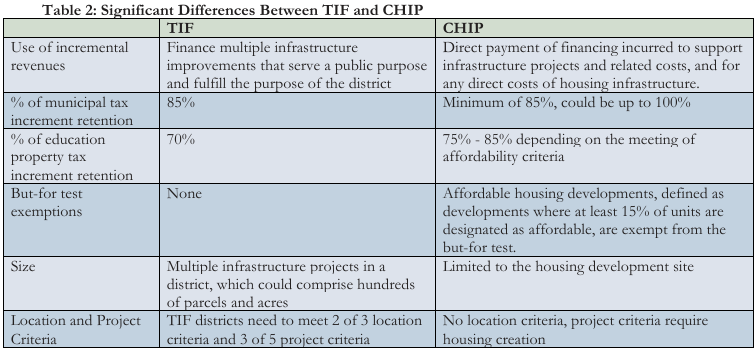
In CHIP, incremental tax revenues could be used for direct payment of financing incurred to support infrastructure projects, related costs, and any direct costs of housing infrastructure. Use of increment for direct payments would be subject to the same public vote provisions as municipal debt incursion for the project. To qualify, projects would need to meet the but-for test and process and certain project criteria:
- But-for test: VEPC determination that the project would not occur, or would occur in a less desirable way, if not for the tax increment financing. Affordable housing developments, defined as having 15% or more of the units in the housing development designated as affordable, would be exempt.
- Process: the project must show it has created a project site, executed a housing infrastructure agreement with a developer or sponsor, and pledged incremental tax revenues to the project. Project: at least 60% of the floor area of the housing project is dedicated to housing or the project meaningfully addresses the Program purpose, with the intent to encourage the development of new primary residences for low and moderate income households in Vermont.
The bill allows VEPC to approve up to $200 million of total retained education property tax increment to service CHIP project debt each year for 10 years and allows VEPC to approve projects through 2035.
1The Joint Fiscal Office (JFO) is a nonpartisan legislative office dedicated to producing unbiased fiscal analysis – this fiscal note is meant to provide information for legislative consideration, not to provide policy recommendations.
3There is no appropriation in the bill for this purpose.
iThe full fiscal note history is available on the fiscal tab of the bill page on the General Assembly website and can be pulled up through a bill number search on the JFO page.
JFO GENERAL-381569-v9-Act69_FN-v2.pdf
Community and Housing Infrastructure Program (CHIP)
The Community and Housing Infrastructure Program (CHIP) is a statewide tax increment financing tool designed to help Vermont communities unlock housing opportunities by investing in critical public infrastructure.
With CHIP, $2 billion can be invested between now and 2035, one of the largest investments in municipal infrastructure in Vermont history.
CHIP was created with the passage of S.127 (Act 69).
What CHIP Does
CHIP enables municipalities to finance essential infrastructure (like water, sewer, roads, and stormwater systems) that supports new housing development. It allows towns and cities to:
- Access long-term financing without raising local property taxes
- Capture a portion of new property tax revenues from future development
- Invest in public improvements that directly support the creation of homes
Why It Matters
Infrastructure is one of the biggest barriers to housing development in Vermont. CHIP provides a scalable, municipality-driven solution to this challenge by giving communities the financial tools to:
- Grow their grand lists
- Develop the types of housing most needed in their community
- Support economic growth and workforce needs
- Help generate an estimated $380 million in new Education Fund revenue over time, without raising taxes
How It Works
Municipalities apply to the Vermont Economic Progress Council (VEPC) to designate housing development sites
Once approved, towns can retain a portion of new property tax revenue to pay for infrastructure investments for up to 20 years:
- Not less than 85% of new municipal tax increment
- Up to 75% of education tax increment for market-rate developments
- Up to 85% of education tax increment for developments with at least 15% affordable units
Both rental and homeownership projects are eligible.
Debt may be issued by municipalities, developers, or third-party sponsors.
What’s Next
The VEPC, housed within the Department of Economic Development, will lead program administration with support from the Department of Housing and Community Development.
The target launch date for CHIP is January 2026.
7.17.2025. Governor. 109 State Street | The Pavilion | Montpelier, VT 05609-0101 | www.vermont.gov
To support vital journalism, access our archives and get unique features like our award-winning profiles, Book of Lists & Business-to-Business Directory, subscribe HERE!
