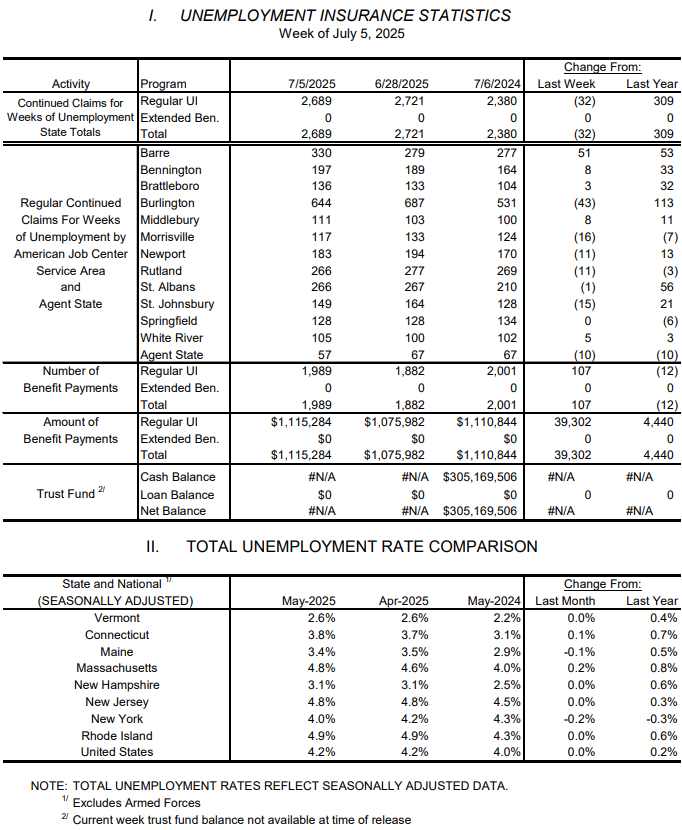
by Timothy McQuiston, Vermont Business Magazine Vermont weekly unemployment claims for the week ending July 5, 2025, fell by over 200 claims after a smaller drop the previous week. New claims were 309, down 222 claims from the week before and up 14 from last year at this time. Claims, which tend to be lowest in the summer, were 181 at the end of September 2024.
In Vermont for the weekly report, the Service industry accounted for the most claims last week with 54%, up 12 points from the previous week. Construction was 4%, up 2 points. Manufacturing accounted for 22% of claims, up 2 points.
For the week, Vermont total unemployment insurance claims were 2,998 (down 254 for the week and up 323 from this time last year).
The Vermont Unemployment Trust Fund is well capitalized. As of the most recent data, there was $305.2 million in the Trust Fund (as claims are paid out on one side, employers are contributing to the fund on the other). The pre-pandemic Trust Fund balance on March 1, 2020, was $506.2 million.
The stock market responded favorably to the positive US jobs report in June (see below) despite the passage July 3 of the federal budget adjustment act, which cuts taxes but is expected to also increase the budget deficit.
However, President Trump's on-again off-again tariff policy was again on-again late this week, which sent shares down from an all-time high for the S&P. There are also concerns about tariffs increasing inflation and about the unsettled geopolitical conflicts between Israel and Iran and the continuing invasion of Ukraine by Russia.
On the other hand, the Treasury recorded an unexpected surplus as tariff receipts boosted its coffers.
The S&P, which most closely tracks the overall economy, reached another new peak Thursday to 6,280.46, but was down about 0.35% Friday. The Dow, which peaked at over 45,000 in December, was down about 0.7% to 44,340 late Friday. While the volatile NASDAQ, which also peaked on Thursday at 20,630.66, was down about 0.3% late Friday.
Year-to-date 2025, the S&P is up 6%, after being up 25.7% for all of 2024, up 21.9% in 2023 and up 94.3% over the last 5 years (18.9% per annum). The Dow is up 11.7% YTD and up 66.2% over the last 5 years (13.2%). NASDAQ is up 6.9% YTD and up 96.5% over 5 years (19.3%)
Labor Report
The US DOL is reporting that for the week ending July 5, the advance figure for seasonally adjusted initial unemployment claims was 227,000, a decrease of 5,000 from the previous week's revised level. The previous week's level was revised down by 1,000 from 233,000 to 232,000. The 4-week moving average was 235,500, a decrease of 5,750 from the previous week's revised average. The previous week's average was revised down by 250 from 241,500 to 241,250.
Total nonfarm payroll employment increased by 147,000 in June, and the unemployment rate changed little at 4.1 percent, the U.S. Bureau of Labor Statistics reported July 3. Job gains occurred in state government and health care. Federal government continued to lose jobs.
Household Survey Data
Both the unemployment rate, at 4.1 percent (down one-tenth), and the number of unemployed people, at 7.0 million, changed little in June. The unemployment rate has remained in a narrow range of 4.0 percent to 4.2 percent since May 2024.
Among the major worker groups, the unemployment rate for Blacks (6.8 percent) increased in June, while the rates for adult women (3.6 percent) and Whites (3.6 percent) decreased. The jobless rates for adult men (3.9 percent), teenagers (14.4 percent), Asians (3.5 percent), and Hispanics (4.8 percent) showed little or no change over the month.
In June, the number of long-term unemployed (those jobless for 27 weeks or more) increased by 190,000 to 1.6 million, largely offsetting a decrease in the prior month. The long-term unemployed accounted for 23.3 percent of all unemployed people.
The labor force participation rate changed little at 62.3 percent in June, and the employment-population ratio held at 59.7 percent.
The number of people employed part time for economic reasons, at 4.5 million, changed little in June. These individuals would have preferred full-time employment but were working part time because their hours had been reduced or they were unable to find full-time jobs.
The number of people not in the labor force who currently want a job was essentially unchanged at 6.0 million in June. These individuals were not counted as unemployed because they were not actively looking for work during the 4 weeks preceding the survey or were unavailable to take a job.
Among those not in the labor force who wanted a job, the number of people marginally attached to the labor force increased by 234,000 in June to 1.8 million. These individuals wanted and were available for work and had looked for a job sometime in the prior 12 months but had not looked for work in the 4 weeks preceding the survey. The number of discouraged workers, a subset of the marginally attached who believed that no jobs were available for them, increased by 256,000 in June to 637,000.
Establishment Survey Data
Average hourly earnings for all employees on private nonfarm payrolls rose by 8 cents, or 0.2 percent, to $36.30 in June. Over the past 12 months, average hourly earnings have increased by 3.7 percent. In June, average hourly earnings of private-sector production and nonsupervisory employees rose by 9 cents, or 0.3 percent, to $31.24.
The average workweek for all employees on private nonfarm payrolls edged down by 0.1 hour to 34.2 hours in June. In manufacturing, the average workweek held at 40.1 hours, and overtime was unchanged at 2.9 hours. The average workweek for production and nonsupervisory employees on private nonfarm payrolls declined by 0.2 hour to 33.5 hours in June.
Bankruptcy Filings Increase
Meanwhile, total US bankruptcy filings were 276,126 during the first six months of 2025, a 10 percent increase from the 251,069 total filings during the same period a year ago, according to data provided by Epiq AACER, the leading provider of U.S. bankruptcy filing data.
Total individual filings registered an 11 percent increase, as the 260,938 filings during the first half of 2025 were up from the 235,849 filings during the first six months of 2024. Individual chapter 7 filings climbed to 163,219 during the first half of 2025, an increase of 15 percent over the 141,566 chapter 7 filings in the first half of 2024. The 97,125 individual chapter 13s filed in the first six months of 2025 represent a 3 percent increase over the 93,870 filings during the same period in 2024.
“The strong 15 percent increase in individual Chapter 7 bankruptcy filings underscores the growing financial pressure facing American households,” said Michael Hunter, vice president of Epiq AACER. “Elevated interest rates, record-high credit card and household debt, and the resumption of student loan repayments and collections are all contributing factors driving more individuals to seek bankruptcy protection.”
Small Business & Inflation Concerns
Meanwhile, a study from Lido.app released July 3, 2025, examined challenges facing small companies across all 50 states, tracking employment figures, wage shifts, utility expenses, and price jumps between 2020 and 2024 to measure inflation's impact. Vermont finished in the middle of the pack for inflation impact at 25th with a score of 54.99.
North Dakota small businesses are the least impacted by inflation, scoring 86.86 out of 100. Arizona businesses are the most impacted by inflation, with a 28.80 score after gas bills surged by 75.83%. Scores are based on employment figures, wage shifts, utility expenses, and price jumps between 2020 and 2024 to measure inflation's impact.
Vermont’s unemployment rate unchanged at 2.6 percent in May
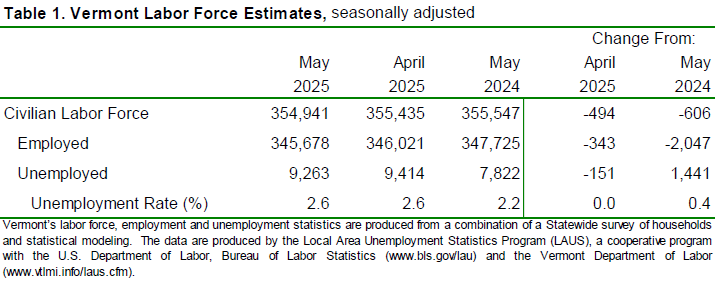
The Vermont Department of Labor on June 24, 2025, reported that the seasonally adjusted statewide unemployment rate for May was 2.6%. This reflects no change from April's revised estimate, and from December 2024, when it was 2.5%. However, the Labor Force and Employment have been losing ground slightly every month this year. Over the last two years, the Labor Force peaked at 357,467 in January 2025, as did the Labor Force at 348,340. The high point in Unemployment was just in April.
The preliminary estimates for April showed an unemployment rate of 2.7% but the initially reported increase of one-tenth of one percentage point disappeared due to the inclusion of more data. The civilian labor force participation rate was 65.0 percent in May, a decrease of one-tenth of one percentage point from the prior month’s revised estimate.
Vermont has the third lowest jobless rate in the nation, behind South (1.8%) and North Dakota (2.5%). Nevada continues to have the highest rate, at 5.5%.
The comparable United States rate in June was 4.1%, down from May's 4.2%, unchanged from April. The seasonally adjusted Vermont data for May show the Vermont civilian labor force decreased by 494 from the prior month’s revised estimate (see Table 1). The number of employed persons decreased by 343 and the number of unemployed persons decreased by 151. No changes were statistically significant in the seasonally adjusted series.
"Whether you're a business looking to fill open positions or a job seeker exploring training and employment opportunities, the Vermont Department of Labor’s Workforce Development Division is here to help. Learn more at: https://labor.vermont.gov/workforce-development and https://labor.vermont.gov/child-labor.”
The May unemployment rates for Vermont’s 14 counties ranged from 1.8 percent in Addison and Chittenden Counties to 2.9 percent in Orleans County (note: county unemployment rates are not seasonally-adjusted – see Table 2). For comparison, the May unadjusted unemployment rate for Vermont was 2.2 percent, a decrease of five-tenths of one percentage point from the revised unadjusted April level and an increase of two-tenths of one percentage point from a year ago.
The seasonally adjusted data for May reported an increase of 900 jobs from the revised April data. There was no change between the preliminary and the revised April estimates due to the inclusion of more data. The seasonally adjusted over-the-month changes in May varied at the industry level. The industries with a notable increase were Administrative & Waste Services (+800 jobs or +5.7%), Other Services (+300 jobs or +2.9%), and Accommodation & Food Services (+300 jobs or +1.0%). The industries with a notable decrease were Construction (-300 jobs or -1.9%), Private Educational Services (-200 jobs or -1.5%), and Durable Manufacturing (-200 jobs or -1.3%).
The preliminary ‘not-seasonally-adjusted’ jobs estimates for May showed an increase of 100 jobs when compared to the revised April numbers. As with the seasonally adjusted data, this over-the-month change is from the revised April numbers which experienced a decrease of 300 jobs from the preliminary estimates. The broader economic picture can be seen by focusing on the over-the-year changes in this data series. As detailed in the preliminary not-seasonally-adjusted May data, Total Private industries increased by 4,500 jobs (+1.8%) over the year and Government (including public education) employment decreased by 1,600 jobs (-2.8%) in the past year.
To support vital journalism, access our archives and get unique features like our award-winning profiles, Book of Lists & Business-to-Business Directory, subscribe HERE!