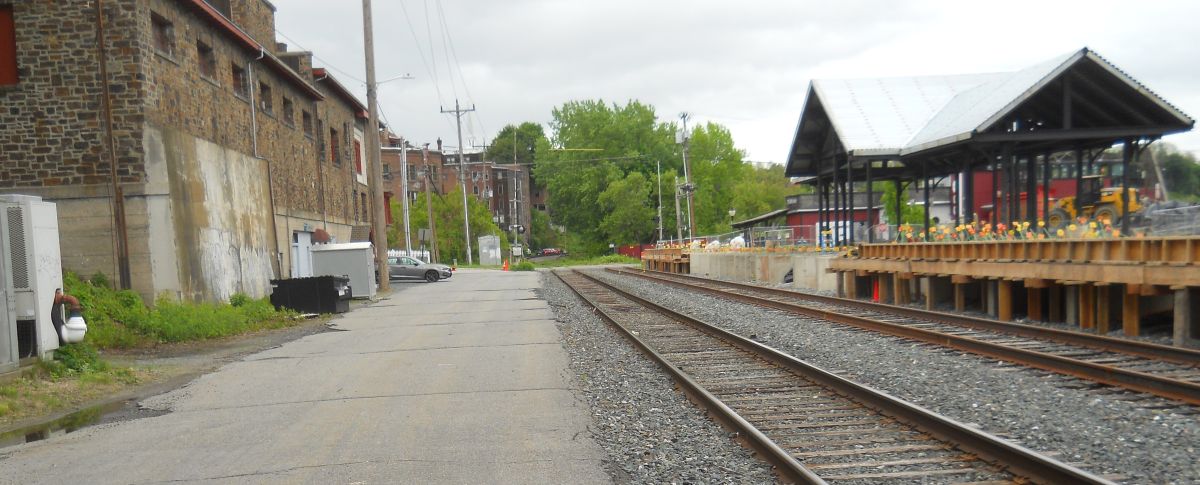
The Brattleboro Amtrak station, is currently under renovation. Photo by C.B. Hall
by C.B. Hall, Vermont Business Magazine
An eight-mile upgrade to the Winooski Branch railroad in Chittenden County, connecting downtown Burlington’s Union Station to Essex Junction via Winooski and Colchester, is expected to boost Vermont’s passenger rail and freight services.
The New England Central Railroad, a Genesee & Wyoming subsidiary, received a federal grant last October to fund these improvements. Currently, the line is limited to 10 mph freight traffic and is not permitted for passenger service.
The upgrade will enable New England Central Railroad trains to operate at speeds up to 25 mph on the line. NECR utilizes this route for delivering wood chips to Burlington’s McNeil Generating Station and for interchanging cars with the Vermont Rail System.
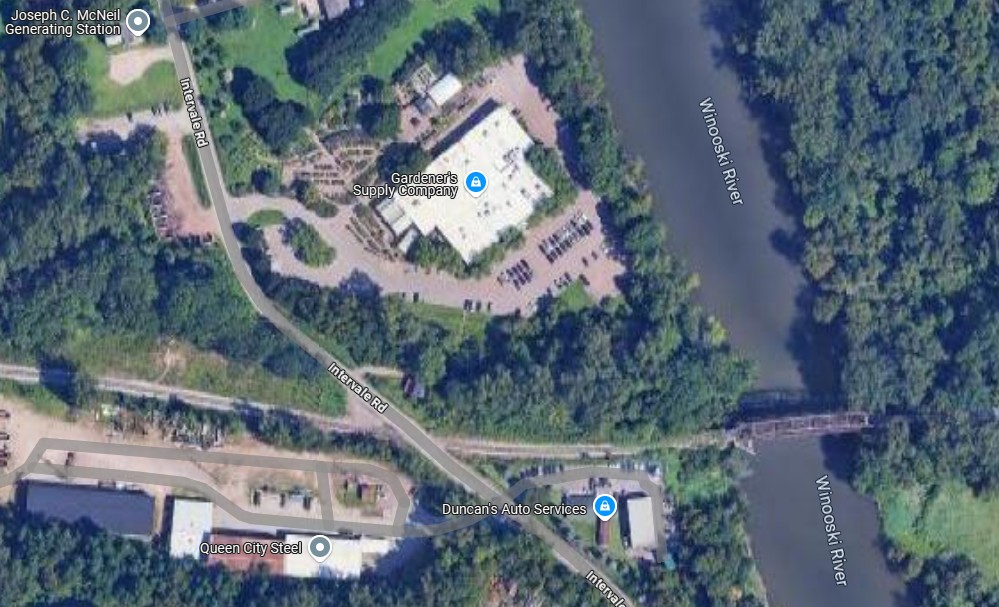
Winooski Branch track now operates at a walking pace. The upgrade will allow heavier trains and faster speeds. Google Maps aerial screenshot.
The Vermont Rail System, in turn, manages the line extending south from Burlington’s Union Station to destinations in southwestern Vermont and New York state. This same track also serves Amtrak’s Ethan Allen Express, connecting Burlington to Manhattan’s Penn Station.
The rehabilitation will additionally enable NECR to transport freight cars weighing up to 286,000 pounds, an increase from the current 263,000-pound limit. This heavier capacity, which aligns with the national standard, will significantly enhance convenience by allowing the movement of extra-heavy cars commonly used on freight lines nationwide.
Federal Rail Administration regulations would permit passenger trains to use the upgraded route at speeds up to 30 mph. This prospect excites passenger rail advocates, who view the connection as vital for linking Vermont’s two Amtrak services: the Ethan Allen and the Washington, D.C.-St. Albans Vermonter, which stops daily in Essex Junction.
Currently, Essex residents wishing to take the Ethan Allen to destinations like New York’s Hudson Valley must either drive to downtown Burlington and find parking, or use a Green Mountain Transit bus. This bus journey from the Essex Junction Amtrak station to Burlington takes 35 to 50 minutes and leaves travelers six blocks from Union Station.
According to Carl Fowler, a veteran passenger rail advocate from Williston, the new FRA classification would allow the Ethan Allen train to cover the eight miles in approximately 20 minutes, without any intermediate stops. This extension of the route to Essex Junction would effectively complement the train’s current service to the Burlington metropolitan area, as a station already exists in Ferrisburgh, just outside Vergennes, to the south of the city.
Vermont’s 2021 State Rail Plan classified the Winooski Branch upgrade and the Ethan Allen extension to link with the Vermonter at Essex Junction as third-tier initiatives. In early June, the Agency of Transportation released a 78-page draft update of this plan, which is available on the agency’s website.
A preliminary list of 39 rail initiatives, compiled earlier this year for the revision and obtained by VermontBiz, elevates the track segment improvement to a first-tier initiative while maintaining the Ethan Allen service extension to Essex Junction as third-tier.
During a broad discussion of initiatives at a May 21 meeting of Vermont’s Rail Advisory Council, established by the state in 1993, Dan Delabruere, director of AOT’s Rail Bureau, emphasized that the tiers did not signify priorities as one might assume. Instead, the categorization is based on factors such as the initiative’s ongoing status or funding availability. Delabruere also stated that initiatives must be included in the state’s existing rail plan to qualify for Federal Rail Administration funding.
The Long-Lost Connection
Both the state’s 2021 plan and the current revision include the restoration of Montréal as the Vermonter’s northern terminus on the Agency of Transportation’s agenda. However, the reinstatement of this connection, suspended in 1995, appears to be an increasingly distant prospect.
The restoration hinges on the completion of a customs preclearance facility at Montréal’s Central Station, a proposal that has been in a state of indefinite “supposed to“ since Amtrak first unveiled a design for the facility in 2009.
Since then, various governments on both sides of the border have grappled with the unexciting, yet crucial, details of how — or even if — to construct this facility, which would primarily benefit Amtrak and its passengers in a foreign country.
In an interview, commenting on the apparent lack of progress on the initiative, Fowler suggested that the customs facility could be constructed in Lacolle, Québec, 50 miles south of Montréal and near the international border, instead of in Montreal.
“I don’t think it is the best spot for the border facilities,“ he said, “but if after another year of effort we still can’t move forward (with Montréal) then it should be considered. This might also be necessary because of potential high costs in Montréal.“
Lacolle could additionally fulfill the customs requirements for Amtrak’s current New York City-Montréal service, the Adirondack. Fowler noted that incorporating a few intermediate stops between the metropolis and Lacolle might offer beneficial utility for Canada.
During the VRAC meeting, Fowler raised concerns about the extended development period of the Montréal initiative.
“I’ve been on this council for over 20 years, and we’ve been talking about this all that time. If in 12, 18 months we can’t make this project work, we should look at progress we can implement,“ he said, alluding to the Lacolle possibility.
“We are making progress on Montréal,“ Delabruere stated, without providing further details. As of press time, a follow-up email from VermontBiz requesting specific information on this progress had not received a response.
“The mystery north of the border is not going to be solved by Vermont,“ Transportation Secretary Joe Flynn, who serves as council chair, told the meeting’s attendees. “How we invest north of the border has always been a riddle.“
The strained relationship between the two countries, stemming from the current tariff dispute and President Trump’s hopes of making the Dominion the 51st state, is undoubtedly hindering the Montréal initiative. However, Fowler noted in his interview that the U.S. administration has not yet taken any known actions to withdraw from the long-standing initiative.
Meanwhile, Down South
At the southern end of Vermont, there appears to be a greater likelihood of another potential passenger service expansion: extending one of Amtrak’s Valley Flyer trains to Brattleboro. Currently, the Valley Flyer service, which operates two daily round-trips, connects Greenfield, Massachusetts, with Springfield, Massachusetts, using the same tracks as the Vermonter. Numerous connections south from Springfield through Connecticut provide links to the broader Amtrak national network.
A shortage of usable equipment — passenger cars — continues to impede the expansion of the national passenger rail provider’s reach across the country. However, extending a Valley Flyer train the 18 miles from Greenfield to Brattleboro could become feasible without Amtrak needing to assemble a new set of cars, which a more ambitious northward expansion of Vermonter-corridor service, for example, to White River Junction, would likely require. Sources told VermontBiz that, to equip such a service, Vermont would have to wait until 2030 to receive these cars, as part of a large Amtrak equipment order originally slated for deployment years earlier.
During the Vermont Rail Advisory Council meeting, Fowler articulated the challenges of near-term Amtrak service expansion in straightforward terms: “Amtrak has no cars. We keep running into this ’Ain’t got none’ problem.“
Brattleboro, Vermont’s third-busiest Amtrak stop, has influential advocates pushing for improved Vermonter service. State Sen. Wendy Harrison (D-Brattleboro), a member of the Vermont Rail Advisory Council, is among them.
“More frequent service, especially service that would allow someone to go to New York City and return home to Vermont in a single day, would benefit Vermonters and encourage people to relocate to our state,“ Harrison said in an interview.
She suggested that extending the Valley Flyer to Brattleboro “would be achievable with less money“ than a more complex extension to White River Junction.
The draft list of rail projects for the coming years includes adding a train to the Vermonter corridor, potentially extending to Brattleboro or White River Junction. Ben Heckscher, co-founder of Trains in the Valley, a Massachusetts advocacy group, expressed concerns about stopping at Brattleboro.
“If you only go to Brattleboro, you’re probably not getting the bang for your buck,“ he said. “Maybe what you really need to be looking at is White River Junction.“
Despite this, Heckscher noted that “the Vermonter is getting to be a busy train.“ Amtrak data shows a 12.2% increase in Vermonter ridership from federal fiscal year 2023 to FY 2024, while Ethan Allen patronage grew by 2.7%.
The possibility of extending service to Brattleboro is being examined in a federally funded study by VTrans. This study is looking into potential service expansion along the Vermonter route. However, Delabruere emphasized in an email that this study and a similar one for potential new service in the western Vermont corridor used by the Ethan Allen were “only planning documents.
“There are several phases that will take several years before the agency will be able to evaluate whether the expansion of additional services is needed,“ he wrote.
Heckscher commented that the study “starts to set a frame a mind“ in anticipation of Amtrak’s equipment roster being strengthened in the coming years.
Not A Welcoming Climate?
Crucial to the development of Vermont’s rail lines is the careful integration of the needs of both freight railroads and the traveling public.
Vermont has 14 Amtrak stops, giving it the highest ratio of passenger rail stations to population in any U.S. state. Additionally, the state owns 305 of Vermont’s 578 miles of active rail lines.
Fowler told VermontBiz that VTrans’ role in fostering the passenger-freight partnership is notable among U.S. states, where Amtrak and many private railroads that host its trains can be seen as having a difficult relationship.
The Trump administration’s stance on any expansion of Amtrak services, however, remains notably unclear. In addition to the challenging situation along Vermont’s northern border, there was the sudden resignation of Amtrak CEO Stephen Gardner in March.
Reuters reported that Gardner was asked to resign at the president’s request. This, combined with media reports of Trump ally Elon Musk’s characterization of Amtrak as “a sad situation“ and his suggestion to sell the publicly supported company to a private entity, means wariness among passenger rail advocates is understandable.
Recent reports from the nation’s capital have been quite favorable, with the national Rail Passengers Association indicating that Amtrak “has so far avoided the proposals for dramatic cuts the White House has outlined for similar quasi-governmental organizations like the Public Broadcasting Service and National Public Radio.“
U.S. Secretary of Transportation Sean Duffy, in his testimony to Congress, has also mentioned that he uses Amtrak himself. However, Max Schindler, director of the Vermont Rail Action Network, expressed pessimism after recently returning from discussions with other passenger advocates in Washington, D.C.
Referring to the Trump administration’s penchant for eliminating, or at least trying to eliminate, various federal programs, Schindler said, “This is not exactly a welcoming climate for expansion. ... Our task now is protecting passenger rail from cuts made by the federal government.“
Asked how he felt about the prospects that the Trump administration would ultimately provide the funding for the Winooski Branch’s upgrade, NECR’s Hunter reply was simple: “ Very confident.“
C.B. Hall is a freelance writer from southern Vermont.
To support vital journalism, access our archives and get unique features like our award-winning profiles, Book of Lists & Business-to-Business Directory, subscribe HERE!