Kelly Pawlak, former general manager at Mount Snow Resort and former President and CEO of the National Ski Areas Association accepted an Industry Achievement Award for her contributions to Vermont’s ski industry from Molly Mahar. Ski Vermont photos.
Early thaw and Canadian response to rhetoric from the federal government limited late season skiing
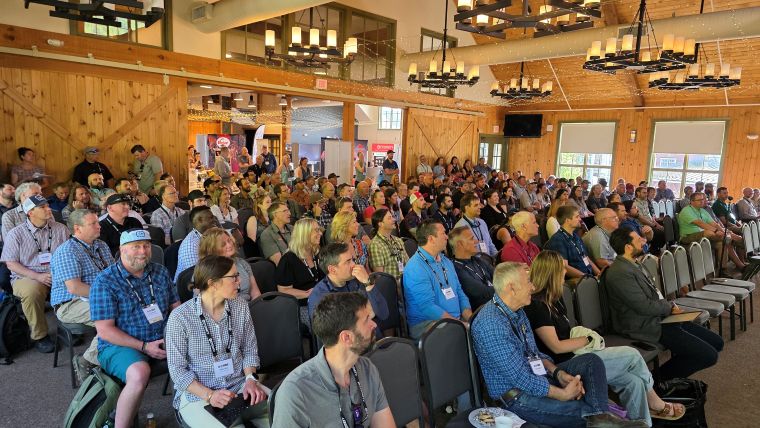
Vermont Business Magazine Vermont’s alpine and cross-country ski areas joined industry partners, supporters, and friends at Ski Vermont’s 56th Annual Meeting at Sugarbush Resort, June 4–5, recapping a season of continued growth despite challenges.
Vermont’s alpine ski areas reported 4.16 million skier visits for the 2024–25 season, an increase of 1.1% over the previous year and 6.2% over the 10-year average. These totals put Vermont 0.6% ahead of the New England region’s 0.4% growth, and just 0.6% behind the national average visitation increase of 1.7%.
With strong visitation and continued year over year growth, Vermont remains the top ski state in the east and fourth largest in the nation, measured by skier visits, a key performance indicator for the snow sports industry. The state’s ski areas averaged 117 operating days this season, slightly lower than the 10-year average of 123 days. Average snowfall of 218 inches was a 19-inch increase over last year, and 35 inches above the 10-year average.
“The growth in visitation numbers reflects the commitment Vermont’s ski areas have to providing the best experience and best possible snow for visitors,” said Ski Vermont President Molly Mahar. “Ski areas are committed to investing in resilience for their communities, with capital dollars going toward efficiency and snowmaking projects as well as expanded programming and activities to appeal to a wider range of guests.”
Despite a slow start in November, the core winter months of December, January and February delivered consistently seasonable weather and temperatures with abundant snowfall, particularly in the northern mountains. Blustery and frigid weather dampened peak period visitation over the Martin Luther King, Jr. Birthday weekend and Presidents’ week. The lack of March snowfall and inclement weather during spring weekends further reduced visitation, and an early melt cut the spring season short.
Further exacerbating challenges for ski areas was the Canadian response to rhetoric from the federal government, resulting in decreased visitation toward the end of the season. Canadians account for up to 50% of visitation at several ski areas in the northern part of the state. Vermont’s ski areas will continue working with the tourism industry to strengthen relationships and keep lines of communication open with our neighbors to the North.
|
Skier Visits Ski Vermont Data 2025-2025: 4.16M 2023-2024: 4.1M 2022-2023: 4.1M 2021-2022: 3.8M 2020-2021: 3.5M 2019-2020: 3.7M (season ended in mid-March due to COVID-19) 2018-2019: 4.2M 2017-2018: 4.0M 2016-2017: 3.9M 2015-2016: 3.2M 2014-2015: 4.7M 2013-2014: 4.5M 2012-2013: 4.5M 2011-2012: 3.9M 2010-2011: 4.4M VermontBiz Historic Data 2009-2010: 4,125,082 2008-2009: 4,068,696 2007-2008: 4,354,621 2006-2007: 3,820,431 2005-2006: 4,147,467 2004-2005: 4,399,273 2003-2004: 4,214,068 2002-2003: 4,470,677 2001-2002: 4,148,438 2000-2001: 4,579,719 1999-2000: 3,957,457 1998-1999: 4,042,461 1997-1998: 4,250,569 1996-1997: 3,971,920 1995-1996: 4,109,109 1994-1995: 3,652,751 1993-1994: 4,308,633 1992-1993: 4,258,191 1991-1992: 3,871,299 1990-1991: 4,100,000 1989-1990: 4,600,000 1988-1989: 4,500,000 1987-1988: 4,850,000 1986-1987: 5,200,000 1985-1986: 4,460,000 1984-1985: 3,850,000 1983-1984: 4,150,000 1982-1983: 3,000,000 1981-1982: 4,000,000 1980-1981: 3,100,000 1979-1980: 2,100,000 1978-1979: 3,200,000 1977-1978: 3,600,000 1976-1977: 3,000,000 1975-1976: 2,600,000 1974-1975: 2,800,000 1973-1974: 1,650,000 1972-1973: 2,300,000 1971-1972: 2,650,000 1970-1971: 2,650,000 1969-1970: 2,400,000 1968-1969: 2,250,000 1967-1968: 1,800,000 1966-1967: 1,650,000 1965-1966: 1,650,000 1964-1965: 1,150,000 1963-1964: 1,175,000 1962-1963: 1,020,000 Source: Ski Vermont. Vermont Business Magazine. |
The consistently cold winter weather was a boon for Ski Vermont’s cross-country area members, which reported a total of 322,353 skier visits, up 37% from last season’s disastrous result when 50% of visits were lost. While several of Vermont’s cross-country ski areas have limited snowmaking on portions of their trail networks and several others have plans to add it, and the majority rely on natural snowfall. Adequate snow over the holidays and a reliably cold January and February meant cross-country areas could consistently operate for most of the season, though some had to close in early March due to milder temperatures and a lack of natural snowfall.
Highlights of this year’s Annual Meeting program included a workforce development panel and roundtable, a presentation on Vermont’s outdoor recreation strategic plan, and a presentation and working session on the importance of mental health and inclusion in the outdoor industry.
Speakers included Heather Pelham, Commissioner of the Vermont Department of Tourism and Marketing; Claire Polfus, Recreation Program Manager for the Vermont Department of Forests, Parks and Recreation; Sabina Haskell, Executive Director of Workforce Strategy and Development for the State of Vermont, Kendal Smith, Deputy Commissioner of the Vermont Department of Labor; Tino Rutanhira, co-founder of the Vermont Professionals of Color Network, Jon Erickson, Associate Dean of the UVM Rubenstein School of Environment and Natural Resources; Sean Doll, Professor at Vermont State University’s Outdoor Education, Leadership and Tourism and keynote speaker Mirna Valerio, an author, athlete and advocate for inclusive outdoor spaces.
Kelly Pawlak, former general manager at Mount Snow Resort and former President and CEO of the National Ski Areas Association accepted an Industry Achievement Award for her contributions to Vermont’s ski industry. Career Industry Awards were also announced for Keiki Sierman (46 years) and Alan Donahue (42 years) from Killington Resort and Doug Zecher (57 years) and Terry Randolph (36 years) from Bromley Mountain. Career awards are given to retiring employees with 25 or more years of service at a ski area.
Skiing is an important economic driver and employer in the state, particularly in rural areas where many ski areas are located. Ski Vermont’s Fifth Grade Passport helps to get thousands of children on the slopes annually and partial proceeds from the program support Vermont Adaptive Ski and Sports.
A non-profit trade association founded in 1969 to serve alpine and cross-country ski areas, Ski Vermont (the Vermont Ski Areas Association) is a proud ambassador of the thriving winter tourism industry in Vermont, where skiing and snowboarding are the official state winter sports. The top ski state in the east and among the top destinations in the US, Vermont boasts world-class snowmaking quality, coverage, and efficiency, a wide variety of terrain, and a profound historical impact on the sports of skiing and snowboarding - making it one of the most significant ski and ride destinations in the world. VSAA’s mission is to help maintain an environment in which the state’s ski areas can operate and prosper.
MONTPELIER, Vt. (June 5, 2025) – Ski Vermont Discover Skiing in Vermont - Premier Winter Destinations — Ski Vermont
To support vital journalism, access our archives and get unique features like our award-winning profiles, Book of Lists & Business-to-Business Directory, subscribe HERE!