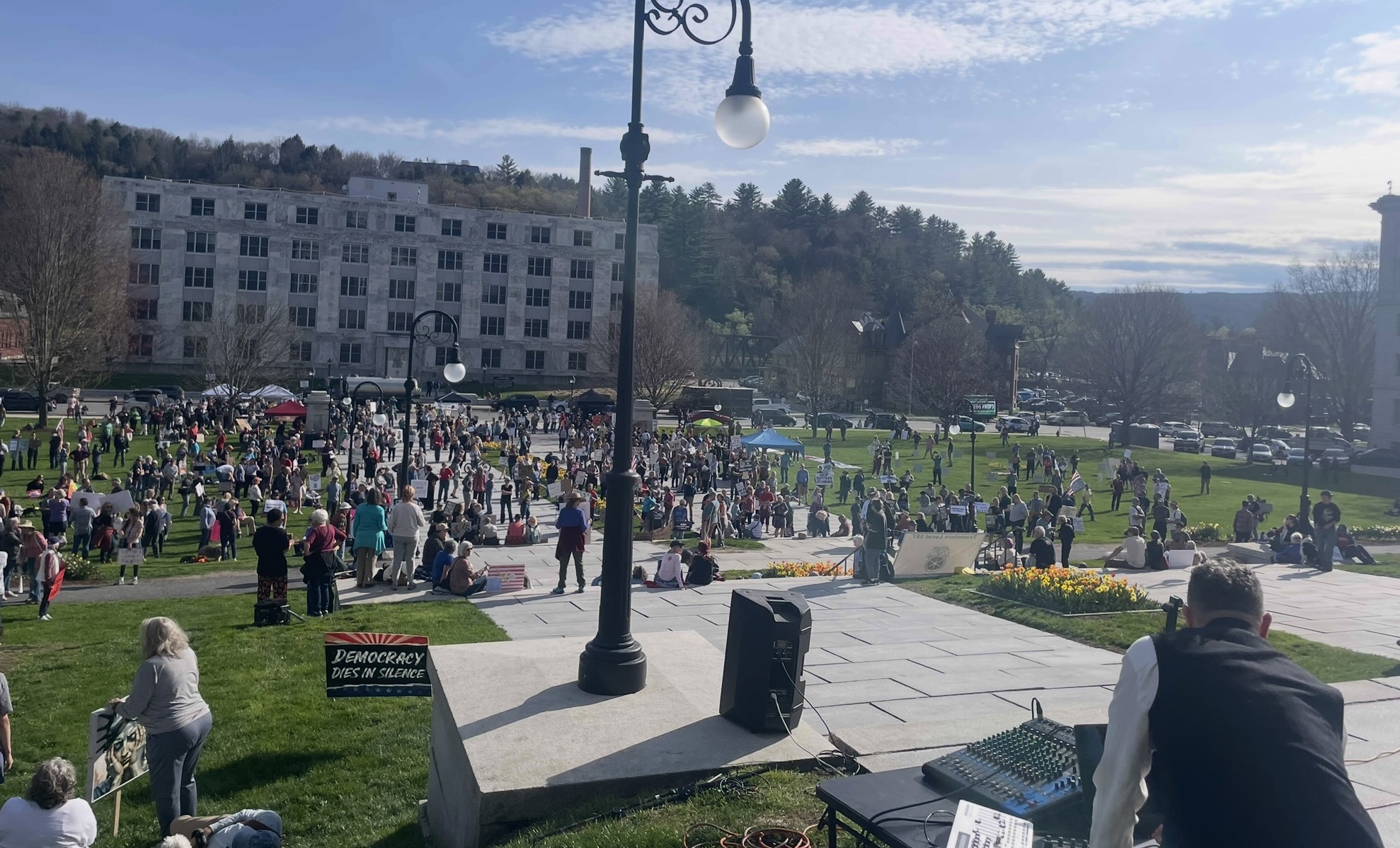
DJ Chia warms up the crowd.
A Weekly State House Recap
by Maggie Lenz and Nick Charyk on behalf of Atlas Government Affairs
Pencils Down
The Senate Education Committee wrapped up its work (for now) on the education bill, H.454, on Friday evening. The bill passed out of committee on a 6-0 vote, but not without some hand wringing and hesitation. Senators openly acknowledged that the bill might not have all its ducks in a row, particularly when it came to the complicated pupil weighting system at its core. There were lingering questions, uneasy glances, and a general air of uncertainty. But finally, with what felt like a candid and collective shrug, the committee sent the bill along to Senate Finance, the chamber’s designated home for number crunching, with the hope that they could finish the math.
Throughout the process, the committee cycled through multiple funding simulations from the Joint Fiscal Office. Under various versions the committee considered, there were strange and puzzling wins and losses for school districts. In the last version modeled, Winooski, a high-need district, would lose over $2 million in funding. Burlington, the state’s largest and most diverse district with high poverty and English language learner needs was set to lose over $6 million. Stowe, one of Vermont’s most affluent towns, would experience a $2 million cut. Barre would gain upwards of $10 million, and Washington Central would lose over $4 million. Montpelier-Roxbury would lose just under $1 million.
It’s hard to say exactly which version they settled on, as tweaks were made to some of the weights and not others, with no apparent modeling to accompany the final version. Members were visibly uncomfortable with how little time they had to understand the ripple effects and how misaligned the outcomes seemed with the bill’s intended goals.
Much of what the committee wrestled with would normally fall under the jurisdiction of the Senate Finance Committee. The amount of time Senate Education spent on tax policy, fiscal modeling, and district-by-district projections was unusual. While the committee clearly cares about equity, the mechanics of how dollars flow from the Education Fund to school districts feel improvised and uncertain.
Right before voting the bill out, the committee reinstated tiered English Learner weights, a structure where students learning English are counted at different levels depending on their proficiency. These tiers were included in the House-passed bill, but were left out of Senate modeling until just before the vote.
Weights are a tool used to adjust how much funding a district gets based on student needs. A student learning English, for example, may be counted as more than one student for funding purposes. But instead of using the full set of research-backed weights recommended in Vermont’s main needs-based model, the committee only brought back one piece. Without further consideration and input from experts, this has the risk of returning to the kind of inconsistent and arbitrary system that the Legislature set out to fix in 2022 with Act 127 when the state updated all the weighting categories to incorporate scientifically derived weights.
The committee itself recognized that its version might need more work. As Senator Kesha Ram Hinsdale put it bluntly during one discussion, “I think the safest thing for us to do here is to undo a little bit of what we’ve done in recent days. We might have not done what we intended here.”
The Senate Education Committee’s draft is also notably friendlier to independent/private schools than either the House or Governor’s proposals. Where those versions required at least 51 percent publicly funded students for an independent school to be eligible for tuition dollars, the Senate reduced that threshold to just 25 percent.
To their credit, the committee was upfront about the uncertainty and the limits of the process. They put in long hours and made a sincere effort to improve equity, even if the result is still a work in progress. Now the bill moves to Senate Finance, which will try to shape that draft into something more workable for the districts that have to live with it. But even that will not be the final word. The bill is almost certain to head to a conference committee, where three members from each chamber will negotiate a final version. And whatever they decide will still have to make it past the governor’s veto pen. All eyes are still on May 30 for adjournment, but there is an incredibly steep and arduous policy hill to climb before that final gavel hits.
Curiosities: a weekly peek at the odd and intriguing happenings under the Golden Dome
The People’s DJ: Rep. Brian Cina’s Soundtrack for the Movement
Passersby and attendees at this week’s May Day rally on the State House lawn got more than just speeches and picket signs. They were greeted by a DJ set from Rep. Brian Cina, who kicked things off by blending P.M. Dawn and The Commodores with audio clips from Bernie Sanders and other voices of labor leaders past and present. You can hear the set on Mixcloud.
It wasn’t background music. It set the tone.
For Cina, it was just another day doing what he’s always done. Bringing people together with music and purpose.
Cina represents Burlington in the Vermont House. He’s served since 2017, but folks who know him will tell you his influence started long before that. He’s a social worker, a longtime community organizer, and a fixture in the local arts scene. This year also marks his 30th anniversary performing as DJ Chia.
“I started spinning records because I love music, but I stuck with it because it’s about storytelling,” Cina told us. “You can take people on a journey. That’s what I try to do in the Legislature too. It’s not just facts and policy. It’s helping people feel something.”
Cina grew up in New Jersey outside of New York City and went to Dartmouth, where he studied electro acoustic music composition and ethnomusicology. His first big gig came in 1994 when he threw a rave that drew hundreds to a campus hall. He moved to Burlington in 1998 to serve with AmeriCorps and never left. He’s worked at Spectrum Youth & Family Services, helped launch music mentoring programs for teens, and spent years supporting vulnerable Vermonters through frontline social work.
His style in the State House is pretty different from most of his colleagues. He dresses with intention. He thinks about how his presence feels in a room. And he’s not afraid to bring joy into serious spaces. He launched an impromptu “Dance Caucus” after COVID to help legislators, staff, and other State House regulars reconnect.
“There’s a reason we say ‘music is medicine,’” he said. “It brings healing, connection, energy. You can say all the right things in a policy debate, but if people don’t trust you or feel moved by you, it won’t matter. Music helps build that bridge.”
In the Legislature, Cina is a steady advocate for healthcare access, housing justice, and reforming Vermont’s criminal legal system. His approach is principled but also collaborative. He rarely raises his voice and tries to find common ground, even when he disagrees.
“I’ve spent my life helping people one at a time,” he said. “But policy is where we can make things better before they go wrong. That’s why I ran. If we do it right, we won’t need so many social workers.”
For Cina, politics and music aren’t separate lanes. They’re both tools to bring people together, shift the culture, and push for change. So next time you’re at a rally or in a hearing room, keep an ear out for DJ Chia.
On May Day, he didn’t just show up for the labor movement. He gave the people something to move to.
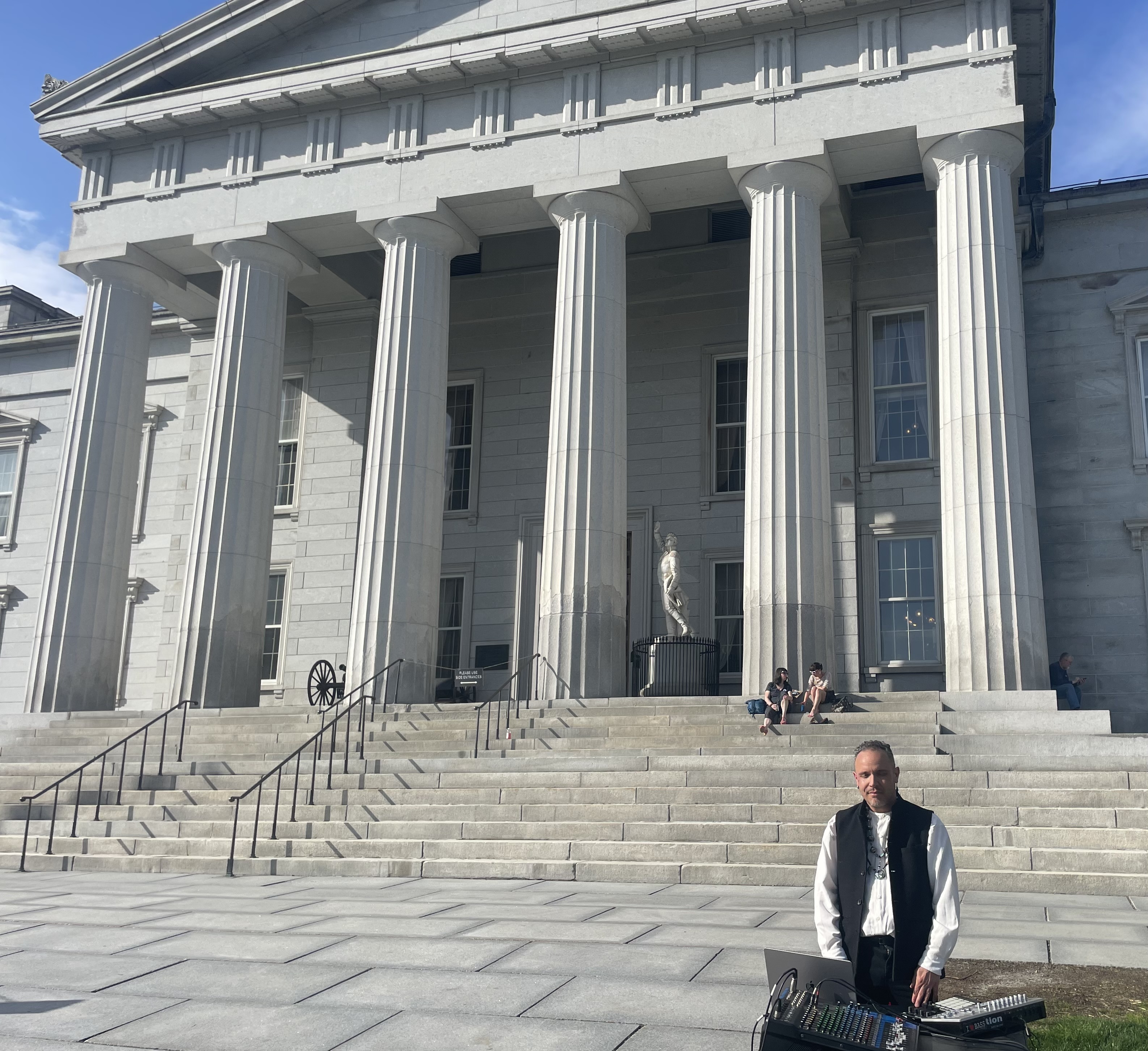
Rep. Brian Cina preparing for the May 1st rally at the State House.
To support vital journalism, access our archives and get unique features like our award-winning profiles, Book of Lists & Business-to-Business Directory, subscribe HERE!