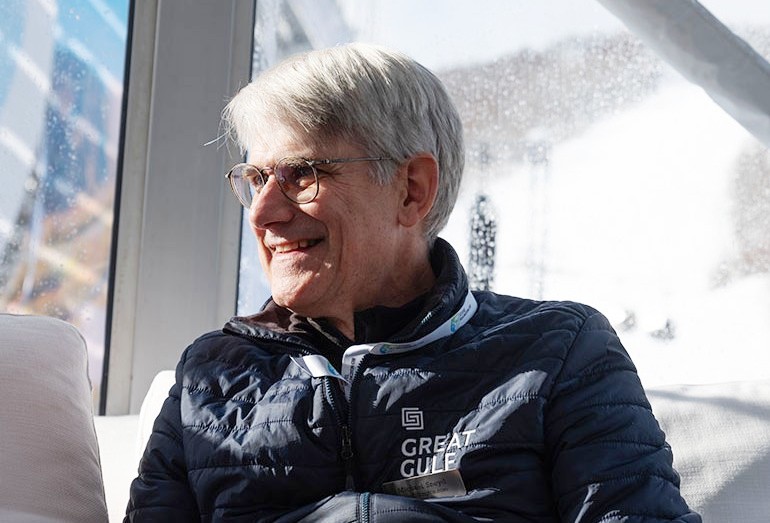
Michael Sneyd chats with a guest at the Audi FIS Ski World Cup VIP tent at Killington Mountain in November 2024. Photo credit: Daimian Lix.
by Maia Segura, Vermont Business Magazine
The largest ski resort in the eastern United States — with annual revenues estimated at over $3 million and traditional home to the Stifel Killington World Cup for women’s downhill racing — Killington Mountain Resort is set to undergo a metamorphic redevelopment that aims to solidify its reputation as a world-class, four-season destination.
Spearheaded by award-winning North American developers Great Gulf, the ambitious project leans into public-private partnerships, blending hyper-modern architecture and amenities with community-focused initiatives.
With a projected investment of $3 billion over 25 years, the development has the potential to reshape not just the mountain, but also the surrounding region by enhancing its appeal to residents, tourists and investors alike.
The Vision for ’Live Killington Village’
At the heart of this transformation is “Live Killington Village," a pedestrian-oriented community designed by Safdie Architects and PWP Landscape Architecture.
Encompassing 1,095 acres, with 45 acres dedicated to the village itself, the plan includes more than 720 ski-in/ski-out condominiums, luxury townhomes and single-family residences in the initial phases. Two public squares will anchor the development, providing hubs for dining, retail and year-round activities.
Central to the village is The Crystal lodge, an 85,000-square-foot structure replacing the existing Snowshed and Ramshead lodges, featuring modern glass architecture that intends to reflect the natural beauty of Vermont’s Green Mountains.
Behind the project is Killington Investor Group, led by Great Gulf and investors Phill Gross and Michael Ferri, both of whom have deep connections to the mountain. The group also includes John Casella, of the Casella waste management empire; the adventure lifestyle company POWDR, which recently sold the mountain to the group but then decided to stay on for the new development phase; and approximately 16 other investors, according to Great Gulf.
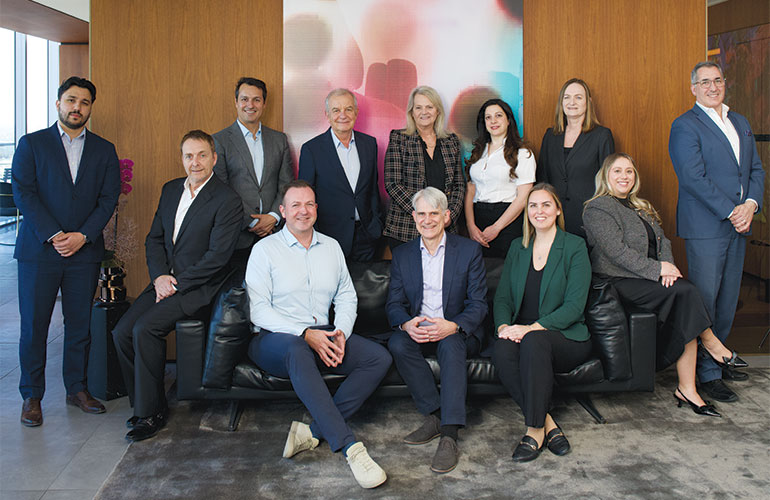
Photo: Picture Perfect The Great Gulf team includes, seated from left, Nigel Hollidge, managing director; Craig Mode, chief operating officer; Michael Sneyd, president, Resort Residential; Karen Bannister, senior vice president of marketing and communications; and Nicole Guadagnoli, senior development manager; Standing, from left, are Jonathan Hussain, senior financial analyst; Mark MacGregor, president, Low-Rise Homes; Tad Putyra, president and chief operating office, Low-Rise Construction; Kathleen Schofield, president, Low-Rise Residential; Lina Abbosh senior legal counsel; Jennifer Stade, senior marketing manager; and Peter Nikolakakos, executive vice president of development and planning. Courtesy photo.
The initial phase of the project, set for completion by 2028, includes 225 residential units, 32,000 square feet of retail and dining space, and the construction of The Crystal. Sales for Phase 1 residences are expected to begin in 2025, with prices catering to a wide range of buyers.
Planned capital investment projects on the mountain, totaling over $30 million for the next two seasons, include:
- A two-year, low-energy snowmaking investment with 1,000 new low-energy HKD snowmaking tower and fan guns. Approximately 500 new guns were installed at Killington and Pico prior to the current season, with the remainder to be installed this summer.
- Four new fully automated fan guns, to be installed at the bottom of the Superstar trail.
- Skyeship Gondola revitalization, comprising 116 new gondola cabins, expected to be installed this summer, and a new gondola storage barn in Northbrook, to be constructed in future years.
- Summer activities investments include mountain bike trail expansion.
- In addition, replacement of the Superstar Express Quad to a high-speed six-pack with installation of the lift, is scheduled to start this summer, with a completion date of December.
The $12 million project will require the Killington World Cup to relocate to Copper Mountain, Colorado, this year, providing a short-term hit to the region’s economy with the loss of 30,000 spectators that the event draws annually.
Moreover, the Killington World Cup Foundation raises over $600,000 annually from ticket sales to support local ski programs, infrastructure improvements, community development projects and winter sports access programs. Providing over $2 million in grants as of 2024, the foundation has served an estimated 45,000 children across 12 Northeast states since its inception.
The event is slated to return to Killington in 2026.

Mikaela Shiffrin takes selfies with fans at 2023 World Cup. Killington photo.
Subsequent phases of Live Killington will expand the village, adding up to 2,300 housing units over 25 years. Each phase will include new amenities, such as market gardens, Nordic spas, an amphitheater and enhanced trail systems, with the intention that the village will evolve with the needs of its community and visitors.
Michael Sneyd, president of the Resort Residential Division for Great Gulf, hails the project as “a once-in-a-lifetime opportunity to create the greatest ski village in the East.“
According to Sneyd, “Killington already has the best skiing, the best snowmaking and the best lifts in the region. Now, it’s time for it to have the best village — a destination that celebrates community, discovery and entertainment.“
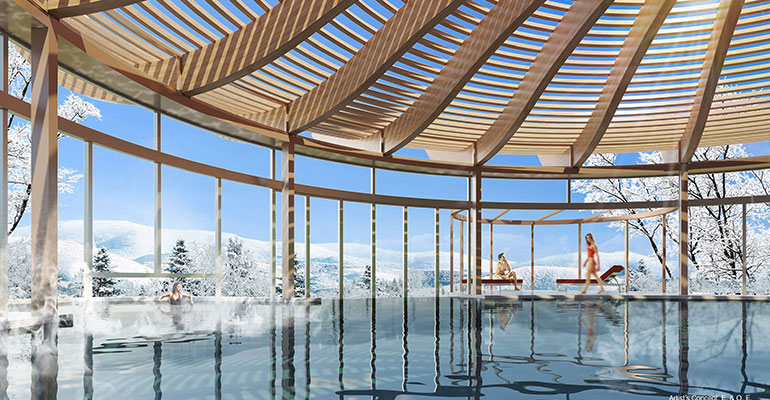
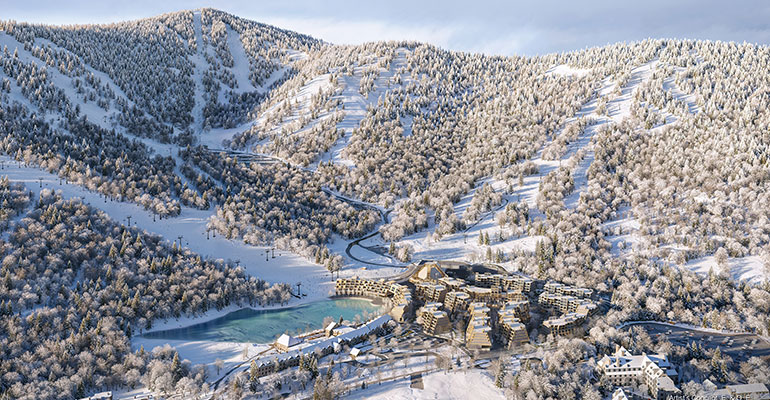
Photos: Artist renderings of Live Killington Village. Top photo, an aerial view of the development. Below, the pool at Killington resort. Renderings Courtesy Great Gulf.
Public-Private Collaboration
The Live Killington Village project leans on public-private collaboration with the town of Killington, which is instrumental to the project’s success while also bolstering town infrastructure. A significant hurdle for project development has been the extensive infrastructure improvements needed, which include new and safer roads, improvements to the municipal water system and support for worker housing.
The Killington Forward Initiative addresses these concerns through a diverse funding strategy. This initiative is supported by a tax increment financing district, the American Rescue Plan Act, the State Revolving Fund, a Vermont Catalyst grant, and a Community Recovery and Revitalization Program grant. Additionally, the initiative incorporates financing and loans from the U.S. Department of Agriculture’s Rural Development Program, which includes provisions for some forgivable loans.
The TIF district will channel increased property tax revenues from the Live Killington Village development to repay bonds used to finance the infrastructure improvements. In addition to the town, the investment group has skin in the game.
“If Great Gulf does not proceed with developing the units,“ the company said in a statement, “we will assume responsibility for paying the property tax revenue that was anticipated from those units. (However,) Killington Resort has no financial obligation under this arrangement.“
The collaboration has successfully secured a U.S. Department of Transportation Raise Grant, which will provide significant additional funding for essential projects, such as the construction of a new waterline. This new waterline will not only serve the new village but also replace an existing line that currently supplies water to residences, schools and businesses affected by polyfluoroalkyl substance contamination.
A key milestone was voter approval in 2022, which enabled the groundbreaking for Phase 1 the following year. Developers have set a target completion date of 2026 for this phase. Current work, as detailed on the town website, includes the construction of the water transmission line, storage tank, well house and pumping facilities.
“The cooperation we’ve experienced from the town of Killington, the Rutland region, the state of Vermont and federal agencies has been outstanding,“ said Sneyd. “This isn’t just about building luxury homes, it’s about laying the groundwork for a thriving, sustainable community that benefits everyone.“
In addition to financial collaboration, the project’s success hinges on community input. Public consultations have helped shape elements of the village to align with local values, while embracing forward-thinking design.
Vermont’s Act 250 land-use law adds another layer of collaboration, requiring developers to meet strict environmental and community standards. While a previous lodge design had gained Act 250 approval, changes to the plan require resubmission.
“We’re working through the designs right now to affect some of those changes. As soon as that’s done, we will come to the development review board here in Killington to get their approval,“ Sneyd said. “And then we need to get Act 250 approval. Fortunately, the agencies all know us, and we will absolutely do all of the background work. So, I’m hoping that we can have a relatively quick process.“
Workforce Housing: Meeting Community Needs
A cornerstone of the development’s success is addressing the region’s workforce housing challenges.
Great Gulf and Killington Resort recently pledged $700,000 to support the town’s efforts to develop 300 workforce housing units on a 70-acre site serviced by the new municipal water system. This initiative aligns with Killington Forward, which prioritizes affordable housing for workers who are critical for a thriving local economy.
The workforce housing project will feature a mix of multifamily apartments and single-family homes, providing secure and affordable living options for the employees who sustain the resort and surrounding businesses. The proximity to municipal services and green spaces further enhances the appeal of this housing development. Sneyd underscores the importance of this initiative.
“We recognize that the development of this project will require thousands of construction workers and hospitality staff. Providing secure, affordable housing is essential for sustaining the workforce and ensuring the long-term vitality of Killington,“ he said.
A Catalyst for Economic Growth
Beyond addressing immediate housing needs, the project also aims to ensure a lasting impact on the region’s labor market. The construction phase alone will generate an estimated 3,800 year-round jobs, providing a steady source of income for local contractors, suppliers and laborers for the next 25 years.
“That’s full employment for construction workers for a career,“ Sneyd said.
In addition to the immediate benefits of construction jobs and housing, the Live Killington Village project promises to deliver lasting economic impacts. It’s estimated that the development will create 1,200 permanent jobs, increase property values by $285 million over the next decade and significantly boost year-round tourism.
“Killington is celebrated as a destination for avid downhill skiers, mountain bikers and golfers, but it is less recognized for activities like Nordic skiing, snowshoeing, ice skating, family hikes or trail rides,“ said Sneyd.
But by expanding Killington’s appeal beyond its current offerings, the resort will attract more visitors in every season.
“We’re creating a vibrant, year-round destination that offers something for everyone,“ Sneyd asserted. “A working farm will support our farm-to-table dining experiences and animal husbandry programs, allowing families to engage in activities like watching cows being milked or gathering fresh eggs.“
He also noted plans for offering experiences such as tree canopy walks, outdoor spas, sleigh rides, skating paths, art installations, hiking and biking trail adventures, horse-drawn carriages and a new amphitheater.
“We’re designing experiences that enrich the community and provide families with endless opportunities to connect and explore, no matter the season,“ he said.
The project’s expected year-round positive economic effect is likely to extend beyond the resort. Local businesses along Killington Road stand to benefit from increased traffic and spending. Furthermore, by providing year-round employment opportunities, the development is positioned to offer a stable economic foundation for local families.
“The success of this village is deeply intertwined with the success of local retailers and restaurateurs,“ Sneyd said. “When we do well, they do well, creating a vibrant ecosystem that supports the entire region.“
In addition, through collaborations with local businesses, Great Gulf aims to ensure that the development complements and uplifts the existing community. One example is the partnership with Killington Mountain School.
“By investing in the education and development of young athletes, we’re reinforcing the values that make Vermont special,“ Sneyd said.
Sustainability and Innovation
Partnership with Killington Resort ensures that existing environmental initiatives are integrated into the new development. The resort’s sustainability practices extend to wastewater recycling and broader operations efforts, including the recent installation of low-energy snowmaking guns, which reduce both water and energy consumption.
“Killington has always been a leader in environmental best practices,“ said Sneyd. “We’re committed to enhancing that legacy with designs that honor Vermont’s natural beauty and minimize environmental impact.“
The new project incorporates sustainable building practices including geothermal heating and cooling, triple-pane windows, heat pumps and innovative water recycling systems. The village will also feature solar panels where feasible and rely on energy-efficient systems to minimize its carbon footprint.
In addition to infrastructural sustainability, the village design emphasizes connectivity and walkability. The pedestrian-only main street will eliminate vehicle emissions within the village core, while the planned network of hiking and biking trails offer sustainable alternatives to motorized transport.
Great Gulf’s partnership with PWP Landscape Architecture further enhances these efforts, with plans to create lush green spaces, market gardens and eco-friendly water features.
Looking ahead, Great Gulf plans to incorporate educational components into the village’s sustainability efforts.
“Sustainability isn’t just about building practices. It’s about fostering a culture of environmental responsibility,“ Sneyd said. He envisions activities like interactive farm-to-table experiences and environmental workshops that engage visitors and residents alike.
As Live Killington Village progresses, the goal is clear for Great Gulf and its partners to create a destination that sets a new standard for mountain living while preserving the spirit of Vermont.
“This isn’t just about building structures,“ Sneyd said. “It’s about building a legacy — one that future generations will enjoy and cherish."
Maia Segura is a freelance writer from southern Vermont.
To support vital journalism, access our archives and get unique features like our award-winning profiles, Book of Lists & Business-to-Business Directory, subscribe HERE!