Vermont Business Magazine The Vermont House of Representatives on Wednesday passed H.91, An act relating to the Vermont Homeless Emergency Assistance and Responsive Transition to Housing Program, legislation that reforms the emergency housing program away from a hotel/motel focused program to a prevention and supportive service-based model. The strong bi-partisan vote reflects months of hard work, deep collaboration amongst state and community partners, and thoughtful input from Vermonters. The bill calls for a $10 million appropriation. See fiscal details below.
In a statement, Speaker of the House Jill Krowinski and Representative Theresa Wood, Chair of the Committee on Human Services, highlighted the importance of the bill:
“The passage of H.91 is a huge step forward in moving our emergency housing program to a more cost effective, prevention-based program that some of our most vulnerable Vermonters desperately need,” said Speaker Jill Krowinski. “For years now, we have asked the Governor and his Administration for a plan to transition to a better system of care for Vermonters who did not have a roof over their heads. A plan never came.
“I could not be more thankful for Representative Thresa Wood’s leadership and members of the Human Services Committee who worked across the aisle to create a plan that will provide the support vulnerable Vermonters need and one that will save the state money in the long term.”
“This bill makes the transition to a community-based service system that can be creative, quick acting and responsive to the needs of people who are homeless and perhaps most importantly, focused on preventing homelessness,” said Representative Theresa Wood. “Critical decisions are best made in the community, closest to the people who are impacted.”
“Recently, Vermonters have heard many conflicting stories regarding what this program is and what it isn’t. This program exists to house our most vulnerable Vermonters: pregnant women, veterans, domestic violence victims, medically vulnerable individuals, and families with children,” said Speaker Jill Krowinski. “We as a state have a decision before us: do we believe in supporting our neighbors that need our help or are we ok with turning our backs on Vermonters that have no access to a roof over their heads? I, for one, believe this is an easy choice and I look forward to seeing how our colleagues in the Senate and the Governor and his Administration show up on this important issue.”
Vermont Legislative
Joint Fiscal Office
Fiscal Note
H.91 – An act relating to the Emergency Temporary Shelter Program
As Passed by the House of Representatives1i
Bill Summary
The bill proposes to establish the Vermont Homeless Emergency Assistance and Responsive Transition to Housing (VHEARTH) Program in the Department for Children and Families (DCF) to replace General Assistance (GA) emergency housing and the Housing Opportunity Grant Program (HOP).
Fiscal Summary
The bill would appropriate $10 million in one-time funds from the General Fund to DCF (Section 7). The bill does not propose any other changes to the Governor’s recommended fiscal year 2026 budget proposal as it pertains to GA emergency housing or HOP. However, provisions of the bill would have implications for the fiscal year 2027 budget.
The bill also expresses intent to use funds and resource previously attributed to GA emergency housing and HOP in fiscal year 2025, and any other identified funds, to fund the VHEARTH program in fiscal year 2027.
Background and Details
Currently, GA provides emergency housing to families who meet specific eligibility criteria. Outside of the period known as Adverse Weather Conditions (AWC), which lasts from December 1 to March 31, the program is limited to a maximum of 1,100 rooms with a cap of 80-days per household. There are no caps during AWC, but it may be limited by room availability.
HOP contains funding to operate or provide emergency overnight shelters, essential services to shelter guests, transitional housing where appropriate; rapid rehousing of homeless individuals and families, services to prevent individuals and families experiencing a housing crisis from becoming homeless, coordinated entry to streamline client access to resources, and the administration of the Homeless Management Information System (HMIS).2
The primary goals of the program are to:
• Decrease the number of individuals and families experiencing homelessness;
• Shorten the length of time people experience homelessness;
• Reduce the number of individuals and families returning to homelessness; and
• Prevent people from becoming homeless.
Fiscal Impact
Section 3 – Vermont Homeless Emergency Assistance and Responsive Transition to Housing Program (VHEARTH)
Section 3 expresses purpose language to replace the provision of emergency housing through GA and HOP and use the funds previously attributed to these programs, and any other identified State and federal monies, to fund VHEARTH.
VHEARTH would be established in DCF and be operated by community action agencies, in collaboration with other community partners, to the extent funds exist. The program would serve households that are experiencing homelessness or that are at risk of homelessness in the state by providing support services, and extreme weather event shelter or emergency shelter, either temporary or transitional. This would also include support services and shelters specific to households impacted by domestic and sexual violence. This section would take effect on July 1, 2026.
Section 4 – VHEARTH Implementation Advisory Committee
Section 4 would create the VHEARTH Implementation Advisory Committee to provide advice and recommendations to the DCF Commissioner and to the community action agencies regarding the design, implementation and transition of VHEARTH. The Committee would receive administrative, technical, and legal assistance from DCF and would consist of 19 members. Advisory committee members would be entitled to per diem and compensation expenses permitted under 32 V.S.A. § 1010 for not more than 12 meetings annually from monies appropriated to DCF. Per diems are estimated to be no more than $7,000 per year. The Committee would cease to exist on July 1, 2029.
Section 5 – Implementation Plan
On or before February 1, 2026, DCF in collaboration with community action agencies and in consultation with other the departments of the Agency of Human Services (AHS) and the VHEARTH Implementation Advisory Committee would be required to submit a plan for the implementation of VHEARTH to the legislative committees of jurisdiction that ensures maximum flexibility for the use of resources and streamlines process for program participants. The plan would include recommending funding allocations among the community action agencies and other providers, identifying any additional State and federal funding sources for the program, and anticipating challenges requiring legislative action.
Section 7 – Appropriations
Section 7 would appropriate $10 million in one-time funds from the General Fund to DCF for the following:
• $6.5 million for distribution to community action agencies and the statewide organization serving households impacted by domestic and sexual violence;
• $500,000 for contractual and other system transformation assistance; and
• $3 million for the continued development of shelter capacity in the state.
Section 8 – Future Appropriations; Legislative Intent
Section 8 provides legislative intent that in fiscal year 2027 and thereafter, equivalent funds and resources, base and one-time, used in fiscal year 2025 for GA emergency housing and HOP grants be redesignated for VHEARTH.
1 The Joint Fiscal Office (JFO) is a nonpartisan legislative office dedicated to producing unbiased fiscal analysis – this fiscal note is meant to provide information for legislative consideration, not to provide policy recommendations.
2 HOP Program Standards & Guidance, Department for Children and Families
The chart below shows the fiscal year 2025 Budget as enacted and the Governor’s recommended fiscal year 2026 budget proposal. It does not include any proposed changes included in H.489 (the fiscal year 2025 budget adjustment act). It also may not include all of the administrative costs associated with implementing these programs.
GA Emergency Housing and HOP:
FY 2025 Appropriated and FY 2026 Governor’s Budget Recommendation, Base & One-Time (x million)
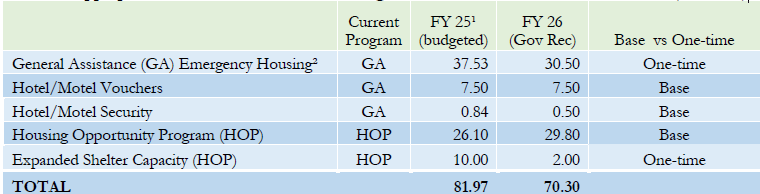
¹ This does not include any proposed changes included in H.489 (fiscal year 2025 Budget Adjustment) ² Includes funding for limited services positions at ESD in support of GA emergency housing
i The full fiscal note history is available on the fiscal tab of the bill page on the General Assembly website and can be pulled up through a bill number search on the JFO page.
Source: 4.3.2025. MONTPELIER, VT — Speaker of the House
To support vital journalism, access our archives and get unique features like our award-winning profiles, Book of Lists & Business-to-Business Directory, subscribe HERE!