A Weekly State House Recap
by Maggie Lenz and Nick Charyk on behalf of Atlas Government Affairs
Constitution v. Reality
On Friday, the House Education Committee voted 7–4 to advance H.454, the bill that has become the Legislature’s vehicle for a broad restructuring of Vermont’s education system. It lays out a multi-year consolidation of school districts, sets new minimum class sizes, and tightens the rules for which independent schools can receive public tuition. It also proposes changes to the State Board of Education, which approves independent schools and adopts many of the rules that give these reforms shape.
One section of the bill suggested rebalancing who sits on that board. What followed on Thursday was not a typical markup, but a six-hour seminar in constitutional law. Legislators were immersed in foundational questions about how government is structured in Vermont, who holds appointment power, and what the Constitution allows. The stakes were high, and so was the level of discourse. But in the end, it was not constitutional theory that determined the outcome. It was political reality.
The proposal to shift the Board’s composition originated in a separate bill, H.179, introduced by Rep. Kate McCann (D-Montpelier), a U-32 teacher and public education champion. Her bill would have eliminated the Governor’s majority appointment power and redistributed seats to legislative leaders and major education organizations, including the NEA, Principals’ Association, School Boards Association, Superintendents Association, and the Vermont Independent Schools Association. The Governor, the Speaker, and the Senate’s Committee on Committees would make the remaining appointments. The goal was to insulate the Board from executive control and ensure that it reflected the priorities of Vermont’s public education system.
The push to restructure the Board comes amid growing concern about public tuition dollars flowing to independent and religious schools. The State Board decides which schools are eligible to receive that funding. With more public money moving toward private institutions, lawmakers argue that the Board should be accountable to more than a single branch of government. The makeup of the Board, in their view, has become a proxy fight for a larger question: who sets the rules when public dollars leave the public system.
The committee turned to its legal counsel for guidance. Beth St. James, representing the Legislature, told members the proposal was likely constitutional. In a detailed memo prepared ahead of the hearing, she cited multiple sections of the Vermont Constitution to support that view. The most important, she said, was Chapter II, Section 20, which gives the Governor appointment power “except where provision is otherwise made by law.” Since the State Board was created by statute and its appointments are not constitutionally defined, the Legislature could reassign that authority through legislation.
“The Constitution is not a grant of power to the Legislature,” she said. “It is a limitation.” Unless the Constitution prohibits something or a court strikes it down, the Legislature can act. “You are the legislative branch, not the judicial branch,” she added. “It is only the judicial branch that can determine whether an action by one branch of government constitutes a usurpation of another’s constitutionally defined authority.” In her analysis, the Legislature’s power is “practically absolute.”
She also addressed concerns about separation of powers. Appointing members to a board does not mean the Legislature is executing the law. Once the appointments are made, the Legislature’s role ends. The Governor retains the power to remove Board members for cause, which she described as a meaningful check. She pointed to other state boards with non-gubernatorial appointments that exercise rulemaking authority and continue to function without challenge.
Later that day, Jaye Johnson, legal counsel to Governor Scott, presented a different view. Johnson argued that the State Board performs executive functions and should remain accountable to the executive. Reducing the Governor’s control, she said, would frustrate the Governor’s constitutional duty to faithfully execute the laws.
She raised procedural concerns as well. Under the Board’s rules, a quorum is a simple majority. Johnson warned that if most members were appointed by the Legislature or outside groups, they could form a quorum and act without any Governor-appointed members present. That, she said, could allow the Board to operate entirely outside the Governor’s oversight while still carrying out executive responsibilities.
Rep. McCann asked whether the issue was the act of making legislative appointments at all, or whether it only became unconstitutional if those appointees formed a majority. Johnson declined to draw a specific line. “I'm not here to discuss what the correct number is,” she said. She returned to structure. When the Legislature or its agents begin to govern rather than legislate, that, she said, is when the separation of powers is violated.
Chair Rep. Peter Conlon (D-Cornwall), who had earlier joked that he “enjoyed learning that the power of the Legislature is absolute,” acknowledged the seriousness of the argument. He noted that the Legislature is leading a major transformation in education policy and that wanting a voice in the makeup of the board that helps carry it out seemed reasonable. But he also recognized the political limits. One member called the original proposal “a veto waiting to happen.” Another described it as a “poison pill.”
Jaye Johnson spoke in constitutional terms. But for those listening closely, it was clear she was not just offering a legal interpretation. She was delivering a preemptive veto message. If the Legislature passed a bill that removed the Governor’s control over the Board, the Governor would veto it. There was no need to speculate. Her testimony made the consequences unmistakable.
And with the Legislature’s veto-proof majority now a thing of the past, committee members understood what that meant. They could pass a bill that tested the limits of constitutional structure, or they could pass a bill that stood a chance of becoming law.
They chose the latter. The revised version gives the Legislature two appointments: one by the Speaker of the House and one by the Senate’s Committee on Committees. The Governor keeps six. The Board expands slightly to preserve an executive majority. The student and non-voting members remain unchanged.
It was not the version many public school advocates had hoped for. But it was the version that might survive. A proposal rooted in big constitutional questions ultimately gave way to a familiar political calculation.
Curiosities: A Weekly Peek at the Odd and Intriguing Happenings Under the Golden Dome
His Roots are Showing
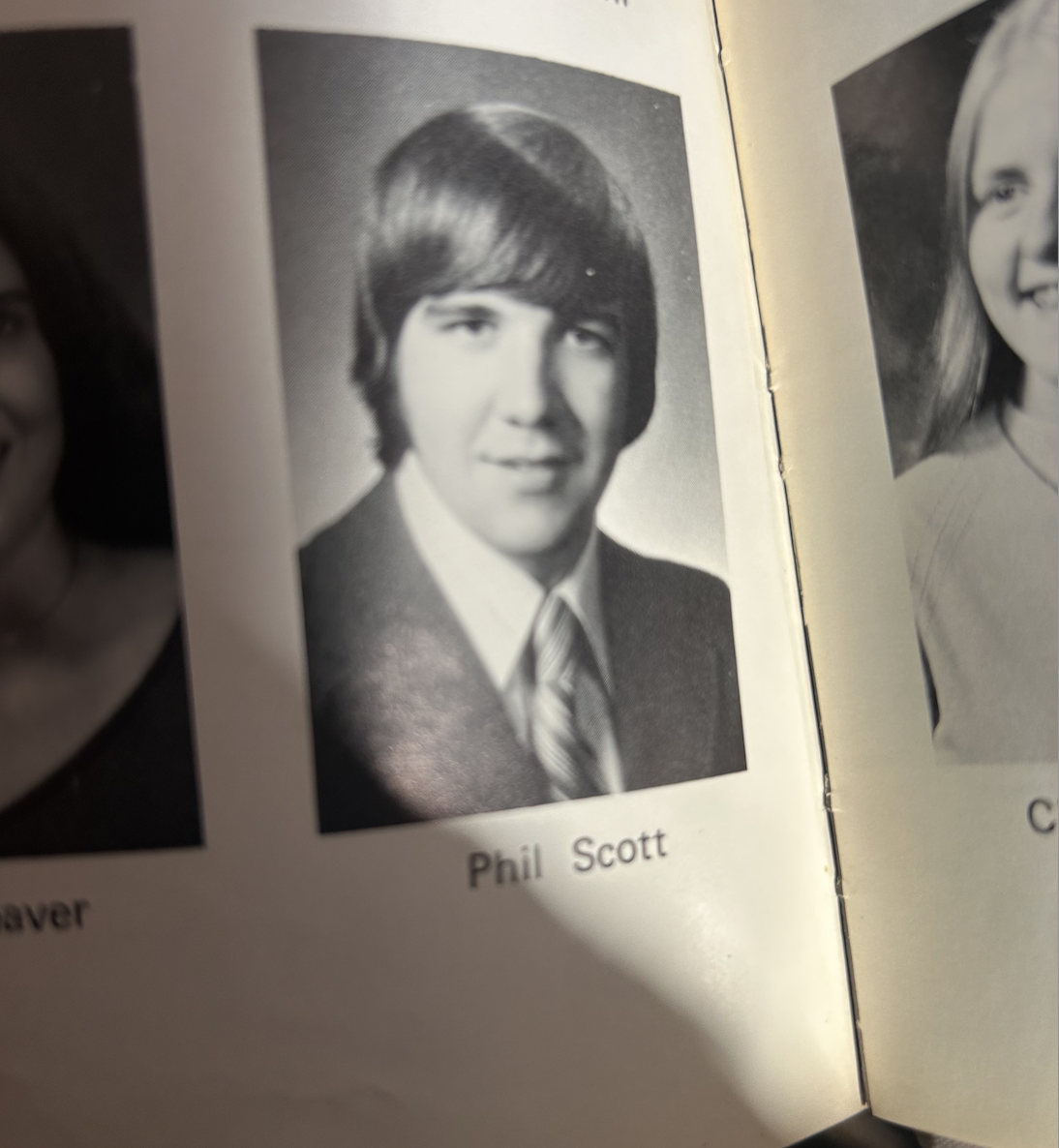
A regular reader recently shared a gift with us from their 1976 Spaulding High School yearbook. There, in full senior portrait form, is Phil Scott. No hard hat, no veto message, no comment. Just a kid from Barre in a tie with his hair doing what 1970s hair did.
Before the governor’s office and before Thunder Road, he was just another Spaulding student. He played sports, worked on cars, and for a brief stretch in the 1990s helped open a nightclub in Montpelier called Legends. Racing memorabilia on the walls, loud music, regulars who knew what they wanted to drink. Like most things in Vermont nightlife, it burned quick and bright and then faded into local lore.
Scott moved on, as most do. He returned to construction, then to public service. He has held statewide office for more than two decades, first as Lieutenant Governor and then, since 2017, as Governor. Along the way, he has cultivated a persona that hovers somewhere between public servant and reluctant ruler. He often says he never set out to be a politician, that he only ran to help. But after five statewide campaigns for Governor and more than a decade at the top of state government, it’s hard to say how reluctant he really is.
The governor appoints the boards. He holds the veto pen. He walks into a room and people stand. They clap. In Vermont, that is about as close as it gets to being treated like a king.
The yearbook photo doesn’t predict any of that. It shows a serious looking young man preparing for whatever comes next. It does not mention vetoes or transition memos or the quiet weight of executive authority. But it captures something else: a moment when the road ahead felt open.
Staring at this picture, you can almost hear the low thrum of Foghat on a cassette deck. (Side note: “Slow Ride” was recorded in 1975 at a mountaintop studio in Sharon, Vermont, and went on to become a road trip staple and a fixture in the background of slow-rolling teenage ambition.)
The windows are down, the volume is up, and Barre is fading in the rearview. The kid shifts into gear and heads north on Route 14.
To support vital journalism, access our archives and get unique features like our award-winning profiles, Book of Lists & Business-to-Business Directory, subscribe HERE!