Vermont Business Magazine Today, House Speaker Jill Krowinski and Representative Marc Mihaly, Chair of the House Committee on General & Housing, issued the following statement following the tri-partisan vote to pass H.479, an act relating to housing. The bill now moves on to the Senate for consideration.
See detail below.
“Vermonters across the state are feeling the impact of the housing crisis in their communities, and while I am proud of the hundreds of millions of dollars in housing investments and the modernization of our Act 250 laws, H.479 will truly make a meaningful impact in creating much needed housing,” said House Speaker Jill Krowinski. “Housing is by far the biggest need I hear from Vermonters - each and every day. Whether it’s the need for units for those that are unhoused, for people moving to or trying to stay in Vermont, or homes for working Vermont families, the need is great and impacts all 14 counties. The shortage creates a cascade of interconnected challenges, like workforce and childcare shortages, that prevent Vermont communities and our economy from thriving.”
“We have a housing emergency in the state—there’s not enough and what’s available is beyond the reach of most Vermonters. This absence of affordable housing makes it hard for companies, schools and local governments to find new employees,” said Representative Marc Mihaly, Chair of the House Committee on General & Housing. “It contributes to our homeless problem. New young people and families cannot come into the state for lack of housing, exacerbating the cost of our health insurance and school financing problems.”
“The House omnibus housing bill addresses these issues.”
The House omnibus housing bill addresses many of the issues facing communities in all 14- counties.
Key elements of the legislation include:
- Reforms the appeals process to ensure that those who challenge housing appeals have to show specific harm to their personal interests and demonstrate that the proposed housing violates the applicable zoning laws.
- A program in the Vermont Bond Bank to ensure that funds flow to housing-related infrastructure such as roads, water, sewer and sceptic.
- Measures to move forward promotion of prefabricated modular housing and assistance to mobile home parks and owners.
- Significant appropriations to the Vermont Housing and Conservation Board to help buy down the cost of rental and homeowner housing to a level that lower income and middle-income Vermonters can afford.
- Significant funding of programs in the Vermont Housing Finance Agency to help landlords fund rehabilitation of dilapidated apartments so they become available to renters, to help developers reduce the cost of rental housing to levels most Vermonters can afford, and to promote homeownership among first-time and first-generation homebuyers.
“I look forward to continuing the work to create healthy, safe, equitable, and affordable housing solutions for all Vermonters,” said Speaker Krowinski. “The housing crisis has been an incredibly difficult time for Vermonters and businesses, but I am optimistic that with the previous investments and legislation passed, this bill will add on to the progress we’ve made and make Vermont a place that is affordable for renters and homeowners alike.”
Joint Fiscal Office
H.479 – An act relating to housing
As recommended by the House Committee on Ways and Means, 3.20.2025
Bill Summary
his bill would fund and modify existing programs, create new ones, and establish various policy directives aimed at increasing the supply, affordability, and accessibility of housing in Vermont.
Fiscal Summary
The bill’s total fiscal year 2026 cost is $71,846,500. Of that, $71,596,500 is for appropriations for new and existing housing programs, staff positions, and studies. The remaining $250,000 would cover the fiscal year 2026 cost of the affordable housing tax credit used to fund the First-Generation Homebuyer Program.
While this bill would reauthorize Down Payment Assistance Program tax credits and newly authorize First-Generation Homebuyer Program tax credits, the $250,000 cost of affordable housing tax credits in fiscal year 2026 results solely from the latter. Fiscal year 2026 tax credit allocations for the Down Payment Assistance Program were previously authorized and are not a new expense in this bill. New costs from the bill’s five-year reauthorization of the Down Payment Assistance Program tax credit would begin in fiscal year 2027.
Background and Details
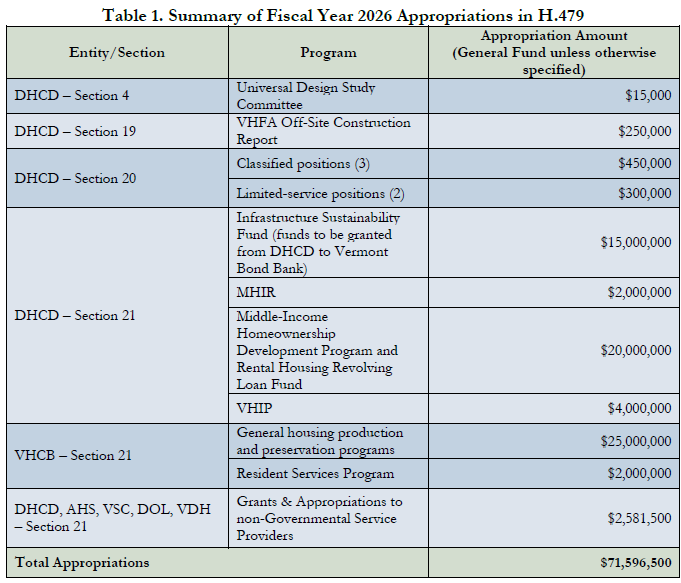
This bill appropriates $71,596,500 for State housing programs in fiscal year 2026. These appropriations include:
- The creation of a new Vermont Infrastructure Sustainability Fund within the Vermont Bond Bank;
- The continuation of various existing programs;
- Five State positions to support housing programs;
- One-time grants to housing service providers outside of State government; and
- Studies of new strategies to increase housing supply and affordability.
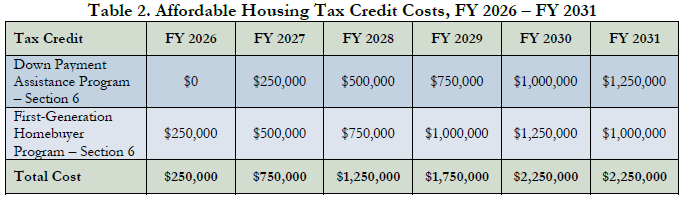
The bill as recommended also proposes to authorize the First-Generation Homebuyer tax credit for fiscal years 2026 through 2030 and reauthorize the Down Payment Assistance tax credit for fiscal years 2027 through 2031. As introduced, the bill would have authorized the First-Generation Homebuyer tax credit indefinitely.
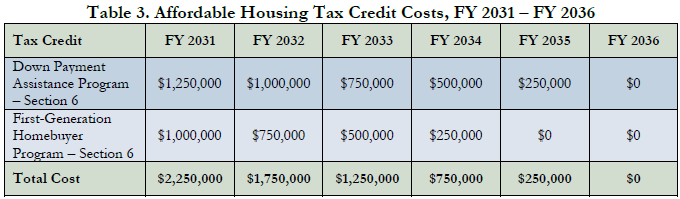
The total cost of both credits is $250,000 in fiscal year 2026. The total cost of the credits increases by $500,000 each fiscal year until it reaches $2,250,000 in fiscal years 2030 and 2031 (see Table 2). The total cost then declines to $0 by fiscal year 2036 as previously-awarded credits – which are claimed in equal increments over five years – are retired without replacement (see Table 3 on the following page).
Descriptions of Appropriations and Other Provisions with a Fiscal Impact
Universal Design Study Committee
Section 4 appropriates $15,000 from the General Fund to the Department of Housing and Community Development (DHCD) in fiscal year 2026 for a Residential Universal Design Study Committee to explore the implementation of statewide universal design standards for all residential buildings. This appropriation would cover per diems and expense reimbursements for Committee members.
Affordable Housing Tax Credits
Section 6 authorizes two affordable housing tax credit programs administered by the Vermont Housing Finance Agency (VHFA): the Down Payment Assistance Program and the First-Generation Homebuyer Program.
Authorization for the Down Payment Assistance Program tax credit currently expires at the end of fiscal year 2026. The bill would extend this credit through fiscal year 2031. Because the program was set to expire in fiscal year 2026, all credits awarded beginning in fiscal year 2027 represent a new fiscal cost to the State in the form of forgone revenue.
The bill would also fund the First-Generation Homebuyer Program through a five-year authorization of the First-Generation Homebuyer tax credit. Since VHFA was not previously authorized to award this credit in fiscal year 2026 or beyond, this represents a new cost to the State in the form of forgone revenue. As recommended, authorization for the issuance of new First-Generation Homebuyer Program tax credits would sunset on July 1, 2030 (see Tables 2 and 3).
VHFA Off-Site Construction Report
Section 19 appropriates $250,000 in fiscal year 2026 from the General Fund to DHCD for a grant to VHFA to further develop recommendations from the 2025 “Opportunities to Utilize Off-Site Construction to Meet Vermont’s Housing, Workforce and Climate Goals” report. The bill would require VHFA to submit an interim report to the House Committee on General and Housing and the Senate Committee on Economic Development, Housing and General Affairs by January 15, 2026 and a final report by December 15, 2026.
New Full-time Classified Positions at DHCD
Section 20 appropriates $450,000 in fiscal year 2026 from the General Fund to DHCD for the creation of three full-time, classified positions. Of these, two positions would support the administration of the Vermont Rental Housing Improvement Program (VHIP) and one would support the Manufactured Home Improvement and Repair Program (MHIR).
Extension of Limited-Service Positions at DHCD
Section 20 also appropriates $300,000 from the General Fund to DHCD in fiscal year 2026 to fund two existing limited-service positions in fiscal year 2026.
One position provides technical assistance to municipalities, nonprofit organizations, and private developers in developing infill and middle-income housing through the Homes for All initiative. The other position coordinates funding for distribution among State entities and oversees housing data collection and analysis to ensure the efficient use of Homes for All funds.
DHCD Programs
Section 21 appropriates $15 million to DHCD from the General Fund in fiscal year 2026 for a grant to the Vermont Bond Bank to implement the Vermont Infrastructure Sustainability Fund.
Section 21 also appropriates $26 million to DHCD from the General Fund in fiscal year 2026 for existing programs:
- $20 million for a grant to VHFA for the Middle-Income Homeownership Development Program and the Rental Housing Revolving Loan Fund;
- $4 million for the Vermont Rental Housing Improvement Program (VHIP); and
- $2 million for the Manufactured Home Improvement and Repair Program.
Vermont Housing and Conservation Board (VHCB) Appropriation
Section 21 appropriates $27 million to VHCB from the General Fund in fiscal year 2026. Of that appropriation, $25 million is to provide support and enhance capacity for the production and preservation of affordable mixed-income rental housing and homeownership units and $2 million is to implement the Resident Services Program established in Section 88 of Act 181 (2024).
Grants to Non-Governmental Housing Service Providers
Section 21 appropriates $2,581,500 from the General Fund in fiscal year 2026 to various State entities for grants to non-governmental housing service providers and to the Vermont State Colleges. These appropriations are:
- •$500,000 to DHCD to grant to five NeighborWorks America-affiliated homeownership centers for the purpose of providing homebuyer education, financial literacy counseling, and foreclosure prevention programs;
- $235,000 to DHCD to grant to HomeShare Vermont for the purpose of funding case management positions and an intake coordinator;
- $400,000 to the Agency of Human Services (AHS) to grant to Cathedral Square to continue the Support and Services at Home (SASH) for All pilot program;
- $373,000 to the Vermont State Colleges (VSC) for new apprenticeships, curriculum development, employer partnerships, and faculty training in the field of heating, ventilation, and air conditioning (HVAC);
- $448,500 to the Department of Labor (DOL) for a three-year grant to the Associated General Contractors of Vermont to promote and expand training and certification programs for the construction and building trades; and
- $300,000 to the Department of Health (VDH) for recovery residences certified by the Vermont Alliance for Recovery Residences, including at least three new certified recovery residences; and
- $325,000 for first month fees for individuals entering a certified recovery residence in Vermont.
As recommended by the House Committee on Appropriations. 3.25.2025
Bill Summary
This bill pertains to various programs aimed at increasing the supply, affordability, and accessibility of housing in Vermont. The House Committee on Appropriations recommends deletion of several sections that proposed appropriations, positions, and tax credits with impact to the General Fund, consistent with the Committee’s typical practice of reflecting these subjects within the fiscal year 2026 appropriations act.
Fiscal Summary
The following sections of H.479, as recommended by the House Committee on Appropriations, would have fiscal impacts:
• Section 4 would authorize the creation of a Residential Universal Design Study Committee, with per diems and expense reimbursement for Committee members being contingent on an appropriation being made to the Department of Housing and Community Development (DHCD) for this purpose.
• Section 19 would require the completion of a report by the Vermont Housing Finance Agency (VHFA) regarding the use of off-site construction to meet Vermont’s housing goals. The bill as recommended by the House Committee on Appropriations makes DHCD’s implementation of this provision contingent on receiving an appropriation in fiscal year 2026.
Background and Details
As recommended by the House Committee on Appropriations, the following sections of the bill would have a fiscal impact:
Section 4: Residential Universal Design Study Committee Section 4 would create a Residential Universal Design Study Committee to explore implementation of statewide universal design standards for all residential buildings. “Universal design” refers broadly to design practices that make built environments usable by people of different ages, abilities, and physical or cognitive characteristics without additional customization. The bill as introduced would appropriate $15,000 from the General Fund to DHCD in fiscal year 2026 for per diems and expense reimbursements for Committee members.
The House Committee on Appropriations recommends deleting the $15,000 appropriation from the bill and inserting language stating that funds for per diems are contingent on a fiscal year 2026 appropriation from the General Fund to DHCD for this purpose.
Section 19: VHFA Off-Site Construction Report
As introduced, Section 19 of the bill would appropriate $250,000 in fiscal year 2026 from the General Fund to DHCD for a grant to VHFA to further develop recommendations from the 2025 “Opportunities to Utilize Off-Site Construction to Meet Vermont’s Housing, Workforce and Climate Goals” report. VHFA would be required to submit an interim report to the House Committee on General and Housing and the Senate Committee on Economic Development, Housing and General Affairs by January 15, 2026 and a final report by December 15, 2026.
The House Committee on Appropriations recommends deleting the appropriation and inserting language stating that DHCD’s duties under Section 19 are contingent on an appropriation from the General Fund in fiscal year 2026 for this purpose.
The bill as originally introduced by the House Committee on General and Housing can be found here. The full fiscal note history is available on the fiscal tab of the bill page on the General Assembly website and can be accessed through a bill number search on the JFO page.
The Joint Fiscal Office (JFO) is a nonpartisan legislative office dedicated to producing unbiased fiscal analysis – this fiscal note is meant to provide information for legislative consideration, not to provide policy recommendations.
Source: 3.27.2025. Montpelier, Vt. – Office of the Speaker
To support vital journalism, access our archives and get unique features like our award-winning profiles, Book of Lists & Business-to-Business Directory, subscribe HERE!