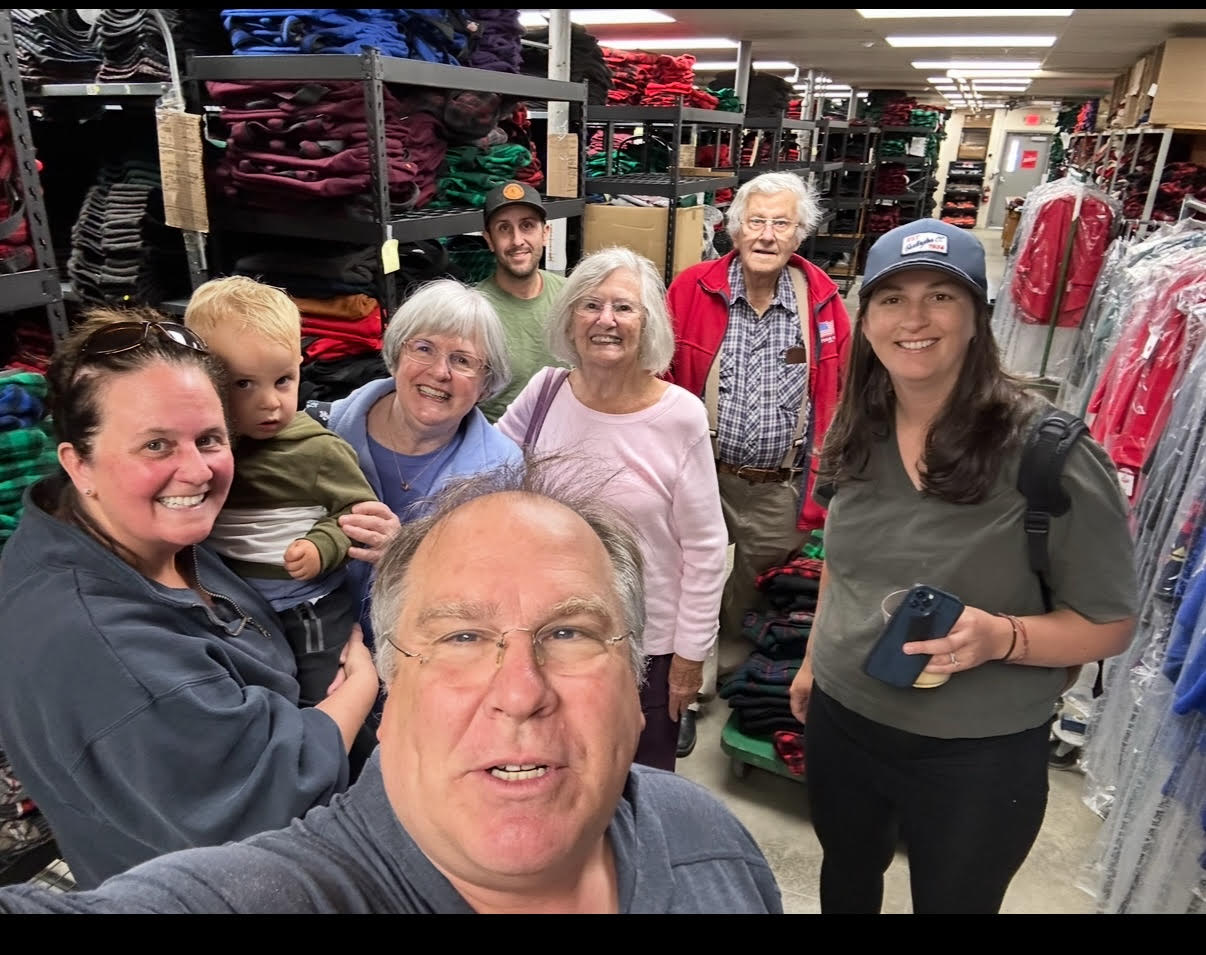
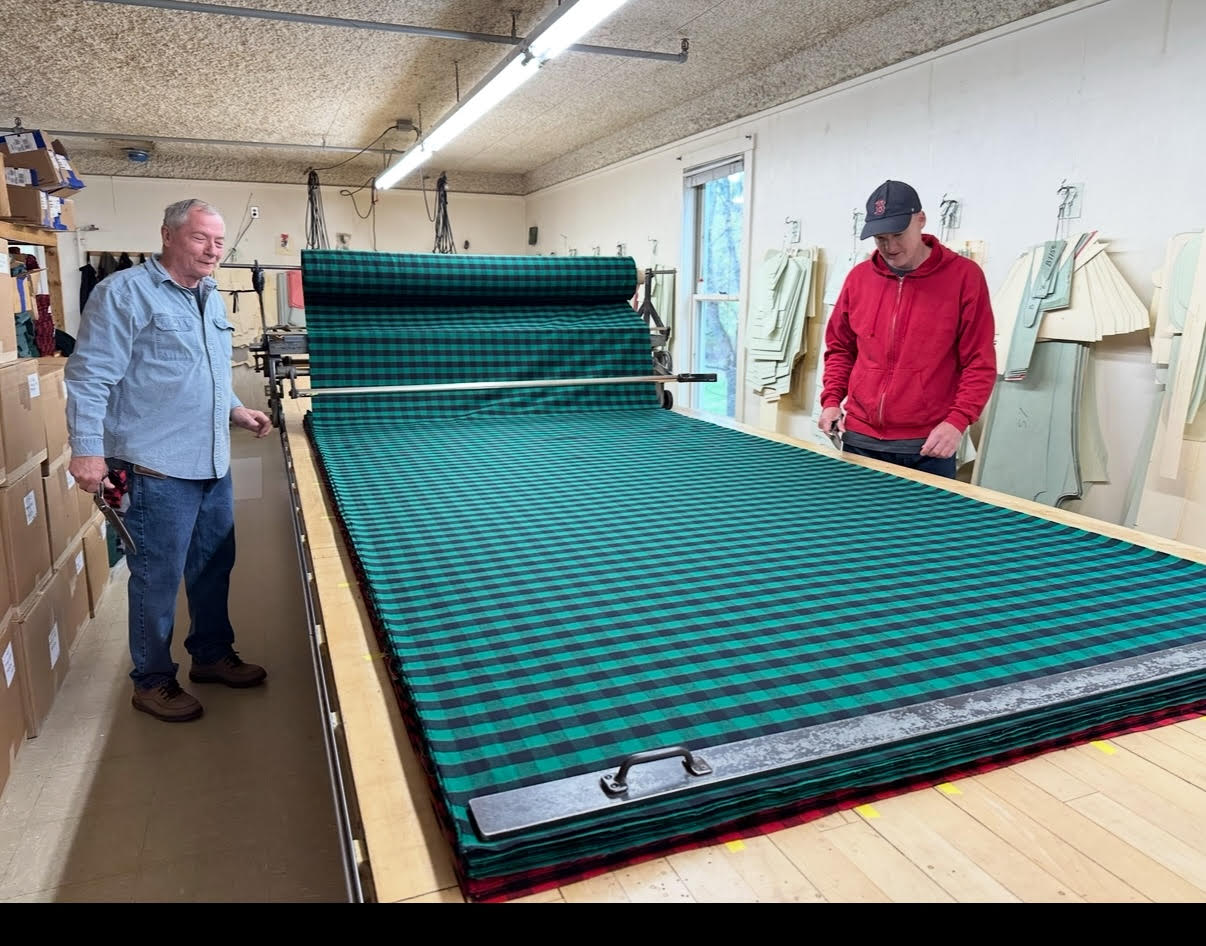
Gene Richards with staff. Courtesy Johnson Woolen Mills
Owner of Johnson Woolen Mill renovating 1842 mill, MSI moves forward with permitting for new industrial park. Keeping Johnson Woolen Mills open.
by Olga Peters, Vermont Business Magazine Gene Richards is proud of the products Johnson Woolen Mills produces and its long-standing role in Johnson. He says he didn’t buy the mill in 2023 to get rich.
“I am a Vermonter, and kind of a stubborn one at that,“ he said. “I’m just going to do everything in my power to make sure (the company) is around another 100 years. I bought it so that this way of life remains here in Vermont, owned by Vermonters, and I really believe in everything Vermont.“
Textile mills were once plentiful in the U.S., but since the 1990s most have closed or moved overseas in search of lower labor costs.
Johnson Woolen Mills, which opened its doors in 1842, shifted to clothing production in the early 20th century and became famous for its spruce green wool pants and Jac shirts. Richards purchased the company in 2023 as part of an ownership group that includes his wife, Julie; the couple’s two sons and their partners; and longtime business associate Erin Desautels.
Under Richards’ ownership, Johnson Woolen Mills has added more items through its Northwoods X 1842 product line, a collaboration between JWM and the Northwoods Whitetails, a Vermont hunting group.
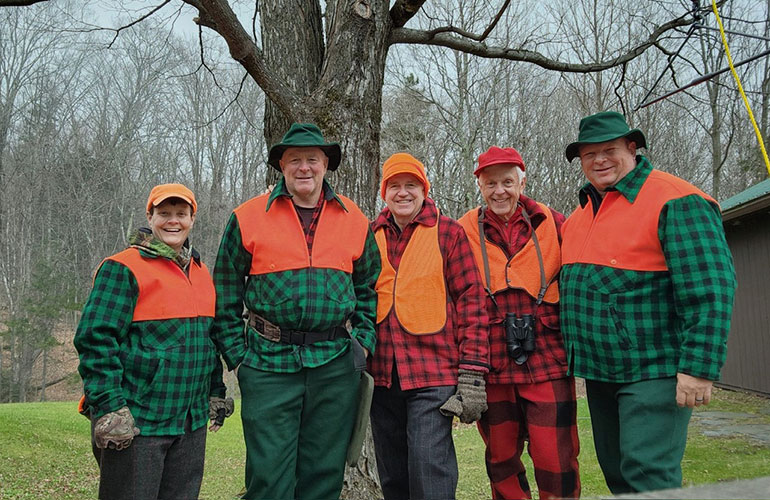
Photo: Johnson Woolen Mills. Courtesy photo.
Richards and his family have made substantial improvements to the company’s operations. They have renovated the retail store, redesigned the website and rebuilt the inventory system from the ground up.
In Richards’ opinion, paying salaries that help workers live and thrive in Vermont is crucial to the company’s prosperity.
“So we have worked on that, and we’ve given increases in salary,“ he said. “We are trying to understand our inventory and what sells and what doesn’t.“
The business is also diversifying with the goal of increasing the company’s economic resilience. This diversification includes the recent purchase of Vermont Bosna Cutting in Winooski. Currently, JWM and VBC employ 35 people, an increase from the 13 workers employed at the Woolen Mill when Richards took over. Richards is also in the process of redeveloping the older 1875 Johnson mill, located nearby, into five short-term rentals and a restaurant.
“That the whole community can come and celebrate on the Gihon River,“ he said. “We really believe that the Gihon is our gift and not a curse.“
Johnson sits on the banks of the Gihon and Lamoille rivers.
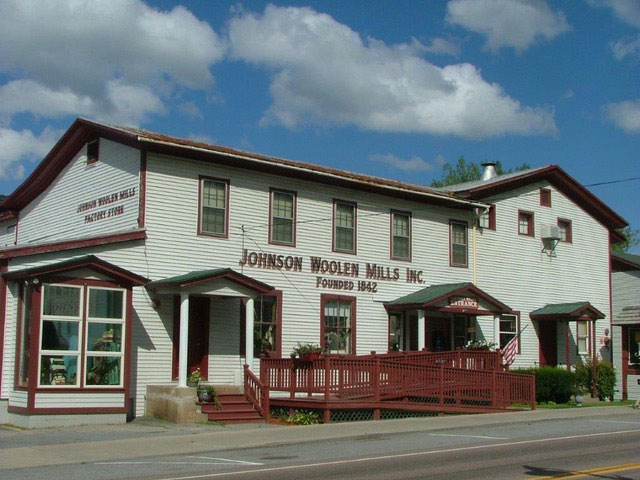
Photo: Johnson Woolen Mills. Courtesy photo.
Richards plans to have the 1875 mill building rehab completed by the summer or early autumn. The building was in severe disrepair. Contractors have completed flood mitigation work in the building’s former wool washing and dyeing area, which sits at river level. The new concrete floor is pitched 5 inches from back to front to allow for water drainage, and the walls have been treated with materials similar to those used in swimming pools.
Earlier in his career, Richards worked in banking, real estate and served for nine years as the director of aviation at Leahy Burlington International Airport. In 2012, Burlington Mayor Miro Weinberger appointed Richards to the post at a time when the airport had reached junk bond status.
Richards says he helped turn the airport around and brought in companies like Beta Technologies and the Skinny Pancake. He credits the people he worked with, “who were 10 times smarter than me,“ with spurring the airport’s success.
“I loved that job, it was great up until the last day,“ he said.
In 2021, Richards was fired from the job after employees alleged he engaged in verbal abuse. Richards disputes the complaints, calling them untrue and pointing to the airport’s continued success as proof of a job well done.
As much as Richards enjoyed working at the airport, he has left 2021 behind and is focused on keeping Johnson Woolen Mills in Vermont. He said the community can look forward to more merino wool products coming out of Winooski in the fall. A new line of women’s clothing and a collaboration with Eighteen East, a New York City-based clothing line, are also on the horizon.
“I love this job,“ he said of Johnson Woolen Mills. “And I love my people here.“
In newspaper coverage of Richards’ purchasing of Johnson Woolen Mills, employees have spoken positively about Richards.
“I don’t look for the quick buck. I look for the right fit. And in Johnson, there’s just so many possibilities,“ Richards said. “I can’t tell you how much I love walking through our factory and listening to the women and the men laugh. It’s turning into something really special.“
Creating Space for Future Businesses
Morristown may soon add a new light manufacturing park to its ranks. The municipality and its incorporated village, Morrisville, is the largest town in Lamoille County, by population, and home to several well-known businesses, including Copley Hospital, Concept2, Turtle Fur, Butternut Mountain Farm, Hearthstone and Manufacturing Solutions Inc.
MSI CEO Garret Hirchak and his wife, Beth Slavas, who serves as president of the company, are developing an industrial park at 2322 Laporte Road, across from the Morrisville-Stowe State Airport. The 89-acre site, zoned industrial, will support 25 lots with water and wastewater systems and can accommodate 1,800 employees.
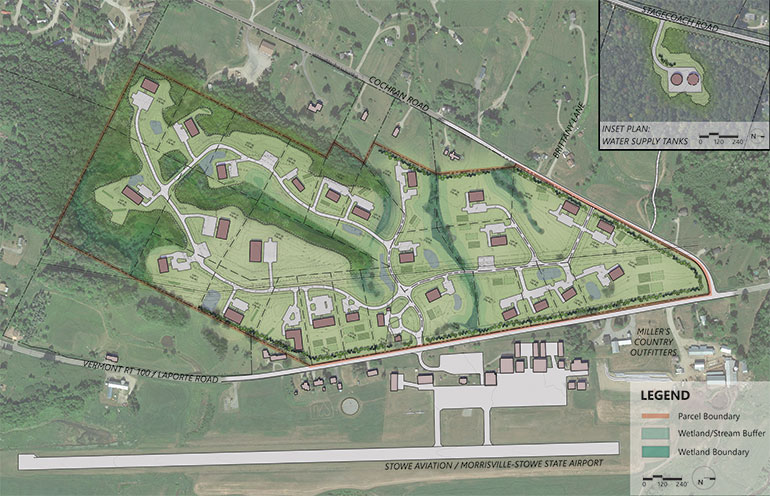
Photo: Map showing the site of MSI’s development of an industrial park across from the Morrisville-Stowe State Airport. Courtesy photo.
“It’s exciting,“ Hirchak said. “I think, big picture, it is good for the town. There’s really nothing else available in Lamoille County that’s suitable for investment in that kind of infrastructure.“
A friend of Hirchak, attorney James R. Dean Mahoney, jumps in to make a point. “He makes it sound easy and a no-brainer — and it’s neither. I’ve represented Garrett and Beth since ’95, so I’ve seen this movie. This is what true entrepreneurs do, and they do it at really significant risk.“
The future industrial area, estimated to cost $6 million to $8 million to complete, is two years into the permitting process. MSI has conducted a 72-hour well test, environmental reviews and archeological assessments as part of the work.
According to Mahoney, the park’s water system alone is subject to three permits.
MSI drilled a well to test its water system’s potential and then performed a 72-hour pump-down test. Engineers pumped the well continuously for 72 hours at maximum capacity. They measured the test well to see if water levels had dropped. They also checked the water levels in volunteer wells within a 2,500-foot radius.
So far, the project has obtained six permits. An Act 250 hearing is scheduled for February.
The entire property that MSI purchased totals 429 acres. The industrial portion is zoned light industrial, and the remaining 340 acres are zoned rural residential and agricultural. MSI has no plans for the land outside the industrial area beyond maintaining an existing forestry plan. Approximately 200 acres may qualify for conservation.
The municipality zoned the property light industrial approximately a decade ago.
MSI provides contract manufacturing, assembly, fabrication and shipping services for companies such as Concept2. Hirchak and Salvas founded the company three decades ago. They also operate a commercial real estate company, Sunrise Development, which owns more than 30 commercial properties in northern Vermont and has more than 100 commercial tenants, Mahoney said.
In Mahoney’s opinion, if Lamoille County wants to continue to grow and attract new residents, it needs shovel-ready projects to meet the needs of entrepreneurs.
In documentation related to its Act 250 permit, Mahoney noted that the Lamoille Economic Development Corp. has identified the lack of shovel-ready land suitable for industrial use as an “impediment to the region reaching its full economic development potential.“
But some community members have raised concerns about the project’s long-term impacts on the town.
For example, a 2023 Morristown Development Review Board meeting was standing-room only. The board voted to allow MSI to level a 12-foot knoll on the park property and sell any resulting gravel. News articles outline how audience comments moved beyond the immediate issue of the knoll to larger concerns about too much development happening too fast.
Community members have expressed concern about water issues and the potential for a large influx of new residents.
Hirchak reminded community members that the project must meet state specifications.
“We’re not just going to wing it,“ Hirchak said. “We’re working to a (state) standard that’s in place. So maybe there’s not an understanding of the rigor that we’re trying to fit this project into.“
Mahoney pointed out that the industrial park project aligns with the goals listed in the regional Comprehensive Economic Development Strategy and Morristown plans.
If Hirchak could change anything about the permitting process, he’d like the Act 250 requirements to have “crisper edges.“ Sometimes, the requirements are unclear as to what MSI needs to achieve to meet them.
“I’m infinitely proud of the fact that if this gets pulled off, it will be with private money and not the government’s,“ he said. “I think private industry can do things quicker, less expensively and just as well, if not better, than the government in many circumstances.“
So, what makes getting the industrial park off the ground worth it?
“That’s the entrepreneur mindset,“ Mahoney said. “We’ve had some really important entrepreneurs in this county over the last 30 to 40 years, and Garrett is officially one of those guys.“
The Lamoille Economic Development Corp. is supporting the town of Johnson in creating a light industrial park, which has received partial funding through the Northern Border Regional Commission, A federal-state partnership for economic and community development within the most distressed counties of Maine, New Hampshire, Vermont and New York.
“Right now, we’re in the pre-permitting planning stages, but we expect over the next year or two for that to be an impact project in that town,“ LEDC Executive Director Patrick Ripley said.
Ripley explained that the town owns the property and is planning to add infrastructure such as a road, sewer, water, and internet, which is crucial to attracting businesses.
“I think people are recognizing that municipal infrastructure is important to economic development,“ he said. “There’s more applications for those kinds of products because of the awareness around Vermont that having access to sewer and water are big things.“
Olga Peters is a freelance writer in southern Vermont.
To support vital journalism, access our archives and get unique features like our award-winning profiles, Book of Lists & Business-to-Business Directory, subscribe HERE!