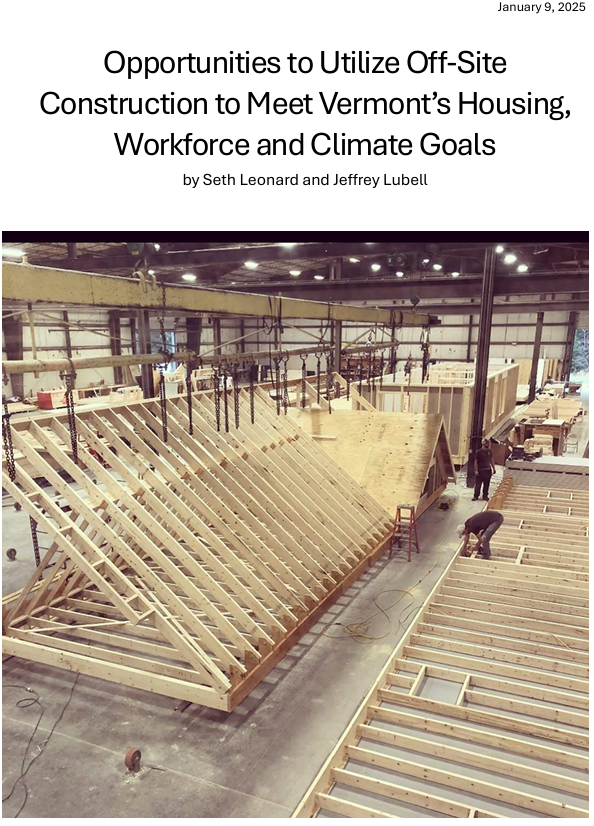
Vermont Business Magazine The Vermont Housing Finance Agency (VHFA), the Vermont Economic Development Authority (VEDA), and the Vermont Agency of Commerce and Community Development (ACCD) are announcing the results of a new study they jointly commissioned that examines the potential of off-site home construction. Off-site construction homes are built in factories, shipped, and assembled at the housing site by the manufacturer. Opportunities to Utilize Off-Site Construction to Meet Vermont’s Housing, Workforce and Climate Goals reviewed whether off-site construction could produce homes quickly at a cost competitive with traditional on-site homebuilding.
“Manufactured and modular homes are high quality and cost less than on-site construction, bringing down the price and allowing more renters to become first-time homebuyers,” says VHFA Executive Director Maura Collins. “Innovating the building process is one way to slow the growth in the cost of housing development.”
Vermont’s housing issues are well-documented. There are not enough homes for sale or rent at any price point to meet current or future demand. According to the Housing Needs Assessment, Vermont needs to create between 24,000 and 36,000 new homes by 2029. While further assessment is needed, prefabricated homes may help expand the capacity of a constrained construction industry in Vermont.
“At VEDA we help finance Vermont’s future, and the future requires building more housing faster than we are today,” says Cassie Polhemus, VEDA CEO. “In addition to providing Vermonters with a place to live, investing in off-site construction could also result in job creation, growth of the construction industry, and enhancing the state’s economy.”
The report also identified current limitations in manufacturing capacity and the state’s workforce that would hamper efforts to grow the use of off-site construction in Vermont. Building a new off-site construction factory could take millions of dollars in investment. Demographics are also a challenge. Growing the off-site construction industry could be difficult as the number of working-age Vermonters continues to shrink.
“This report represents the beginning of a conversation looking for wholistic, creative approaches to increase supply and lower costs as we tackle our decades-in-the-making housing problem,” says Alex Farrell, Commissioner of the Department of Housing and Community Development which is within ACCD. “We are grateful to our statewide partners for the collaborative approach we are taking to study innovative ideas and determine if they are a good fit for Vermont.”
In the meantime, there are other efforts underway to expand the availability of housing in Vermont. In addition to its typical funding, as part of the HOME Act of 2023 (Act 47), VHFA funded over 400 for-sale and rented homes targeted to middle-income households who don’t qualify for traditional affordable programs.
There have also been regulatory changes that make it easier to build all types of homes.
The Vermont Housing Improvement Program and Manufactured Home Improvement and Repair program rehabilitate and repair homes so Vermonters can stay in them. The Homes For All initiative is empowering small-scale developers to add right-sized housing units that match the character of our downtowns and village centers. ACCD will work this legislative session to reinforce that success and add even more tools to the toolbox, including increasing access to water and sewer to service future homes.
There are three volumetric modular factories in New England that produce residential housing. One is in Vermont, and a second is in nearby Claremont, NH. There are also volumetric modular plants in Maine and Quebec capable of delivering homes to Vermont.
A number of additional Vermont facilities produce panels or kits that can be assembled onsite to produce Accessory Dwelling Units or other structures. A survey and interviews with these manufacturers indicate that manufacturers are generally optimistic about the future of off-site construction in the region. The research also identified challenges and opportunities associated with expanding the use of off-site construction in Vermont.
One challenge is the cyclicality of the housing market, which makes it risky for manufacturers to expand their operations. An opportunity is the possibility to achieve greater economies of scale through bulk purchases of large numbers of homes using a standardized design.
One interviewee also discussed the potential to restart operations at a former manufactured housing facility in Fair Haven to increase the state’s off-site construction capacity.
The increased use of off-site construction in Vermont could produce a number of benefits:
• Cost Savings: Off-site construction helps to shorten project timelines, allowing projects to generate sales or rental revenue more quickly than site-built housing. Further cost savings could be achieved from the bulk purchase of a large volume of modular or manufactured homes utilizing a simple, repeatable design, which allow design and engineering costs to be shared across homes and production lines to be optimized to achieve economies of scale.
• Workforce development. Starting or expanding off-site construction facilities in Vermont could lead to the creation of well-paying year-round jobs in Vermont. These jobs would make it easier to recruit and retain skilled workers.
• Mitigate Labor Shortages6: Because housing is produced on an assembly line, workers in offsite construction facilities do not need the same level of physical strength or specialized skills as traditional construction workers, broadening the potential labor pool.
• Higher volume and pace of building: Through efficient assembly lines, off-site homes can be built faster and with fewer workers than site-built housing, allowing more homes to be produced in less time. The ability to produce homes quickly makes off-site construction a good source of housing to help victims of natural disasters.
• Statewide Climate Goals: Off-site construction can advance the state’s climate goals by utilizing energy-efficient home designs and by reducing waste in the construction process through precision manufacturing.
• Standardize design and building standards: Off-site construction could be used to create homes that are compliant with state and local codes (both form and function) with most quality inspections taking place centrally, reducing the need for intensive on-the-ground regulatory inspection. This could both reduce costs and speed up the overall development timeline.
Why Explore the Expanded Use of Off-site Construction in Vermont?
Vermont needs more homes. The 2025 Vermont Statewide Housing Needs Assessment identified a need for between 24,000 – 36,000 additional year-round homes in the state between 2025 and 2029 to normalize vacancy rates and keep pace with expected population growth.1 With fewer than 16,000 housing units produced in the past five years, Vermont would need to increase the pace of construction in the state by 50 percent to reach the low end of this projection and by more than 100 percent to reach the high end.
A key consequence of Vermont’s limited production of new housing is a sharp increase in housing costs.
Per the 2025 Housing Needs Assessment, between 2001 and 2023 the median rent increased 137 percent compared to a 72 percent increase in median household income.2 Over the same time period, home prices increased by 275 percent.3
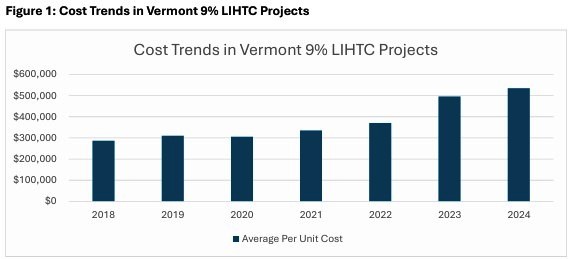
The cost of producing housing in Vermont is also rising sharply. Since 2020, Vermont has experienced dramatic increases in the cost of building homes, with costs for projects seeking 9% Low-Income Housing Tax Credits now averaging $520 per square foot and over $500,000 per unit. While somewhat lower, the average costs of projects seeking middle-market program assistance are in the range of $325 to $400 per square foot.4
Vermont’s housing production methods are not adequate to keep pace with demand and slow increases in rents and home prices. While traditional construction techniques are continuously advancing, buildings have mostly been built on site by developers and contractors for decades. 1Vermont 2025-2029 Statewide Housing Needs Assessment 2Vermont 2025-2029 Statewide Housing Needs Assessment 3U.S. Federal Housing Finance Agency, All-Transactions House Price Index for Vermont [VTSTHPI], retrieved from FRED, Federal Reserve Bank of St. Louis 4Data provided by FHFA.
Traditional construction methods require complex on-site management and sequencing of labor, materials, and highly trained or specialized workers.
Unlike many more populous states, Vermont does not have the size and density to support large subdivisions that can benefit from economies of scale that make development more economically feasible. The problem is compounded by statewide labor shortages, which make it difficult for builders to find workers.
As recently as July 2024 there were two job openings for every unemployed Vermonter.5
Many of these problems are also being experienced around the U.S. With shortages of homes, sharply increasing housing and construction costs, and constrained labor markets in Vermont and across the nation, interest has grown in investigating alternative approaches that can speed delivery and lower the construction costs of new homes.
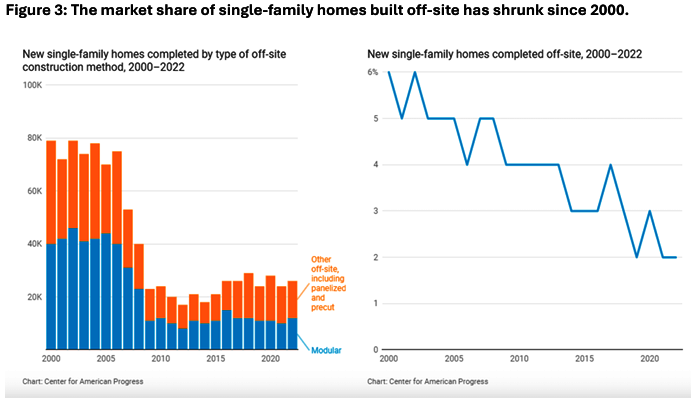
Figure 3 reproduces charts on off-site construction prepared and published by the Center for American Progress based on the U.S. Census Bureau’s Survey of Construction.11 The blue bars show the annual volume of volumetric modular single-family housing while the orange bars show the volume of other forms of single-family off-site construction, such as panelized construction. (Note that modular construction is also used for multifamily housing and commercial construction, which are not shown here.) As indicated, there was a sharp drop-off in the volume of both forms of off-site construction between 2006 and 2009, corresponding to the Great Recession. Across all building types (including on-site and off-site construction), the number of single-family home starts has increased since 2009 (not illustrated here),12 though at levels well below those of earlier decades, but as shown in the second panel of Figure 3, modular and panelized construction has continued to drop as a share of single-family new construction.
These data illustrate the high degree of vulnerability of off-site construction to the booms and busts of the economic / housing cycles, especially the Great Recession. Nationwide, the number of home builders declined by more than 50% between 2007 and 2012 in a building slowdown linked to the Great Recession.13 While the number of employees in residential construction has slowly rebounded since that time, there were still fewer residential construction workers in the U.S. in 2023 (927,200) than the peak year of 2006 (1,008,700).14 Adjusting for the growth in the overall U.S. workforce underscores the severity of the shortage; the share of the nonfarm workforce devoted to residential construction in 2023 was only 80% of its peak in 2006.15
Potential Next Steps
1. Review and confirm the state’s policy objectives and priorities.
2. Develop a plan for using bulk purchases of homes produced through off-site construction to achieve lower construction costs for single-family and missing middle housing types.
3. Develop a plan for using offsite construction to achieve lower multifamily construction costs.
4. Consider issuing a formal Request for Information to get input from potential manufacturers about how best to achieve cost savings through a bulk purchase program.
5. Allocate funding to support bulk purchases.
6. Implement prioritization and incentives for using offsite construction within existing funding programs.
7. Facilitate restarting the Fair Haven plant and support the expansion of other existing Vermont manufacturers.
8. Consider providing business planning support in the form of small grants and technical assistance to existing Vermont businesses seeking to develop or expand offsite construction businesses.
9. Consider adopting a state-wide building code for offsite construction and procedures for factory-level inspections and pre-approved designs.
10. Create a Northern New England working group that reaches across state lines and considers a regional market and shared approach.
Read Opportunities to Utilize Off-Site Construction to Meet Vermont’s Housing, Workforce and Climate Goals to learn more about the history of off-site construction in Vermont, the current state of the industry, and opportunities for the future.
1Vermont 2025-2029 Statewide Housing Needs Assessment
2Vermont 2025-2029 Statewide Housing Needs Assessment
3U.S. Federal Housing Finance Agency, All-Transactions House Price Index for Vermont [VTSTHPI], retrieved from FRED, Federal Reserve Bank of St. Louis
4Data provided by FHFA.
5Vermont Department of Labor, July 2024 Unemployment and Jobs Report
6Draffen, Leah. 2023. “Could Modular Construction Open the Floor for More Women?” Builder Magazine.
11 Center for American Progress. 2023. Increasing Affordable Housing Stock Through Modular Building. CAP tabulations of data from the U.S. Census Bureau, "Characteristics of New Single-Family Houses Completed, Construction Method.” These charts are reproduced with permission of the Center for American Progress in conformity with their terms of use and fair use policy.
12 U.S. Census Bureau and U.S. Department of Housing and Urban Development, New Privately-Owned Housing Units Started: Single-Family Units [HOUST1F], retrieved from FRED, Federal Reserve Bank of St. Louis, accessed Dec. 15, 2024.
13 Quint, Rose. 2015. US Government: Number of Builders Declined 50% between 2007-2012. National Association of Home Builders.
14 U.S. Bureau of Labor Statistics, All Employees, Residential Building Construction [CES2023610001], retrieved from FRED, Federal Reserve Bank of St. Louis, accessed Dec. 15, 2024.
15 Similarly, the average annual proportion of the nonfarm workforce devoted to residential construction in the period from 2011 through 2023 was only 84 percent of that from 2001 through 2010, a period that included both the boom of the mid-2000s and the bust of the latest 2000s. U.S. Bureau of Labor Statistics, All Employees, Residential Building Construction/All Employees, Total Nonfarm.
Source: 1.17.2025. Montpelier, Vt. – Vermont Housing Finance Agency
To support vital journalism, access our archives and get unique features like our award-winning profiles, Book of Lists & Business-to-Business Directory, subscribe HERE!